
Pest Control in the Lettered Streets, Bellingham
The Lettered Streets hold the oldest continuously occupied housing in Bellingham, and the pest work follows directly from that. Post-and-pier foundations over bare earth, framing cavities that run from the crawl to the attic, and alleys that concentrate rodent pressure across a whole block rather than one house.
Call 360-410-2199 Request a free inspection
Lettered Streets, Bellingham on the map
The oldest ground in the city
The Lettered Streets are where Bellingham’s residential history starts. This is the oldest continuously occupied housing in the city, laid out on a tight grid north of downtown, on small lots with alleys running behind, under mature street trees, with a great deal of the stock predating 1930.
It is a genuinely lovely neighborhood and it is, from our side of the work, the most consistently challenging housing in Bellingham. Not because anything was built badly, but because it was built to a standard that had never heard of air sealing, and because a hundred and twenty years is a long time for a building to accumulate openings.
Nearly every job we do here comes back to the same three features.
Post-and-pier over bare earth
Most of these houses sit on posts and piers with a short crawlspace beneath, and in a large share of them the floor of that crawlspace is still soil.
That single condition drives more of our work here than anything else. Bare earth puts ground moisture continuously into the space and into the joists above it, in a climate that supplies about thirty-five inches of rain a year across a long gray season. The framing above never fully dries. That figure comes from NOAA’s US Climate Normals rather than from us.
Everything moisture-driven follows. Moisture ants colonize wood that has softened. Decay fungus runs where it stays wet, and decay rather than insects is what actually costs structural capacity here. Sowbugs, millipedes, springtails and silverfish live in the damp and occasionally come up into the house through a gap around a pipe.
The correction is not a treatment. It is a sound vapor barrier over clean ground, drainage that takes roof water away from the foundation rather than into it, and grade that slopes away from the building. Where a crawl has been damp long enough that insulation is hanging loose, that material comes out before anything else — wet fiberglass holds moisture, accelerates decay above it and makes excellent nesting material.
We will say plainly when the person you need next is a drainage contractor. On this housing stock that happens often, it costs us the recurring service, and it is the correct answer.
Framing that runs floor to roof
The second feature is the one that produces the most baffled phone calls.
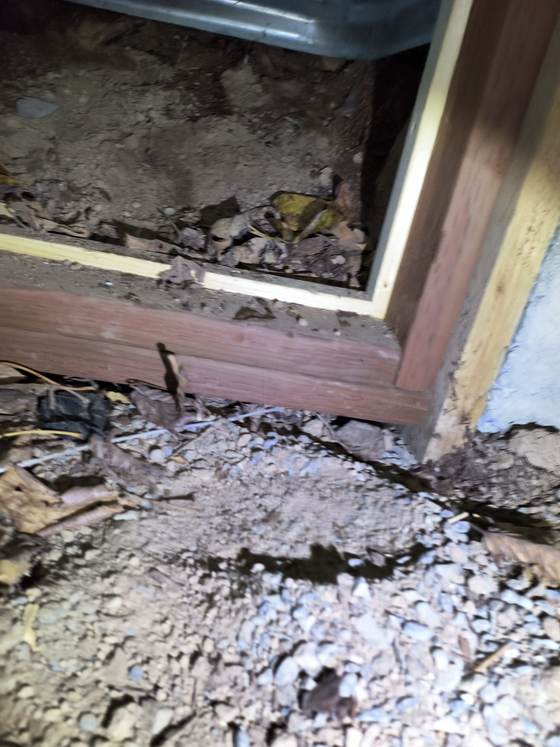
These houses were built with balloon or near-balloon framing, where the stud cavity runs from the sill plate all the way to the top plate with no firestop in between. A mouse that gets under the house at grade can be in the attic without ever crossing an occupied room.
So the classic Lettered Streets call is somebody hearing scratching in an upstairs ceiling and being unable to work out how anything got up there. The answer is nearly always that it never came in upstairs at all — it came in at the crawlspace and used the wall.
That is why treating where the noise is accomplishes very little here, and why the work has to start underneath. Find the entry, close it properly, and the route stops being available. Trap in the attic without doing that and you are removing individuals from a population that still has a door.
A century of penetrations
The third is simple accumulation. Gas, water, waste, electrical, three generations of telephone and cable, an abandoned oil line, a chimney thimble from a stove nobody remembers. Every one drilled generously by whoever was doing that job on that day, and essentially none of them sealed afterwards.
Add to that board sheathing that has shrunk over a century and left gaps, vent screens whose original light mesh rusted through decades ago, skirting that no longer meets the ground, and crawl hatches that no longer seat.
None of this is a defect in the houses. It is what a hundred and twenty years looks like. But it means a proper exclusion job here is genuinely a job — not half a dozen gaps but two or three dozen, and finding them is most of the value.
The alleys, and why the block matters
This is the feature that makes the Lettered Streets different from anywhere else in the city, and it is worth being honest about.
Alley-served neighborhoods concentrate waste. A block where every can sits out on the same alley on the same night supports a rodent population that belongs to the block rather than to any one address. Add mature landscaping, garages and outbuildings of various ages, compost, fruit trees and the occasional backyard flock, and the alley becomes a continuous corridor of food and cover running the length of the block.
So there is a limit to what sealing one house achieves. That house stops having an interior problem, which is genuinely worth doing and is what most people actually want. But the number of animals in the alley does not change.
We say this at the first visit rather than after the third. Where several neighbors will coordinate — bins that close, feed and fruit picked up, a couple of sealed garages — the difference is substantial and quick. Where they will not, we can still protect your building, and you should know that is what you are buying.
Rats, and the Bellingham autumn
Norway rats are the most common single reason anyone in this neighborhood calls us, and the local pattern is not the one national material describes.

Through spring and summer they live outdoors and do well. Himalayan blackberry along the alleys and vacant corners, decking with a gap underneath, woodpiles, compost, fruit trees, bird feeders and the creek corridors give them everything they need, and most residents never see one.
Backyard fruit and compost are garden management questions as much as pest ones, and Hortsense is where WSU publishes its home garden and landscape advice.
Then the rain sets in. Somewhere between late September and early November the ground saturates, burrows flood, and that entire outdoor population needs somewhere dry within a few weeks. Your crawlspace is dry. Your garage is dry. The space above your porch ceiling is dry.
There is no mystery in it. It is a housing crisis with a predictable date, and it is why the single most valuable thing we do in this neighborhood is exclusion work in August. A house sealed before the rain never has the interior problem. A house sealed in December has an interior problem plus a sealed-in animal, and the order of operations gets considerably more complicated.
Backyard chickens deserve a mention because they are common here. We do not tell people to get rid of them. We do tell them that spilled feed and an open feed bin are what turn an ordinary yard into a rat-supporting one, and that a coop needs building as though it is trying to keep rats out, because it is.
Carpenter and moisture ants
Both are common in this stock and the distinction changes everything.
Moisture ants are the honest ones. They colonize wood that is already wet and already decaying, so finding them is useful information rather than merely a problem. On these houses the source is usually a gutter that has been overflowing down a wall for years, a downspout discharging at the foundation, a porch roof that has leaked quietly, siding in contact with soil, or a sill plate sitting too close to grade.
Carpenter ants prefer wood that has begun to soften and keep a parent nest outdoors — a stump, a fence post, a landscape timber, a woodpile — with satellite nests inside the structure. The satellites are what people see. Treating those while the parent sits untouched in the back garden is why this work gets a reputation for returning.
In spring, winged carpenter ants get reported as termites regularly. The simplest tell is the waist: sharply pinched on an ant, uniform on a termite. Getting that right first costs nothing and changes the entire approach.
Bed bugs and shared walls
The Lettered Streets carry a substantial rental stock, including a lot of older houses divided into units, and that changes how bed bug work has to be scoped.
In a building with shared structure the population is a building-level population. Wall voids, plumbing chases and the framing cavities described above connect units, and insects move through them without regard to who pays which lease. Treating one unit while the ones either side go untreated relocates the problem, usually next door and often back again a month later. Tenants reasonably conclude the treatment failed; it did not fail, it was scoped wrong.
What works is a building plan — map the affected units, identify the source, treat in a coordinated pass, and follow up on an interval that matches the life cycle rather than the billing cycle. A landlord who skips it tends to end up paying for the same infestation again and again.
Bed bugs are the one service where our assessment carries a fee, credited against treatment if you proceed. Everything else costs nothing to have us look at.
Spiders, and the reassuring version
Every September the calls start about large fast spiders indoors, and in century-old housing with this much crawlspace and this much mature planting the volume is high.
They are giant house spiders. Harmless, long established throughout western Washington, and the large ones people find are wandering males looking for mates rather than an invasion responding to cold. The ones stranded in a bathtub are males that got in and could not climb out.
Brown recluse has never been recorded in this part of Washington, and the species is not established anywhere in the state. Anyone telling you otherwise while holding a quote is selling fear, and on a house of this age there is plenty of genuine work to discuss without inventing any.
What reduces the population is unglamorous: clearing exterior webbing, dealing with harborage under porches and in crawl vents, moving firewood off the wall, correcting exterior lighting that concentrates the insects they feed on, and sealing the door sweeps and thresholds most of them use.
Garages, outbuildings and the back of the lot
The buildings behind the house matter more here than in most neighborhoods, and they are routinely left out of scope by whoever quoted before us.
A hundred years of back-lot construction sits along these alleys: original carriage sheds, 1940s single garages, later additions, workshops, and storage built at various times to various standards. Many have earth floors or slabs that have cracked and settled, siding that no longer meets the ground, and doors that have not closed properly in decades.
From a rodent’s point of view that is ideal — dry, undisturbed, close to the alley food supply, and connected to the rest of the block. A population living in a garage is a population with a permanent base twenty feet from the house, and sealing the house alone leaves it entirely intact.
So a proper scope here includes the outbuildings, even where the complaint is about the kitchen. Sometimes the honest answer is that a garage is beyond sealing and the sensible move is to remove what is attracting them and defend the house properly. We will say which it is rather than quietly quoting for both.
Stored items are the other half. Cardboard, old furniture, bagged pet food, birdseed and garden supplies in an unsealed outbuilding provide harborage and food together. Hard containers and a clear floor change the picture more than anything we can apply.
Renovation, and what opening a wall reveals
A lot of these houses are being restored, and renovation is both the best and the worst moment for pest work.
Best, because a wall that is open is the only time anybody sees what a century did to the framing. Old carpenter ant galleries, moisture damage around a window that failed decades ago, a run of soft sill plate, a rodent nest in a cavity nobody could reach — all of it becomes visible at once, and the correction is never cheaper than while the finish is already off.
Worst, because a building under renovation is wide open. Doors propped, siding off, temporary covers, materials stacked outside, and nobody living there to notice anything. We see houses acquire problems during a remodel that they did not have before it started, particularly over an autumn.
The useful sequence, if you are planning work: have somebody look before the walls close, seal the envelope as part of the project rather than after it, and be deliberate about the crawlspace while access is easy. Sealing penetrations is trivial during a remodel and awkward forever afterwards.
Old damage is worth a specific note. Galleries in a joist and old exit holes are evidence of history, not of current activity, and damage persists for decades after the insects are gone. We would far rather establish which you are looking at than treat something that finished twenty years ago, and on a restoration we will tell you when the finding is structural rather than ours.
Heating, chimneys and the winter list
Older houses here have been heated several different ways over their lives and each has left something behind.
Disused chimneys and flues are a recurring entry point — an uncapped stack, a thimble left open when a stove was removed, a fireplace that has not been used in thirty years. Anything that can climb has a route in, and anything that gets in frequently cannot get out again.
Retrofit insulation is the other winter factor. Blown-in material added to a cavity that was never designed for it is warm, undisturbed and ideal nesting material, and rodents tunnel through it rather than merely crossing it. Attic insulation that has been contaminated is both a hygiene issue and an ongoing attractant, and where that is the situation the sequence matters: exclude first, remove and replace second. Doing it the other way installs new material into a building that is still open.
We start outside and walk the whole perimeter, including the alley side, which is the elevation most people never look at and where a good share of the findings are. Grade and drainage, the siding-to-foundation transition, vents, penetrations, skirting, vegetation contact, the state of any previous exclusion attempt, and what the garage and outbuildings are doing.
Then underneath, properly, with a light and on our back if the clearance requires it. On these houses that is where the answer is and it is the step most commonly skipped by whoever came before us. A report written from the crawl hatch is not worth much.
Then the attic, then the interior.
You get a plain account of what we found, what is causing it, what needs doing now, what can wait, and which items belong to a contractor, a roofer or a drainage specialist rather than to us. On a century-old house a real share of the answer is not work we get paid for, and we say it anyway.
Inspections are free for every pest we handle here, bed bugs excepted, and there is no long-term contract to escape from.
If you are not sure whether what you are hearing is an animal or simply a century-old house doing what they do on a cold night, describe it on the phone or send a photograph before booking anything. A good share of the calls we take from this neighborhood are resolved that way without a visit, and we would rather tell you that than send somebody out.
Frequently asked questions
Why can I hear something in the attic when the crawlspace is where they got in?
Because these houses were built with balloon or near-balloon framing. The stud cavity runs from the sill plate to the top plate with no firestop, so a mouse entering at grade has an unobstructed vertical route to the roof without ever crossing a room.
My neighbors have rats too. Does that change what you do?
It changes the honest scope. On an alley-served block the population is shared, and one sealed house helps that household without reducing the number of animals on the block. We will still seal your building properly, and we will tell you plainly what it can and cannot achieve alone.
Is a dirt crawlspace really a problem?
Yes, and it is the single most consequential feature of this housing stock. Bare soil puts ground moisture straight into the space and the joists above it, which is what supports moisture ants, decay fungus and the whole damp-crawl group underneath.
How old are these houses actually?
A large share predate 1930 and some are considerably older. That matters less as a date than as a construction method — no air sealing, board sheathing that has shrunk, and a century of utility penetrations that were each drilled oversize and never closed.
Can you even get under these houses when the crawlspace is tiny?
Usually, and we go in properly rather than looking from the hatch. Clearance here is often low and the access is frequently in an awkward corner of a porch addition, but the evidence is under there and a report written from the doorway is not worth much.
Are you quick to the Lettered Streets?
Yes. This is our home city and we are on the Guide Meridian, so no part of this neighborhood is more than about fifteen minutes away. One to two days covers most calls here, and urgent ones are often faster.
Is the inspection free?
Free for every pest we handle, with bed bugs the one exception — those carry a verification fee credited against treatment if you proceed. Going into the crawlspace is part of the free visit, and it is where the useful information is.
Pest problem in Lettered Streets?
Family-owned, no long-term contracts, and every treatment is backed by our 100% Service Guarantee.
Most calls in Whatcom County are out within 1–2 days, about 3 during the late-summer peak.
Last updated