
WDO Treatment for Real Estate Transactions
Your inspector found wood-destroying organisms and you have a closing date. That is the half we do: our WSDA license carries the PCO Structural category, which covers treating the termites, carpenter ants, wood-boring beetles and decay fungus a report lists. We do not issue the report itself, which is a separate credential.
Call 360-410-2199 Request a free inspection
WDO treatment: the job at a glance
| What it covers | Treating the termites, carpenter ants, wood-boring beetles, moisture ants and decay fungus that an independent inspector documented |
|---|---|
| Included | A free visit to look at the listed items, a written quote that separates treatment from repair, targeted treatment and a treatment record |
| Not included | Issuing the findings document, which needs a credential we do not hold, and structural repair or carpentry |
| We will not | Treat an inactive infestation, sell a soil barrier for dampwood termites, or recommend tenting |
| How long it takes | Same-week for most findings; longer where drying or a repair has to come first |
| What it costs | No flat figure. Quoted after the free visit from the items listed, access and sequencing, and a closing date is never an upcharge |
Who this page is for
You are buying or selling a house in Whatcom County. An inspector has been through it and produced a document listing wood-destroying organisms, or conditions conducive to them, and now somebody has to deal with it before the sale closes.
That is the situation this page addresses. It is a narrow, time-pressured, and frequently stressful lane, and it is one where the pest control industry is routinely vague about what it is actually licensed to do. So we will be specific.
The two roles, and why they are not the same company
There are two distinct pieces of work in a transaction like this, they require different credentials, and it genuinely matters which one you are asking for.
Identifying. A licensed structural pest inspector examines the building and documents what is present. Their finding is what a lender, a buyer and an escrow officer rely on. It is a regulated activity in Washington and it carries its own license.
Treating. Somebody then has to actually deal with what was found — treat the active insects, and address the conditions that let them in. That requires a pesticide license carrying the right category.
We do the second one. We are not licensed structural pest inspectors, we do not perform that examination, and we do not issue that document. If that is what you need, you need somebody else, and we will happily say so on the phone rather than waste your time.
We think that separation is a feature rather than a limitation. When the same company both identifies the problem and sells you the cure, it has a direct financial interest in the size of the problem. Nobody in that arrangement is doing anything improper by default, but the incentive is plainly there, and in a transaction where a buyer is already nervous and a seller is already negotiating, removing it is worth something. An independent finding and an independent quote is simply a cleaner arrangement for everybody.
What our license actually covers
Our people hold Washington State Department of Agriculture licenses — a commercial applicator license, which under the state’s Pesticide Application Act attaches to the business of applying pesticides to the land of another, and commercial operator licenses, which attach to the employees doing the applying. Every one of them carries the same two categories: PCO Structural and PCO General.
PCO Structural is the relevant one here. In the state’s own terms it covers the control of pests that attack structural material, including fungus, termites, carpenter ants and wood-boring beetles. That is a treatment authority, and it is what allows us to work on the findings in front of you.
The license numbers are published on our about page next to the names of the people who hold them. You can put any of them into the WSDA license search and confirm the status, the expiry and the categories yourself, in about a minute. We publish them because a credential you cannot check is a claim rather than a credential, and in a transaction with money and a deadline attached you should not be taking anybody’s word for it — ours included.
The organisms, and what treatment actually involves
Six things turn up on findings in this county with any regularity. They are genuinely different problems and they need genuinely different work, which is why a single flat “termite treatment” price is usually a sign that nobody has looked properly.
Pacific dampwood termite
By far the most common termite finding here. It is a large insect, it does not need soil contact, it builds no mud tubes, and it has one absolute requirement: wood with high moisture content. It cannot establish in dry, sound lumber.
Treatment is localized to the infested material rather than applied as a soil barrier around the building, because there is no soil-dwelling colony to intercept. Where the damaged member is structural, the honest answer is often that a section needs replacing rather than treating, and that is carpentry.
The critical part is the water. A dampwood finding is really a moisture finding with insects in it. Treating without correcting the source buys a quiet year.
Western subterranean termite
Present in Washington, and a different animal entirely — though the range is narrower than most termite writing implies. The WSU Cooperative Extension termite bulletin, EB0787, gives its northern limit in western Washington as Seattle, which is around ninety miles south of Whatcom County. Soil-dependent, builds the shelter tubes people associate with termites, and where it is genuinely established the treatment approach is the conventional soil-focused one. It is listed here because the license category covers it and because an inspector’s report can name it, not because it is a probable finding at this latitude.
Correct identification matters enormously here, because the treatment for this species is substantially more involved than for dampwood, and being sold one when you have the other is a common and expensive error.
Carpenter ants
Extremely common in this county and frequently documented in a finding. They excavate galleries to nest rather than eating the wood, they prefer material that has begun to soften, and a mature colony almost always has a parent nest outdoors — a stump, a dead limb, a landscape timber, a fence post — with satellites inside the structure.
Treating the satellite without locating the parent is why so many carpenter ant jobs come back. Where we can find the parent colony, the result holds. Where it sits on a neighboring property, we say so and plan accordingly.
Wood-boring beetles
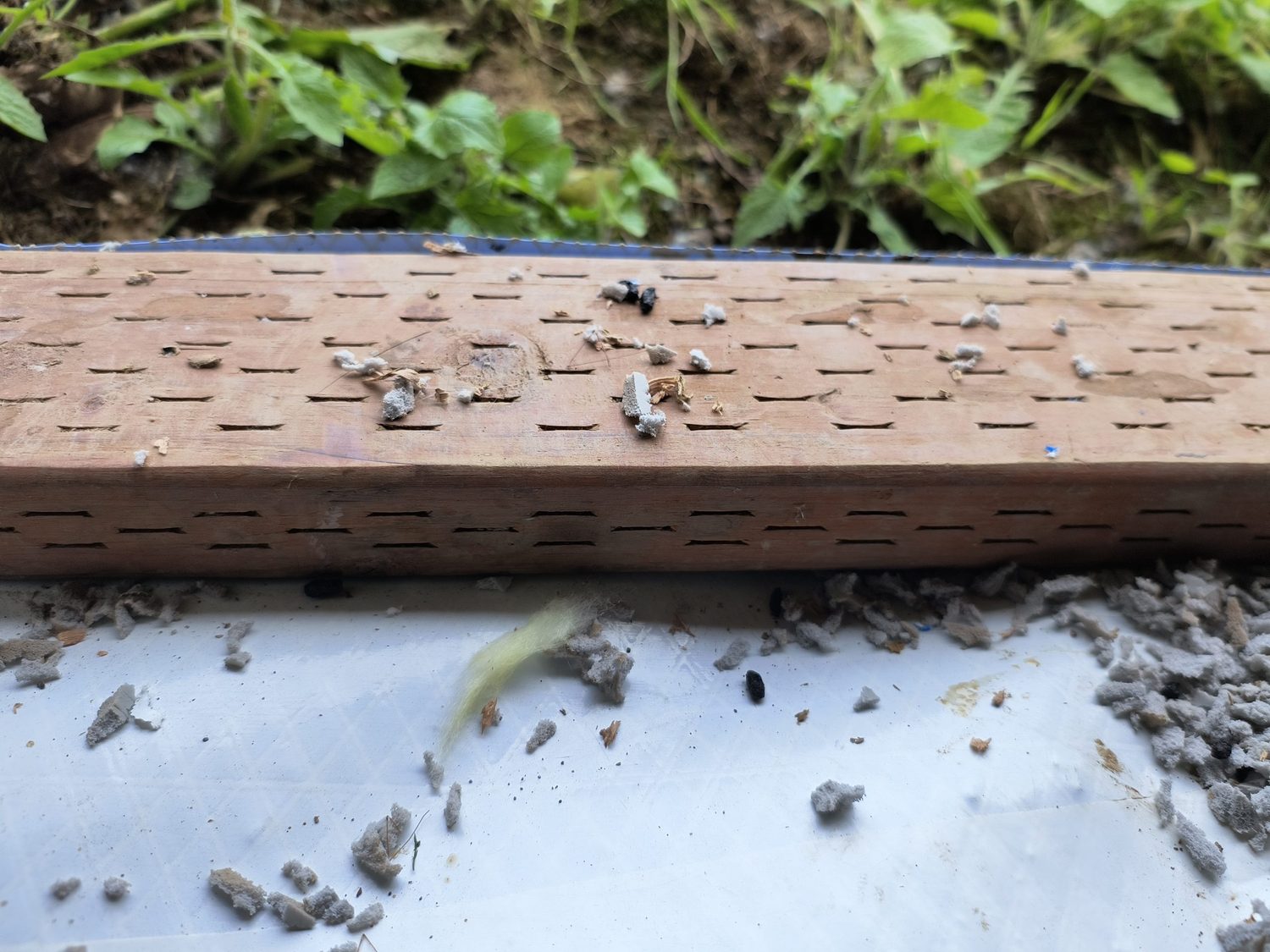
Usually anobiid beetles in this region, and genuinely common in damp older crawlspaces. The signature is small round exit holes with fine powdery frass below them, in joists, subfloor and sill.
The question that decides the treatment is whether the infestation is active or historic. Damage persists for decades after the insects are gone, and exit holes in a joist are not by themselves evidence of anything current. We would rather establish that than treat a museum piece, and if the finding is old and inactive we will tell you so even though it costs us the job.
Moisture ants
The most honest insect on the list. They colonize wood that is already wet and already decaying, which makes finding them useful information: they are the symptom, and the water is the disease. Treatment without correction produces a new colony in the same wood.
Wood decay fungus
Not an insect at all, and frequently the most consequential item on a finding. Decay fungus is what actually destroys structural capacity in this climate, and it needs sustained moisture to run. Where it is active, the meaningful work is drying the assembly and correcting the water, followed by repair or replacement of what has lost strength.
We treat what falls within our category and we are direct about where the line sits. Structural repair is a contractor’s work and we do not pretend otherwise.
Conducive conditions, which usually matter more than the insects
Most findings in Whatcom County include a section on conditions conducive to wood-destroying organisms, and in our experience that section is the one worth reading twice.
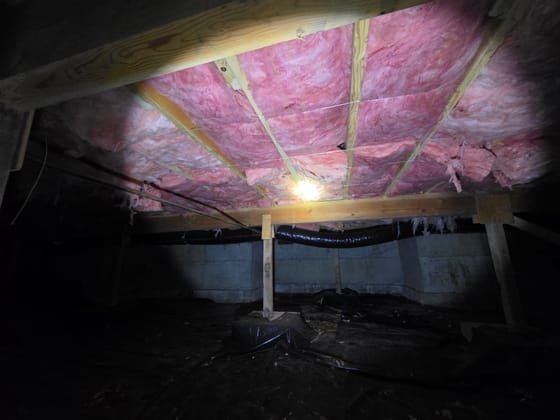
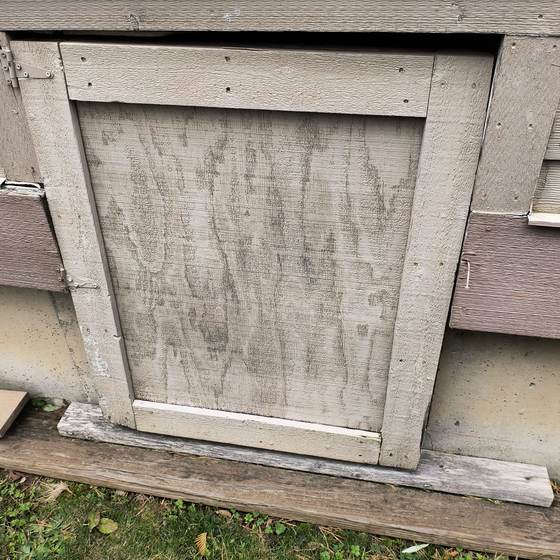
The recurring items are unglamorous and predictable. Standing water in the crawlspace. A missing, torn or displaced vapor barrier. Blocked, broken or missing foundation vent screens. Earth-to-wood contact where grade has been built up against siding. Downspouts discharging at the foundation instead of away from it. A deck ledger flashed badly or not flashed at all. Bark mulch piled against the sill. Plumbing weeping slowly under a bathroom. Gutters that have been overflowing down one wall for years.
None of those are pests. Every one of them is the reason pests arrive. In this climate — no hard freeze, roughly thirty-five inches of rain a year, wood that never really dries out — the conducive conditions section is the part that predicts what the house will be dealing with five years from now.
So when we quote, we tell you which items are ours and which are not. Correcting grade, replacing a vapor barrier, rehanging a downspout and flashing a ledger are not pest treatments. Some of them we can do, some belong to a contractor, and pretending the whole list is a pest problem would be a straightforward way to overcharge you.
How the timing works
Transactions run on dates, so here is the realistic sequence.
The finding is produced. You send it to us — a photograph of the relevant pages is fine to start. We can usually tell you from that alone whether it is a straightforward treatment or something that needs eyes on it first, and give you a rough range on the phone.
We come out and look. That visit costs nothing and it is where the quote comes from. We are looking at the specific items documented, at whether they are active, and at what is driving them.
You get a written quote separating treatment from anything that is a repair. If part of the work needs a contractor, you get told that at this point rather than after we have started, because a contractor lead time is the thing most likely to threaten a closing date.
Treatment is scheduled. For most findings this is same-week. Where drying or a repair has to happen first, the sequence matters and we will lay out the order.
You receive documentation of what was treated, what was used and when. That is the record for your file, your agent’s file and the transaction.
Tell us the closing date at the first phone call. It is the single most useful piece of information you can give us, and the difference between a comfortable schedule and a scramble is almost always that one detail arriving late.
For agents, lenders and escrow officers
We work with a number of Whatcom County agents and we know what makes this easy on your side.
You get a quote that distinguishes pest treatment from building repair, so nobody is negotiating a credit against a number that quietly includes carpentry. You get realistic scheduling rather than an optimistic date, because a missed promise on a closing week is worse than an honest longer estimate. You get documentation that states what was done. And you get a straight answer when the finding does not actually require treatment, which happens more often than the industry likes to admit — historic beetle damage with no active infestation being the usual example.
We also will not quote against a finding we have not read. If somebody is giving you a price for wood-destroying organism treatment over the phone without seeing the document or the structure, that number is a guess, and guesses in a transaction tend to become disputes.
What we will not do
We will not issue the report. Repeating it because it is the thing people most often hope we will bend on. We are not licensed for it.
We will not treat an inactive infestation just because it appears in a finding. Old galleries and old exit holes are evidence of history, not of current activity, and treating them changes nothing.
We will not sell a soil barrier for a dampwood infestation. The species has no soil dependency. Treating the perimeter for an insect living in a wet window header is spending money on the wrong problem.
We will not recommend tenting or fumigation here. It is not a Whatcom County treatment for Whatcom County species. If it has been proposed to you locally, get a second opinion before committing to anything.
We will not attach an ongoing annual plan to a transaction treatment unless there is a recurring pressure that genuinely justifies it. A dry, sound, well-drained house with a corrected water problem does not need a recurring program, and the sale is a poor moment to sign somebody up for one.
What drives the cost
We do not publish a flat figure for this work, because the variation is real and a headline number would be misleading.
The things that move it: how many separate items are on the finding and whether they are the same organism; whether the infestation is active or historic; access, because a crawlspace you can sit up in is a different job from an eighteen-inch one; how much of the affected material is reachable without demolition; and whether drying or a repair has to be sequenced first.
What does not move it is urgency. We do not price a closing deadline as an upcharge. If we can do it in the window we quote it the same as any other week, and if we cannot, we say so instead of taking a deposit and hoping.
What the treatment visit itself looks like
People are often surprised by how much of the day is spent not treating.
We start in the crawlspace, because that is where most Whatcom County findings live and because it is where the evidence is. That means going in properly with a light, on our back or our stomach, following the affected member to see how far the damage actually runs. A finding says a joist is affected. It does not usually say whether that continues four feet further into a bay nobody could reach on the day.
Then the exterior: grade, drainage, the siding-to-foundation transition, vents, downspout discharge and anything holding water against the structure. The point is to be able to tell you why this happened, not merely what is present.
Treatment is targeted to the material and the organism. For dampwood termites and carpenter ants in a specific member that generally means working the galleries directly. For beetles it depends on whether we have established current activity. For a decay fungus condition the meaningful intervention is drying and correcting water, and we will say so rather than applying something for the look of it.
Afterwards you get a treatment record: which items from the report were treated, what product was used, where, and on what date. It also states which items are building repairs rather than pest treatments, so nobody assumes a carpenter’s job was covered by ours. In a transaction that last line is the one that saves arguments later.
What that record is not, and does not pretend to be, is a document setting out findings of wood-destroying organism damage. Under Washington’s rules that is a regulated report with its own requirements, and it belongs to the licensed inspector who wrote yours.
If you are the buyer, before the finding comes back
There is a short list worth walking yourself, because it tells you what is likely coming and it costs nothing.
Open the crawlspace hatch and look, even briefly. Standing water, a vapor barrier that has been shoved aside, insulation hanging down, or a smell of damp earth are all things you will see without training, and any of them predicts what a finding is going to say.
Walk the perimeter and look at where the ground meets the building. Soil or bark mulch piled above the siding line is the single most common conducive condition in this county and among the cheapest to correct.
Look up at the gutters and follow the downspouts. If one discharges at the foundation, the wall below it has been getting wet for as long as that has been true.
Check the deck where it attaches to the house. Ledger flashing is a chronic defect in this housing stock, it is expensive when it fails, and it produces exactly the wet framing that dampwood termites and moisture ants require.
None of this replaces a proper examination by somebody licensed to do it. It does mean you will not be surprised by the document when it arrives, and you will have a sense of which items are trivial and which are a real negotiation.
Related work
Most transaction findings in this county trace back to one of the same handful of underlying problems, and these pages go into them properly: termite control for the biology and identification detail, ant control for carpenter and moisture ants, and crawlspace restoration for vapor barrier, insulation and drying work after the fact.
Frequently asked questions
So what exactly do you do in a real estate transaction?
The treatment. Once an inspector has documented what is in the structure, our PCO Structural category is what allows us to treat it — dampwood or subterranean termites, carpenter ants, wood-boring beetles, moisture ants and decay fungus conditions. We work to the closing date.
Can you do the inspection for my home sale?
No. We are not licensed structural pest inspectors and we do not issue that report. It is a separate credential from the one we hold. You need an independent inspector for that part, and we would rather tell you plainly than take the booking and disappoint you.
How quickly can treatment happen before closing?
We schedule it as soon as the closing date needs it, and the honest answer is that the date is rarely the constraint — the prep is. Some of this work cannot start until a contractor has corrected water intrusion, or until access is opened up. Tell us the closing date on the first phone call rather than at the end, and we will tell you straight away whether it is our schedule or the preparation that decides it.
Why should the inspection and the treatment be separate companies?
Because it removes the conflict. When the party identifying the problem is also selling the remedy, they have a financial interest in how big that remedy is. Keeping the two in different hands is better for a buyer, a seller and a lender, and it is how we prefer to work.
What licenses do you hold for this work?
Washington State Department of Agriculture licenses — a commercial applicator license plus commercial operator licenses — all carrying the PCO Structural and PCO General categories. PCO Structural is the one covering pests that attack structural material. The numbers are published on our about page so you can verify them directly with WSDA.
Does treating the insects solve the problem?
Only half of it, and this is the single most important thing on this page. Dampwood termites, moisture ants and decay fungus all require wet wood. If the water source is not corrected, the conditions that invited them are still there after the treatment.
Do you charge to come out and quote the treatment?
No. Coming out to look at what was found and putting a price on the treatment costs nothing. We will also tell you honestly if part of what was documented is a building repair rather than a pest treatment, even though that part is not work we get paid for.
Guides
From the blog
WDO Treatment for Real Estate Transactions in Whatcom County?
Family-owned, no long-term contracts, and every treatment is backed by our 100% Service Guarantee.
Most calls in Whatcom County are out within 1–2 days, about 3 during the late-summer peak.
Last updated