
Pest Control in Deming, Washington
Deming sits where farmland meets standing timber, and it gets the pest pressure of both. Rats and mice off the farm ground year round, a heavy carpenter ant season through spring and summer out of the forest itself, and lady beetles, stink bugs and spiders arriving together every autumn.
Call 360-410-2199 Request a free inspection
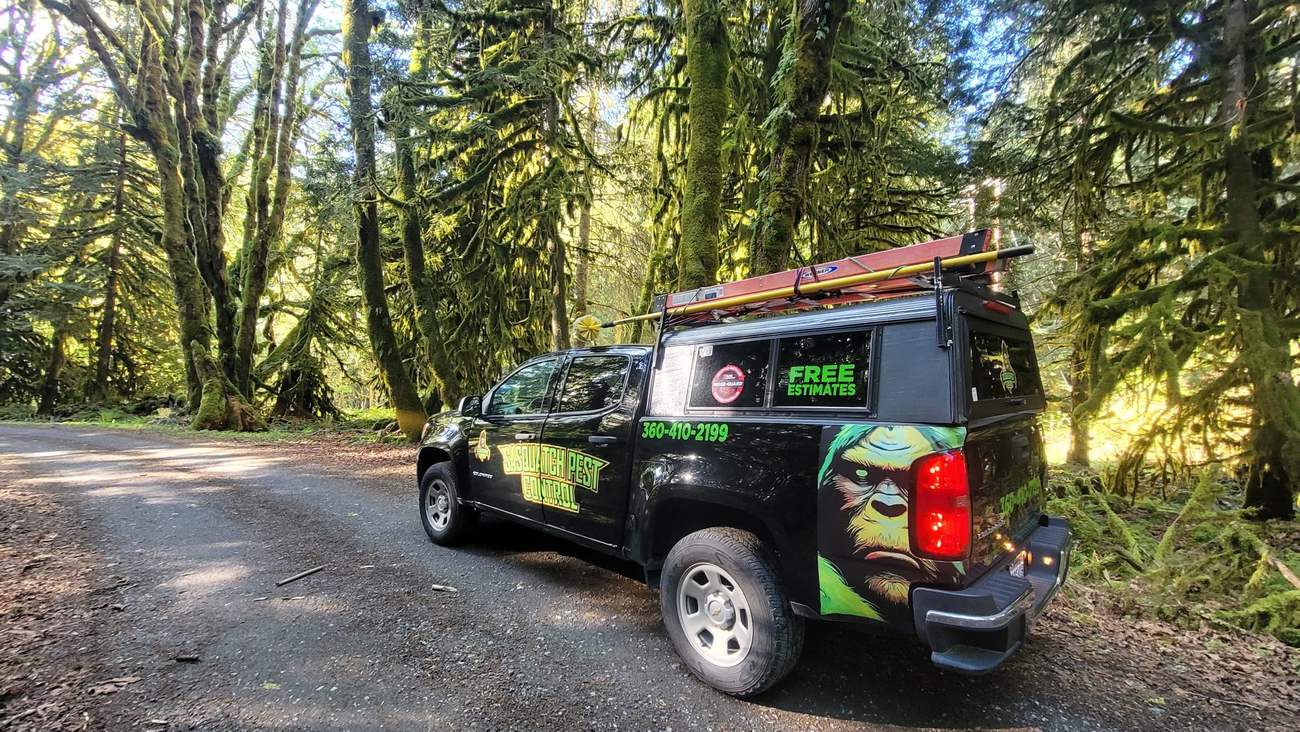
Deming on the map
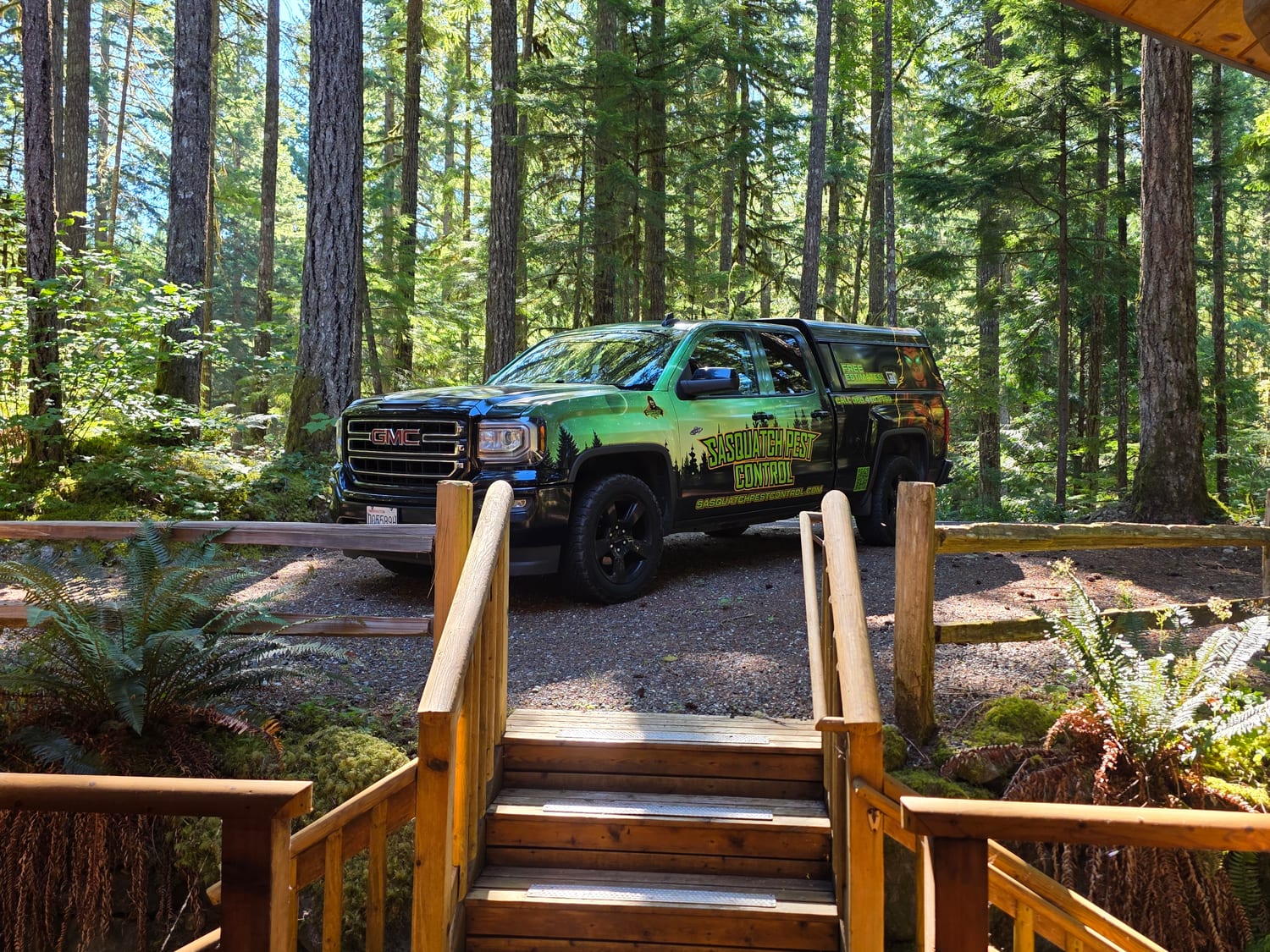
Where the farmland stops and the timber starts
Deming sits at the point on the Mount Baker Highway where the valley floor gives way to the foothills. West of it is farm ground. East and above it is standing timber running up toward the mountain. Most properties here have some of each within sight.
That boundary is the whole story of pest control in this area, and it is what makes Deming different from the towns further down the valley. Nooksack and Everson are surrounded by fields. Custer is open country. Deming is both at once, and it gets the pest pressure of both at once.
The practical result is that a Deming property has two separate sources of trouble working on it from opposite directions, on different schedules, with different fixes. The farm ground sends rodents. The forest sends carpenter ants. The two problems overlap in the calendar but almost never in the solution, and treating them as one job is how people end up disappointed.
Two kinds of rodent, and this area has both
Most residential rodent work in this county is mice. Out here it is frequently rats as well, and the difference is worth understanding before anybody sets a trap.
Farm ground supports both. Grain, feed, silage, fruit, standing water and dense ground cover produce populations that live outdoors quite happily for most of the year and only approach buildings when something changes — the ground is worked, the cover is cut, the weather turns, or a food source moves indoors for storage.
Mice live in small spaces, breed quickly, and do not range far. A mouse problem is usually local to one building and one entry point, and it grows fast once it starts.
Rats range much further, are far more cautious about anything new in their environment, and cause a different kind of damage. Chewed wiring in a shop, holes gnawed through a crawlspace vent, heavy noise in a floor or a wall at night — those are more often rats than mice. They are also considerably harder to trap carelessly, because a rat will avoid a new object in a familiar run for days.
Which one it is changes the placement, the timing and the expectation, so we work that out before we do anything. Droppings, the size of the gnawing, the runs and the smell all say which animal you have, and getting it wrong wastes a fortnight.
What the farm ground does to a building
The route in is nearly always ordinary. A crawlspace vent with perished or missing screening. A gap where a plumbing or electrical line passes through a rim joist. A garage door with a worn seal. The base of a shop wall where the siding stops short of the slab.
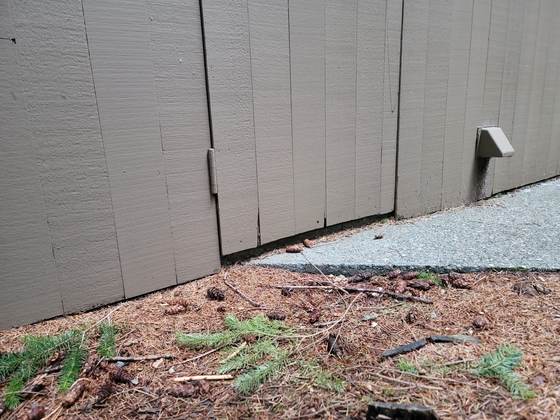
None of those look like damage. They look like a building that has been standing for thirty years, which is exactly what they are. Rodents do not need a failure, only an opening, and a quarter of an inch is enough for a mouse to use.
On a property with outbuildings — and nearly every property here has them — the sequence matters. The shop, the barn and the woodshed take the pressure first, because they are closest to the ground cover and least sealed. The house comes second, once those buildings are full. Sealing the house alone concentrates the population instead of removing it, which is why we quote the site rather than the building.
Anyone farming the ground west of the highway can take the crop and livestock end of this to WSU Extension’s Whatcom County office, which serves growers here.
Carpenter ants are the spring and summer story
This is the pest that defines Deming, and the reason is the timber.
Carpenter ants do not eat wood. They excavate galleries in it to nest, and their natural habitat is exactly what surrounds this community: stumps, fallen logs, standing dead trees, and the damp punky wood at the base of living ones. A mature forest edge supports a great many colonies, and none of them have anything to do with anybody’s house until they expand.
The way they expand is the part most people have never been told. A mature colony establishes a parent nest outdoors — in a stump, a log, a tree — and then throws out satellite colonies nearby. Satellites contain workers and older larvae but not the queen, and they will happily set up in a structure. A wall void, a rim joist, a door frame, the wood around a skylight.
That is why the carpenter ant problem here is so much heavier than in town. In a subdivision, a building generally has to generate its own problem through years of unnoticed moisture. On the forest edge, the colony already exists forty feet away and only has to move part of itself indoors.
The season is genuinely a season
Activity starts as the ground warms in spring and builds through summer, which is why this is a spring and summer job here rather than a year-round one.
The first sign for most households is not damage. It is large black ants indoors in March or April, often near a window or a sink, often one or two at a time. People kill them and assume that is the end of it. What those individuals actually indicate is that something has become active nearby and has begun foraging.
Winged ants indoors are a different and more serious signal. They mean a mature, reproducing colony, and if they are emerging inside the building rather than arriving through a door, the colony is in the structure rather than outside it.
The other sign is frass — the material they push out of the galleries as they excavate. It looks like sawdust and is not: it is fibrous and shredded, it frequently contains insect fragments, and it accumulates directly below the gallery that produced it. Finding a small pile on a sill, a stair tread or the top of a baseboard is worth more than finding the ants, because it tells you where to look.
Following the moisture, and the cedar
Carpenter ants prefer wood that has already been softened. That is why the damage we find here concentrates in predictable places: a sill plate under a leaking hose bib, framing around a poorly flashed window, a rim joist over a crawlspace that never dries out, the base of a post where a deck meets the house.
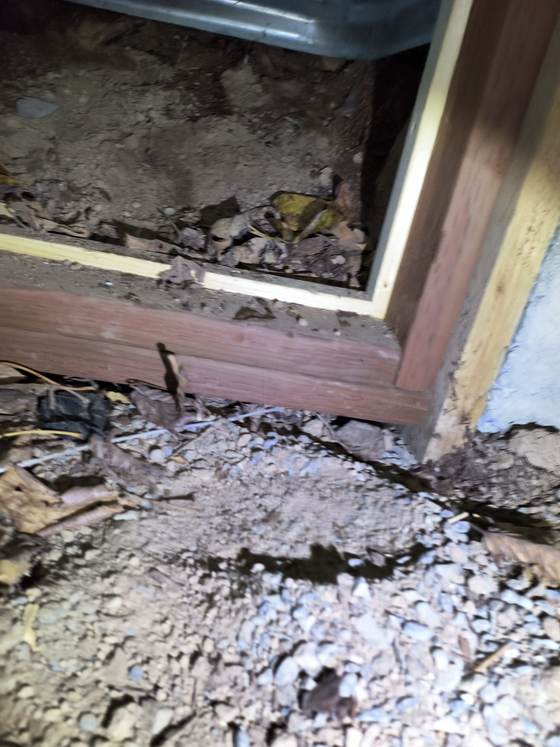
Cedar is worth a specific mention because there is a great deal of it in this area, in siding, trim, decking and outbuildings. Cedar’s reputation for durability is about decay resistance, not insect resistance, and once a cedar member has taken on moisture it is perfectly workable for an ant. The USDA Forest Products Laboratory’s Wood Handbook sets out what cedar heartwood actually resists, which is fungal decay rather than anything with mandibles. A cedar shake wall on the shaded north side of a house at the forest edge is a common place to find galleries.
Treating without addressing the water buys a season. The colony goes, the damp wood stays, and something occupies it again. On a wooded property, where the building dries slowly and the ground stays damp under the canopy, that turnaround can be quick.
The autumn arrivals come together
Then the season changes and an entirely different set of insects shows up.
Multicolored Asian lady beetles and brown marmorated stink bugs are both relatively recent arrivals in this state, and both do the same thing every autumn: they look for somewhere sheltered to spend the winter and they choose buildings. Spiders appear at the same time for their own unrelated reasons, which is why the three get reported together in a single phone call.
The scale surprises people. This is not a handful of insects. On a warm afternoon in late September a sunlit wall can carry hundreds at once, and a proportion of them will find a way in — under siding, around a window frame, through an unscreened attic vent, into a soffit.
Once they are inside a wall void they are dormant. They do not feed and they do not breed there, and they do no damage to the building. The one caution is the lady beetle, which will nip if it is handled and leaves a staining yellow fluid if it is crushed. The problem is entirely that they are there, and that on the first warm days of late winter some of them wake up on the wrong side of the wall and end up in a bedroom.
Why the timing of that work matters so much
Because the useful window is short and most people call after it has closed.
Sealing can be done at any time and is the part that lasts. Exterior treatment of the walls these insects gather on only works in the few weeks when they are massing on the outside and have not yet moved through, which in this part of the county is usually late August into September. Too early and the residual has degraded. Too late and the wall being treated is one they have already left.
Once they are in the void, honest options narrow considerably. What emerges can be removed, and the sealing can be done properly for the following year, but nobody should be treating the inside of a house repeatedly through winter for insects that cannot reproduce there.
Spiders on a wooded property
Spiders are the most reported and least dangerous item on this list. Nothing with a medically significant bite has established itself this far north, and the two species behind nearly every call — the giant house spider and the cross orbweaver — are harmless to people.
A forest-edge property gets more of them for a simple reason: there are more insects around it to eat. The autumn increase indoors is mostly males wandering to find females rather than anything moving in, and it coincides with the beetle and stink bug wave, which is why it feels like one event.
Reducing exterior lighting that concentrates flying insects, knocking down webs where they matter, and closing the same gaps that keep everything else out does more than repeated spraying.
Wasps at the forest edge
Wasps do well here for the same reasons everything else does — plenty of forage and plenty of sheltered structure across a house, a shop, a barn and a woodshed.
Ground-nesting yellowjackets are the genuine hazard rather than the nuisance. A nest in a bank, a ditch edge or an old rodent burrow gives no warning until a mower or a brush cutter goes over it, and on wooded acreage there is a great deal of ground where that can happen. If there is regular clearing on the property, it is worth knowing where the activity is in July rather than meeting it in August.
We do not treat honey bees and will say so. A swarm is a beekeeper’s job and there are people locally who will collect one.
Crawlspaces under a canopy
Crawlspaces here dry slowly, and some barely dry at all.
Shade from mature trees, ground that stays damp long after rain, and airflow broken up by surrounding vegetation all mean a crawlspace at the forest edge runs wetter than one on open ground a few miles west. Wet crawlspaces are the common root of several problems at once: softened framing for carpenter ants, moisture that draws sowbugs and pillbugs, and material a rodent will nest in.
The vapor barrier over the soil is the only thing between wet ground and the underside of the floor, and when it is torn, displaced or lapped badly it is not doing that job. Getting that right is frequently the single most useful thing done on a property out here, and it fixes several complaints at once rather than one.
Woodpiles, stumps and what is stacked against the house
There is one item on a Deming property that does more damage than its size suggests, and it is the woodpile.
Split firewood stacked against a wall is a colony’s ideal position: it is dry under a cover, it is already partly decayed, it is undisturbed for months at a time, and it is touching the building. Carpenter ants found in a wall are very often carpenter ants that arrived from the stack six feet away, and the same stack shelters rodents, spiders and overwintering beetles.
Moving it is free and it works. Off the wall, up on a rack, and where practical away from the house entirely. Bring in what will be burned in a few days rather than storing a season’s worth against the siding.
Stumps and buried wood are the other half of it. A stump left in the ground within thirty or forty feet of a building is a likely parent colony site, and so is any buried construction debris — offcuts, form boards, a stack of scrap left under a deck when the house was built. Where we find galleries in a structure here, there is very often a source outdoors that nobody had thought about because it is not visible from the house.
Vegetation touching the building
The other thing worth doing before spending money on treatment is breaking the bridges.
A branch resting on a roof is a road. Ivy on a wall is cover and a ladder at the same time. Shrubs grown tight against siding hold moisture against the paint, stop that wall drying after rain, and give everything a sheltered route to the eaves. None of this requires clearing the property, which is neither possible nor the point out here — it means a foot of daylight between the planting and the building, and nothing resting on the roof.
It is the cheapest work on this page and it reduces four separate problems at once: ant access, rodent access, spider harborage and the damp that starts the whole sequence.
The Deming year
January to March. Overwintering beetles and stink bugs waking in wall voids and appearing indoors on mild days. Rodents already established and breeding. Repair and exclusion season.
April to June. Carpenter ants become active and this is when most people first see them. Wasp queens start nests, which is the cheapest possible moment to deal with one.
July and August. Carpenter ant activity at its peak, wasp colonies at the size that gets noticed, and ground-nest risk highest during mowing and clearing. The window opens for treating walls ahead of the autumn arrivals.
September and October. The heaviest weeks of the year. Lady beetles, stink bugs and spiders together on warm walls, and farm ground being cut so rodents move toward buildings at the same time.
November and December. Whatever got in is in. Cold concentrates rodent activity in the heated parts of a building, which is when the noise overhead starts.
What we will not sell you
A carpenter ant treatment with no attempt to find the water. We will do the treatment, and we will tell you plainly that it is temporary if the damp wood stays. We would rather quote the repair.
Interior treatment through winter for overwintering insects. They are dormant in a void and cannot reproduce there. Spraying the room they emerged into does nothing about the rest of them.
Ongoing service where one visit would do. A good deal of acreage out here genuinely does, because the pressure never stops. Some properties do not, and if sealing and a single treatment will hold, that is what we will say.
How we work in Deming
Deming is sixteen miles east and runs on scheduled route days. It is a significant area for us rather than an outlying one, and it gets serviced accordingly. Most calls in Whatcom County are handled within one to two days, and about three across August and September when everybody phones at once.
The first visit is a walk of the whole property rather than the one room the call was about — the crawlspace, the outbuildings, the roofline, the vents, the vegetation line, and wherever the ground meets a wall. On a wooded property the answer is usually at the edge of the site, in a stump, a woodpile or a wet corner that nobody has looked at in years.
If it is not urgent, send a photograph first. Identification is free, and it is often enough for us to tell you whether you need a visit at all.
Frequently asked questions
Why are carpenter ants so much worse out here?
Because the source is the forest rather than your house. A parent colony lives outdoors in a stump, a log or a standing dead tree, and it sends satellite colonies into nearby structures. In town a building has to generate its own problem. Here the problem is already next door and only has to move in.
Is it rats or mice we have?
Often both, and they behave differently enough that it matters. Mice live in smaller spaces, breed faster and travel less. Rats range further, are more cautious about new objects, and are far more likely to be the cause of noise in a crawlspace or a chewed wire in an outbuilding. We identify before we set anything.
Should I cut the trees back from the house?
Trimming contact between vegetation and siding is worth doing and helps with several things at once. Removing the forest is neither possible nor the point. Most of the benefit comes from breaking the bridges — branches touching the roof, ivy on a wall, firewood stacked against the house.
Do the lady beetles and stink bugs actually damage anything?
No. Neither breeds indoors and neither harms the building, though a lady beetle will nip if you pick it up and will mark a wall yellow if you squash it. They are a nuisance rather than a hazard, and that changes what a sensible response looks like — the useful work is sealing and correctly timed exterior treatment, not repeated spraying inside all winter.
How far out is Deming for you?
Sixteen miles east, and it runs on scheduled route days rather than same-day availability. It is a significant area for us and it gets serviced properly. We will name the day rather than promise a window we cannot keep.
Is there a charge to come and look?
Only bed bugs carry one, and it is a verification fee that comes off the treatment price if you go ahead. Every other pest, we come out, look at it properly and give you a number, at no charge.
Guides
Pest problem in Deming?
Family-owned, no long-term contracts, and every treatment is backed by our 100% Service Guarantee.
Most calls in Whatcom County are out within 1–2 days, about 3 during the late-summer peak.
Last updated