
Pest Control in Nooksack, Washington
Nooksack is a very small town surrounded by berry acreage, and the fields set the calendar. Harvest and field work push rodents toward buildings, and the same open country sends cluster flies, stink bugs and lady beetles onto warm walls each autumn looking for somewhere to overwinter.
Call 360-410-2199 Request a free inspection

Nooksack on the map
The town is small and the ground around it is not
Nooksack has fewer than two thousand residents and covers less than a square mile. Almost everything that decides pest pressure here happens outside that square mile, in the berry fields, the dairy ground and the open country that runs from the edge of town to the foothills.
That is the single most useful thing to understand about pest control in this place. The problems people call about are usually not generated by their own building. They are generated by several hundred acres of cover and food nearby, and they arrive at the building on a schedule set by farm work rather than by anything the homeowner is doing.
It means the timing of a job matters more here than the products used in it, and it means a house that had no trouble for four years can be overrun in a fortnight without anything about the house having changed.
Berry ground, and what harvest does to it
Whatcom County grows more red raspberries than anywhere else in the country, and Nooksack sits in the middle of that. Raspberry and blueberry acreage surrounds the town on most sides, along with the dairy and grass ground mixed through it.
A mature berry field is excellent rodent habitat for most of the year. It is dense at ground level, it holds moisture, it is rarely disturbed through the growing season, and from midsummer it carries fruit. Populations build under that cover through spring and summer without anybody seeing much evidence of them.
Then harvest happens. Machines move through, the ground is disturbed, fruit is gone, and within a few weeks the canes are cut and the cover is removed. The animals living in that field do not disappear when it is cut. They relocate, and they relocate to the nearest structure that offers what the field has stopped offering.
This is why the busiest stretch for rural rodent calls around Nooksack is late summer into autumn rather than the middle of winter, which is when most people expect it. By the time it is properly cold, the animals that were going to come inside have usually been inside for weeks.
The berry side of that calendar is documented locally by WSU Extension in Whatcom County, which works with the operations growing the fruit.
What that looks like at a building
The first structures to take it are the ones nearest the field and least sealed: equipment sheds, detached shops, pump houses, barns and older outbuildings. Those buildings frequently have gaps that nobody minds, because until now nothing was using them.

From there it moves to the house. A crawlspace with an unscreened vent, a garage with a worn door seal, a gap where a plumbing line passes through a rim joist — all of these are ordinary and all of them are enough. Rodents do not need a failure, only an opening, and a quarter of an inch is enough for a mouse.
The practical response on a rural property is to treat the outbuildings as part of the same job rather than as separate ones. Sealing a house well while a shed forty feet away stays open is not solving the problem, it is moving the address.
Cluster flies, and why they concentrate here
Cluster flies are one of the defining rural pests of this part of the county, and Nooksack gets them heavily.
They are not a hygiene problem and they have nothing to do with the state of a kitchen. The larvae develop in earthworms in pasture and field soil, which means the population is produced by the ground around a building rather than by anything inside it. Open country with permanent grass and moist soil produces a great many of them, and there is a great deal of that here.
In late summer and early autumn the adults look for a place to overwinter. They choose warm vertical surfaces, gather on them in numbers through the afternoon, and work into whatever gaps that wall offers — under siding, around window frames, into attic spaces and wall voids. Through winter they sit dormant in those voids. On the first warm days of late winter, some of them wake up on the wrong side and end up in the room.
That last part is what most people actually call about: flies appearing indoors in February with the windows shut and no obvious source. The source is a decision the insects made the previous September.
Stink bugs and Asian lady beetles do the same thing
The brown marmorated stink bug and the multicolored Asian lady beetle follow the same pattern on the same walls at roughly the same time, and the three are routinely found together.
None of them breeds indoors and none damages the building. The lady beetle will bite if it is handled, which the stink bug will not, and it is a nip rather than an injury. They are a nuisance rather than a threat, and that distinction matters, because it changes what a sensible treatment looks like. Nobody should be fogging a house repeatedly through winter for insects that are dormant in a wall and cannot reproduce there.
The work that helps is done before they arrive: closing the gaps they use, and treating the walls they gather on in the right few weeks of late summer. Once they are inside the void, the honest options narrow to removing what emerges and doing the exclusion properly the following year.
The overwintering window is short
The reason we push people to plan this in August rather than October is that the window is genuinely narrow.

Treating the exterior walls too early means the residual has degraded before the insects gather. Treating after they have already worked into the siding means treating a wall they are no longer on. The useful period is the few weeks when they are massing on the outside and have not yet moved through, and in this part of the county that is usually late August into September depending on the year.
Sealing can be done at any time and is worth more in the long run. It is also the part most people put off, because a gap under a piece of trim does not look like anything until several hundred insects have used it.
Everson is a mile away and this is not that page
Nooksack and Everson sit about a mile apart and share a school district, a valley and a good deal of housing stock. It would be easy to write the same page twice.
They are not the same job. Everson sits directly on the Nooksack River, and water is the first thing about pest work there — flood-affected buildings, rebuilt crawlspaces, and rodents pushed off saturated ground. Nooksack sits slightly back from the river, and the fields matter more here than the water does.
Both towns took serious flooding in November 2021 and there are buildings in both that were repaired afterwards. Where that is true of a property here, the same principle applies as anywhere: material that has been wet stays a problem until it comes out. Wet insulation holds moisture, feeds decay and makes excellent nesting material, and sealing a building around it simply traps the conditions in place.
Carpenter ants and moisture ants
The ant work here follows the buildings rather than the fields.
Carpenter ants do not eat wood. They excavate it to nest in, and they strongly prefer wood that is already softened by moisture. In practice that means the places on a rural building where water has been getting in quietly for years: a sill plate under a leaking hose bib, the framing around a poorly flashed window, a section of rim joist above a crawlspace that never dries out.
Moisture ants are an even more direct signal. Finding them is close to a guarantee that there is a genuine water problem in that timber, because they need consistently damp wood to nest in at all.
Treating either without dealing with the water is temporary by definition. A colony removed from wet wood is replaced by another colony in the same wet wood, usually within a season or two. On a property this far out, where a soft sill can sit unnoticed behind a workbench for years, finding the water is most of the job.
Wasps on a rural property
Wasps are worse on acreage than in town, for two straightforward reasons.
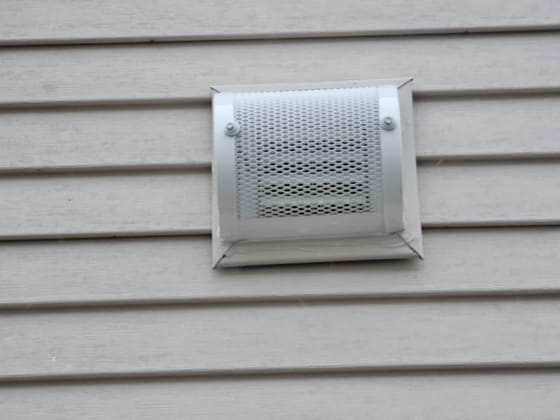
There is more building surface per property — house, barn, shop, pump house, carport — and more of it is unpainted, unsealed or open-sided, which is exactly the sheltered structure a colony wants. And there is far more forage, so colonies get larger before anybody notices them.
Yellowjackets that nest in the ground are the ones that cause injuries here, because they are found by mowing rather than by looking. A nest in a bank or an old rodent burrow gives no warning until a machine goes over it. If there is regular mowing on the property, it is worth knowing where the activity is before August rather than discovering it at speed.
We do not treat honey bees, and we will say so plainly. A swarm belongs with a beekeeper, and there are local ones who will come and take it.
Spiders and the rest of the domestic list
Spiders are the most common thing people ask about and among the least dangerous. No spider of medical concern has an established population in Whatcom County. Giant house spiders and cross orbweavers account for most of what turns up, and the autumn surge indoors is males wandering to find females rather than an invasion.
The rest of the residential list here is ordinary: sowbugs and pillbugs around damp foundations, earwigs in wet ground cover, silverfish in bathrooms and older crawlspaces, and cluster flies as described above. Most of it responds to moisture management and sealing rather than to repeated spraying.
Feed rooms, coolers and the small commercial side
A fair share of the work around Nooksack is not residential at all. Berry and dairy operations run buildings that concentrate exactly what rodents want: feed in bulk, water, warmth and constant door movement.
A feed room is the clearest case. Grain and pellets in volume, spillage that is difficult to eliminate entirely, and a door that opens many times a day. No amount of treatment outcompetes an open food supply, so the work there is sequencing: storage in sealed containers first, spill discipline second, the building envelope third, and control measures last rather than first.
Cooler and packing buildings have the opposite problem. They are cleaner, but they run doors open through harvest and carry a great deal of vehicle traffic, which is how populations move onto a site rather than build up on it. On agricultural accounts we plan around the operation’s calendar. Turning up in the middle of harvest to do exclusion work is not useful to anybody.
What actually holds on a rural building
Exclusion on acreage fails in predictable ways, and most of them come down to material choice.
Expanding foam alone does not hold. Rodents chew through it, and on a building this exposed it degrades in sunlight at the edges. Hardware cloth stapled over the outside of a vent works until the staples rust, which in this climate is a few seasons. Steel wool packed into a gap is a stopgap and rusts into a stain down the siding.
What holds is metal that is fastened rather than pressed in: screened covers cut and folded to fit the opening, mortar or backing rod and sealant where the gap is in masonry, and sheet metal over chewed edges on a door or a sill. It costs more on the day and it is still there in ten years, which on a property with a dozen openings across five buildings is the only economics that works.
The other thing that holds is doing the outbuildings at the same time. Sealing a house properly while the shop stays open produces a house that is fine and a shop that is worse, because the population that was spread across two buildings is now concentrated in one.
Rodents in the attic, and what you are actually hearing
Most rural rodent calls start with a noise, and the noise tells you more than people expect.
Scratching and scurrying overhead after dark, in short bursts, is usually roof rats or mice in the attic or a ceiling void. Heavier, slower movement lower in the building is more often Norway rats in a crawlspace or wall base. Rapid activity at dusk and again before dawn fits rodents; something moving during the middle of the day is more likely a squirrel, and that is a different job.
What matters is that the noise is a late signal rather than an early one. By the time an animal is audible from a bedroom, it is established, it has a route in and out, and it has almost certainly been there a while. That is why the first thing we do is find the entry rather than set traps in the roof space. Trapping without sealing removes the individuals and leaves the door open behind them.
Insulation is the part people underestimate. Rodents tunnel through blown-in material, contaminate it and flatten it, and once that has happened the insulation has stopped doing the job it was installed for. The Washington State Department of Health’s pest pages cover the health side of that mess, which is worth reading before anybody crawls in to pull it out. Where it is bad enough, removing and replacing it is part of the repair rather than an upsell.
The Nooksack year
January to March. Overwintering insects waking in wall voids and appearing indoors on warm days. Rodents already established and now breeding. This is cleanup and exclusion season rather than prevention season.
April to June. Ants become active as ground warms. Wasp queens start nests — the cheapest time all year to deal with one, when it is the size of a golf ball and holds a single insect.
July and August. Wasp colonies reach the size that gets noticed. Berry harvest begins and the first field-displaced rodents start showing up in outbuildings. This is also the window for overwintering treatment on south and west walls.
September and October. The heaviest weeks. Fields cut, cover gone, rodent pressure at its peak, and cluster flies, stink bugs and lady beetles massing on warm walls at the same time.
November and December. Whatever got in is in. Cold weather concentrates activity in the warm parts of a building, which is when people hear it overhead at night.
What we will not sell you
A monthly contract for a house with no ongoing pressure. Plenty of properties here have a real, continuous problem because of what surrounds them. Plenty do not. If a one-time treatment and some sealing will hold, we will say so.
Repeated interior fogging for overwintering insects. They are dormant in a void, they cannot reproduce there, and treating the room they emerged into does nothing about the several hundred still in the wall. Exterior timing and exclusion are the work.
Treatment for a wet-wood ant problem without addressing the wet wood. We will do the treatment, but we will tell you it is temporary, and we would rather quote the repair.
How we work in Nooksack
Nooksack is eighteen miles from the shop and it sits on scheduled route days. Most calls in Whatcom County are handled within one to two days, and about three across August and September when everybody phones at once. We would rather name the day than promise a window we cannot keep.
For a rural property, the first visit is a walk of the whole site rather than the one room the call was about. Outbuildings, the crawlspace, the roofline, the vents, the field margin and wherever the ground meets the building. On a property surrounded by acreage, the answer is nearly always at the edge of the site rather than in the middle of it.
A photograph sent ahead is genuinely useful and often enough for us to tell you whether you need a visit at all. Identification is free.
Frequently asked questions
Why do I only see these bugs on one side of the house?
Because they are choosing it. Cluster flies, stink bugs and lady beetles gather on whichever wall holds afternoon heat longest, which here is nearly always the south or west face. It is not a sign that side of the building is failing. It is the sun.
Does harvest actually change the rodent situation?
Yes, and it is the most predictable thing about this town. Cutting, mowing and clearing take cover away from a population that has spent the summer in it, and those animals move to the nearest structure with food and shelter. Sheds, shops and crawlspaces fill within days rather than weeks.
Can you keep cluster flies out entirely?
Not entirely, and anyone who says otherwise on a rural property is selling something. They enter through gaps far smaller than a rodent needs. Sealing the worst of it before September, and treating the walls they gather on at the right time, is the difference between a handful and hundreds.
Is Nooksack far enough out to be a problem for you?
Eighteen miles, and it sits on scheduled route days rather than same-day availability. We will tell you which day that means instead of promising a window we cannot keep.
Do you work with berry and dairy operations?
Yes. Feed rooms, equipment sheds and cooler buildings are the usual list, and the work runs on the operation's calendar rather than ours. Agricultural accounts get planned around harvest and planting instead of being treated as call-outs.
Is there a charge to come out and look?
Not for any pest except bed bugs, which carry a verification fee credited against treatment if you go ahead. Otherwise we come, look properly, and quote.
Guides
Pest problem in Nooksack?
Family-owned, no long-term contracts, and every treatment is backed by our 100% Service Guarantee.
Most calls in Whatcom County are out within 1–2 days, about 3 during the late-summer peak.
Last updated