
Carpenter Ant — Camponotus modoc
Camponotus modoc · Ants
Carpenter ants are large black ants that tunnel through wood to nest in it without eating any of it. A colony here runs a parent nest outdoors, usually in decaying wood within about a hundred yards, and satellite nests inside buildings. Indoor activity in winter means one is already in the structure.
Call 360-410-2199 Request a free inspection
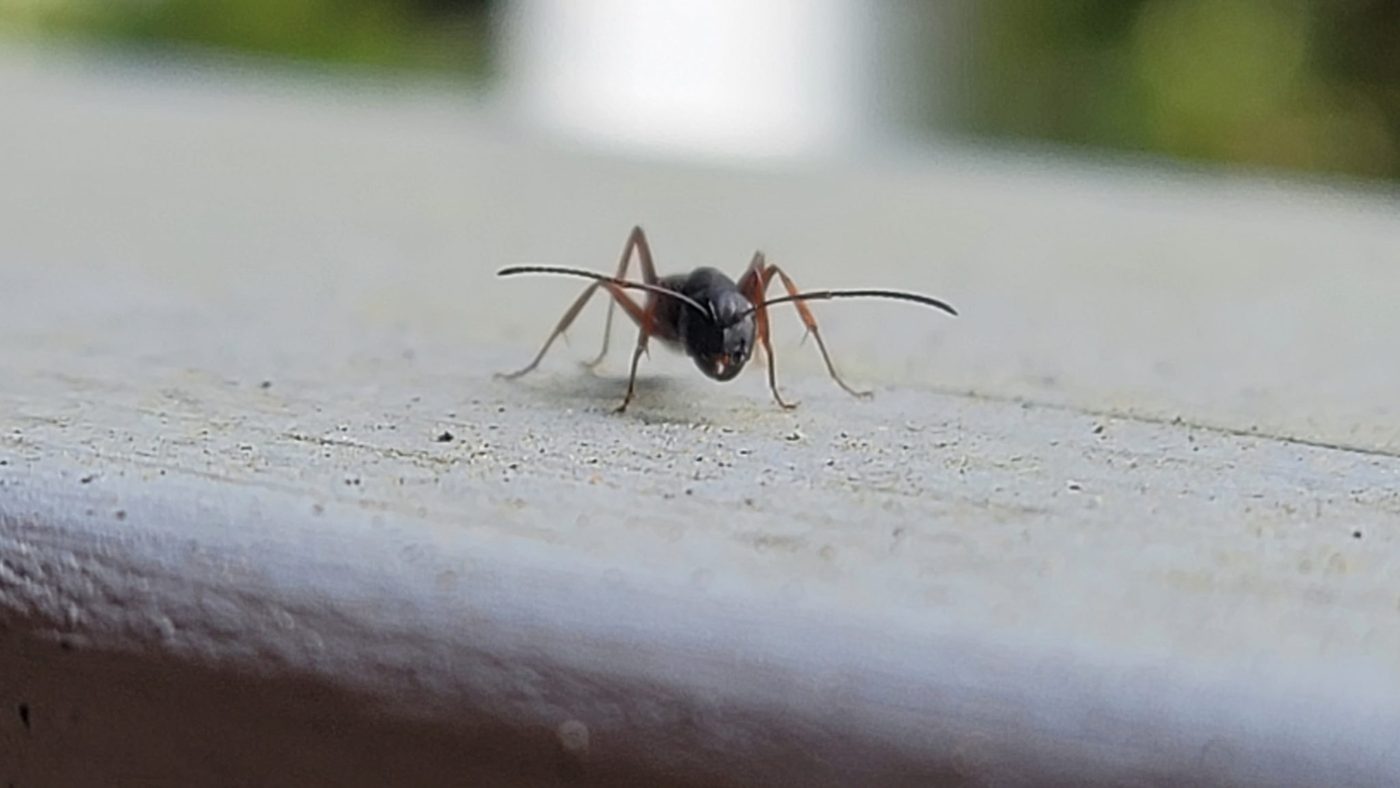
We treat this, and finding it usually warrants treating.
Carpenter ant at a glance
| Size | Workers a quarter to half an inch, in several sizes in one nest; queens to three quarters of an inch |
|---|---|
| Color | Black, with legs that read reddish-brown on white paper under a lamp |
| Thorax and waist | One smooth unbroken curve along the top of the thorax; a single node at the waist |
| How to tell it from a moisture ant | Much larger and black rather than yellowish, with no notch in the thorax profile |
| How to tell winged ones from termites | Elbowed antennae, front wings longer than hind wings, and a pinched waist |
| Nest | Parent colony in decaying wood outdoors, often within a hundred yards; satellites inside buildings |
| Damage | Excavates wood for shelter without eating it; rarely significant in one season, serious over years |
| Do we treat it | Yes — at both the satellite and the parent colony, and the water gets corrected |
Signs you have them
- A pile of coarse wood shavings mixed with insect parts and shed wings below an opening
- Shavings caught in spider webbing in a crawlspace or garage
- Winged ants emerging at an interior window in March, April or May
- Large black ants trailing along fence lines, driveway edges or a branch touching the roof, mostly at night
- A faint dry rustling in a wall void, most noticeable at night in a quiet room
- Clean, smooth-sided galleries with no soil or pellets when trim comes off
What you are actually holding
Size settles most of these before anything else does. The WSU Clark County Master Gardener sheet puts western carpenter ant workers between a quarter and a half inch, with queens reaching three quarters of an inch, and describes them as black except for reddish legs. Get one onto a sheet of white paper under a lamp and the legs read reddish-brown rather than dark, which is a quicker check than most people expect.
Two structural features finish the identification when size is ambiguous. Viewed from the side, the upper surface of the thorax is one smooth unbroken curve — evenly convex, in WSU’s phrase. That single arc is the mark that separates this genus from the moisture ants, whose thoracic outline carries a visible notch or dip partway along. And the waist between thorax and abdomen carries a single node rather than a pair, which is what rules out pavement ants and most of the small kitchen species at a glance.
Then there is the thing that confuses people more than any other detail: within one nest, the workers are not the same size. Carpenter ants are polymorphic, so a mature colony produces small workers, medium ones and majors with visibly larger heads, all siblings from the same queen. Households routinely conclude they are dealing with two separate species and buy two separate products. They have one colony behaving normally.
They excavate wood. They do not eat any of it.
This is the single fact that explains everything else on this page, and it is the one most consistently gotten wrong.
The USDA Forest Products Laboratory states it without hedging in the Wood Handbook: carpenter ants use wood for shelter rather than for food, usually preferring wood that is naturally soft or has been made soft by decay. The Clark County sheet says the same thing from the other direction — the ants burrow into timber to construct nests, and feed on insects, aphid honeydew, tree sap, human food and pet food.
Nothing in that list is cellulose. A carpenter ant has no more capacity to digest a stud than you do. What it does is bite the fibers loose, gather the shavings, walk them to an opening and drop them outside the nest. The timber leaves the building as waste rather than as food.
Three consequences follow, and each one changes how the problem gets found.
The damage is removal, not consumption. A gallery is a void where wood used to be, and the wood is now in a heap somewhere below. Nothing has been eaten, so nothing about the volume of debris tells you the colony is feeding — it tells you the colony is expanding.
Bait works. Because these ants forage for sugars and protein and share what they collect through the nest by mouth, material placed where they are already feeding gets carried inward and distributed. An insect that genuinely digested wood would never take a bait home, which is why baiting is a live option here and a dead end against a true wood-feeder.
The galleries look wrong for a termite. Penn State Extension describes carpenter ant workings as smooth-sided and containing no soil particles or fecal pellets. Housekeeping is compulsive; the nest is kept clear because the ants live in it. Termite workings are the opposite in exactly the way you would expect from an animal that eats what it tunnels through. Subterranean species pack their runs with soil and hardened material, and WSU’s termite bulletin describes dampwood pellets as roughly a twenty-fifth of an inch and slightly hexagonal, adhering loosely to the gallery sides or scattered along the floor.
So when a section of trim comes off, the useful question is not how much timber is missing. It is whether the cavity is clean. A void that looks sanded and holds nothing is ant work. A void packed with grit, mud or hard pellets is not, and the conversation changes.
Frass, and what it is telling you
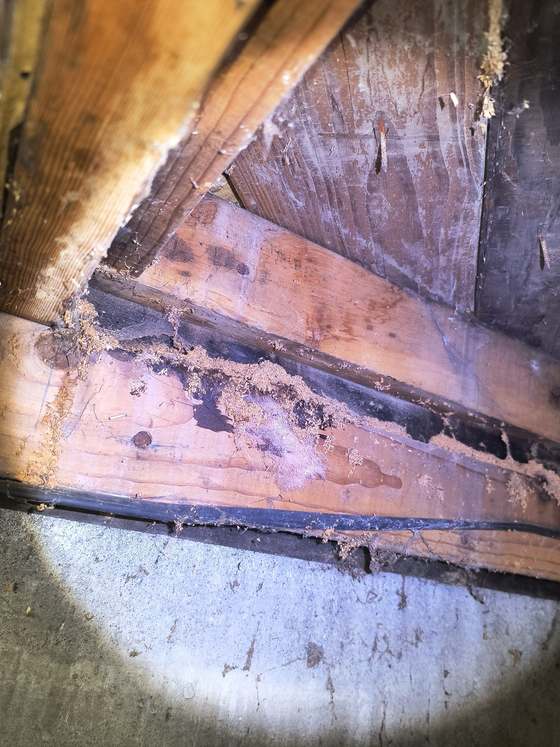
The heap of coarse material below a gallery opening is the outdoor half of the same fact. It is not sawdust in the sense of something a saw made — it is excavated wood fiber that has been carried out deliberately, mixed with whatever else the colony was clearing: shed wings from last spring’s reproductives, legs and head capsules from dead nestmates, the remains of prey.
That mixture is diagnostic. Debris made purely of fine powder with no fragments in it points at wood-boring beetles. Uniform hard granules point at termites. Fibrous shavings with insect parts scattered through them are carpenter ants, and almost nothing else produces that combination in a house here.
Two practical notes. First, frass falls, so the gallery is above the pile rather than behind it; follow a plumb line upward from the heap and look for a slit at a joint or a nail hole. Second, the debris is often caught in cobwebs near the opening before it reaches the floor, and the Clark County sheet lists exactly that — sawdust caught in spider webbing — as a sign worth looking for in a crawlspace or a garage where nobody sweeps.
The spring swarmer problem
Every April this county produces a run of calls that begin “I think I have termites,” and in the overwhelming majority of them the specimen on the windowsill is a winged carpenter ant. This is the most common misidentification in the region and it is worth taking apart properly, because the two answers carry very different consequences and the wrong one gets treated for years.
Three features separate them. Any single one is sufficient, and all three are visible without magnification if the light is good.
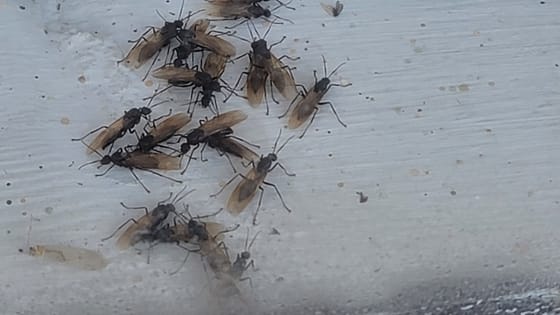
The antennae bend. An ant’s antenna has a long first segment and then an obvious joint, so the whole structure looks elbowed. A termite’s antennae run straight out from the head, sometimes described as looking beaded along their length. Maryland Extension’s comparison leads with this pair — elbowed for ants, straight for termites — and it is the tell to check first, because it needs no reference specimen alongside it.
The wing pairs are unequal. Maryland puts it as front wings longer than the hind wings and tinted brown on ants, against front and hind wings of similar shape and equal length, pale and translucent, on termites. WSU’s own termite bulletin makes the identical point from the termite side: both termite wings are the same size, while the anterior wings of the ant are considerably larger than the posterior ones. Lay the insect on white paper and look at the two wings on one side. Matched pair, termite. Mismatched, ant.
The waist is pinched. Ants carry a narrow constriction between thorax and abdomen. A termite’s body runs straight back from the head with no waist at all, broad along its whole length. On a specimen the size of a carpenter ant reproductive this is obvious once you know to look for it.
There is a fourth tell that costs nothing, and in this county it is nearly as reliable as the anatomy: the calendar. Carpenter ant reproductives develop the previous season, overwinter inside the nest and leave the following spring — the Clark County sheet says exactly that. Pacific dampwood termite flights, per WSU’s termite bulletin, happen on warm evenings in late summer or fall, particularly after rain. A cloud of winged insects at a window in March, April or May here is almost always ants. A flight against a lit window on a warm, damp September evening deserves a closer look.
Why swarmers indoors are the strongest signal on the page
A colony does not produce reproductives until it can afford to. Penn State puts a mature colony at roughly two to three thousand workers, reached over several years, and only then does it begin turning out winged forms — somewhere around two to four hundred a year.
That arithmetic is what makes an indoor swarm meaningful. Winged ants emerging inside your house in spring are not visitors. They are the output of a nest that has been established long enough to mature, and it is inside the building rather than in the yard, because reproductives leaving a stump forty feet away emerge outdoors where they belong.
A handful of large workers on a summer counter is worth attention. A spring emergence at an interior window is a different order of evidence entirely, and it is the finding that most reliably justifies opening a wall.
Parent colonies, satellites, and why indoor-only treatment fails
A carpenter ant population is not a nest. It is a network, and understanding the shape of it is what separates work that holds from work that does not.
The parent colony holds the queen, the eggs and the youngest brood. Developing eggs need consistently high humidity, so this nest is almost always in wood with a high moisture content — the Clark County sheet describes nests starting in decayed or wet wood and extending outward into sound material from there. In practice that means a stump, a buried root, a fallen log, a standing dead limb, a rotting fence post, a landscape tie sitting on soil, or the bottom of a woodpile that has not moved in five years.
Satellite colonies hold workers, older larvae and pupae — life stages that tolerate drier air. Because their humidity requirement is lower, satellites can be established in places the parent nest could never survive: a wall void, an attic, a hollow door, the framing under a bathtub, a boxed-in soffit, the space behind kitchen cabinets. WSU frames the driver simply, which is that satellites form when a parent colony needs room to expand.
Workers move continuously between the two, carrying food inward and brood outward. That traffic is the whole reason the network is treatable at all — and it is also the reason a treatment confined to the building tends to fail. Remove a satellite and you have removed a branch. The queen is untouched, the parent nest is intact, and the conditions that made your wall attractive have not changed, so another satellite goes into the same place. Households that treat indoors every spring for six years are usually doing this without realizing it.
WSU’s recommendation is unambiguous on the point: treating the parent colony as well as the satellites is what produces effective control.
The hundred-yard radius
The parent colony is often not on your property.
Penn State places it in a tree, log or waste wood within about a hundred yards of the house. That is a circle covering something like six acres, which on a Bellingham city lot takes in your neighbors on both sides, the property behind you, the strip along the alley and whatever is growing in the greenbelt at the end of the block.
Carpenter ants do not cross that ground at random. They travel edges, and the edges on a residential lot here are predictable: fence lines, the base of a retaining wall, the seam where a driveway meets the lawn, irrigation lines, utility drops, and — the one that matters most — any branch or shrub touching the building. A limb resting on a roof is a bridge that bypasses every ground-level measure anybody has taken, and cutting it is often the highest-value ten minutes on the whole job.
The practical consequences are worth stating plainly, because they are why this species is genuinely harder than the rest of the group.
A thorough job spends most of its time outdoors, walking the perimeter and the ground beyond it rather than working the room where the ants were seen. Trails run at night, so following them properly means being on site after dark — the Clark County sheet puts the window between sunset and sunrise, April to mid-October, and Penn State narrows the most productive hours to between ten at night and two in the morning, May through July. And where the parent colony sits on land we cannot enter, the honest description of the work changes: we are managing a building against pressure from a source we cannot reach, which is a real and useful thing to do and is not the same as resolving the colony. Anybody who tells you otherwise about a stump on the next lot is describing an outcome they do not control.
Where they turn up in this county’s housing
The pattern here is set by the wet season rather than by winter cold, and it concentrates in a short list of places.
Rim joists and sill plates. The timber closest to grade in an older crawlspace, taking splash-back off a hard surface and sitting in air that never really dries between October and April.
Window and door framing, especially at the bottom corners, and above all where a replacement unit was fitted into an old opening without the flashing behind it being corrected.
Roof edges and boxed soffits, where a plugged gutter has been overflowing against fascia for several winters.
Around chimneys, skylights and vent penetrations, where flashing failure tracks water along framing well away from any visible stain.
Deck ledgers, which in the older housing stock here were routinely fastened to a wall with no flashing at all.
Bathroom and kitchen subfloors over a slow supply or waste leak.
Attached garages and outbuildings, particularly where firewood is stacked inside against a shared wall.
The common thread is not the room. It is that water has been getting into a piece of wood for long enough to soften it — which is why the FPL notes that carpenter ant presence can indicate a moisture problem somewhere in the structure, and why a competent visit looks at gutters and grade before it looks at products.
What the damage actually amounts to
Proportion matters here, in both directions.
Penn State is measured about it: structural damage from carpenter ant nesting is rarely significant. Over a single season, in a single satellite, that is consistent with what we see — a colony working a door casing for one summer is not a structural event.
The honest qualification is time, and it is the reason this profile carries a treat verdict rather than a softer one. Galleries follow the grain and expand into the softest available material year on year. Ten years of an unnoticed network in a chronically wet rim joist takes real section out of a member that is carrying load, and it does so in company with the decay fungi that softened the wood in the first place. By that stage the two causes are not separable and the repair is carpentry rather than pest control.
The FPL’s numbers on decay are worth borrowing for scale, because they explain why the combination is worse than either part: toughness losses ranging from six percent to more than half occur by the time decayed wood has lost one percent of its weight, and by ten percent weight loss most strength properties can be expected down by more than half. Ants excavating into material already in that condition are compounding a problem, not starting one.
Nobody needs to be frightened about this in year one. Everybody should act in year one, because the cost curve is steep and entirely avoidable.
Telling them apart from the ants they get confused with
Moisture ants are the confusion that most often runs the other way — small yellowish ants in a wet sill get reported as carpenter ants because the location fits. Size resolves it immediately, since WSU puts moisture ant workers at three to five millimeters against a carpenter ant’s quarter inch and up, and color resolves it again, yellow to mid-brown against black with red legs. Under a lens the thoracic profile is decisive: a notch on the moisture ant, an unbroken curve on the carpenter ant. The finding means something different too, which is covered on their own page.
Odorous house ants are small, dark, and much more numerous in a visible trail than carpenter ants ever are. Crush one and you get a strong smell, described in WSU’s publication as rotten coconut or blue cheese; a crushed carpenter ant smells faintly of formic acid at most. If the ants on your counter are running a dense two-way column and are all identical in size, they are not carpenter ants, and treating them as though they were will make things worse rather than better.
Termites are covered above and are the consequential confusion. The three anatomical tells, the flight season and the state of the galleries settle it between them. Where a wood-destroying organism has been identified in your building by somebody qualified to do that, treating it is squarely within what we are certified to carry out.
Why this one is worth treating, and what that involves
Carpenter ants get a treat verdict for reasons that do not apply to most of this library. The colony does not run its course seasonally. It does not leave when the weather changes. It expands into a building on its own schedule, it operates mostly at night in places nobody looks, and left alone it compounds a decay problem that is already running. Waiting does not improve any variable.
What competent work looks like:
Identification before anything else, under a lens where the specimen is ambiguous, because every decision downstream turns on it.
Locating nests rather than trails. Sounding suspect timber, moisture readings, tracing frass to its opening, and working the exterior — stumps, dead limbs, ground-contact timber and woodpiles — inside the foraging radius.
Non-repellent materials and baits, chosen so workers carry them inward. Contact killers applied to a visible trail remove the most expendable members of the population and warn the rest away from the treated surface. The PNW handbook is blunt that over-the-counter sprays are highly repellent and can scatter ants through a structure.
Treatment placed at both ends of the network, satellite and parent, which is the step that decides whether this recurs.
Correcting the water, which is frequently somebody else’s trade and which we will say so about.
Removing the harborage — the stump, the buried timber, the woodpile against the siding, the branch on the roof.
Coming back to check. Activity commonly rises for a period after baiting begins, because recruitment to the material is exactly what is supposed to happen, and reading that increase as failure is how good treatments get abandoned halfway through.
What makes it worse
Spraying the trail, which removes the diagnostic route and leaves the network intact. Sealing the gallery opening the frass is coming out of, which hides the best marker on the building without closing anything. Retail bait stations formulated only for sugar-feeders, which a colony provisioning for brood will walk past. Sweeping up the frass before anyone has seen it. And treating indoors year after year while the stump that supplies the building sits untouched forty feet away, which is the most expensive mistake available in this entire category and the reason the outdoor half of the work is not optional.
Frequently asked questions
If they do not eat the wood, what happens to it?
It gets carried outside. Workers chew the fibers loose, haul the shavings to an opening and drop them, which is why a colony produces a pile of debris rather than a hollow you can see from the room. The wood is removed rather than consumed.
How do I know the winged ones are not termites?
Look at the antennae first, because that tell needs no comparison specimen. Ant antennae bend at a joint partway along; termite antennae run straight out from the head. The wings and the waist confirm it: unequal wing pairs and a narrow pinch mean ant.
Why does the nest keep coming back to the same wall?
Because the wall is still damp and the parent colony outdoors is still producing workers. Satellites are established where conditions suit them, and nothing about that wall changed when the previous satellite was treated, so the site gets used again.
Does a big pile of debris mean a big colony?
Not directly. The pile records how much excavating has happened at one opening, which depends on how long the nest has been there and how soft the wood is. A modest heap under an old satellite can represent more removed timber than a large fresh one.
Is the tapping or rustling in the wall real?
Usually. A large colony working in a void makes a faint dry sound, most noticeable at night in a quiet room, and knocking on the wood nearby often changes it. It is one of the few signs that survives a tidy household.
Can I just cut out the piece of wood they are in?
Sometimes, and it is a legitimate approach for a small satellite in replaceable trim. It does nothing about the parent colony that supplied it, so on its own it tends to move the problem rather than end it.
Are they dangerous to people or pets?
Not meaningfully. Major workers can deliver a pinching bite if you handle them and may spray formic acid into it, which stings briefly. There is no venom of consequence and no disease association. The concern is the timber, not the household.
Sources
- WSU Extension, Clark County Master Gardeners — Carpenter Ants — read September 1, 2026
- Penn State Extension — Carpenter Ants — read September 1, 2026
- USDA Forest Products Laboratory — Wood Handbook FPL-GTR-282, ch. 14: Biodeterioration of Wood — read September 1, 2026
- University of Maryland Extension — Ants and Termites: How to Tell the Difference — read September 1, 2026
- WSU Cooperative Extension EB0787 — Termites: Biology, Prevention and Control — read September 1, 2026
- PNW Insect Management Handbook — Nuisance and household pests: Ant — read September 1, 2026
Rules change. This page is scheduled for review against its sources by September 1, 2027. If you are reading it after that date and something looks out of step with the current rule, the rule is right and we are wrong — please tell us.
Pest problem in Whatcom County?
Family-owned, no long-term contracts, and every treatment is backed by our 100% Service Guarantee.
Most calls in Whatcom County are out within 1–2 days, about 3 during the late-summer peak.
Last updated