
Pest Control in Birch Bay, Washington
Birch Bay is a recreation community that turned into a year-round one, and the housing has not entirely caught up. Lightly built cabins now lived in through the winter, a large vacation rental economy with constant guest turnover, and shoreline exposure that works on every building out here.
Call 360-410-2199 Request a free inspection

Birch Bay on the map
A summer place that became a town
Birch Bay was built as somewhere to spend July. Much of the housing went up in the sixties and seventies as cabins, beach places and weekend property, on small lots, close together, near the water and built to a standard appropriate to three warm months of occupancy.
Then people moved in permanently. Cabins were insulated, extended, re-roofed, converted and lived in through the winter, and a substantial year-round population now occupies a housing stock that was not originally designed for it.
That gap between what a building was built for and what it is now asked to do explains most of our work here, and it is a genuinely different situation from Blaine a few miles up the road — that is a working town with a harbor and a border crossing, this is a recreation community with a rental economy.
What the original construction did
The seasonal cabin stock shares a set of characteristics, and every one of them is a pest consideration once the building is occupied year-round.
The underfloor space. Very often skirting, piers or a shallow crawl rather than a proper sealed foundation. It was never intended to be part of a conditioned building, so it has bare earth, no vapor barrier worth the name, and access points nobody thought twice about. It is the single easiest place on most Birch Bay properties for something to get in.
Light framing and thin envelopes. Small dimension lumber, minimal sheathing, and insulation retrofitted decades later into cavities that were not designed for it. Retrofit insulation is warm, and warm is exactly what a rodent is looking for in October.
Additions. Most of these places have been added to at least once. Every addition created a junction between old framing and new, and those junctions are where the gaps are — at the roofline, at the rim, where a new floor meets an old one, and around whatever services were rerouted at the time.
Decks and skirting. Nearly universal, frequently enclosed at the base, and the enclosed space underneath is dry, sheltered and undisturbed. It is prime harborage, and on a lot of properties it connects directly to the underfloor space.
Plumbing and services run underneath. Water lines, waste lines and heat ducts running through or under an unsealed floor cavity, each with a penetration around it. Where a rodent gets into that space it has access to the whole building’s underside.
The rental economy
Birch Bay has a large short-term rental market and it changes the pest picture in a way that catches owners out.
Turnover is the transport mechanism. A house that changes occupants weekly sees more people, more luggage and more soft goods through it in a season than a family home sees in a decade. That is the mechanism by which bed bugs travel, and it is why rentals carry a risk profile that owner-occupied property simply does not.
Guests do not report things. A visitor who sees a mouse or gets a bite frequently says nothing to the owner, leaves a review, and goes home. So the first the owner knows about a problem is a rating drop or a cluster of complaints arriving at once, by which point the situation has been running for weeks. Occupied family homes catch problems in week one. Rentals catch them in week six.
The season compresses everything. The window when the property is earning is the same window when wasps peak and when the building is most heavily occupied, and it is the window in which a treatment is most disruptive. Which means the useful work happens in the shoulder seasons, and owners who plan for that have a far easier summer than owners who do not.
Our practical advice to rental owners here is consistent. Deal with wasps in spring, before the nests are established and before the bookings start. Get exclusion done in the autumn after the season ends, when the crawl is dry and the rodent movement is beginning. Use mattress and box spring encasements as standard, because they make bed bugs both harder to establish and far easier to detect. Brief whoever cleans between bookings on what to look for, because they are on site more often than anyone else. And do not try to compress a treatment that needs a follow-up interval into a single changeover day.
Bed bugs specifically
It is worth being direct about this because rental owners are understandably sensitive to the subject.
A bed bug problem in a rental is not a hygiene failure and it is not a reflection on housekeeping. It is a transport problem, and any property with regular guest turnover is exposed regardless of how well it is kept. The operators who handle it best are the ones who accept that and build detection into their routine, rather than the ones who assume it cannot happen to them.
Early detection is everything. A problem caught in one room while it is still one room is a contained job. The same problem three months later, after guests have moved between bedrooms and soft furnishings, is a whole-property treatment at several times the cost and with far more disruption to the calendar.
Bed bugs are the one service where our assessment is not free. There is a verification fee, and it is credited against the treatment if you go ahead. We charge it because verification is slow, careful work and because free bed bug callouts attract speculative visits that push out real appointments. Everything else we handle here costs nothing to have us look at.
Wasps, and why vacant property gets the worst of it
The wasp pattern in Birch Bay is driven by the same occupancy gap as everything else.
A queen founds a nest in a sheltered spot in April or May — an eave, a soffit, a deck rail, the underside of a bench, a gap in the skirting. At an occupied house somebody notices it in June while it is still small and trivially dealt with. At a property standing empty between the winter and the season, nobody notices anything, and the colony grows without interruption until somebody opens the place up in July and finds it at full size beside the front door.
The colony is also at its most defensive late in the season, exactly when the property is busiest with guests and children. Which is why the single most cost-effective thing a Birch Bay owner can do is have somebody walk the eaves and the deck in spring.
Yellowjackets additionally nest in the ground along lawn edges, in the base of skirting and under decking, and those are the ones that produce genuine incidents, because they are invisible until something disturbs them.
WSU’s Pestsense factsheets deal with wasps and the other pests that turn up around Washington houses, which is a better fit for a Whatcom rental than a national page.
The bay, the berm and the exposure
The shallow bay and its tidal flats shape the shoreline properties more than people expect.
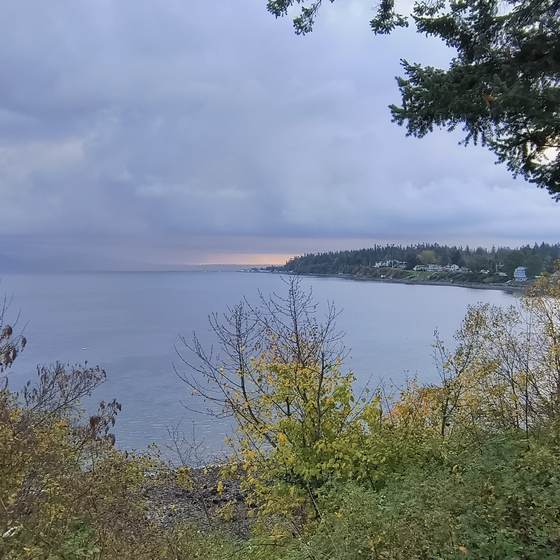
Tidal flats produce insects in enormous quantity, and that production feeds everything above it. Shoreline houses get a heavier flying-insect load on warm evenings than anywhere inland, and consequently a heavier spider population, because the spiders follow the food. Exterior lighting matters a great deal here: a bright white fixture on a summer night is doing more to create a spider problem than anything else on the property, and changing the fixture is more effective than treating for the spiders.
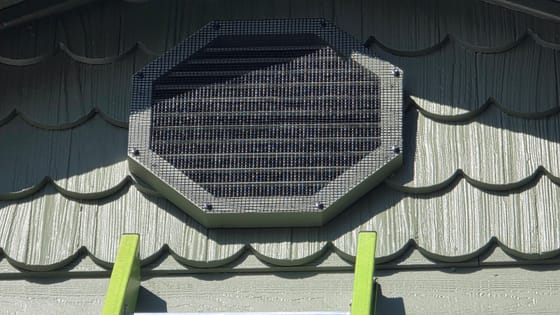
Salt and wind work on the building envelope continuously. Vent screens corrode. Fasteners fail. Sealants degrade. Trim and flashing loosen. Every one of those is an entry point, and out here they open faster than they do a few miles inland. Any exclusion work worth paying for on this shoreline has to be specified for the exposure — stainless mesh and appropriate fasteners rather than ordinary galvanized, which will not survive.
The berm and the shoreline drive concentrate housing tightly along the water, which means properties are close together and a problem rarely belongs to one building. Rodents in particular treat a run of closely spaced shoreline houses as a single opportunity.
Septic, drains and the damp-building list
A good deal of the community is on septic rather than sewer, and the older systems here are exactly as old as the cabins they serve.
Drain flies and fungus gnats around a failing system, a slow drain or a wet spot in a yard are a symptom worth reading rather than a pest to be sprayed. When we find them, we talk about the system and the drainage rather than about spraying anything.
The same logic runs through the whole damp-building list that this climate and this housing stock produce together: sowbugs, millipedes, springtails and silverfish in an underfloor space that stays wet, and moisture ants in any framing that has been damp long enough to soften. Every one of those is telling you about water. Treating them without addressing the water is a temporary result on a permanent condition, and on a lightly built cabin over bare earth the water is usually not hard to find.
The Birch Bay year
The rental calendar and the pest calendar are the same calendar, which is what makes planning possible here.
Late winter. The quiet stretch, and the right time for anything disruptive. Overwintering insects appear at sunny windows on mild afternoons. Rodent activity indoors is at its peak in properties that were closed up in the autumn, and nobody is there to hear it.
Spring. The most valuable eight weeks of the year for a rental owner. Wasp queens are founding nests and are trivially dealt with now. Ants become active. Anything done in this period costs a fraction of what the same problem costs in July.
Early summer. Occupancy climbs and the opportunity for disruptive work closes. Wasp nests are established and growing. This is when problems that were ignored in spring start generating guest complaints.
High summer. Peak occupancy, peak wasp activity, peak spider load on the shoreline, and the worst possible time to be doing anything invasive. Work here is reactive and has to fit into changeover gaps.
Autumn. The season ends and the second valuable window opens. Crawlspaces are still dry and the rodent movement is just beginning. Exclusion done now prevents the whole winter problem. Deferred to spring, it becomes remediation of a winter’s worth of damage instead.
Rodents, and the specific Birch Bay version
Rodents are the largest single category of work here, and the pattern is set by the housing rather than by the animals.
Norway rats and house mice both do well in this community for the same reason: the buildings offer an unusually easy way in. Where a house in town presents a continuous foundation with a handful of sealed penetrations, a converted cabin presents skirting with a gap at one corner, an underfloor space with bare earth, a deck enclosure connecting to it, and services running through the floor cavity. That is not one entry point to find, it is a dozen.
The seasonal driver is the same as the rest of the county — the autumn rain floods outdoor burrows and everything looks for somewhere dry — but the consequence is sharper here, because the underfloor space of a lightly built house is warmer, drier and less disturbed than almost anything else available. When that starts in a given year tracks the rain, which the National Weather Service forecast office in Seattle covers for this stretch of coast.
Once inside that cavity, the damage runs to insulation, ducting and wiring, and the smell that eventually appears in a bedroom is usually something that died in a space nobody can easily reach. Getting it right means going under, assessing the whole underside rather than the one spot where droppings were seen, and closing the envelope properly with material that will last in this exposure.
Where a property is on piers or skirting, the honest answer is sometimes that the underfloor space needs enclosing properly as a piece of construction before any pest work will hold. We would rather say that than take payment for repeated trapping against an open building.
Ants, and what they are reporting
Ant calls here divide cleanly into two kinds and the distinction decides the whole approach.
Odorous house ants and pavement ants come in from outside, usually along the slab edge, the sill, or a service penetration, drawn by whatever is available in a kitchen. They are a nuisance rather than a structural signal, and they respond to a combination of exterior treatment and closing the specific route they are using.
Moisture ants are different and more useful. They colonize wood that is already wet and already decaying, which on this housing stock is a common condition — lightly built cabins over bare earth, additions with imperfect junctions, skirting that traps damp against a rim joist. Finding them means finding a water problem, and treating them without correcting it produces a new colony in the same timber.
Carpenter ants take the middle ground, preferring softened wood and keeping a parent colony outdoors in a stump, a woodpile or a section of deck framing that stays wet. The satellites indoors are what people notice.
On a rental in season, the practical answer is often to deal with the immediate problem quickly and schedule the structural correction for the shoulder season, and we will say which is which rather than pretending one visit resolves both.
Spiders and the autumn calls
Every September the phone starts about large fast spiders indoors, and on this shoreline the load is heavier than inland for a specific reason: the tidal flats produce insects in quantity, and the spiders follow the food.
They are giant house spiders — harmless, long established here, and the ones found in a bathtub are males that got in and could not climb out. What actually reduces the population is unglamorous: knocking down exterior webbing, dealing with harborage under decks and in skirting, correcting the exterior lighting that concentrates their prey, and sealing the door sweeps and thresholds most of them use to get in.
For a rental owner this matters commercially as well, because a guest who finds spiders in a bathroom writes about it.
How we work in Birch Bay
Birch Bay is about eighteen miles from our shop and sits on scheduled route days rather than same-day availability. For an active nest by a door, or something in living space at an occupied rental, tell us and we will do what we can to move it up the week.
A visit starts outside and underneath, because on this housing stock that is where the answer nearly always is. We look at the skirting and the underfloor access, the deck and what is under it, the vents, the additions and their junctions, the roofline, and the state of any previous exclusion attempt. Then inside.
You get a straight account of what we found and what is driving it, what needs doing now, what can wait, and which items belong to a contractor rather than to us. For rental owners we will also tell you what is worth doing before the season and what is better left until it is over, because scheduling is half the problem here.
No long-term contract is required, and inspections are free for everything except bed bugs.
Frequently asked questions
I rent my Birch Bay place out. What should I be worried about?
Bed bugs first, because guest turnover is the transport mechanism and a rental changes occupants far more often than a home does. After that, wasps in eaves between bookings and rodents in the gaps under a lightly built floor. All three are cheaper to prevent than to handle mid-season.
Why do so many Birch Bay houses have rodents under the floor?
Because a lot of the stock was built as seasonal cabins on skirting, piers or a shallow crawl rather than a full sealed foundation. That underfloor space was never meant to be a conditioned part of a year-round home, and it is the easiest place on the property for something to get into.
Can you treat between guest bookings?
Usually yes, and we schedule a lot of Birch Bay work that way. Tell us the gap you have and we will tell you honestly whether the job fits it. Some treatments need a return visit on a set interval, and squeezing that into a changeover day is how a problem gets half-solved.
Is the wildlife from the state park a problem?
Park-adjacent property gets more rodent pressure, because continuous cover runs right up to the buildings. It is not something to be fixed, it is why people live here. The work is at the interface: the vents, the underfloor access, the deck skirt and the grade against the building.
Does the bay itself affect what you deal with?
It does. Shallow tidal flats produce insects in quantity, which feeds the spiders, and salt and wind work on every metal component of a building envelope. Vent screens and previous exclusion work corrode faster here than they do a few miles inland.
How quickly can you get to Birch Bay?
It sits on scheduled route days rather than same-day work, being about eighteen miles from our shop, though in practice that is usually a wait of only a day or two — closer to three across August and September, the heaviest part of our year. For an active wasp nest by a door, or a rodent in living space at an occupied rental, tell us and we will do what we can to move it up the week.
Do you charge for the inspection?
No, for every pest except bed bugs, which carry a verification fee that is credited against treatment if you proceed. For rental owners we will also tell you plainly which items are worth doing before the season and which can wait until it is over.
Guides
Pest problem in Birch Bay?
Family-owned, no long-term contracts, and every treatment is backed by our 100% Service Guarantee.
Most calls in Whatcom County are out within 1–2 days, about 3 during the late-summer peak.
Last updated