
Year-Round Home Protection Plan
A recurring plan makes sense when pest pressure on your property is continuous rather than a single event. Visits are timed to what actually happens here month by month, not to arbitrary quarters. There is no long-term contract, and if a one-time treatment would solve your problem we will tell you that instead.
Call 360-410-2199 Request a free inspection
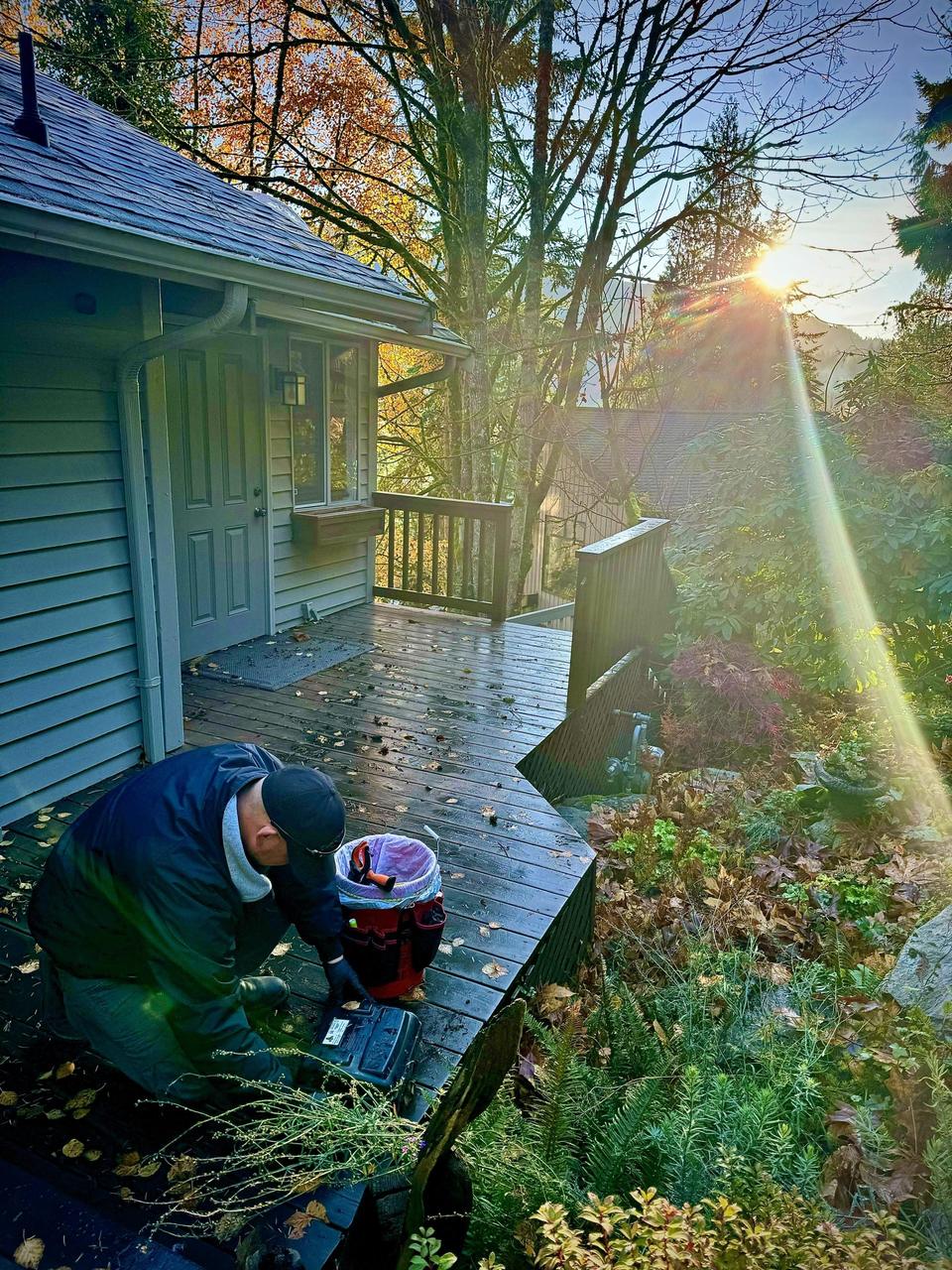
Home plan: the job at a glance
| What it covers | Scheduled visits for general household pests on properties with continuous outdoor pressure |
|---|---|
| Included | Exterior perimeter treatment, web and starter-nest removal, a report each visit, and covered callbacks between visits |
| Not included | Bed bugs, wood-destroying pest treatment, exclusion, crawlspace and insulation work, and structural repair |
| Visit schedule | Timed to the local pest calendar rather than even quarters, including an early autumn rodent visit |
| Guarantee | Covered pests that come back between visits get a return visit at no additional charge, with no cap |
| Contract | No long-term contract or early termination fee, just a short notice period |
| What it costs | Priced from the property after a free visit, in writing before anything begins |
Who this is actually for
Most of this site argues against buying treatment you do not need, so it would be strange to put up a recurring plan page that pretends everyone needs one. Here is the honest version.
A plan makes sense when the pressure is continuous. A house on a forest edge in Sudden Valley, a property backing onto a greenbelt in Whatcom Falls, an address surrounded by farmland outside Lynden — these have populations pushing at the building constantly, from land you do not control. Nothing you do to the structure changes what is happening outside it, and managing that is ongoing work by nature.
It makes sense when there is history. A house that has had rodents twice, or carpenter ants in successive springs, has demonstrated something about its site that is unlikely to change on its own.
It makes sense for rentals and second homes, where nobody is present to notice the early signs. Scheduled visits substitute for the attention an owner occupier provides for free.
And it makes sense when you simply do not want to think about it. That is a legitimate reason to buy a service and we are not going to be snobbish about it.
Who it is not for
One identifiable problem with a fixable cause. A wasp nest under an eave. A gap in the foundation letting rodents in. Ants tracking to one moisture source. Fix the cause, treat once, and you are done. Selling a year of visits for a problem a single afternoon resolves is the practice that has given this industry its reputation.
Well-sealed newer construction with no history. A house in Cordata or Barkley with sound siding, screened vents and no record of anything is not buying much.
A situation where the money should go to exclusion instead. This is the common one. If you have a rodent problem and a limited budget, close the gaps. Exclusion is bought once and keeps working; a plan has to keep being paid for. We will sequence it that way even though the recurring number is better business for us.
If you call us and one of those describes your situation, that is what we will tell you.
What the plan actually does
Exterior perimeter treatment, applied where it matters — foundation, entry points, eaves, and the harborage around the structure — rather than broadcast across surfaces for the sake of appearances.
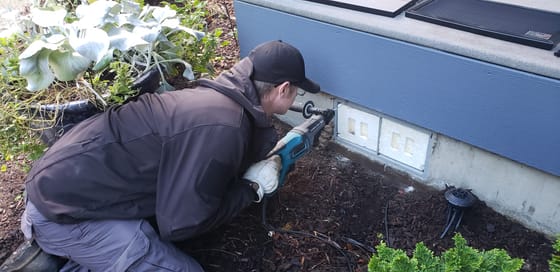
Web and nest removal. Physical clearing of webbing, egg sacs and small starter wasp nests from eaves, entries and outdoor living areas. Unglamorous, and the most effective single thing done on most visits.
Interior treatment only where warranted. Most of the work belongs outside. We treat inside when there is an active interior problem, not as a matter of routine.
Monitoring and reporting. What we found, what we did, and what is changing on the property. Rising activity in one area is information worth acting on before it becomes a call.
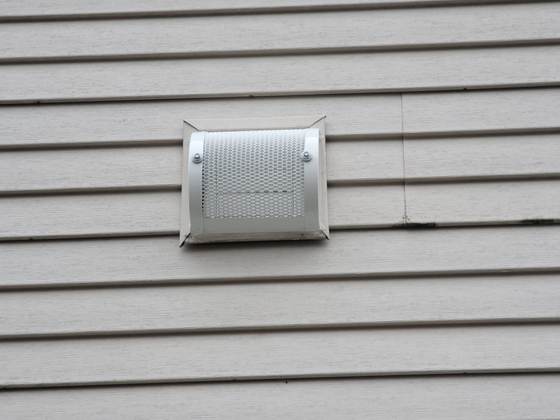
Entry point observation. Every visit is a chance to notice a new gap — a vent screen that has failed, a contractor’s penetration, siding that has gone soft. Those go on the report, and where they are small we deal with them there.
Covered callbacks. Between scheduled visits, if something covered comes back, we return at no additional charge under our 100% Service Guarantee.
What it does not cover
Plainly, because a plan that claims to cover everything is not a real document.
Bed bugs are separate — a paid verification visit credited toward treatment, then per-room pricing. See bed bug control.
Structural exclusion — sealing vents, penetrations, skirting and the gaps an animal is actually using — is quoted per job, because the scope depends entirely on the building. See exclusion and repairs.
Bird work and nuisance wildlife, including bats and squirrels, are not services we offer at all. If that is what you have, we will say so and point you to somebody who does it.
Wood-destroying pest treatment for termites and boring beetles is a separate scope, because it involves moisture diagnosis and often other trades.
Exclusion, crawlspace and insulation work is project work, not plan work.
Structural repair is not ours at all, and we will tell you when it is what you need.
None of that is upselling by omission. Those are genuinely different jobs, and bundling them into a monthly figure would either inflate the plan for everyone or leave us doing them badly.
Timed to what actually happens here
Most recurring plans in this industry run on even quarters because quarters are easy to bill. The pest calendar in Whatcom County is not evenly spaced, and the schedule should follow the pests rather than the invoicing cycle.
Late winter into spring is when overwintered wasp queens are founding nests and carpenter ant colonies are becoming active again. Knocking down small starter nests now prevents the September problem entirely and carries almost no risk. Ant work done in early spring reaches colonies before they have built.
Late spring and early summer is the productive window for spiders and general perimeter work — populations are building alongside their insect prey, and treatment and web removal do the most good here. It is also when most people are least worried, which is exactly why it gets skipped.
Late summer is wasp and hornet peak. Colonies are at maximum size and defensiveness through late August and September, and this is when nearly every sting happens.
Early autumn is the critical one. As the ground saturates through late September and October, rodents move indoors — driven by water rather than cold. NOAA’s US Climate Normals show how steeply average monthly rainfall climbs here between late summer and October, and that climb is what the animals are responding to. This is the visit that prevents a winter rodent problem, and it is the reason the schedule is not evenly spaced.
Mid-autumn brings the overwintering insects — cluster flies, boxelder bugs and conifer seed bugs piling onto south-facing walls looking for a way in.
Winter is quiet outside, which makes it the right time for the structural conversation: what the crawlspace is doing, where the gaps are, what should be sealed before spring.
How it works with the guarantee
The plan and the guarantee are the same commitment described two ways.
While a plan is active, covered pests returning between scheduled visits means we come back at no additional charge, with no cap on return visits within the plan period and no argument about whether it has been too soon.
Two conditions apply and they are on the guarantee page rather than hidden. Re-service needs reasonable access to the treated areas. And where we have identified a cause on your side — a gutter, a vent screen, a door sweep — the guarantee is not a substitute for fixing it. We will keep coming back, and so will the pests.
Coverage pauses on an account that is past due and resumes when it clears. If you cancel mid-plan, coverage runs to the end of the period you have paid for rather than stopping the day you call.
No contract, and why
The long-term contract is standard in this industry and its real function is retention rather than service quality. A company confident in its work does not need a termination penalty to keep customers.
So there is no multi-year term, no early termination fee buried in a schedule, and no requirement to justify canceling. The service agreement states the schedule, the scope and a short notice period, and that is the whole document.
The trade is that we have to be worth renewing every year. We think that is the right pressure to be under.
What it costs
Priced from the property rather than from a table, because the variables are real: square footage, lot size and how much perimeter there is, what is adjacent — forest edge, greenbelt, farmland or suburb — the pest history, and how much exterior structure there is to service.
Two honest notes on the money.
First, if exclusion work would reduce what the plan has to manage, do that first. It sometimes reduces the pressure enough that a plan stops being worth buying, and we would rather tell you that now than have you work it out in year three.
Second, compare the plan against what you would actually spend calling ad hoc. For a property with genuine continuous pressure the plan is usually cheaper and considerably less annoying. For a property with one fixable problem it is not. The estimate is free and it will include our honest read on which one you have.
Around the county
Forest edge and lakeside — Sudden Valley, Silver Beach, Edgemoor, Whatcom Falls. Continuous pressure from land you do not control, and the clearest case for ongoing service anywhere in the county.
Farm-adjacent — the country around Lynden, Everson, Nooksack and Sumas. Rodents from field margins, cluster flies in autumn, and outbuildings that need including in the scope.
Older city neighborhoods — Lettered Streets, Columbia, Sunnyland, York. The honest recommendation here is frequently exclusion and crawlspace work first, then a plan afterward if it is still warranted.
Waterfront and seasonal — Blaine, Birch Bay and Semiahmoo. Scheduled visits substitute for the owner who is not there to notice anything, which makes the plan more valuable here than the equivalent occupied house.
Getting started
A free inspection first. We look at the property, tell you what is actually happening, and give you our read on whether a plan is the right purchase or whether something else is.
If it is, you get the schedule, the scope and the price in writing before anything begins. If it is not, you get that in writing too, along with what we think you should do instead.
What a visit actually looks like
Worth setting expectations, because “quarterly service” means very different things at different companies and some of it is a truck in a driveway for six minutes.
A scheduled visit starts outside and stays there for most of its length. The technician walks the perimeter, clears webbing and any starter nests from eaves, entries and outdoor living space, checks the foundation line and the entry points that were noted last time, and applies targeted treatment where it is warranted rather than everywhere as a matter of routine.
Anything that has changed on the property goes on the report — a new gap, a downspout that has come apart, vegetation that has grown into contact with the siding, a vent screen that has failed. Those are the findings that actually prevent next year’s problem.
Interior treatment happens when there is an active interior issue. If there is not, we do not treat inside for the sake of appearing thorough, and we will tell you that rather than spraying a baseboard so the visit feels substantial.
You do not need to be home for a standard exterior visit. You get the report either way.
Changing or pausing a plan
Circumstances change and the plan should be able to follow.
Scaling scope. If you add an outbuilding, a shop or a substantial deck, tell us and we will re-price rather than quietly under-servicing it. If a problem area resolves permanently — usually because exclusion work closed it — we will reduce the scope rather than keeping the number where it is.
Pausing. For a property that is genuinely empty for part of the year, we can schedule around it. There is no requirement to pay for visits to an unoccupied house you are not worried about, though for seasonal homes the empty months are frequently when the plan is most useful.
Stopping. Short notice period, no penalty, coverage runs to the end of the period you have paid for.
Coming back. Customers who stop and return later do not go to the back of any queue and do not pay a re-start fee. If the honest answer at some point is that you no longer need us, we would rather you stopped and came back when you did than kept paying out of inertia.
Commercial and multifamily
The residential plan described above is built for houses. Businesses and multi-unit buildings need something structurally different, and we run those separately rather than stretching a home plan to fit.
The differences are real. Device placement gets mapped so an inspector or auditor can see the layout. Every visit produces a record that stands on its own. Scope usually includes areas a home plan never touches — dock doors, waste enclosures, utility chases, feed or product storage. And scheduling has to work around the operation rather than around us, which for food service and retail usually means before opening or after close.
For apartments and HOAs the unit of work is the building, not the apartment, because shared walls and utility chases mean treating one unit while its neighbors go untouched simply relocates the problem. Those are covered under commercial programs.
What we track between visits
The part of a plan that is easy to overlook is the record, and over a couple of years it becomes the most useful thing about it.
Each visit logs what was found and where, what was done, and what changed since last time. That accumulates into a picture of the property: which side of the house takes the pressure, whether activity in one area is climbing or falling, which interventions actually held, and which entry point keeps reopening.
That record is what lets us tell you in year two that the problem is not really pests but a downspout, or that the area we have treated four times needs sealing rather than a fifth treatment. Without it, a recurring plan is just repetition — which is exactly what recurring service becomes at companies that do not keep one.
For rentals, second homes and anywhere the owner is not present, that history is also the only real visibility into what has been happening at the property.
The honest comparison
If you are weighing a plan against calling as things come up, the arithmetic is worth doing rather than guessing at.
Calling ad hoc costs nothing until something happens, and then costs a call-out plus treatment each time. For a property with one problem every couple of years this is straightforwardly cheaper, and we will say so.
A plan costs a predictable amount and includes the return visits. It becomes the better purchase somewhere around two or three service events a year — which is common on forest-edge, greenbelt and farm-adjacent properties, and uncommon on a well-sealed house in a suburban street.
Exclusion changes the arithmetic more than either. It is a one-time cost that reduces how many events happen at all, and on a rodent-driven problem it frequently moves a property from the first category to the second.
The reason we lay it out this way is that the industry standard is to present the plan as the default and everything else as an exception. For a good share of Whatcom County homes that is backwards.
Getting the sequence right
If you are starting from a live problem rather than from prevention, the order that works is consistent.
Deal with the problem. Whatever is actually happening now — rodents, a wasp colony, an ant trail — gets treated as its own job.
Find and fix the cause. The gap, the moisture source, the vegetation contact. This is the step most often skipped and the one that determines whether anything recurs.
Then decide about a plan, with the pressure already reduced and a clear view of what is left. Deciding at this point rather than at the first phone call is how you avoid paying ongoing money to manage a problem that a repair had already solved.
Related work
Most plans are preceded by exclusion and repairs, and many are preceded by a specific job — rodent control, ants or wasps — that resolved the immediate problem. For businesses rather than homes, the equivalent is our commercial programs, which add mapped device placement and the documentation an inspector or auditor will ask for.
Frequently asked questions
Do I actually need a recurring plan?
Often not. If you have one identifiable problem with a fixable cause — a wasp nest, a gap letting rodents in, ants tracking a specific moisture source — a single visit and the repair is the better purchase. Plans earn their place where exterior pressure is continuous, not where one thing needs fixing once.
Is there a contract?
No long-term contract. The service agreement sets out the schedule, the scope and a short notice period for cancellation, and you can use it. We would rather earn the next visit than hold you to a term.
How often do you come out?
Scheduled visits through the year, timed to the local pest calendar rather than to even quarters — the useful months here are not evenly spaced. Between scheduled visits, callbacks for anything covered are included at no additional charge under our 100% Service Guarantee.
What if something comes up between visits?
You call and we come. Return visits for pests covered by your plan are included, with no cap and no argument about whether it has been too soon. That is the main practical benefit of being on a plan rather than calling ad hoc.
Does the plan cover everything?
No, and any company telling you their plan covers everything is not being straight with you. General household pests are covered. Bed bugs, wood-destroying pest treatment and structural repair work are quoted separately because they are different jobs with different scopes.
Should I do exclusion or a plan first?
Exclusion, in almost every case. Sealing entry points reduces what a plan has to manage, and sometimes reduces it enough that the plan is no longer worth buying. We will sequence it that way even though it is the smaller recurring number for us.
Guides
From the blog
Year-Round Home Protection Plan in Whatcom County?
Family-owned, no long-term contracts, and every treatment is backed by our 100% Service Guarantee.
Most calls in Whatcom County are out within 1–2 days, about 3 during the late-summer peak.
Last updated