
Bee Removal in Bellingham & Whatcom County
We do not kill honey bees. Most calls about bees turn out to be yellowjackets, and most genuine bee calls need a beekeeper or nothing at all. Where an established honey bee colony is inside a structure, that is a removal and repair job — the comb has to come out or it causes worse problems than the bees did.
Call 360-410-2199 Request a free inspection
Bees: the job at a glance
| What it covers | Telling bees from yellowjackets, and closing up the structure after a honey bee colony has been removed |
|---|---|
| Included | Free identification, a pointer to a beekeeper for swarms and colonies, and sealing the cavity and entry points afterward |
| Not included | Killing honey bees, or spraying a wall colony and leaving the comb inside |
| Who does the cut-out | Often a beekeeper who specializes in removals, sometimes with a contractor for the repair; their pricing is their own |
| What it costs | Identification is free; sealing work is quoted in writing from a visit |
Start here: it is probably not bees
Most calls we receive about bees are about yellowjackets.
The confusion is understandable — yellow and black, flying, stinging — but the distinction decides everything, because we treat yellowjackets and we do not kill honey bees.
Honey bees are golden brown, fuzzy, and moderately sized. They visit flowers. They have no interest in your food, your drink, your bin or your barbecue. They sting once and die, so they are reluctant to do it. A honey bee at a picnic is almost always a yellowjacket.
Yellowjackets are smooth, shiny, brightly marked with a narrow waist, and noticeably faster and more assertive. They are hunting protein early in the season and sugar late, which is exactly why they show up at your table in September. They sting repeatedly. UC IPM sets out that same seasonal shift from meat to sweets, which is the reason the insect bothering a plate of food is a yellowjacket and not a honey bee. See wasp and hornet control.
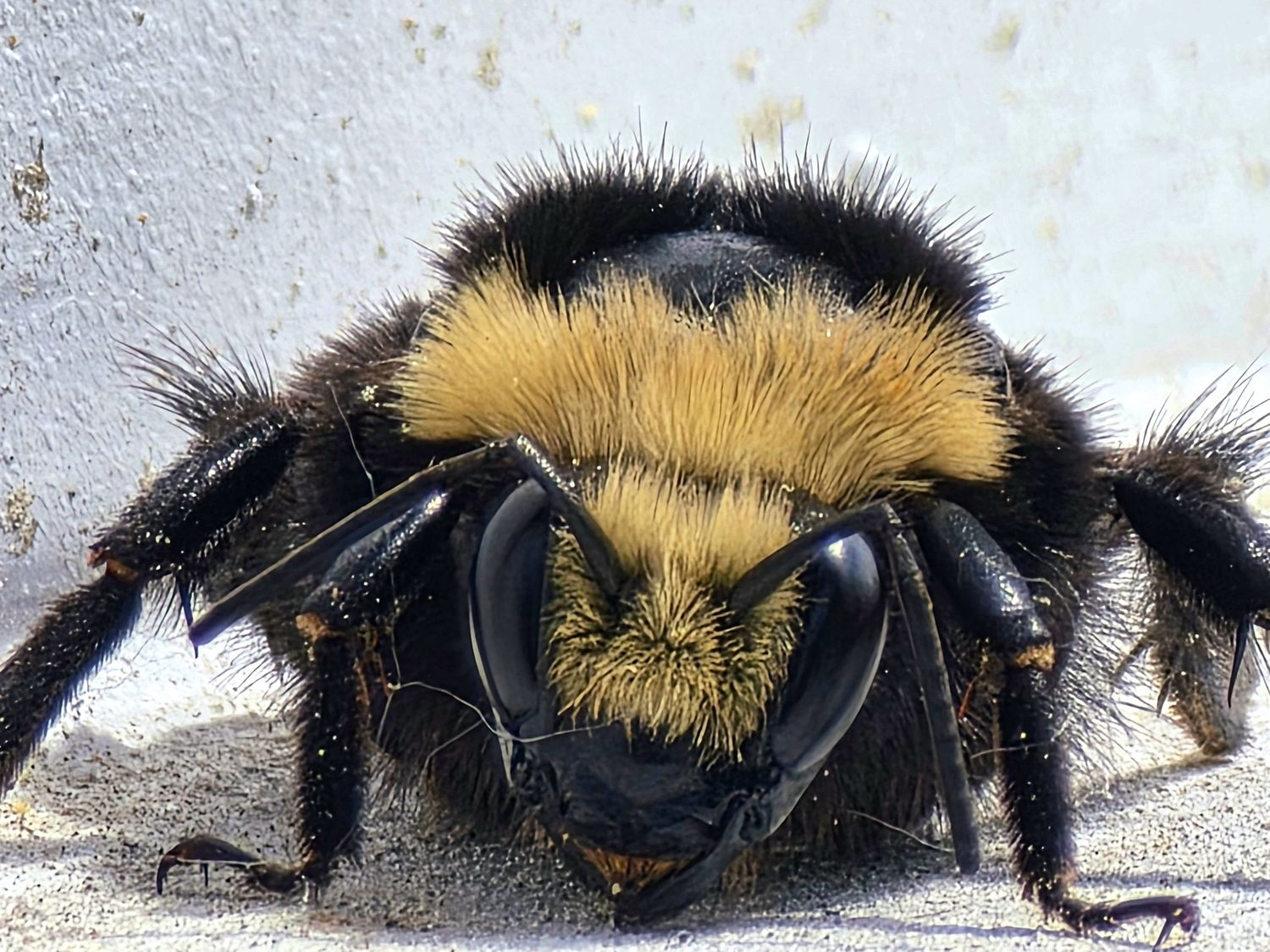
Bumble bees are large, round and very hairy, often with bands of yellow, black and sometimes orange. Slow, loud and famously placid.
Mason and mining bees are small, solitary, often metallic blue-green or dark, and active in spring. No colony, no defense, effectively no sting risk.
If you can photograph it, send it. Identification is free and it frequently ends the conversation with “you do not need us.”
Why we will not kill honey bees
This is a firm position and worth explaining rather than just asserting.
Practically, it makes the problem worse. A colony inside a wall represents pounds of wax comb, brood and honey. Kill the bees and all of that stays in the cavity. Without the colony maintaining it, the comb warms, the honey ferments and runs, and it soaks into the drywall and framing — producing staining, odor, and a long-term food source that attracts ants, wax moths, carpet beetles and rodents. Households that pay to have a wall colony poisoned frequently pay again a year later for a considerably messier job.
Ecologically, it is a bad trade. Pollinator pressure is real, and destroying a functioning colony that a beekeeper would happily collect is difficult to justify when a better outcome exists.
And there is usually a better option. Swarms get collected. Established colonies get removed properly. Neither requires killing anything.
Swarms
A swarm is a colony in transit — a queen and a large cluster of workers that have left a hive to establish a new one. They gather on a branch, fence post, wall or vehicle in a dense mass, sometimes thousands of bees, while scouts look for a permanent cavity.
Two things worth knowing.
They are usually docile. Swarming bees have no nest, no brood and no stores to defend, and they are full of honey for the journey. They are not looking for trouble, though they should not be disturbed.
They usually leave on their own within a day or two.
The right response is generally to leave it alone and, if it is somewhere inconvenient, contact a local beekeeper. Beekeepers frequently collect swarms at no charge because a free colony is genuinely valuable to them. We will point you in that direction rather than selling you a service.
What we would ask you not to do is spray it. A swarm is the easiest possible outcome — a colony that has not yet moved into your wall — and killing it wastes that.
Established colonies in a structure
A different proposition entirely, and the reason this page exists.
If scouts chose your wall cavity, soffit, chimney or floor void, the colony builds comb and becomes permanent. Signs are steady directional traffic at one point on the building over weeks rather than days, a low continuous hum audible from inside, warmth in a wall area, and in an established colony, honey or staining appearing through drywall or siding.
Resolving it properly is a cut-out. The cavity is opened, the colony and all of the comb are removed, the cavity is cleaned to remove residue and pheromone, and the structure is repaired and sealed so the site cannot be reoccupied — which it will be, because a cavity that has held bees smells like home to the next scouts.
That is carpentry as much as pest work, and it is frequently done by a beekeeper who specializes in removals, sometimes working alongside a contractor. We will tell you honestly what the job involves and who is best placed to do which part, rather than offering a spray as a shortcut.
What we will not do is treat it and leave the comb in the wall. That is the thing that produces the year-later phone call.
Bumble bees
Our default recommendation is to leave them, and here is why that is not laziness.
Bumble bee colonies are small — dozens to a few hundred individuals rather than tens of thousands. They are annual: the colony dies out in autumn and only new queens overwinter, elsewhere. The nest is never reused. They are docile unless the nest is directly disturbed, and they are among the most effective pollinators in this region for exactly the crops the Whatcom County agricultural corridor depends on.
So a bumble bee nest under a shed, in a compost heap, in an old rodent burrow or in wall insulation is a temporary situation that resolves itself by autumn, and the sensible response is usually to keep away from it and wait.
Where it genuinely sits in a bad place — immediately beside a doorway, in a child’s play area, or where someone in the household has a sting allergy — we will discuss options. Even then, the first option considered is whether the area can be worked around for the remainder of the season.
Mason bees, mining bees and the harmless ones
Every spring we get calls about these, and they need no service at all.
Mason bees are small, dark or metallic, and solitary — every female is her own queen with her own nest, and they have no colony to defend. They nest in existing holes: hollow stems, beetle exit holes, and the tubes people put up specifically to attract them. They are early-season pollinators of real value in orchards and gardens, they do not damage wood, and they are close to incapable of a meaningful sting.
Mining bees nest in small individual burrows in bare soil or lawn, often in loose aggregations that look alarming and are not a colony. Active for a few weeks in spring, then gone. They do not damage lawns.
If either turns up on your property, the honest advice is to enjoy them. We are not going to sell you a treatment for a solitary pollinator, and if someone else has offered to, that is worth knowing about them.
Wood-boring bees
The other genuine bee-related structural issue, and it belongs on a different page.
If you are seeing round, clean holes roughly the diameter of a pencil in fascia, trim, deck rails or siding — often with coarse sawdust below and a large bee hovering nearby — that is a wood-boring bee. It is a structural question rather than a pollinator one, though the damage accrues slowly and is frequently overstated.
See wood-boring bee and beetle control.
What we actually do on a bee call
Identify, free of charge. Species and situation. A large share of these calls end here with advice.
Point you to a beekeeper for a swarm or an established honey bee colony, because that is the right outcome and we would rather give it to you than sell around it.
Handle it as wasps when it turns out to be yellowjackets, hornets or paper wasps, which is most of the time. See wasp and hornet control.
Deal with the structure where a colony has been removed — sealing the cavity, screening the entry, and closing the other openings on the building so it is not reoccupied. That is exclusion and repair work and it is the part most often skipped, which is why some buildings get colonies repeatedly.
Advise on prevention. Capping chimneys, screening vents and soffits, and closing the cavity openings that scouts find attractive.
Around the county
The agricultural corridor — Lynden, Everson, Nooksack, Sumas. Managed hives are part of the working landscape and berry pollination depends on them. Identification matters more here than anywhere, because destroying somebody’s production colony is a genuine problem rather than an abstraction.
Older city neighborhoods — Lettered Streets, Columbia, Sunnyland, York. Uncapped chimneys, open soffits and wall cavities in older construction give scouts exactly the volume they look for, and these are where established colonies turn up.
Around Lake Whatcom and the forest edge — Sudden Valley, Silver Beach, Edgemoor. Bumble bees in ground cavities and under decks, mason bees in cedar and in beetle holes, and plenty of feral honey bee colonies in trees that are nobody’s problem.
Waterfront and seasonal — Blaine, Birch Bay and Semiahmoo. Properties closed up for months, where a colony can establish through a summer and be well developed before anyone notices.
What it costs
Identification is free and frequently the whole interaction.
Where the work is genuinely ours — a wasp colony misidentified as bees, or structural sealing after a colony has been removed — it is quoted like any other job, from a visit, in writing beforehand.
Where the right answer is a beekeeper, we do not take a fee for telling you so. Where it is a cut-out, the pricing is theirs and the repair may be a contractor’s; we will tell you what the parts are so you can judge a quote rather than guessing.
Preventing a colony from moving in
Scouts look for a dry, enclosed cavity of the right volume with a small defensible entrance. Buildings offer plenty, and the ones that get colonies tend to get them repeatedly.
Cap the chimney. An uncapped flue is one of the most reliable colony sites on a house, and it is the hardest to resolve afterwards because access is poor.
Screen the vents. Gable, soffit, ridge and dryer vents with intact metal screen rather than broken plastic louvers.
Close the gaps. Where siding meets trim, around window and door framing, at soffit returns, and any hole a previous colony used. That last one matters most — a cavity that has held bees retains pheromone that actively attracts new scouts, so a former colony site should be cleaned and sealed rather than just emptied.
Check after re-roofing or siding work. New gaps get created by trades, and spring scouts find them quickly.
That work is exclusion and repair, and it closes the same openings that let in wasps, rodents and cluster flies. One job, several problems.
If someone in the household is allergic
This changes the calculus and it is worth saying separately.
A known sting allergy makes proximity to any colony — bee or wasp — a genuine medical consideration rather than a preference. In that situation we do not tell people to tolerate a bumble bee nest beside a doorway, and the default “leave them alone” advice on this page does not apply.
What we will still do is find the least destructive answer that resolves the risk. For a swarm that means a beekeeper, quickly. For an established honey bee colony it means a proper removal rather than poisoning. For a bumble bee nest in a bad location it means discussing options rather than assuming the worst one.
Tell us when you call. It changes the urgency and it changes what we recommend.
Bees on the ground in autumn
A common call that needs no service.
Late in the season, bumble bee and honey bee workers reaching the end of their lives are frequently found on the ground, moving slowly or not at all. Nests are also breaking up in autumn, which puts more individuals in the open.
This is normal seasonal mortality, not a sign of a nest nearby, poisoning or anything wrong with the property. A single bee moving slowly on a path in September is a bee at the end of its life.
If you want to help one, a drop of sugar water on a spoon occasionally revives a bee that is simply out of fuel. That is the entire intervention, and it is not something we charge for.
Why we take this position at all
It would be easier commercially to treat every stinging-insect call the same way. A wall colony sprayed is a quick job at a good margin, and most customers would never know the difference until the honey came through the ceiling a year later.
We do not do it for three reasons, and they are worth putting in writing.
It is not the right work. A treatment that leaves pounds of comb and honey in a cavity has not solved anything — it has converted a bee problem into a moisture, staining and secondary-pest problem, and handed the customer a larger bill later.
The alternative genuinely exists. Beekeepers want swarms. Removal specialists do cut-outs. Referring someone to a better outcome costs us a job and buys something worth more than the job.
And pollinators are not an abstraction here. Whatcom County’s berry and tree fruit production depends on managed and wild pollinators, and the agricultural corridor a few miles north of our office is where that dependence is most direct. Destroying functioning colonies in that context is difficult to defend.
If another company offers to exterminate honey bees in your wall, the question worth asking is what happens to the comb.
What we need to know when you call
A photograph if at all possible. It resolves the identification faster than any description, and identification decides everything else.
Where they are going in. One consistent point on the building, several points, or nowhere in particular. Steady directional traffic at a single spot over weeks means an established colony; bees moving around a garden means foragers.
How long it has been happening. Days suggests a swarm. Weeks or a season suggests a colony with comb.
Whether you can hear anything. A continuous hum audible from inside a wall, particularly when the room is quiet at night, is a strong indicator of an established colony.
Whether anyone is allergic. It changes the urgency and the recommendation.
And whether anything has been sprayed already. It affects what a beekeeper is willing to collect, because a treated colony is generally not salvageable — which is another reason not to spray first and call afterward.
Bees and pesticide use generally
One more thing worth stating, because it applies to work well beyond this page.
Our routine treatments are targeted rather than broadcast — perimeter, entry points, harborage and structure rather than blanket application across vegetation and flowering plants. That is partly because it works better, and partly because broad application over anything in bloom is how general pest treatment harms pollinators.
In practice that means we avoid treating flowering plants, we work around blooming periods where a treatment is near them, and where an application has to happen close to forage we favor timing when bees are not active. On agricultural accounts near managed hives that coordination matters more, and it is worth telling us if there are hives adjacent to a property we are working.
None of that is a certification or a slogan. It is a set of ordinary practices that a company can follow or ignore, and we would rather tell you which we do.
Related work
Most calls that start here end at wasp and hornet control. Structural holes from wood-boring bees are wood-boring bee and beetle control. Closing a cavity after a colony has been removed, and preventing the next one, is exclusion and repairs.
Frequently asked questions
Will you exterminate the bees in my wall?
Not if they are honey bees. Poisoning a colony inside a wall leaves the comb and honey behind, which then melts, ferments, stains through the drywall and attracts other pests for years. It is worse than the bees. The right answer is removal of the colony and the comb, then repair.
How do I know if it is bees or wasps?
Bees are rounder and hairy; wasps and yellowjackets are smooth, narrow-waisted and shinier. The behavior helps more — if they are at your drink or your food in late summer, that is a yellowjacket, because honey bees have no interest in either. Most calls we get about bees are yellowjackets.
There is a huge cluster of bees hanging from my tree. What is it?
That is a honey bee swarm in transit, and it is usually gone within a day or two on its own. Swarming bees are generally docile because they have no nest to defend. A local beekeeper will often collect it at no charge, and that is the outcome we will point you toward.
What about bumble bees nesting in the ground?
Usually leave them. Bumble bee colonies are small, they die out by autumn, they do not reuse the nest, and they are among the more valuable pollinators here. Where a nest sits somewhere genuinely unworkable we will discuss it, but our default recommendation is to wait them out.
Small bees are drilling holes in my siding. What are they?
If the holes are round, clean and about the size of a pencil, that is more likely a wood-boring bee, which is a structural question rather than a bee removal one. If there are many small holes and no drilling, it may be mason bees, which are harmless solitary pollinators worth keeping.
Do you charge to tell me which it is?
No. Identification is free and a clear photograph usually settles it in a minute. It is worth doing before anyone treats anything, because a large share of these calls need no service at all.
Guides
From the blog
Bee Control & Removal in Whatcom County?
Family-owned, no long-term contracts, and every treatment is backed by our 100% Service Guarantee.
Most calls in Whatcom County are out within 1–2 days, about 3 during the late-summer peak.
Last updated