
Pest Control in Custer, Washington
Custer is unincorporated open country rather than a town, and that shapes the work. Properties here are acreage with outbuildings, most on a well and a septic system, exposed to wind off the fields. Field rodents, cluster flies and wasps account for most of what we are called about.
Call 360-410-2199 Request a free inspection
Custer on the map
A place without a middle
Custer is not a town in the way Lynden or Blaine are towns. It is an unincorporated community — a crossroads, a school, a handful of businesses along the highway, and a large amount of farmland and acreage spread around it with no real edge to it.
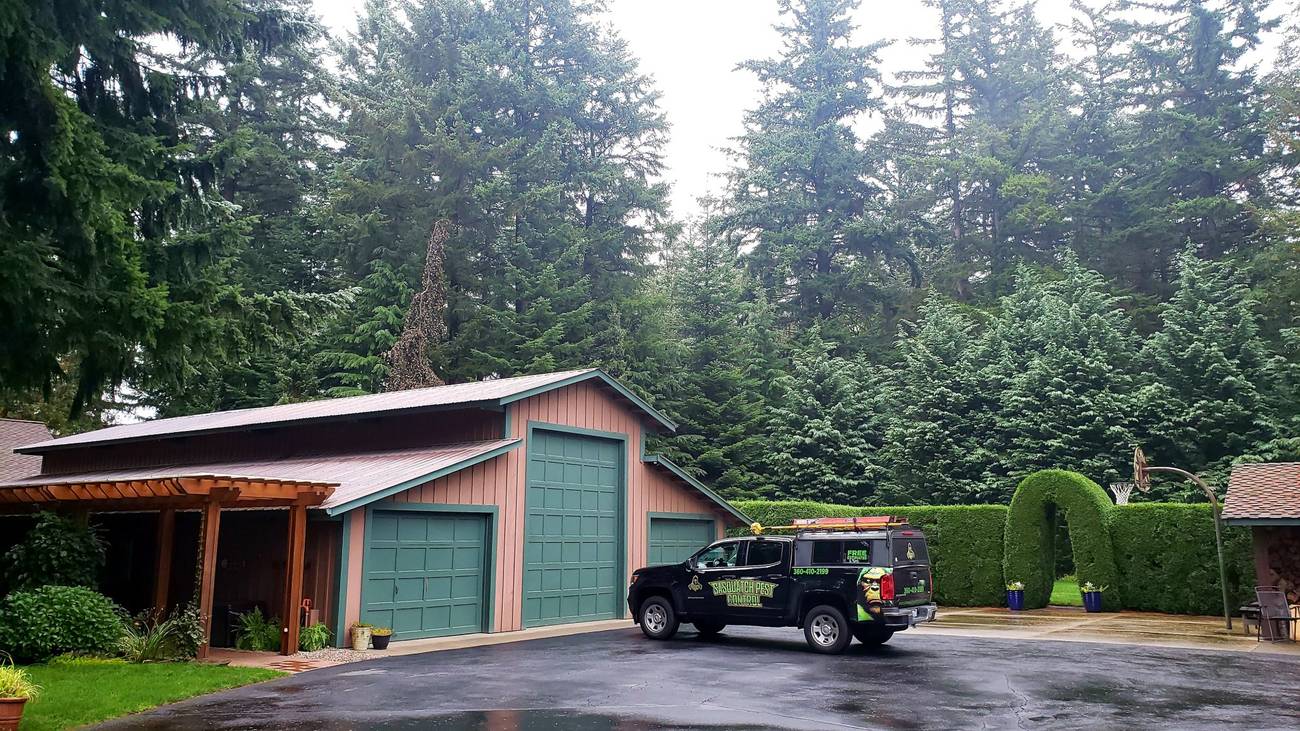
That sounds like a detail about local government. It is actually the most important thing about pest control here, because it changes what a property looks like. A Custer address is usually not a house on a lot. It is a house on several acres with a shop, a barn or a pole building, a long driveway, and open field on at least one side.
Every one of those extra structures is a building that can hold rodents, and almost none of them were built to keep anything out. Pest work here is a whole-site job by default, and treating it as a house call is the reliable way to fail at it.
Open ground on every side
The country around Custer is field, pasture and berry acreage running west toward the water and east toward Ferndale and the foothills. There is very little in the way of natural windbreak between one property and the next.
That exposure matters in two directions. It means buildings here take weather that a house inside a town does not — wind-driven rain against a west wall, siding that works loose, seals that fail early, and flashing that gets tested every winter. Openings appear on rural buildings faster than people expect, and most of them appear on the weather side.
It also means the boundary between a building and open habitat is short. In a subdivision there are several hundred yards of other people’s landscaping between a field and your foundation. Here there is often a fence line and twenty feet of grass.
Field and farm rodents
The rodent work here follows the farming calendar rather than the thermometer.
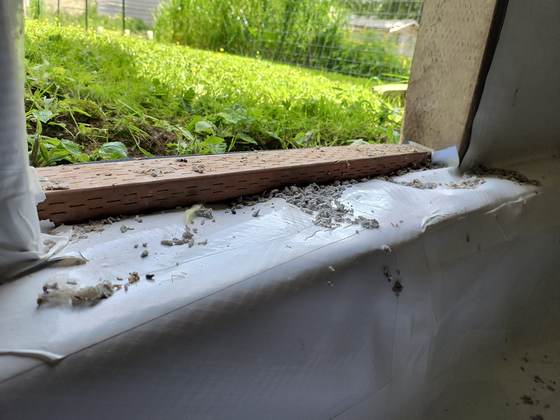
Through spring and summer, field and pasture ground supports a large rodent population that nobody sees, because there is nothing to see. The cover is dense, the food is out there, and the animals have no reason to approach a building at all.
That changes when the ground is worked. Cutting, mowing, harvest and clearing remove the cover across a large area within a short period, and the population that has spent the summer in it has to go somewhere. What it goes to is the nearest structure offering shelter and food, and on a Custer property that is usually a shop or a barn rather than the house. WSU Extension’s Whatcom County office is the place to look for what is grown around here and when it comes off, and that calendar tells you more about when the trouble starts than the thermometer does.
The house typically comes second, a few weeks later, once the outbuildings are occupied and crowded. By then people have often already noticed droppings in the shop and decided it was not worth doing anything about, which is the point at which the job stops being cheap.
Outbuildings are the real building stock
On acreage, the shop is where the problem lives.
Pole buildings and older barns are built for machinery and storage rather than for exclusion. The sill detail at the base of a wall is frequently open. Sliding doors do not seal at the bottom. Service penetrations are cut oversize and never closed. There is usually something stored in there that a rodent will eat, and almost always something it will nest in — insulation, sacking, cardboard, upholstery in a vehicle that has not moved in a while.
None of that is a criticism of how the building was put up. A shop is not supposed to be airtight. It does mean that a serious attempt at a rodent problem on a Custer property starts in the outbuildings and works toward the house, rather than the other way around.
The practical version is unglamorous: close the base of the walls, fit door sweeps that actually reach the slab, screen the vents with metal rather than plastic, get stored feed and seed into sealed containers, and get soft nesting material off the floor.
Cluster flies in open country
Cluster flies are a rural insect and Custer is rural in the way that produces the most of them.
Their larvae develop inside earthworms in pasture and field soil, so the number of flies a property gets is decided by the acreage around it rather than by anything about the housekeeping inside. Permanent grass, damp soil and open ground produce them in quantity, and this is exactly that landscape.
Where a Custer property differs from one in town is the wall itself. With no neighboring buildings or mature planting to shade it, a west or south wall out here holds heat late into an autumn afternoon and stands out from everything around it. The flies find it easily, gather on it in numbers, and press into whatever the siding offers.
Once they are through, they are in the wall void or the attic for the winter, dormant. The complaint that reaches us is usually not about autumn at all. It is about flies appearing indoors in January or February, sluggish, near a window, with the house shut. Those insects are not coming from outside. They are coming from inside the wall, and the decision that put them there was made months ago.
Wasps, and why acreage makes them worse
Wasp problems scale with the amount of sheltered structure on a property and with how much forage is available, and both of those are higher out here.
A property with a house, a shop, a barn and a carport has four times the eave, soffit and rafter space of a house in town. Much of it is open-sided or unfinished, which is precisely what a paper wasp colony wants. And a colony surrounded by field and hedgerow has far more to eat, so it reaches a size that gets noticed later in the season and is larger when it does.
Ground-nesting yellowjackets are the genuine hazard here rather than the nuisance. A nest in a bank, a ditch edge or an abandoned rodent burrow gives no warning until something goes over it, and on a property where mowing is a routine job that is a realistic way to be badly stung. If there is regular mowing, it is worth locating the activity in July rather than meeting it in August.
Stinging insects on and around buildings are handled in the structural and health pest volume of the PNW Insect Management Handbook, a joint WSU, Oregon State and University of Idaho publication.
We do not treat honey bees and we will tell you so. A swarm is a beekeeper’s call, and there are people locally who will come and collect one.
Well water, septic and what it changes
Most properties out here are on a private well and a septic system, and that changes how we work rather than whether we can.
Placements stay clear of the wellhead and of the drain field. Anything applied near either gets discussed before it happens rather than after. Drainage matters more than it does on a town lot, because where water goes on the surface decides where the damp ground is, and damp ground decides where a good deal of the insect pressure comes from.
Septic also produces its own small pest questions. Drain flies breeding in a sluggish line, or a persistent damp patch over a failing field that attracts everything that likes moisture. Those are plumbing and drainage problems that present as pest problems, and we would rather say so than sell a treatment for them.
Crawlspaces on open ground
Crawlspaces here have the same problems they have everywhere in this county, with the exposure turned up.
The vapor barrier over the soil is the only thing between wet ground and the underside of the floor. When it is torn, displaced or was never properly lapped, the space above it stays humid, the joists take on moisture, and the conditions that draw rodents, sowbugs and decay fungus arrive together.
Vents are the specific weakness on a rural building. They are low, they are at the weather side, and the screening in them is usually the original — often plastic, often perished, occasionally missing entirely. A crawlspace vent with failed screening is a rodent door with a frame around it, and it is the single most common entry point we find on properties in this part of the county.
Birch Bay is close and this is not that page
Custer sits a few miles inland from Birch Bay, and the two get mentioned together because of the highway exit and the school. They are not the same job.
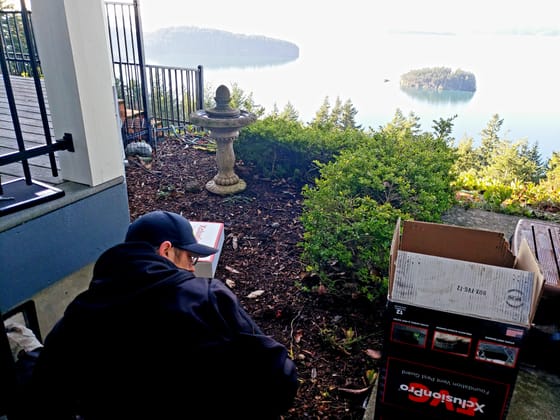
Birch Bay is a shoreline community with a large stock of vacation and part-time-occupancy housing, and the pest work there is shaped by buildings that stand empty for months. Custer is working land, occupied year round, with the outbuildings and machinery that go with it. A property here is more likely to have a feed problem than an empty-house problem.
Where the two overlap is the marine air. Both take salt and moisture off the water, and both see seals, flashing and fasteners age faster than they would inland.
Carpenter ants, moisture ants and soft wood
Ant work on a Custer property is really water work wearing a different name.
Carpenter ants do not eat wood. They hollow it out to nest in, and they go for wood that has already been softened by moisture rather than sound framing. On acreage that means the predictable places where water has been getting in slowly and nobody has had reason to look: a sill plate under an outside tap, framing around a window on the weather side, the rim joist above a crawlspace that never properly dries, the base of a post where a shop wall meets the slab.
Moisture ants are a plainer signal still. They need consistently wet wood to nest in, so finding them is close to proof that there is water in that timber, not a suggestion of it.
Either way, treating the insects without fixing the water buys a season or two. The colony is removed, the damp wood is not, and something moves back into it. Out here that is easy to miss for years, because the soft sill is behind a workbench in a building nobody stands still in.
Spiders and the rest of the domestic list
Spiders are the thing people ask about most and worry about most unnecessarily. There are no medically significant spiders established in Whatcom County. Giant house spiders and cross orbweavers account for nearly all of what turns up, and the autumn rush indoors is males wandering to find females rather than anything moving in.
A rural property does get more of them, for the same reason it gets more of everything: more building surface, more insects around it to eat, and more undisturbed corners in a shop or a barn to sit in. Knocking down webs and reducing the exterior lighting that concentrates their food does more than repeated spraying does.
The rest of the domestic list here is ordinary and mostly moisture-driven. Sowbugs and pillbugs around damp foundations, earwigs in wet ground cover and leaf litter, silverfish in bathrooms and older crawlspaces, and the occasional stored-product insect in a pantry or a feed room. Almost all of it responds better to drying things out and closing gaps than to anything applied on a schedule.
Small commercial work along the corridor
Not everything out here is a farm or a house. The highway corridor carries small commercial buildings, storage, shops and yards, and those have their own pattern.
A storage or equipment yard concentrates two things rodents want — undisturbed cover between items, and buildings with doors that stand open through a working day. A building with vehicle movement in and out has a different exposure from a house half a mile away, and it needs a program rather than a visit: placements mapped, records kept properly, and goals that are realistic for a building that cannot be sealed the way a house can.
Where food is stored or handled, the sequence matters more than the products. Containment first, spill discipline second, the building envelope third, and control measures last. Nothing outcompetes an open food supply, and treating around one is money spent to stand still.
Stored vehicles, equipment and the things nobody moves
There is one category of rodent habitat on acreage that almost never gets mentioned, and it accounts for a surprising share of what we find: the machinery that has not moved in a while.
A tractor, a boat, a camper, a car under a tarp, a mower parked at the end of the season. Each of them is a dry, enclosed, insulated cavity full of soft material, sitting still, usually inside a building that is already accessible. Air filter housings, engine bays, seat foam, wiring looms and duct work are all excellent nesting sites, and wiring damage from rodents is expensive in a way that a nest in a wall is not.
The same is true of stacked material. Pallets, lumber, sacking, feed bags, cardboard, old carpet, coiled hose. Anything stacked against a wall and left alone for a season becomes cover, and cover next to a building is what turns a field population into a building population.
Nothing about this needs a treatment. It needs the stack moved off the wall and onto a rack, a gap kept clear around the inside perimeter of the shop, and the things that are genuinely never going to move checked rather than assumed. A fifteen-minute walk with a flashlight along the inside wall line of an outbuilding finds more than an hour spent anywhere else on the property.
What a first visit usually turns up
For what it is worth, the findings on a Custer property are fairly consistent, and none of them are exotic.
Failed or missing crawlspace vent screening, nearly every time. A gap at the base of a shop wall or under a sliding door. A plumbing or electrical penetration cut oversize and never closed. Feed or seed in bags rather than bins. Material stacked directly against an exterior wall. Vegetation grown into contact with the siding, which is a bridge as much as it is a moisture problem. And somewhere on the property, an outbuilding that everyone had mentally written off.
That list is not a sales pitch. Most of it is work an owner can do without us, and we would rather say which items those are than quote for all of them.
The Custer year
January to March. Overwintering insects waking in wall voids and appearing indoors on mild days. Rodents already inside and breeding. Repair and exclusion season rather than prevention season.
April to June. Ground warms and ants become active. Wasp queens start nests, which is the cheapest possible moment to deal with one — a single insect and a structure the size of a golf ball.
July and August. Wasp colonies become obvious. Ground-nest risk peaks during mowing. The window opens for treating the walls that overwintering insects will gather on.
September and October. Heaviest weeks of the year. Fields cut, cover gone, rodents moving into outbuildings, and cluster flies massing on warm walls at the same time.
November and December. Whatever got in is in. Cold concentrates activity in the heated parts of a building, which is when people start hearing it at night.
What we will not sell you
A recurring plan for a property that does not need one. A lot of acreage here genuinely does, because the pressure never stops. Some properties do not. If sealing the shop and a single treatment will hold it, that is what we will quote.
Interior treatment for overwintering flies. They are dormant inside a wall, they cannot reproduce there, and spraying the room they emerged into does nothing about the rest. Exterior timing and sealing are the work.
A rodent job that stops at the house. We will not seal a house and leave four open outbuildings on the same property, then come back in six weeks to find the population has simply reorganized.
How we work in Custer
Custer is fourteen miles from the shop, northwest, and it runs on scheduled route days. Most Whatcom County calls are handled within one to two days, and about three across August and September, when everybody phones at once.
The first visit on an acreage property is a walk of the entire site rather than the one room the call was about — house, shop, barn, crawlspace, vents, roofline, and wherever the ground meets a wall. On a property this open, the answer is nearly always at the boundary rather than in the middle.
If it is not urgent, a photograph sent ahead is often enough for us to tell you whether a visit is needed at all. Identification is free, and we would rather say you do not need us than book a call you did not have to make.
Frequently asked questions
Do you charge more to come out to Custer?
No. Fourteen miles is an ordinary run for us and there is no rural surcharge. What distance changes is scheduling rather than price — Custer sits on route days, and we will name the day rather than promise a window we cannot keep.
Should the shop and the barn be part of the job?
Almost always, and it is the single most common mistake we see on acreage. Sealing the house while a shop stays open does not remove the population, it concentrates it. On a property with several buildings, the whole site is the job.
Why does the rodent problem start in late summer here?
Because that is when the cover disappears. Cutting and harvest strip several hundred acres of shelter within a few weeks, and the animals living in it relocate to the nearest building. Cold weather gets blamed for it, but the move has usually happened well before the cold arrives.
We are on a well and septic. Does that change what you use?
It changes where we place things and how we handle drainage, yes. Placements stay away from the wellhead and the drain field, and we will talk through anything applied near either. It is a normal part of working out here rather than an obstacle.
Is a yellowjacket nest in the ground worth dealing with?
If anyone mows or works near it, yes. Ground nests are the ones that put people in an emergency room in this county, because they are found by machine rather than by eye. Knowing where the activity is before August is worth a great deal.
Is there a charge to come and look?
Not for any pest except bed bugs, which carry a verification fee credited against treatment if you proceed. Otherwise we come out, look properly, and quote.
Guides
Pest problem in Custer?
Family-owned, no long-term contracts, and every treatment is backed by our 100% Service Guarantee.
Most calls in Whatcom County are out within 1–2 days, about 3 during the late-summer peak.
Last updated