
Bed Bug Treatment & Control in Bellingham & Whatcom County
We confirm bed bugs before anyone pays to treat for them. A $150 verification visit establishes what you actually have, and it is credited toward treatment if you go ahead — so it costs nothing if you do. Treatment is $395 per room with common areas included.
Call 360-410-2199 Request a free estimate
Bed bugs: the job at a glance
| What it covers | Bed bugs confirmed by a proper search of the sleeping areas, then treated room by room |
|---|---|
| Verification visit | $150, credited in full toward treatment if you go ahead |
| What it costs | $395 per room, with common areas such as hallways and living rooms included |
| Included | A written prep list, treatment aimed at harborage, and the planned follow-up visits, which are part of the price |
| Not included | Bat bugs, where the colony above the ceiling needs a bat specialist; we do not do bat work |
| How many visits | More than one; a second visit is timed to when the eggs hatch |
| Before we arrive | Follow the prep list and do not bomb, spray or throw out the mattress; an unprepared room gets rescheduled |
Verification first, and why we charge for it
Most pest companies will book a bed bug treatment off a phone call. We will not, and the reason is that a meaningful share of the calls we get about bed bugs are not bed bugs.
The $150 verification visit exists to answer one question before you spend anything on treatment: is this actually what you think it is? A technician inspects the sleeping areas and the harborage points properly — seams, box spring, headboard, frame joints, baseboard, outlet plates, adjacent furniture — and finds either live insects, cast skins, eggs, or fecal spotting, or does not.
The $150 is credited toward treatment if you go ahead. So if we find bed bugs and you decide to treat, the visit costs you nothing — you have simply front-loaded part of the treatment price in exchange for certainty. If we do not find them, you have paid $150 to avoid paying for a treatment you did not need, and you have a straight answer about what to look at instead.
That is also why bed bugs are the one service where we do not offer a free visit. Everything else we do starts with a free inspection. A bed bug search is a different piece of work — it takes real time, it involves dismantling a bed, and a meaningful share of them find nothing at all. Charging for it and crediting it back is what lets us do it properly rather than quickly.
What treatment costs
Treatment is $395 per room, and common areas are included rather than counted as extra rooms. A one-bedroom apartment with an infested bedroom and a living room the occupant has been sleeping in is not billed as two rooms plus a hallway.
Everything else we do begins with a free inspection. Bed bugs are the exception, and the credit is why that exception costs a treating customer nothing.
We publish these numbers because bed bug work is the one service where scope is genuinely predictable enough to price honestly in advance. Everything else we do gets quoted from a site visit, because a crawlspace with eighteen inches of clearance and one you can stand up in are not the same job. Bed bugs are different: rooms are rooms.
You still get the total in writing before any work begins, and follow-up visits that are part of the plan are part of the price rather than a second invoice.
Why bites are the worst evidence
This is the single most useful thing on this page, so it goes near the top.

Bite reactions are unreliable in both directions. The figure worth knowing comes from the University of Kentucky’s ENTFACT-636 on bed bugs, which reports that about thirty percent of people show no reaction even when they are bitten repeatedly, and that the proportion of non-reactors is higher again among older adults. An absence of bites therefore proves nothing — plenty of infestations are found by someone who has been sleeping in the room for months without a mark, and in a care setting the resident least likely to complain of bites can be the one with the worst harborage under the bed. And in the other direction, a great many things produce small itchy welts in a row: fleas, mites, an allergic reaction, a skin condition, or simply a mosquito that got in.
Reaction timing varies from immediate to more than a week, which also makes “where was I when I got bitten” close to useless as a diagnostic.
So we do not diagnose from bites. We diagnose from the insects, their eggs, their cast skins and their fecal spotting, because those are physical evidence that either exists or does not.
What to actually look for
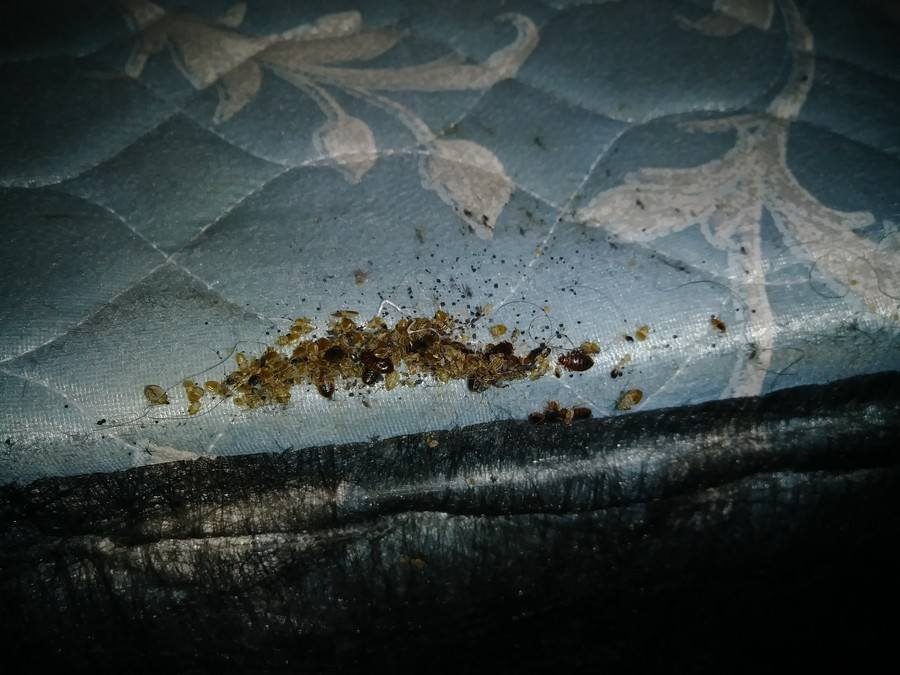
The insects. Adults are about the size and shape of an apple seed, flat, reddish-brown, and noticeably rounder and darker after feeding. Immatures are smaller and much paler — nearly translucent when unfed, which is why people miss them.
Fecal spotting. Small dark spots that bleed into fabric like ink on blotting paper, because it is digested blood rather than a solid. Concentrated where the insects rest, so look at the seams and folds rather than the open surface of a sheet.
Cast skins. Bed bugs molt five times, leaving translucent shells behind. Finding exuviae means a population has been breeding there, not that one hitched a ride.
Eggs. About a millimeter, pearly white, cemented into cracks and seams and genuinely difficult to see. They are also the reason a single treatment is rarely enough.
Where to look, in order. Mattress seams and tufts. The box spring, including underneath the dust cover. The bed frame joints, especially where wood meets wood. The headboard, particularly if it is fixed to the wall. Then outward — the nightstand, the baseboard behind the bed, outlet and switch plates, the edge of carpet, and any upholstered furniture someone sleeps in.
Bed bugs stay close to where people sleep. An infestation is usually a bedroom problem, not a house problem, and that is good news for the cost.
What gets mistaken for them
Carpet beetle larvae are the most common false alarm — small, fuzzy, found in bedding, and they cause skin irritation in some people that looks like bites.
Bat bugs are a genuine possibility in older Bellingham housing with attic bat activity, and they are close relatives that look extremely similar. The distinction matters, because the real treatment is getting the colony out, which is a specialist’s job and not ours. Treating the bedroom while a colony sits above the ceiling solves nothing.
Spider beetles, booklice and fleas round out the list. Fleas in particular get confused with bed bugs regularly, and the treatment is completely different.
This is what the verification visit is for.
How they get in
Bed bugs are a travel and furniture problem. They do not come up from the yard, they are not attracted by food waste, and they have nothing to do with housekeeping. They arrive in luggage, in a backpack, on secondhand furniture, on a guest, or through a shared wall.
We say this plainly because the shame around this pest is genuinely costly. People wait weeks before calling because they think an infestation says something about them, and in those weeks a small localized problem becomes a large dispersed one. Bed bugs turn up in immaculate homes and in good hotels constantly. It is a logistics problem, not a moral one.
The Bellingham pattern
Two things about this market are worth knowing.
The student rental belt. Sehome, Happy Valley, the Western campus edge and the multifamily stock around them run on an academic calendar, which means an enormous amount of furniture and belongings move between units every June and September. That turnover is exactly how bed bugs travel, and it produces a reliable seasonal pattern that a landlord or property manager can plan around. Secondhand furniture moving between student houses is the most common vector we see in this county.
The January spike. Holiday travel returns people to Whatcom County with luggage that has been in hotels, airports and other people’s houses, and we see the resulting calls through January and into February. If you have traveled over the holidays, the luggage protocol at the bottom of this page is worth ten minutes.
Beyond those two, the ordinary sources apply — short-term rentals, hospitality work, healthcare and senior living facilities, and any household with regular overnight guests.
Preparation is most of the job
This is where bed bug treatment succeeds or fails, and it is the part homeowners are least warned about.
A treatment applied to an unprepared room is close to wasted. Clutter gives the insects harborage we cannot reach. Bedding that has not been laundered and dried on high heat re-seeds the room. Furniture pushed tight against walls hides the exact junction we most need access to. Belongings piled on the floor turn a two-hour job into an impossible one.
So we give you a written preparation list before the visit, and — this is the part that matters — if the room is not ready, we reschedule rather than treat. That occasionally frustrates people, and it is the right call every time. Treating an unprepared room means taking money for work that will not hold, and then having the same conversation in three weeks.
Our guarantee reflects this: the customer cooperation clause on our guarantee page exists precisely because re-service depends on preparation having been done.
What not to do
Do not throw out the mattress or furniture. It is the most expensive instinct people have. Dragging an infested mattress down a hallway and a stairwell distributes the problem across the building, and you will have bought a replacement into a room that is still infested. Encasements after treatment cost a fraction of new furniture and let you keep what you have.
Do not use a fogger or bug bomb. Total-release aerosols do not penetrate the cracks bed bugs actually live in, and the repellent effect drives them further into wall voids and into adjacent rooms — or in an apartment, adjacent units. Foggers reliably make the job bigger and more expensive.
Do not move to the couch or the spare room. It is the most natural response and it is how a bedroom problem becomes a whole-house problem. Bed bugs follow carbon dioxide and body heat. Where you sleep is where they go.
Do not start treating with store-bought sprays before we inspect. Same reasoning as elsewhere in this trade — scattered insects are harder to find, and the evidence we need to confirm the infestation gets disturbed.
Apartments, HOAs and rentals
In multifamily buildings the unit boundary is a legal concept, not a physical one. Bed bugs move between apartments through wall voids, shared plumbing runs and electrical chases, and the single most common reason a multifamily bed bug job fails is treating the complaining unit while the ones on either side and above and below go untouched.
For a serious multifamily infestation the honest scope includes inspecting the adjacent units, and sometimes treating them. That is a larger number up front and a much smaller one over the following year.
On who pays: Washington’s landlord-tenant law, RCW 59.18.060, places responsibility for pest control on the landlord, with a carve-out where the dwelling is a single-family residence or where the infestation was caused by the tenant. In a multi-unit building the obligation generally sits with the owner. In a rented house it frequently does not. We work with tenants, owners and property managers, and where the answer depends on which of those you are, we will say so.
Treatment, and what to expect afterward
We match the method to the situation rather than selling one approach for every job — the room, the furniture, the extent and the building type all change what makes sense. What is consistent is that treatment is targeted at harborage rather than broadcast across surfaces, and that follow-up is planned from the start.
Expect more than one visit. Eggs are well protected and do not respond the way active insects do, so a second visit timed to hatching is part of the plan. Seeing activity in the days after a treatment is normal and is not a sign of failure — disturbed insects move more.
Expect it to take a few weeks to go quiet. Confirming success means several checks with nothing found, not one quiet night.
Are they dangerous?
Worth answering directly, because the anxiety around this pest is often worse than the infestation.
Bed bugs are not known to transmit disease to people. What they cause is localized skin reaction, and in some people a stronger allergic response. Scratched bites can become secondarily infected, which is the most common actual medical complication and an ordinary one. That is the state’s position too — the Washington State Department of Health treats bed bugs as a nuisance and a skin-irritation problem rather than a disease-carrying one.
The larger harm is usually sleep and stress. People who know there are insects in their bed stop sleeping properly, and that has real consequences over weeks. It is a legitimate reason to treat this as urgent even though nothing about it is medically dangerous — and it is another reason we would rather verify quickly than leave someone wondering for a fortnight.
If someone in the household is reacting badly to bites, that is a conversation for a physician rather than for us. We handle the insects.
Hospitality, short-term rentals and senior living
Commercial bed bug work runs on a different logic from residential, because the cost of a missed unit is a review, a complaint or a regulatory conversation rather than an inconvenience.
For hotels, motels and short-term rentals, the useful program is proactive inspection on a cycle rather than reactive treatment on a complaint. Finding one unit early is a room out of service for a couple of days; finding it after three guests have complained is a reputation problem and frequently several adjoining rooms. Housekeeping staff are the most effective detection system a property has and they are rarely trained on what to look for, which is a gap worth closing.
Senior living and healthcare facilities add two constraints. Residents often cannot prepare a room themselves, so preparation has to be built into the service rather than handed to the occupant. And reduced sensation means bites frequently go unnoticed, so infestations run longer before anyone reports them — which makes scheduled inspection more valuable than in almost any other setting.
For all of these we document what was inspected, what was found and what was done, because in those industries the record is part of the deliverable.
Why we do not sell one method for every job
There is a lot of marketing in this trade built around a single technique, and we would rather explain our position than pretend the question does not exist.
Heat, targeted application, encasement, monitoring and structural work each do something the others do not, and the right combination depends on the room, the furniture, the extent of the infestation and the building type. A single infested bedroom in a detached house and a third-floor apartment with activity in two adjacent units are not the same problem and should not get the same answer.
What we commit to is telling you which approach we are proposing and why, before you agree to it, and what the follow-up plan is. A company that leads with the method rather than the inspection is selling equipment utilization rather than a result.
If you travel
Ten minutes of habit prevents most of what we treat in January.
In the room, put luggage on the rack away from the bed rather than on the bed or floor. Pull back the sheet at the head of the mattress and look at the seam and the headboard edge for spotting before unpacking. On returning, unpack directly into the laundry and run everything through a dryer on high heat — the dryer does the work, not the wash. Keep the suitcase out of the bedroom, in a garage or closet rather than under the bed.
And treat secondhand furniture as suspect until inspected, particularly upholstered pieces and anything with a frame. Free furniture on a curb in a student neighborhood in June is free for a reason more often than people think.
If you host guests regularly, the same logic applies in reverse and it is worth knowing without being rude about it. Guest bedding washed and dried hot after a stay, and a quick look at the seams of the guest bed a few days later, catches almost everything that would otherwise establish quietly in a room nobody sleeps in for weeks at a time. Infrequently used rooms are where infestations get the longest head start.
Related work
If the insects turn out to be bat bugs, the fix is a bat specialist rather than bedroom treatment — bat bugs follow the colony, and we do not do bat work. If they turn out to be fleas, that is flea control and the approach is different again. For property managers running multiple buildings, our commercial programs cover inspection cycles and the documentation that goes with them.
Frequently asked questions
How much does bed bug treatment cost?
The verification visit is $150, and it is credited in full toward treatment if you proceed — so if we find bed bugs and you treat, it costs you nothing. Treatment is $395 per room, with common areas such as hallways and living rooms included rather than counted as additional rooms.
I have bites but I cannot find any bugs. Is it bed bugs?
Maybe not. Bites are the least reliable evidence there is — the University of Kentucky's ENTFACT-636 puts it at about thirty percent of people showing no reaction even when bitten repeatedly — and plenty of things that are not bed bugs produce similar marks. That is exactly why we verify first. Treating a bedroom for bed bugs you do not have is an expensive way to not solve the problem.
Should I throw out my mattress?
Almost never, and please do not do it before we have looked. Dragging an infested mattress through the building spreads the problem into hallways and stairwells, and you will have bought a new mattress into a room that is still infested. An encasement after treatment costs a fraction of a replacement.
Why is the bed bug visit not free when your other inspections are?
Because a bed bug visit is a genuine search rather than a look around — it takes time, and a real share of them find nothing, which is a useful result but not a billable job. The $150 is credited toward treatment if you proceed, so a customer who actually has bed bugs pays nothing extra for the certainty.
Do bed bugs mean the place is dirty?
No. Bed bugs feed on blood, not crumbs, and they turn up in spotless homes and hotels constantly. They are a travel and furniture problem, not a housekeeping problem. We mention it because the shame around this pest routinely stops people calling for weeks, and the delay is what makes it expensive.
How many treatments will it take?
Plan on more than one. Eggs are the reason — they are well protected and do not respond the way active bugs do, so a follow-up timed to when they hatch is part of the job rather than a sign something went wrong. We schedule it up front so you are not wondering.
I live in an apartment. Does my neighbor need treating too?
Very likely. Bed bugs move between units through wall voids, shared plumbing and electrical chases, and treating one apartment while the adjacent ones go untouched is the most common reason a multifamily job fails. In a multi-unit building, responsibility for control generally sits with the landlord under Washington law.
Guides
From the blog
Bed Bug Control in Whatcom County?
Family-owned, no long-term contracts, and every treatment is backed by our 100% Service Guarantee.
Most calls in Whatcom County are out within 1–2 days, about 3 during the late-summer peak.
Last updated