
Cockroach Control in Bellingham & Whatcom County
The German cockroach is the one that matters in Whatcom County. They live indoors, breed fast, spread between units and resist most sprays, so they need baiting and patience rather than spraying. They are not a crawlspace or moisture insect; they arrive in appliances, cardboard and used furniture. Plan on several weeks and more than one visit.
Call 360-410-2199 Request a free inspection
Roaches: the job at a glance
| What it covers | German cockroaches breeding indoors in kitchens, bathrooms, appliance voids and shared walls |
|---|---|
| Included | Finding the harborage, gel bait placements, a growth regulator where warranted, monitors and follow-up visits |
| Not included | Repellent sprays, foggers or perimeter spraying outside, which scatter or miss an indoor population |
| How many visits | More than one, because egg cases hatch after the first treatment |
| How long it takes | About six to ten weeks until monitors stay at zero; longer in a multi-unit building |
| Before we arrive | Stop spraying, keep the appliances, and cut back stored cardboard |
| What it costs | Free estimate from the visit; a multi-unit building is priced as a program that includes the neighbors |
The identification decides the job
The cockroach that matters in Whatcom County is the German cockroach, and the treatment only works if it is aimed at where that species actually lives. Getting this wrong wastes months.
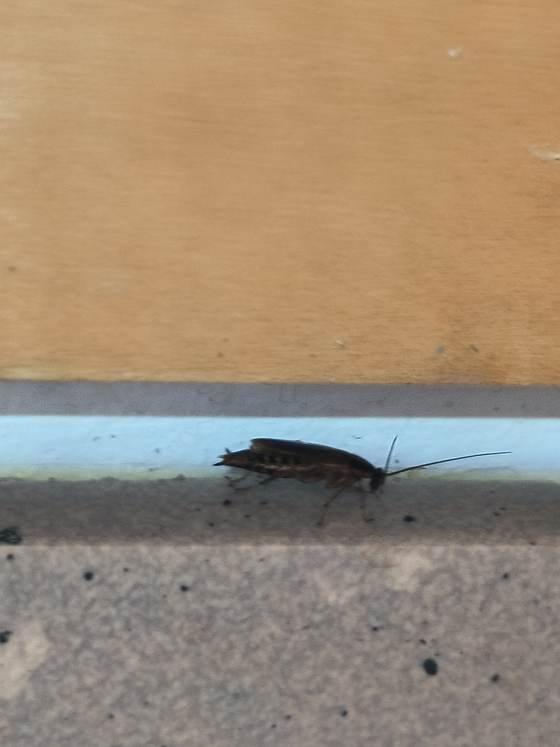
German cockroach. Small, light brown, with two dark stripes running down the shield behind the head. This is the one that matters. It lives entirely indoors, it breeds fast, it concentrates in kitchens and bathrooms, and it moves between units in multi-family buildings. A German cockroach infestation is a genuine infestation and it will not resolve on its own. It is not a crawlspace or moisture insect: it arrives in appliances, cardboard, groceries and used furniture, and it stays with people.
American cockroach. Large, reddish-brown, associated with sewers, drains and commercial floor drains. Present here but far less common than in warmer parts of the country, and mostly a commercial issue.
The practical point: a small striped cockroach in your kitchen is an urgent problem that needs baiting. A cockroach found only in a crawlspace, basement or outdoors is worth a clear photograph before anyone treats anything, because German cockroaches live indoors.
German cockroaches, and why they are difficult
Three things make this species harder than most household insects, and they are worth understanding because they explain everything about the treatment.
Reproduction. A female carries her egg case attached to her body until close to hatching, which means the eggs travel with her and are protected from most of what we can apply. Each case holds a substantial number of nymphs, and a population compounds quickly. This is why a few insects in month one becomes a serious problem by month four.
Resistance. Widespread resistance to the pyrethroid insecticides that make up most consumer sprays is well documented in this species. That is not a marketing claim to sell you a service — it is the reason the can you bought did not work and could not have.
Behavior. They are thigmotactic, meaning they seek tight contact on multiple sides, so they live in cracks, voids, and the inside of appliances rather than in the open. What you see is a small fraction of what is present, and by the time you are seeing them in daylight the population is large.
Why spraying makes it worse
This is the single most useful thing on this page.
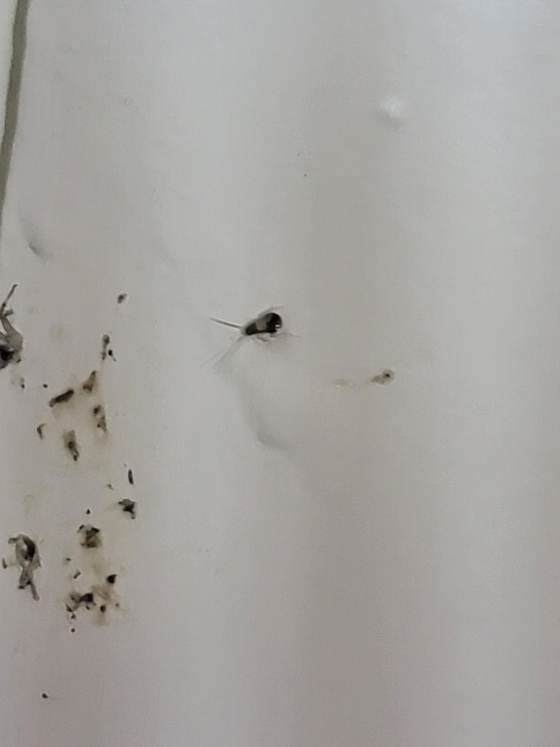
Consumer cockroach sprays are contact killers and repellents. They do two things: they kill the insects they directly touch, and they make the treated surface unpleasant, so everything else avoids it.
Against a German cockroach population that means the survivors scatter — deeper into wall voids, into adjacent rooms, and in an apartment building, into the neighboring unit. A population that was concentrated in a kitchen and reachable becomes a population distributed through the structure and much harder to reach. People frequently call us after a month of spraying and the job is measurably larger than it would have been.
Foggers and bug bombs are the worst version of this. They do not penetrate the cracks where the insects actually live, and the repellent effect drives them outward.
What works is bait. A non-repellent gel that insects feed on and carry back, with secondary transfer through the population via their droppings and by cannibalism of dead individuals. It reaches the ones you never see, which is the whole point. It requires placement in the right locations, in the right quantities, and it requires not spraying repellents over the top of it — which is why we ask people to stop treating before we arrive.
Bait aversion is real, so we rotate active ingredients rather than using the same product indefinitely.
Where they actually live
On a German cockroach job the treatment is placement, so knowing where they harbor is the work.
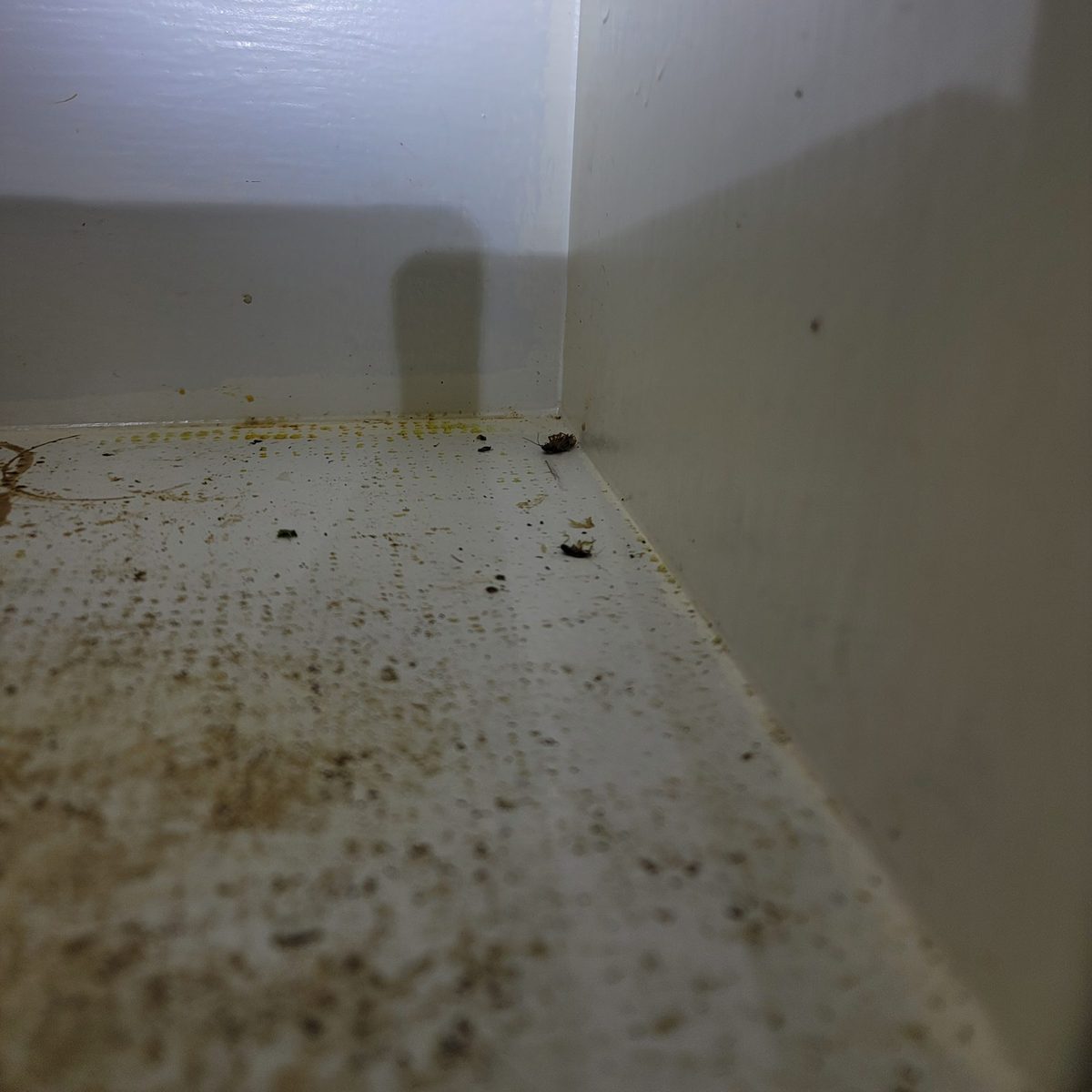
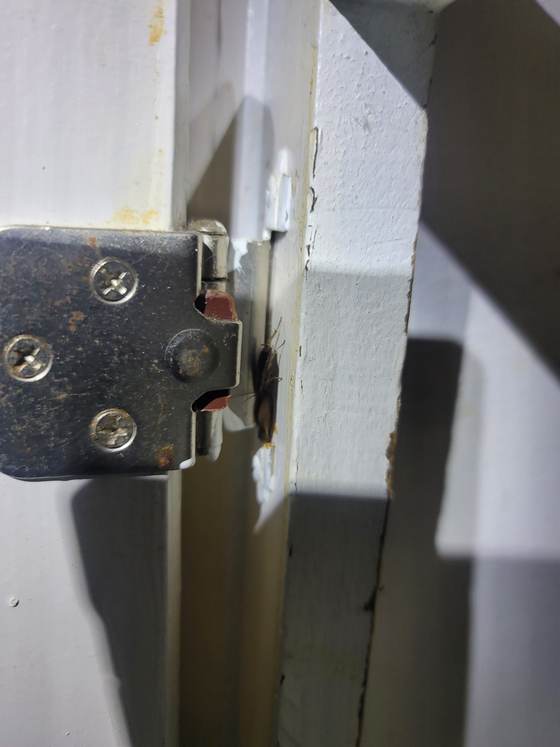
Kitchens dominate: the motor housing and underside of the refrigerator, under and behind the dishwasher, the void beside and beneath cabinets, cabinet hinges and corners, around the sink and its plumbing penetration, inside the microwave housing, and the seams of small appliances — a toaster or coffee maker can hold a population on its own.
Bathrooms second: under the sink, around plumbing penetrations, behind the toilet, and inside vanity voids.
Then the structural routes: wall voids around plumbing and electrical, the space behind switch and outlet plates, and in a multi-unit building, the shared chases that connect apartments vertically and horizontally.
Cardboard is worth naming separately. Corrugated cardboard is close to ideal cockroach harborage — tight, dark, and edible — and stacked boxes in a pantry or a garage frequently hold more of the population than the kitchen does.
Apartments, and the unit boundary problem
The most common reason a German cockroach job fails is that the scope was one apartment.
They travel through wall voids, plumbing chases and electrical runs, so the unit that complains is often not where the population is centered. Treating it while the units above, below and either side go untouched pushes the insects sideways and produces a complaint from the next apartment a few weeks later, then back again.
For a serious multifamily infestation the honest scope includes inspecting the adjacent units and usually treating them. It is a larger number up front and a much smaller one over the following year.
On who pays: Washington’s landlord-tenant law, RCW 59.18.060, generally puts responsibility for pest control on the landlord in multi-unit buildings, with a carve-out for single-family residences and for infestations the tenant caused. Where the answer depends on which side of that you are, we will say so plainly.
Sanitation, honestly
There is a version of this conversation that is really about blame, and we would rather not have it.
Cockroaches arrive in deliveries, cardboard, groceries, used appliances, secondhand furniture and through shared walls. Nobody invites them, and we see them in immaculate homes regularly.
What sanitation genuinely affects is how fast a population grows and how well bait competes. A kitchen with abundant alternative food gives insects less reason to take a bait placement, so the two things that help most are removing competing food and reducing harborage.
Practically: clean under and behind appliances, particularly the refrigerator motor housing. Keep food in sealed containers. Deal with grease around cooking surfaces and behind the range. Do not leave pet food out overnight. Take cardboard out of the building rather than storing it. Fix dripping taps and slow drains, because they need water more urgently than food. And empty and rinse bins rather than letting residue accumulate.
None of that is a substitute for treatment. All of it makes the treatment work faster.
The health side
Worth being accurate about, because this is one of the few household pests with a genuinely well-documented health effect.
The main one is allergens. Cockroach proteins accumulate in household dust and are a recognized asthma trigger, with the strongest evidence in children in multi-unit housing. UC IPM names the same allergen and asthma link in its cockroach guidance. That is a better reason to resolve an infestation properly than the contamination angle people usually reach for.
They also mechanically carry bacteria across surfaces, having traveled through drains and voids, so food-contact surfaces in an infested kitchen warrant more care than usual.
What they do not do is bite, sting, or pose an acute danger to a household.
How we work a cockroach job
Identify. Confirm what it is and where it is breeding. Everything downstream depends on it.
Find the harborage. Appliance voids, cabinet corners, plumbing penetrations, and in multi-unit buildings the shared routes. Monitors placed where activity is suspected tell us where the population actually is rather than where it was seen.
Bait, correctly placed. Small placements in many locations rather than large ones in a few, in the tight spaces they actually use.
Growth regulator where warranted, to break the reproductive cycle rather than only reducing adults.
No repellent sprays over bait. It is self-defeating, and we will ask you to stop treating before we start.
Deal with conditions. Harborage reduction, moisture, and the sanitation items above, in writing.
Follow up. More than one visit, because of the egg cases. Monitors tell us whether the population is falling rather than relying on whether anyone has seen one lately.
Around the county
Student and multifamily housing — Sehome, Happy Valley, the Western campus edge, and the apartment stock along the Guide Meridian corridor. High turnover plus shared walls is the classic German cockroach situation, and secondhand furniture and appliances moving between units in June and September is a reliable vector.
Older city neighborhoods — Lettered Streets, Columbia, Sunnyland, York. Divided older houses with shared plumbing runs, which let a population in one unit reach the next.
Food service and retail — downtown, Fairhaven and the commercial corridors. Deliveries in cardboard are the main entry route, and for these accounts the documentation matters as much as the result. See commercial programs.
What it costs
Quoted from the visit. A single-family home with a contained German cockroach population caught early is a straightforward job over a few visits. A multi-unit building with an established population across several apartments is a program rather than a treatment, and the honest scope includes the neighbors.
The estimate is free, and it will tell you which of those situations you are in.
Before we arrive
Stop spraying. Repellent products scatter the population and interfere with bait, and they make the job longer.
Do not throw out appliances yet. A refrigerator or microwave can be treated. Moving an infested appliance out through a building is how a problem spreads.
Leave a sample if you can. A cockroach in a sealed bag or a clear photograph settles the identification immediately, and the identification decides the whole job.
Note where and when. Which room, which time of day, and roughly how many. Daylight sightings indicate a larger population than night sightings.
Reduce cardboard if you can, particularly stacked boxes in pantries and garages.
How long it actually takes
Setting expectations, because this is a service where impatience causes people to do counterproductive things.
Week one. Bait placed. Activity often appears to increase briefly as insects move to feed, which is the treatment working rather than failing.
Weeks two and three. Visible activity drops substantially. This is the point at which people conclude it is finished and stop cooperating with the plan.
Weeks three to six. The egg cases carried through the first treatment hatch. Nymphs appear. This is the expected second act and it is why the follow-up exists, not evidence that anything went wrong.
Weeks six to ten. With the second generation dealt with, monitors go quiet and stay quiet.
Confirmation is monitors reading zero over consecutive checks rather than somebody not having seen one lately. In a multi-unit building, add time — the population is larger and the scope is the building.
If someone tells you a German cockroach infestation is a one-visit job, that is the clearest signal available about the rest of what they will tell you.
Commercial and food handling
For restaurants, groceries, care facilities and any business under a food safety program, cockroaches are a compliance problem as much as a pest one.
The entry route is almost always deliveries in corrugated cardboard, which is why the most effective single intervention at most commercial sites is de-boxing at the dock rather than carrying cartons into storage. It costs nothing and it removes the main vector.
The pressure points are the same everywhere: dish areas and the voids behind them, motor housings on refrigeration, the space beneath and behind cooking equipment, floor drains, dry storage, and any warm void near a compressor.
For these accounts the record matters as much as the result — what was found, where, what was done, and what remains on the operator’s side. That is part of our commercial programs rather than an extra.
What people get wrong
Two mistakes account for most of the jobs that drag on.
Treating the outside of the building. Perimeter spraying the outside of a building while a population breeds in the kitchen voids. The population compounds while the treatment happens somewhere irrelevant, and repellent product around the structure does nothing to a species that never goes outdoors.
Blaming the crawlspace. German cockroaches are not a crawlspace or moisture insect, so treating or drying the crawlspace does nothing for a population breeding in the kitchen. The work belongs where they live: appliance voids, cabinets, plumbing penetrations and shared walls.
The identification takes a minute and a photograph usually settles it.
The nymphs are the tell
If you want to know whether you have a breeding population rather than a stray, look for the small ones.
Adult cockroaches wander, arrive in bags and boxes, and occasionally turn up somewhere that has no infestation at all. Nymphs do not travel. They are small, wingless versions of the adult, and finding them means the population is reproducing where you found them.
Egg cases are the other confirmation — small, ridged, purse-shaped capsules, usually tucked into a crack or glued behind an appliance. German cockroach cases are carried by the female until nearly hatching, so finding shed cases in a harborage area indicates an established population rather than a visitor.
So the useful report to give us is not just “I saw a cockroach” but whether they were all full-sized or whether there were small ones too. It changes the scope of what we look for.
Related work
For apartment buildings and food-handling businesses see commercial programs. If the insects you are finding are small, fast and in a column rather than scattered, that is more likely ants, and if they are small, dark and jumping, see fleas.
Frequently asked questions
Does having cockroaches mean my home is dirty?
No. German cockroaches arrive in deliveries, groceries, used appliances, secondhand furniture and through shared walls in multi-unit buildings. Sanitation affects how fast a population grows, not whether one starts. We see them in immaculate homes regularly and we are not going to make you feel bad about it.
Why did spraying make it worse?
Most consumer sprays are repellents. They kill what they touch and push everything else deeper into wall voids and shared chases, which scatters a population that was concentrated and reachable. German cockroaches also carry widespread resistance to the pyrethroids in those products, so the survivors are the ones that breed.
How long does it take to get rid of them?
Plan on several weeks and more than one visit. Eggs are carried in a protected case that treatment does not reach, so the job is not finished until the generation inside those cases has hatched and been dealt with. A single visit that looks successful at day three is usually not.
I live in an apartment. Will treating my unit be enough?
Frequently not. German cockroaches move between units through wall voids, plumbing chases and shared electrical, so treating one apartment while the neighbors go untouched relocates the problem rather than solving it. In a multi-unit building the sensible scope is the building, and responsibility usually sits with the landlord under Washington law.
I found a big roach in the basement. Is that the same thing?
Not necessarily. German cockroaches live indoors, in kitchens, bathrooms and appliance voids, and they are not a crawlspace or basement insect. A cockroach found only in a basement, crawlspace or outdoors is worth a clear photograph so we can identify it before anyone treats anything.
Are cockroaches actually a health risk?
The best-documented one is allergens. Cockroach proteins in dust are a recognized asthma trigger, particularly for children, and that is a stronger reason to deal with an infestation properly than the contamination people usually worry about.
Guides
From the blog
Cockroach Control in Whatcom County?
Family-owned, no long-term contracts, and every treatment is backed by our 100% Service Guarantee.
Most calls in Whatcom County are out within 1–2 days, about 3 during the late-summer peak.
Last updated