
Termite Control & Wood-Boring Beetle Treatment in Whatcom County
Our termites are not the ones you have read about. The Pacific dampwood termite follows water rather than attacking sound lumber, so finding them means a wall or crawlspace has been wet long enough to soften. We treat the insects and identify the moisture, because without the second part the first part does not last.
Call 360-410-2199 Request a free inspection
Termites: the job at a glance
| What it covers | Pacific dampwood termites and wood-boring beetles, plus the moisture source that let them in |
|---|---|
| Included | Identifying the insect, tracing the moisture, mapping the damage, targeted treatment and the moisture finding in writing |
| Not included | Soil barriers for dampwood termites, tenting or fumigation, and carpentry where wood needs replacing |
| Home sales | We treat what an independent inspector found; we are not licensed structural pest inspectors and do not issue that report |
| What it costs | Quoted from a site visit, with the figure in writing before work starts; the estimate is free |
What we actually have here
Nearly everything written about termites online is about a different insect in a different climate. Search the topic and you will get material about eastern subterranean termites, Formosan termites, mud tubes, soil barriers and bait station perimeters — an enormous industry built around species that are genuinely destructive across the South and East.
That is not our situation, and pretending otherwise is how people in Whatcom County end up paying for the wrong thing.
Pacific dampwood termite. This is the one we find. It is large — swarmers run around an inch including wings, which makes them startling — and it is defined by a single requirement: it needs wood with high moisture content. Unlike subterranean species it does not need soil contact and does not build shelter tubes, because it lives directly in the wet wood it is consuming. It is common in the Pacific Northwest precisely because our climate keeps wood damp.
Western subterranean termite. Present in Washington, but where in Washington is the part that decides how this page is written. WSU Cooperative Extension bulletin EB0787 states that the subterranean termite occurs only as far north as Seattle in western Washington. Whatcom County sits roughly ninety miles beyond that limit, which puts this species outside its documented range here rather than merely uncommon in it. Distributions do move and timber travels on trucks, so it is not an impossibility — but the default assumption on a Whatcom County termite call is dampwood, and anything that treats subterranean as the starting point has imported a Southern frame into a place it does not fit.
The insect itself is smaller than the dampwood termite and soil-dependent, and it does build the mud shelter tubes people associate with termites. Genuine tubes running up a stem wall would change both the species question and the method, so they are worth thirty seconds of anyone’s attention even where the odds are firmly against them.
What we do not have. Formosan termites are not established here. Drywood termites of the kind that drive fumigation in California and the Southwest are not a Whatcom County problem. If someone has proposed tenting your house in Bellingham, get a second opinion before you agree to anything.
The moisture point, which is the whole point
A dampwood termite colony cannot establish in sound, dry lumber. It is not capable of it. So when we find one in a structure, the finding is not really “you have termites.” The finding is this wood has been wet for a long time.
In practice the source is almost always on a short list. A gutter that has been overflowing down a wall. A downspout discharging against the foundation. A crawlspace with no working vapor barrier and standing groundwater. Plumbing leaking slowly inside a wall. A deck ledger board flashed badly or not at all. Siding in contact with soil or bark mulch. Window or door flashing that failed years ago. A roof leak nobody traced because it only shows in heavy weather.
That is the same list as our moisture ant page, because it is the same underlying condition producing two different insects.
It also means the wood was already decaying before the termites arrived. Fungal decay does not need an insect, and by the time a colony is established the structural loss is usually a combination of both. Which is why treating the insects and stopping there gets you a quiet year and the same conversation later.
We will tell you when the person you actually need is a contractor or a roofer. It costs us work regularly and it is the correct answer.
Telling termites from carpenter ants
The two get confused constantly, especially during spring and fall swarms, and the distinction changes the entire approach.
Waist. Termites are broad through the middle with no obvious narrowing. Carpenter ants have a sharply pinched waist. This is the easiest field mark.
Wings. A termite’s four wings are all roughly the same length and extend well past the body. An ant’s front pair is noticeably longer than the back pair. Shed termite wings found on a windowsill are often all the same size in a small pile.
Antennae. Termite antennae are straight and look beaded. Ant antennae have a distinct elbow.
Frass. Carpenter ants excavate and push shavings out, so you find fibrous frass containing insect body parts below a gallery. Dampwood termites consume the wood and produce hard fecal pellets rather than shavings.
Behavior. Carpenter ants forage in the open — you see workers walking. You will rarely see a termite worker, because they stay inside the wood and avoid light.
Get this wrong in either direction and the treatment is wasted, which is why we identify before we quote.
Swarming season
Dampwood termites swarm in late summer and fall, roughly August through October, on warm evenings. They are strongly drawn to lights, which is why the classic report is a large winged insect at a porch light or a window in September.
Swarmers found outdoors mean there is a colony somewhere in the vicinity — possibly a stump, a fallen log, a landscape timber, a woodpile, or someone else’s structure. It does not by itself mean your house is infested.
Swarmers found indoors, or a pile of shed wings on an interior windowsill, is a much stronger signal. Reproductives emerging inside a structure usually means the colony is inside the structure.
Western subterranean termites swarm on the opposite schedule — spring, generally during the day, often after rain.
The insect nobody warns you about
If you own an older home in this county with a damp crawlspace, the wood-boring insect you are statistically most likely to encounter is not a termite at all.
Anobiid powderpost beetles are genuinely common in Pacific Northwest crawlspaces, and they are frequently mistaken for termite damage or dismissed as old damage. The signs are small round exit holes — roughly the diameter of a pencil lead — in joists, subfloor and sill plates, with fine powdery frass below them. Unlike some wood borers, anobiids will re-infest the same timber generation after generation as long as the moisture content stays high enough.
The reason they matter here is the reason everything on this page matters: they need damp wood. A crawlspace with a functioning vapor barrier, decent drainage and airflow does not support them. One with standing water and no barrier does, indefinitely.
Fine powder below small round holes in a crawlspace is worth a look. It is treatable, and the underlying fix is the same moisture correction.
How we work a wood-destroying pest job
Identify the insect. Termite, carpenter ant, or wood-boring beetle. Everything after this depends on it.
Find the moisture. Meter readings on suspect timber, and tracing the water back to its source rather than noting that the wood is wet. This is the part that determines whether the work holds.
Map the extent. Sounding and probing to establish how far the affected timber runs, because the visible damage is routinely the smallest part.
Treat. Targeted application to the affected members and the colony, matched to the species. Dampwood termites, having no soil dependency, do not call for the soil-barrier approach used against subterranean species — treating them that way is expense without benefit.
Report the moisture finding clearly. In writing, with where it is and what we believe is causing it, so you can act on it with whichever trade is appropriate.
Recommend the structural work. Sometimes that is us — vapor barrier, crawlspace drainage, ventilation, exclusion. Sometimes it is a roofer, a plumber, a gutter contractor or a carpenter. We will say which.
Around the county
Bellingham’s oldest housing. Lettered Streets, Columbia, Sunnyland, York and South Hill. Post-and-pier foundations with sill plates close to grade, unsealed crawlspaces, and a century of gutter and flashing history. The highest concentration of dampwood and anobiid findings in the county.
Around Lake Whatcom. The 1970s cedar stock above the lake sits against a wet forest edge, and the recurring finding is deck ledger boards and the framing behind them. Downed wood and stumps on the surrounding lots hold colonies within easy flight distance of the houses.
Waterfront — Blaine, Birch Bay and Semiahmoo. Salt air is hard on flashing and fasteners, and seasonal homes mean small leaks run unnoticed for months at a time.
Rural and agricultural — Lynden, Everson, Nooksack, Sumas. Outbuildings, stacked lumber, fence posts and structures built close to grade.
Newer construction — Barkley, Cordata, King Mountain. Much less common, because the wood is sound and dry. Where we do find it, there is usually a specific defect — a failed flashing detail or an irrigation head pointed at the siding.
What the damage looks like over time
Dampwood termites work slowly compared to the subterranean species that generate most of the industry’s marketing, and anyone selling you urgency about an imminent collapse is overselling.
What actually happens over years is that structural members in a chronically wet area lose section — sill plates, rim joists, subfloor, the framing around a window that has been leaking. Because the wood was already decaying, the two processes compound, and the eventual repair is a carpentry bill rather than a pest bill.
The argument for dealing with it is not that your house is about to fall down. It is that a moisture problem left running for five more years costs substantially more to fix than one addressed now, and the insects are the most visible evidence you will get that it is running.
What it costs
Quoted from the site visit, and the range is wide because the variable is not really the insect.
A single affected area with clear access and an obvious moisture source is a contained job. A crawlspace with widespread anobiid activity, standing water, no vapor barrier and compromised joists is a larger one, and part of what it needs is crawlspace restoration rather than treatment.
We give you the figure in writing before work starts and the estimate is free. Where the honest answer is that the money is better spent on drainage or a roof than on us, that is what the estimate will say.
Prevention, which is just moisture control
Keep gutters clear and downspouts discharging away from the foundation. Maintain a working crawlspace vapor barrier and address standing water. Keep soil and bark mulch below the siding line. Store firewood off the ground and away from the structure. Remove stumps and buried wood where you reasonably can. Check deck ledger flashing. Keep irrigation off the siding. Trace and fix small plumbing leaks rather than living with them.
Every item on that list is a building maintenance task rather than a pest control one, which is the honest summary of this whole page: in Whatcom County, termite prevention is water management.
Buying or selling a house here
Worth addressing directly, because it is when most people first hear the word termite in Whatcom County.
Here is the distinction, stated plainly, because it is the thing people get wrong and because it decides whether we are any use to you.
We are not licensed structural pest inspectors. We do not issue the wood-destroying organism report that a lender or an escrow company relies on in a property sale. That is a separate credential from the one we hold, and it is regulated for good reason, because a buyer and a lender are relying on the finding. Ask any company you engage for that work which credential they hold, and get the number rather than a reassurance.
We are licensed to treat what that inspection finds. That is the other half of the transaction and it is the half we do. Our WSDA licenses carry the PCO Structural category, which covers the control of pests that attack structural material — fungus, termites, carpenter ants and wood-boring beetles. So where a licensed structural pest inspection has identified dampwood or subterranean termites, carpenter ants, wood-boring beetles, moisture ants or a decay fungus condition, we are the people who come and treat it.
So the order of operations in a Whatcom County sale is straightforward. An independent inspector looks at the house and documents what is there. You send us what they found. We quote and carry out the treatment for the organisms in it. Keeping those two roles in separate hands is better for you anyway, because the party identifying the problem then has no financial interest in the size of the remedy.
If your inspection report lists a wood-destroying organism finding and the treatment needs to happen before closing, that is an ordinary week for us and we can usually work to an escrow timeline. Tell us the closing date at the start rather than at the end.
What we can tell you generally is what buyers in this county should be looking at. The crawlspace matters more than anything else: standing water, a missing or shredded vapor barrier, blocked or missing vent screens, and any wood close to grade. Deck ledger flashing is the second thing, because it is a chronic defect in this housing stock and it is expensive when it fails. Gutters and downspout discharge are the third, and they are cheap to fix and cause more damage than anything else on the list.
If a seller’s paperwork mentions dampwood termites or anobiid beetles, the useful question is not “were they treated” but “was the water fixed.” Treatment without correction is a temporary result on a permanent condition.
What we will not sell you
Soil-barrier treatment for a dampwood infestation. The species has no soil dependency, so treating the perimeter of a house for an insect living in a wet window header is money spent on the wrong problem.
Tenting or fumigation. It is not a Whatcom County treatment for a Whatcom County species, and if it has been proposed to you here it is worth a second opinion before you commit.
An annual renewing termite plan on a structure with no findings and no moisture problem. Recurring programs make sense where pressure is recurring. A dry, sound, well-drained house does not need one, and we would rather tell you that than collect for it.
Treatment of an old, inactive infestation without evidence of current activity. Damage persists long after the insects are gone, and the presence of galleries in a joist is not by itself a reason to treat.
What we find in a crawlspace, in order of frequency
Most of this work happens under floors, so it is worth describing what the space actually tells us.
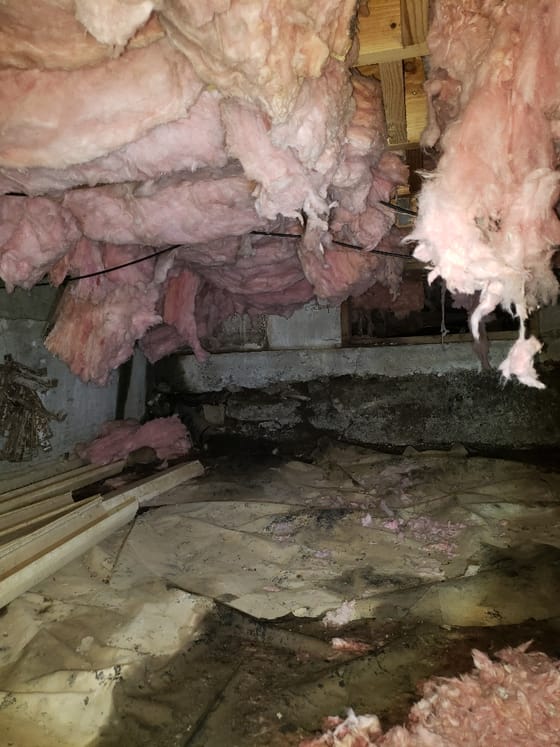
Standing water or saturated soil. The most common finding in older Bellingham housing and the root of nearly everything else. Groundwater, a downspout discharging under the house, or a plumbing leak that has been running quietly.
Missing, shredded or unsecured vapor barrier. Ground moisture evaporates straight into the crawlspace and into the framing above it. A functioning barrier is one of the cheapest interventions available and one of the most frequently absent.
Blocked or missing vent screens. Two problems at once — moisture that cannot escape, and an open door for rodents. It is why wood-destroying pest work and rodent work so often turn out to be the same visit.
Wood in contact with soil. Posts, forms left in place after construction, stored lumber, an old stack of offcuts nobody removed. Every one of those is a colony site within a few feet of the structure.
Elevated moisture readings in the framing. Meter readings on sill plates, rim joists and subfloor tell us whether a problem is active or historical, which determines whether treatment is warranted at all.
Insulation on the ground. Usually a sign of a rodent history, and it holds moisture against the joists once it falls.
Small round exit holes with powder below. Anobiid beetle activity, and worth distinguishing carefully from old damage that is no longer live.
A crawlspace that is dry, sealed, screened and clear of debris does not support dampwood termites, moisture ants or wood-boring beetles. That is not a treatment claim — it is a statement about what those insects require, and it is why the most valuable thing we do on many of these jobs is fix the space rather than spray it.
Timing
Unlike wasps or rodents, this work has no urgent season — the damage accrues over years rather than weeks, so there is no month where acting is dramatically better than another.
What does have a season is the evidence. Swarmers appear in late summer and fall, which is when most people first suspect they have something. Crawlspace moisture is most obvious in the wet months, roughly November through March, when a drainage problem is actually running rather than sitting dry and invisible in August. If you want the clearest picture of what a crawlspace is doing, look at it in February.
The practical advice is simply not to sit on it. A moisture source left running for another two winters costs more to remedy and takes more wood with it, and the insects are the most legible warning you are going to get.
Related work
The same moisture that supports termites supports moisture ants, and the two are found together regularly. Correcting the conditions is usually crawlspace cleanout and restoration and exclusion and repair work. Where wood has been damaged badly enough to need replacement, that is a carpentry job and we will tell you so rather than treating around it.
Frequently asked questions
Do we even have termites in Whatcom County?
Yes, but not the aggressive subterranean species that drives treatment across the South and Midwest. The one here is the Pacific dampwood termite, which needs wood that is already wet. WSU Cooperative Extension bulletin EB0787 states the subterranean termite occurs only as far north as Seattle in western Washington, and this county sits about ninety miles beyond that.
How do I tell termites from carpenter ants?
Three things. Termites have a broad waist, ants a pinched one. Termite wings are all four the same length; an ant's front wings are longer than the back. Termite antennae are straight and beaded, ant antennae are elbowed. Also, ants push out shavings and termites do not.
I saw large winged insects in the evening in September. What are they?
Very likely dampwood termite swarmers. They fly on warm evenings in late summer and fall here, are attracted to lights, and are large — around an inch including wings. Finding them indoors is more significant than finding them outdoors, because it suggests a colony in the structure.
What is the powdery dust and the little round holes in my crawlspace joists?
That is more likely a wood-boring beetle than a termite. Anobiid beetles are genuinely common in damp Pacific Northwest crawlspaces and leave small round exit holes with fine powder below them. It is a different insect, a different treatment, and the same underlying moisture problem.
Will treating the termites fix the problem?
Only half of it. Dampwood termites cannot establish in dry sound wood, so if the water source stays, the conditions that invited them are still there. We treat the insects and tell you plainly where the moisture is coming from, even when the fix belongs to a contractor rather than to us.
How fast do they cause damage?
Slowly, in the sense that a dampwood colony is not going to compromise a structure in one season. The reason to act is that the wood is already decaying — the termites are a symptom of a moisture problem that is doing its own damage, and both get worse the longer they run.
Guides
From the blog
Termite & Wood-Destroying Pest Control in Whatcom County?
Family-owned, no long-term contracts, and every treatment is backed by our 100% Service Guarantee.
Most calls in Whatcom County are out within 1–2 days, about 3 during the late-summer peak.
Last updated