
Centipede & Millipede Control in Whatcom County
Centipedes and millipedes are both telling you the same thing: somewhere is too damp. House centipedes are predators that eat silverfish, roaches and spiders, so their arrival usually means there is prey worth eating. Dry the space, reduce the prey, close the gaps, and both leave.
Call 360-410-2199 Request a free inspection
Centipedes: the job at a glance
| What it covers | House centipedes and millipedes, and the damp conditions that bring them indoors |
|---|---|
| Included | Moisture checks, perimeter treatment for migrations, harborage treatment, and advice on drying and sealing |
| Not included | A recurring plan for a few house centipedes, or broad interior spraying along baseboards |
| Timing | Perimeter work set up ahead of the October and November millipede migrations |
| What it costs | Quoted from the property and usually modest; the estimate is free |
Two very different animals, one message
Both of these turn up for the same underlying reason, and both are worth reading as information rather than as an infestation.
Centipedes are predators. One pair of legs per segment, flattened bodies, fast, and equipped with modified front legs that deliver venom to prey. They hunt insects and other invertebrates.
Millipedes are detritivores. Two pairs of legs per segment, rounded bodies, slow, and they curl into a spiral when disturbed. They eat decaying plant material and are entirely harmless.
Neither damages structures, food, fabric or furnishings. Neither breeds successfully in a dry heated house. And both need consistent moisture, which is why finding them means something about your building or your grounds is holding water.
In this county that puts them on the same list as silverfish, earwigs and moisture ants — a group of pests whose real message is about damp.
House centipedes, which are on your side
The one that generates most of the calls, and the one where the honest advice is hardest to hear.
What it looks like. Grayish-yellow with dark stripes, fifteen pairs of very long legs, long antennae, a body under two inches but a leg span that makes it look considerably larger. It moves in fast bursts and stops dead, which is precisely the behavior people find alarming.
What it does. It hunts. Silverfish, small cockroaches, spiders, ants, larvae, and other soft-bodied insects. It is one of the more effective predators that lives in buildings, and unlike almost everything else on this website it is actively reducing your other pest problems.
Can it bite? Yes, in principle — the modified front legs can penetrate skin. In practice it is uncommon, because their first response to anything large is to run. Where it does happen the result is generally a mild localized sting that resolves quickly. There is no meaningful medical concern here.
What its presence means. This is the useful part. House centipedes are predators, and predators go where the prey is. A house that develops a centipede population usually has an insect population worth hunting — very often silverfish, which need exactly the same humidity.
So the centipede is frequently the messenger rather than the message. Treating the centipedes while leaving the damp and the prey in place changes nothing, because the conditions that supported one will support the next.
We understand that “your alarming fast insect is beneficial” is not what most people want to hear. It is still the accurate answer, and the practical consequence — deal with the moisture and the prey — is the one that actually resolves it.
Millipedes, and the autumn migrations
The other common call, and it usually arrives all at once.
Millipedes live in soil, leaf litter, mulch, compost and rotting wood, feeding on decaying plant material. They are slow, harmless, and normally invisible.
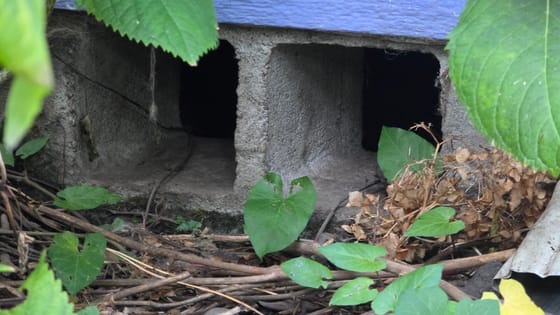
Then it rains hard. When soil becomes saturated — which in Whatcom County means most of October and November — millipedes move in numbers looking for less waterlogged ground. Large aggregations travel across lawns, driveways and patios, meet a foundation, and follow it. Some find a gap.
Indoors they are in trouble immediately, and the reason is the exact opposite of what people assume. Humidity is what a millipede needs; what it cannot tolerate is the dryness of a heated house. UC IPM puts it as millipedes dying quickly indoors from dry conditions and lack of food, and they are generally gone within a day or two, usually curled into their characteristic spiral. So a household finding dozens of dead millipedes along a wall after a wet week is seeing the end of a migration rather than the start of an infestation.
They do not breed indoors, damage anything or bite. Crushed, some species release a defensive fluid that can stain surfaces and irritate skin, so vacuum rather than sweep.
And saturation is not the only trigger. Drought moves them too, and the sources are explicit about it. UC IPM frames the general case as migration when the food supply dwindles or the living space becomes either too wet or too dry. The Alabama extension service records the same mass movement following heavy rain that lands after a hot dry spell. Locally that is the smaller of the two events, but a hot August followed by the first real rain will produce a version of it, and a household that has been told to expect this only after flooding will be looking for a leak that is not there. The insect is responding to the moisture in the ground going wrong in either direction.
Garden and soil centipedes
Worth mentioning because they get lumped in and they are not the same animal.
Soil centipedes are long, thin, pale and slow-moving, found under rocks, boards and in soil. They are predators of soil invertebrates, they are beneficial in a garden, and they do not establish indoors. Finding one under a flowerpot is normal.
What actually resolves both
The same list, because the driver is the same.
Dry the crawlspace. A functioning vapor barrier, working screened vents, and drainage that keeps groundwater out. On older Bellingham housing this is frequently the entire reservoir for both animals and for their prey. See crawlspace cleanout and restoration.
Ventilate the wet rooms. A bathroom extractor that is adequately sized, vents to the exterior rather than into the attic, and runs long enough to clear the moisture.
Dehumidify basements and persistently damp utility spaces.
Clear the perimeter. Pull mulch, leaf litter and compost back from the foundation, lift boards, pots and firewood off the soil, and thin dense ground cover directly against the wall. That band immediately around the building is where the population lives.
Fix the exterior water. Gutters, downspouts discharging away from the house, grading, and irrigation that does not spray the siding.
Close the gaps. Door sweeps, weatherstripping, window and vent screening, utility penetrations, and sill plate gaps. This is exclusion and repair work.
Reduce the prey, for centipedes specifically. If there are silverfish or small cockroaches in the building, the centipedes are there for a reason and dealing with the food supply is more durable than dealing with the hunters.
Then treat where it helps. A targeted exterior perimeter band is genuinely useful during a millipede migration, and harborage treatment around a crawlspace has a role. Interior spraying is rarely the answer, because both animals are transient indoors.
Why we usually recommend leaving centipedes alone
Stated plainly because it costs us work.

If you have a small number of house centipedes and no other visible problem, the sensible response is to vacuum the ones you see, address the humidity, and let them do their job in the meantime. They are consuming exactly the insects you would otherwise be calling about.
Where we do treat is when the population is large enough to be a genuine quality-of-life problem, when someone in the household has a real phobia — which is a legitimate reason and not one we dismiss — or when the underlying prey population needs dealing with anyway and the centipedes come along with it.
What we will not do is sell a recurring treatment plan for a beneficial predator that arrived because of a bathroom fan.
Around the county
Older housing with damp crawlspaces — Columbia, Sunnyland, York, Roosevelt and the Lettered Streets. Post-and-pier foundations, unsealed crawlspaces and original bathroom ventilation give both animals a continuous reservoir directly beneath the living space. The highest volume of house centipede calls in the county.
Shaded lots near the lake and the greenbelts — Sudden Valley, Silver Beach, Edgemoor, Whatcom Falls. Deep leaf litter, ground that never dries, and heavy autumn millipede movement against foundations.
Finished basements anywhere in the older parts of the city, where a warm damp room with stored cardboard supports silverfish, which in turn supports centipedes.
Newly landscaped developments — Barkley, Cordata, King Mountain and newer Ferndale stock. Fresh deep mulch to the siding produces heavy millipede migrations in the first few autumns after planting.
Rural properties — Lynden, Everson, Nooksack, Sumas. Compost, manure, field margins and stacked material, with migrations that can be genuinely large.
What it costs
Quoted from the property, and usually modest.
Where the work is perimeter treatment and harborage reduction ahead of a migration season, it is a small job. Where the reservoir is a wet crawlspace, the pest treatment is the minor part and the restoration is the real project — and it resolves silverfish, moisture ants and wood-destroying insects at the same time.
Where the answer is a dehumidifier and a bathroom fan that actually works, we will tell you that. The estimate is free.
What you can do
Vacuum rather than crush, particularly millipedes, which can stain.
Pull the mulch back from the foundation and lift anything lying on the soil.
Run the bathroom fan properly, and check that it actually vents outside rather than into the attic — a surprisingly common defect in older homes here.
Get a dehumidifier into a damp basement.
Fit door sweeps, which stop most of what walks in during a migration.
Deal with the silverfish if you have them, because that is what the centipedes are eating.
And in a migration week, wait. Millipede movements last days rather than weeks, and the animals coming inside are dying as they arrive.
What people try that does not help
Interior spraying along baseboards. Both animals are transient indoors. The ones you treat were dying anyway, and it does nothing to the reservoir.
Bug bombs. No reach into the damp voids where either lives, product where people live, and no effect on the conditions.
Killing centipedes while leaving silverfish. The most self-defeating version. Remove the predator and the prey population it was suppressing does better.
Sealing the house without drying it. Exclusion helps, but a damp crawlspace that is sealed is still a damp crawlspace, and both animals live down there quite happily without needing to come up.
Treating during a millipede migration and calling it a success. The migration was going to end in a few days regardless. The perimeter work matters for next autumn, not for this week.
Diatomaceous earth broadcast indoors. It works slowly on some insects in dry conditions, which is precisely the opposite of the conditions here, and it is difficult to remove from carpet. In a dry crawlspace or void it has a legitimate narrow use; on a living room floor it does not.
When it is genuinely worth treating
Having spent this page recommending restraint, here is the other side.
A large, established population that persists year-round rather than arriving seasonally, particularly in a finished basement or a heavily used lower floor.
Repeated millipede migrations into a property where the landscaping and grading cannot easily be changed — a perimeter program timed to autumn genuinely reduces what gets in.
Where the prey population is the real job and the centipedes are incidental. Treating a silverfish or cockroach problem resolves both, and that is a legitimate service rather than treating a predator.
Where someone in the household has a genuine phobia. House centipedes are among the most commonly phobia-triggering insects we deal with, and a household where somebody cannot use a bathroom at night has a real problem regardless of what the animal does ecologically. We will treat, and we will still tell you what the underlying driver is.
Commercial and institutional settings where appearance standards apply — hospitality, healthcare, food handling — and the tolerance is legitimately zero. See commercial programs.
Reading the building from the insect
This is worth stating as a general principle, because it applies across most of this site and centipedes and millipedes are the clearest example.
Some pests tell you about food — cockroaches, pantry beetles, ants at a spill. Some tell you about access — rodents, wasps in a wall void. And some tell you almost nothing about themselves and a great deal about the building.
Centipedes, millipedes, silverfish, sowbugs, pillbugs, moisture ants and dampwood termites are all in that third group. None of them can establish without sustained moisture, and none of them is doing much harm on its own. What they collectively indicate is that part of the structure is holding water — and that condition is doing damage regardless of which insect happens to be reporting it.
A crawlspace wet enough to support millipedes is wet enough to support fungal decay in the joists above it. A bathroom humid enough for silverfish is depositing that moisture somewhere. The insects are the visible part of a problem whose expensive part is invisible.
So when we come out for centipedes and spend most of the visit with a moisture meter and a flashlight in the crawlspace, that is not scope creep. It is reading the actual message.
The seasonal shape
Winter and early spring. Both are present but quiet, living in the damp voids and soil. Occasional centipede sightings in bathrooms as they hunt.
Late spring. Activity rises with warmth. Centipede sightings increase because the animals are moving more, not because numbers changed dramatically.
Summer. The most consistent period for house centipede indoor sightings, particularly at night in bathrooms and basements. Millipedes are largely invisible unless a dry spell drives them to seek moisture.
Autumn — and this is the one that matters. Heavy October and November rain saturates soil and triggers millipede mass movement. This is when the foundation lines fill up and the calls arrive in clusters after a wet week.
And the year-round point: a damp crawlspace has no season. If the reservoir is under the floor, the population is continuous and the sightings simply track how much anyone is looking.
If you would rather not kill them
A note for the households — and there are plenty in this county — who would prefer to relocate rather than treat.
Both animals are easy to catch and move. A cup and a piece of card works, and neither is fast enough to be difficult once cornered, despite the centipede’s reputation. Put them outside under leaf litter or mulch, well away from the foundation, and they will do better there than they were doing in your bathroom.
For millipedes during a migration, a broom and a dustpan and a walk to the back of the garden handles a wall’s worth in a few minutes, and they are heading somewhere anyway.
Where we get involved in those households is usually the moisture work rather than the pest work — a vapor barrier, a bathroom fan, a dehumidifier — which resolves it without killing anything at all. That is a legitimate way to approach this and we are not going to talk anyone out of it.
What to tell us when you call
Which animal. Fast with long legs, or slow and curling into a spiral. That single detail sends the visit in different directions.
Where and when. A bathroom at night is a different picture from a garage in October, and a foundation line after heavy rain is a third thing again.
Whether it is one or many. A single house centipede is normal in a Pacific Northwest home. Several a week suggests a prey population worth finding.
Whether you have seen silverfish, which is the most useful single piece of information for a centipede call and the one people rarely think to mention.
And what the crawlspace is like, if you know. Standing water, a torn barrier, or a musty smell from the floor vents all point at the reservoir before anyone opens the hatch.
What it means for an older Bellingham home
A short closing note, because these two animals are so strongly associated with a specific housing type here.
The prewar city stock — post-and-pier foundations, unsealed crawlspaces, original bathroom ventilation and a century of settlement — produces most of the centipede and millipede calls in this county, and it produces them for structural reasons rather than anything to do with how the house is kept.
That is worth saying to owners of those houses, because the calls often come with an apology attached. There is nothing to apologize for. A crawlspace built in 1925 was not built with a vapor barrier, and the fix is a project rather than a habit.
Related work
The reservoir is nearly always damp, so the durable fixes are crawlspace cleanout and restoration and exclusion and repairs. If centipedes are present, look for silverfish, which are usually what they are hunting. The same damp perimeter also produces earwigs, sowbugs and pillbugs.
Frequently asked questions
What is the fast one with all the legs in my bathroom?
A house centipede — long legs, gray-yellow with dark stripes, and startlingly quick. It is a predator, it eats silverfish, small roaches, spiders and other insects, and it does no damage to anything. Its presence usually means there is a prey population worth eating somewhere in the building.
Can centipedes bite?
House centipedes can, and it is uncommon because they run rather than confront. Where it happens the result is usually a mild localized sting, comparable to a small bee sting, that resolves quickly. They are not aggressive and they are not a meaningful risk in a household.
Hundreds of millipedes are along my foundation. What happened?
That is a mass migration, and it usually follows heavy autumn rain saturating the soil they live in. They move in numbers looking for drier ground, meet your foundation, and follow it. They cannot survive indoors and will die within a day or two, so the answer is the perimeter rather than the inside.
How do I tell them apart?
Legs and speed. Centipedes have one pair of legs per body segment, are flattened, and move fast. Millipedes have two pairs per segment, are rounded, move slowly, and curl into a tight spiral when disturbed. Centipedes hunt; millipedes eat decaying plant matter.
Should I be worried about damage?
No. Neither damages structures, furnishings, food or fabric. Millipedes can leave a staining fluid if crushed, and that is the extent of it. What is worth attention is the moisture that brought them, because that does cause problems.
Will spraying get rid of them?
Not durably. Both live outdoors or in damp voids, and both keep arriving as long as the conditions hold. Perimeter treatment helps during a mass migration, but the fix is drying the space, clearing the harborage against the foundation, and sealing the gaps.
Guides
From the blog
Centipede & Millipede Control in Whatcom County?
Family-owned, no long-term contracts, and every treatment is backed by our 100% Service Guarantee.
Most calls in Whatcom County are out within 1–2 days, about 3 during the late-summer peak.
Last updated