
Wood-Boring Bee & Beetle Control in Whatcom County
Hole size tells you which insect. Round holes about half an inch across in fascia or deck rails are carpenter bees. Holes the size of a pencil lead in crawlspace joists, with fine powder below, are wood-boring beetles — and in this county those are a moisture problem before they are an insect problem.
Call 360-410-2199 Request a free inspection
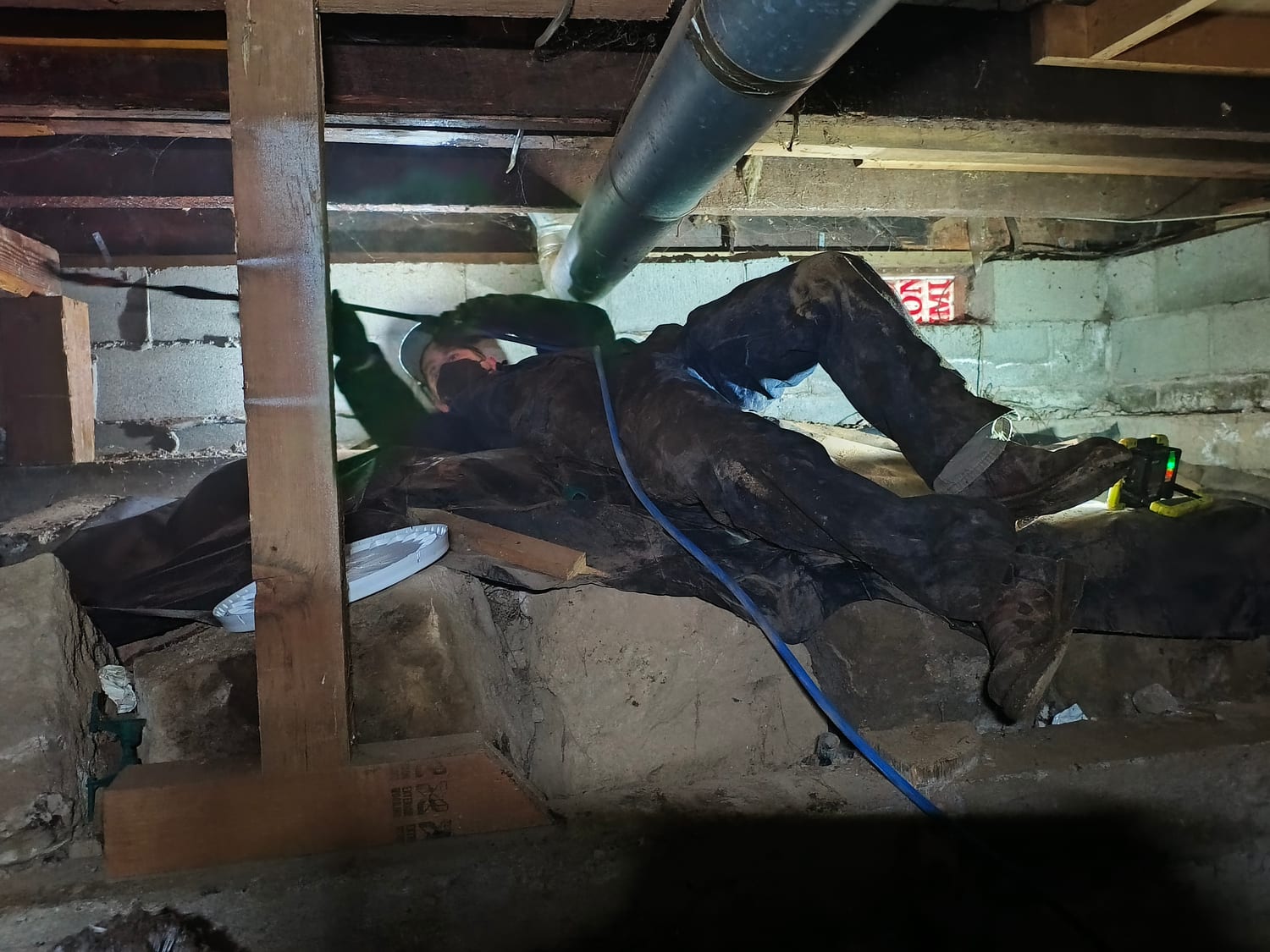
Wood borers: the job at a glance
| What it covers | Carpenter bees in exposed softwood, and wood-boring beetles in crawlspace framing |
|---|---|
| Included | Measuring holes, a frass test for activity, moisture readings, gallery or borate treatment, then filling and sealing |
| Not included | Fumigation, treating old inactive damage, recurring beetle plans, and replacing decayed members, which is carpentry |
| Timing | Carpenter bee holes are treated and filled in late summer or autumn, once the new generation is out |
| What it costs | Quoted from the visit; bee work is usually contained, beetle work depends on the moisture |
Two different problems, and hole size separates them
Everything on this page starts with measuring a hole.
About half an inch, perfectly round, in exposed softwood — fascia, deck rails, handrails, eaves, unpainted siding, outbuilding timber. That is a carpenter bee, and it is a surface-level nuisance with a specific fix.
About the diameter of a pencil lead, in crawlspace joists, subfloor or sill plates, with fine powder beneath — that is an anobiid powderpost beetle. In Whatcom County this is the one that actually matters, and it is a moisture story.
Tiny pinholes in hardwood flooring, furniture or trim, with talcum-fine powder, suggests lyctid powderpost beetles, which attack hardwood rather than structural softwood.
Get the identification right and the rest of the job follows. Get it wrong and you are treating a deck rail for a crawlspace problem.
Carpenter bees
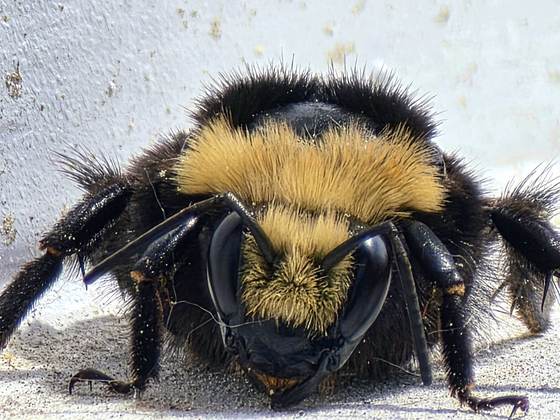
What they look like. Large, roughly bumble bee sized, but with a shiny, hairless black abdomen — that is the distinguishing feature. Bumble bees are fuzzy all over. Carpenter bees have a densely haired thorax and a bare, glossy rear.
They are less abundant here than in the eastern and southern states where they generate most of the online advice, which is worth saying because a great deal of carpenter bee content is written for a much larger problem than Whatcom County actually has.
What they do. Females excavate a nearly perfect round entrance hole into unfinished or weathered softwood, then turn and tunnel along the grain, creating a gallery where eggs are laid in provisioned cells. They do not eat the wood — they excavate it, like carpenter ants, and the sawdust is pushed out.
The bluffing male. The bee that hovers and darts at you when you walk past the deck is a male defending territory, and males have no stinger. It is entirely display. Females can sting and essentially never do unless handled or trapped.
Where they choose. Unpainted or weathered softwood, preferentially: fascia boards, deck rails and joists, handrails, eaves and soffit edges, fence rails, outbuilding timber, and the underside of anything horizontal and unfinished. Painted and well-finished wood is markedly less attractive, which is the basis of most of the prevention.
Why it accumulates. Galleries get reused and extended year after year, and new females frequently nest near where they emerged. A rail with one hole this year may have four next year, and the tunneling behind them can be considerably more extensive than the exterior suggests.
The woodpecker problem. Worth knowing about, because it does more visible damage than the bees. Woodpeckers hear or detect larvae in galleries and open the wood up to reach them, converting a neat half-inch hole into a torn strip of fascia. If you have fresh woodpecker damage on a fascia board, there is usually a carpenter bee gallery behind it.
Wood-boring beetles, which are the local one
If you own an older home in this county with a damp crawlspace, this is the wood-boring insect you are most likely to actually encounter.
Anobiid powderpost beetles attack softwood — the structural framing, joists, subfloor and sill plates in a crawlspace. The signs are small round exit holes roughly the diameter of a pencil lead, with fine powdery frass accumulating beneath them or streaking down a joist.
The moisture requirement is the whole story. Anobiids need wood with elevated moisture content, and they will re-infest the same timber generation after generation as long as it stays damp. This is why crawlspace beetle problems recur endlessly under repeated treatment and stop when the space is dried. The USDA Forest Products Laboratory’s Wood Handbook makes the same point from the timber side: the durable control for both decay and the organisms that live in damp wood is holding the moisture content down, not repeating a treatment.
It is exactly the same argument as dampwood termites and moisture ants, and it usually turns out to be the same crawlspace.
Lyctid powderpost beetles are a different situation — they attack the sapwood of hardwoods with high starch content, which means flooring, trim, cabinetry and furniture rather than framing. The frass is the field test, and it works by touch: lyctid frass is loose and flour-fine, almost like talc, while anobiid frass is gritty between the fingers because it is made of compressed fecal pellets. Lyctid infestations usually arrive in the wood itself rather than starting in place.
Old house borer attacks softwood framing and is notable for the audible rasping some people report from inside timber. It is worth naming only to rule it out: it is an eastern species and is not established in western Washington, so rasping in a local wall is far more likely to be an anobiid, a wood-boring weevil in decayed timber, or carpenter ants.
Active or old?
The most useful diagnostic on the page, and one that saves people money.
Exit holes persist indefinitely. A beam with holes made in 1962 looks much the same in 2026, and a great many “infestations” reported to us are historical damage in wood that has since dried out.
The frass test. Clear away all the powder and debris beneath the suspect area — brush it off, vacuum it, wipe it down. Note the date. Come back in two to four weeks. Fresh powder means active. Nothing means the damage is old and no treatment is warranted.
Other indicators. Fresh holes have clean, sharp, pale edges; old ones are darkened, dusty and weathered. Fresh frass is loose and light-colored; old frass is compacted and gray. And moisture readings in the surrounding timber tell you whether the wood could currently support a population at all.
We do this test rather than quoting from the sight of holes, because “you have wood-boring beetles” is an easy and expensive thing to say about a beam that has been quietly inert for forty years.
How we work it
Identify and measure. Hole diameter, frass texture, location and timber type.
Establish whether it is active, using the frass test where the timing allows, rather than assuming.
Take moisture readings. For anobiids this is the diagnosis rather than a supporting detail.
Trace the moisture source. Crawlspace ground moisture and missing vapor barrier, blocked or absent venting, plumbing leaks, gutters and downspouts, grading, deck ledger flashing. This is where the job actually is.
Treat where treatment is warranted. Borate products penetrate bare, accessible wood and are well suited to crawlspace framing, sill plates and subfloor — unfinished timber that can be reached. They are not effective through paint, sealer or finish, which is a real limitation and worth saying.
For carpenter bees, treat the gallery, confirm activity has stopped, and only then fill and seal.
Correct the conditions. For anobiids this is crawlspace restoration and ventilation work, and it is the part that decides whether any of the rest holds.
Assess the structure honestly. Where a member has lost meaningful section, that is a carpenter’s job, and we will say so rather than treating around it.
Sealing carpenter bee holes, in the right order
Worth its own note because people reliably get this backwards.
Do not fill an active gallery. Sealing the entrance with an insect inside produces a new hole beside the repair within days — they are perfectly capable of chewing a fresh exit. It also traps developing larvae in a gallery where they will die and, in enough numbers, feed carpet beetles.
The order is: treat the gallery, wait and confirm no further activity, then fill with wood filler or a tight-fitting dowel, then paint or seal the surface.
Timing. Late summer or autumn, once the current generation has emerged, is the cleanest window. Filling in spring while a female is provisioning cells is the wrong moment.
Then finish the wood. Paint and solid stain are the genuine deterrent — carpenter bees strongly prefer bare or weathered timber. A fascia board that gets painted after repair is substantially less likely to be chosen again. Clear finishes and semi-transparent stains help less.
Around the county
Decks and outbuildings everywhere. Carpenter bee damage tracks unfinished softwood rather than neighborhood, so it turns up wherever there are weathered deck rails, fence posts and barn timber — which in this county is most rural and lakeside property.
The old city housing. Lettered Streets, Columbia, Sunnyland, York and South Hill. Anobiid activity in crawlspace framing is common here, and it goes hand in hand with the moisture problems described across this site. This is the majority of our wood-boring beetle work.
Around Lake Whatcom. Sudden Valley, Silver Beach and Edgemoor bring 1970s cedar, extensive decking and shaded lots that never fully dry — good conditions for both groups at once.
The farm country. Lynden, Everson, Nooksack and Sumas, where barns, outbuildings, fence lines and stored lumber give carpenter bees unlimited unfinished softwood.
Waterfront properties. Blaine, Birch Bay and Semiahmoo, where salt air is hard on finishes and weathered exposed timber is the norm.
What it costs
Quoted from the visit, and the two problems price very differently.
Carpenter bee work is usually contained — treating a number of galleries, then repair and finishing. The variable is access and height, since fascia and eave work happens on a ladder.
Wood-boring beetle work depends almost entirely on the moisture. Treating accessible crawlspace framing with borate is a moderate job. Doing it properly alongside a vapor barrier, vent screening and drainage correction is a crawlspace restoration project, and that is where the real number sits — and the real benefit, because it resolves several problems at once.
Where the damage turns out to be old and inactive, we will tell you that and charge you nothing for the treatment you do not need.
What we will not do
Treat inactive damage. Old exit holes in dry timber need no product.
Fumigate. It is not a Whatcom County treatment for a Whatcom County problem, and if it has been proposed to you here it is worth a second opinion.
Sell a recurring plan for wood-boring beetles. If the wood is dry they cannot re-establish; if it is wet, the answer is drying it, not visiting annually.
Fill carpenter bee holes on the first visit while a gallery is still active.
Treat around structural decay. Wood that has lost section needs replacing, and applying product to it is covering a problem rather than fixing it.
Telling wood damage apart
Four different insects leave marks in structural timber and they are routinely confused. The distinctions are practical rather than academic, because they send the job in four directions.
Clean round exit holes with powder below, no galleries visible on the surface — wood-boring beetle. The tunneling is internal and you only see the exits.
Rough galleries following the grain, with fibrous shavings pushed out that contain insect body parts — carpenter ants. They excavate rather than eat, and the frass is shredded rather than powdery.
Galleries packed with soil-like material, or mud tubes on a foundation wall — subterranean termites, which are uncommon on this side of the Cascades but present.
Galleries in wet wood with hard fecal pellets rather than shavings — Pacific dampwood termite, the local termite species.
One perfectly round half-inch hole with a tunnel turning sharply along the grain — carpenter bee.
Frass texture is the single most useful clue. Powder means beetle. Shavings with body parts mean ants. Hard pellets mean termites. Photograph what you find and leave it in place, because sweeping it up removes the evidence.
Timing
Carpenter bees. Adults emerge in spring and females begin excavating and provisioning. The nuisance is most visible in late spring and early summer, when males are hovering. The right time to treat, fill and finish is late summer or autumn, after the current generation has emerged, which is why we often book this work months after the call.
Wood-boring beetles. Adults emerge and produce new exit holes in spring and early summer, which is when fresh frass appears and people notice. Development inside the timber takes a long time — frequently a year or more, longer in cool damp wood — so the population you are seeing reflects conditions from previous years.
And the moisture side has its own season. A crawlspace tells you the truth in February, when a drainage problem is actually running, rather than in August when everything looks dry. If you want to know whether a beetle problem has a future, look at the space in winter.
Preventing carpenter bee damage
Almost entirely a finishing question, and it is one of the few pest problems where ordinary property maintenance is the whole answer.
Paint or solid stain the vulnerable timber. Carpenter bees strongly prefer bare and weathered softwood, and a properly finished surface is markedly less attractive. Fascia, deck rails, handrails, exposed beam ends and fence rails are the targets worth finishing. Clear finishes and semi-transparent stains help less than solid coverage.
Keep the finish maintained. A board that was painted twelve years ago and has weathered back to bare wood is no longer protected. The maintenance cycle is the protection.
Cap and cover exposed end grain, which is where excavation frequently starts, with trim, flashing or paint.
Repair damage promptly. Filled and finished galleries are much less likely to be reoccupied than open ones, and open galleries attract new females.
Consider material at replacement. Where a rail or a fascia is being replaced anyway, composite or a treated and finished product takes that element out of the picture — carpenter bees do not excavate it, so the cycle of reoccupation stops there.
And do not let woodpecker damage sit. Open, torn wood is both an invitation and a moisture entry, and the moisture side matters more for the structure than the bees do.
What we find in a crawlspace, and what it means
Because most of our wood-boring beetle work happens under floors, it is worth describing what an assessment actually looks at.
Moisture readings across the framing. Sill plates, rim joists, joists and subfloor. This is the number that decides whether an infestation has a future, and it is why we bring a meter rather than a flashlight alone.
The vapor barrier. Present, absent, torn, or shifted aside by whoever last ran a duct. Its condition explains most of the readings above it.
Standing water and drainage. Whether groundwater is entering, whether a downspout discharges under the house, and whether the ground stays saturated.
Wood on the ground. Offcuts, form boards, buried lumber and stored material, each of which is a reservoir within feet of the structure.
Exit holes and frass, mapped rather than noted. Where they are concentrated tells us which part of the structure is wettest, which usually points straight at the source.
Ventilation. Blocked, screened, missing, or painted shut.
What you get in writing from us is a record of the treatment performed — the product used, the members and locations treated, and the date. We are not structural pest inspectors and we do not issue a document setting out findings of wood-destroying-organism damage; that is a separately licensed activity. What we will do is talk you through what we are seeing while we are standing in it, because the practical point is usually the same either way: applying borate to timber that will be wet again next winter is a way of spending money without changing anything, and the drainage is the job.
Buying or selling a property
Wood-boring insect damage turns up in property transactions more than any other pest on this site, and it is worth knowing how to read it.
Most of what gets flagged is old and inactive. Exit holes in a beam are a permanent record of something that may have finished decades ago, and a report noting their presence is not the same as a finding of active infestation.
The questions that matter are whether there is fresh frass, what the moisture readings say, and whether any member has lost meaningful section. Those three answers determine whether this is a repair item, a monitoring item, or nothing at all.
Ask whoever assessed it which of the three they established, and whether they used a moisture meter. If the answer is that holes were observed, that is an observation rather than an assessment.
Related work
Anobiid beetle findings almost always lead to crawlspace cleanout and restoration and exclusion and repairs. The same moisture supports dampwood termites and moisture ants, so these are frequently found together. If the large bee at your deck turns out to be a bumble bee or a honey bee rather than a carpenter bee, see bee removal — and the answer there is usually to leave them alone.
Frequently asked questions
How do I know if the damage is active or old?
Fresh frass is the test. Active galleries push out powder or pellets continuously, so clear the area beneath a hole, wait a couple of weeks, and see whether more appears. Old exit holes in a dry beam can sit unchanged for decades, and treating them achieves nothing.
What size hole am I looking at?
Roughly half an inch and perfectly round in exposed softwood means carpenter bee. About the diameter of a pencil lead, in crawlspace or subfloor timber with fine powder beneath, means anobiid beetle. Much smaller pinholes in hardwood flooring or furniture suggest lyctid powderpost beetles.
A big bee at my deck keeps charging at me. Will it sting?
That is a male carpenter bee, and he cannot sting — males have no stinger. The hovering and darting is territorial display and it is entirely bluff. Females can sting but are docile and rarely do unless handled.
Should I fill the holes?
Yes, but not yet. Filling an active gallery seals insects in, and with carpenter bees they simply chew a new exit beside your repair. Treat first, confirm activity has stopped, then fill and seal. Doing it in the wrong order is the most common mistake with this one.
Why do the beetles keep coming back in my crawlspace?
Because the wood is still damp. Anobiid beetles re-infest the same timber generation after generation as long as the moisture content stays high enough, so the durable fix is drying the space rather than repeated treatment of the wood.
Is the structure at risk?
Rarely urgently. Both work slowly, and most of what we find is cosmetic or long-standing. What matters is whether it is active and whether moisture is feeding it, because a wet structural member is losing strength to decay as well as to insects.
Guides
From the blog
Wood-Boring Bee & Beetle Control in Whatcom County?
Family-owned, no long-term contracts, and every treatment is backed by our 100% Service Guarantee.
Most calls in Whatcom County are out within 1–2 days, about 3 during the late-summer peak.
Last updated