
Pest Control in Cordata, Bellingham
Cordata is Bellingham's newest large neighborhood and it fools people. The buildings are tight and well made, so residents assume they are sealed, and the ground they stand on was open field and forest within living memory. The population that lived there did not move away.
Call 360-410-2199 Request a free inspection
Cordata, Bellingham on the map
New buildings, old ground
Cordata is the newest large piece of Bellingham, and it produces a conversation we have more often here than anywhere else in the city: a homeowner who cannot understand how a house built five years ago has rodents.
The confusion is reasonable. These buildings genuinely are better than the older stock — proper sheathing, continuous housewrap, sealed sill plates, conditioned crawlspaces in the newer phases, and none of the century of accumulated penetrations that defines the Lettered Streets or Sunnyland.
But the ground underneath them was open field, pasture and second-growth forest within living memory, and the animals that lived on that ground did not relocate to another county when the survey stakes went in. They lost their cover and their food source over a single season, and then a few hundred warm buildings appeared with landscaped beds, irrigation, refuse and pet food.
From a rodent’s point of view a new Cordata development is an upgrade, and the first autumn after a phase completes is reliably the busiest that phase will ever have.
Where a tight building actually leaks
Modern construction here is sound until a trade puts a hole through it. Every penetration is drilled by a subcontractor working at pace, and the standard closure is expanding foam.
Foam is an air seal. It is not a barrier — a rodent opens it in an evening — and the failure points repeat from house to house with almost no variation.
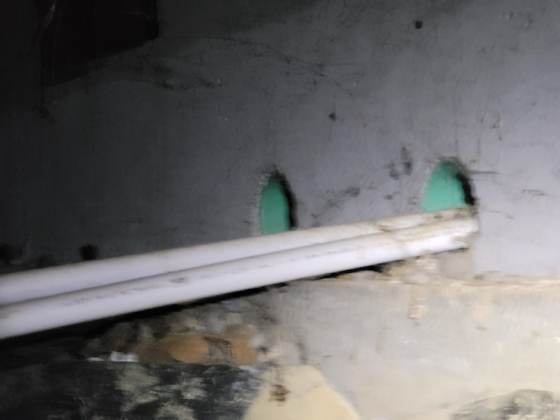
The dryer duct where it crosses the rim joist, particularly once the exterior flap has warped or a louver has snapped. The hose bib and the irrigation supply, both drilled generously to allow for the escutcheon. The heat pump or refrigerant line set, which enters at an angle and leaves a crescent-shaped gap at the top of its hole. The electrical and low-voltage entries, frequently clustered behind a panel in one oversized opening. And the bottom seal of a garage door on a slab that has settled a few millimeters, which is present on nearly every property we survey.
Add to those the crawlspace or foundation vents in the vented phases, where the factory screen is a light mesh a rat opens without much effort, and the attic-to-garage transition, which in production framing frequently has an unsealed top plate.
None of that is a defect. It is a set of small, cheap oversights that only matter because they sit on the outside of a warm dry box in a county where the rain drives everything indoors in October. NOAA’s US Climate Normals put numbers on that October turn. Sealing them properly is a finite job with an end point, and once it is done it stays done.
Landscaping is the other half
Newer neighborhoods are landscaped to a standard older ones are not, and the landscaping is doing more pest work than most residents realize.
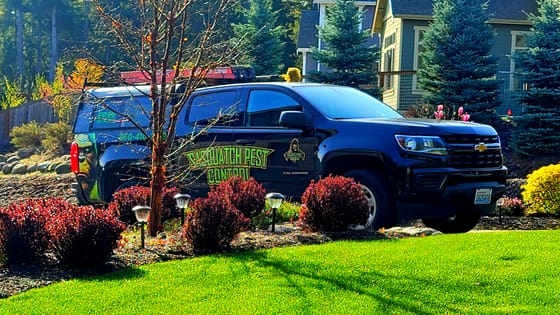
Irrigated beds against warm walls. A drip line or a spray head keeping a bed damp against the foundation, under bark mulch that never fully dries, produces exactly the conditions odorous house ants and pavement ants want. They then enter along the slab edge, through the sill, or via one of the penetrations above, and appear in a kitchen. In spring this is the single most common call we take from this neighborhood.
Mulch and grade. Bark piled above the siding line puts moisture against material that was never meant to sit in it, and provides a covered approach right to the wall.
Young trees and shrubs planted close. They are small at handover and nobody thinks about them. Five years later a branch is touching a roof and a shrub is pressed against a vent.
Landscape timber and retained beds. Softening timber is carpenter ant nesting material, and on a newer lot it is frequently the only such material available, which makes it the parent colony site by default.
The corrections are landscaping decisions rather than pest treatments: pull mulch back off the foundation, leave a dry band at the base of the wall, adjust heads that spray the building, and keep planting off the siding. Where a homeowner or an HOA makes those changes the treatment holds. Where they do not, we are back next spring, and we would rather say that than take the repeat booking quietly.
The open ground behind the fence
Cordata still has undeveloped parcels, greenways, retention ponds and agricultural land at its edges, and properties backing onto any of those are on a different footing from those in the middle of a finished phase.
The population out there is permanent. Nothing applied to your property reduces it, and any company suggesting otherwise is selling something. What it does is supply continuous pressure against the buildings on the boundary.
Two events concentrate it. When adjacent open ground is cut, cleared or built on, cover disappears over a matter of days and everything living in it looks for the nearest structure. And when the autumn rain saturates the ground and floods burrows, the same thing happens on a larger scale.
That makes late summer the decisive window for anyone on the edge of a phase — dry ground, dry crawlspaces, easy exterior access, and the movement still weeks away. A house sealed in August does not have the winter problem at all.
Retention ponds and swales deserve a specific mention. They are wet, vegetated, undisturbed and usually nobody’s individual responsibility, which makes them good habitat sitting inside a residential area. They also produce insects in quantity on summer evenings, which is why houses near them see more spiders on the water-facing elevation.
Apartment complexes
A large share of Cordata is purpose-built rental housing, much of it near the college, and multi-unit work follows different rules from a single house.
Once walls and plumbing are shared, you are dealing with one population across the whole building. Wall voids, plumbing chases, shared attics and common service runs connect units, and insects use them without regard to who holds which tenancy.
Treat one apartment thoroughly and the population next door is untouched. It moves back. The resident concludes the treatment failed and the manager concludes the resident reintroduced it, and neither is right — the scope was wrong.
What resolves it is a coordinated plan: establish which units are affected, identify the likely source, treat in one pass rather than as separate call-outs, and follow up on an interval matched to the insect rather than to the billing cycle.
The practical advantage in Cordata is that these are mostly larger managed buildings with one owner or one management company. That means one decision-maker and one schedule, which makes a building-level plan far easier to arrange than it is in a neighborhood of individually owned divided houses. When a manager will authorize it, the result is genuinely different rather than marginally better.
Bed bugs are the clearest case. There is real turnover in this rental stock, turnover moves furniture, and furniture is how bed bugs travel. It is a transport problem rather than a hygiene one, and any property with regular turnover is exposed regardless of how well it is kept. Managers who accept that and build detection into the turn between tenancies do dramatically better than those who treat each report as an anomaly.
The turn itself is the opportunity: an empty unit can be inspected properly and treated without coordinating around anybody, and it costs a fraction of dealing with the same problem three months later across several units.
Bed bug verification is the only assessment we charge for, and it comes off the treatment when you go ahead.
German cockroaches are the other. They arrive inside appliances, cardboard and kitchen equipment, they live in voids rather than on surfaces, and they breed faster than an unplanned schedule can knock back. In a block with shared kitchens and high turnover they need the same coordinated treatment and the same follow-up discipline.
Refuse in a managed building
If there is one physical change that moves rodent outcomes in this neighborhood, it is the shared refuse area.
Enclosures sized for fewer occupants than a building actually has. Gates that no longer close against the ground. Overflow left beside a container. Cardboard from online deliveries stacked rather than broken down and inside. Recycling that fills with rain and organic residue.
Each of those is a food supply available around the clock, and in a dense neighborhood the effect compounds across buildings. By October it is sustaining a population that then looks for somewhere dry, which is the buildings the bins belong to.
None of that is ours to fix, which is exactly why it goes in the report rather than getting quietly serviced around. A manager who corrects capacity, closure and collection frequency sees a difference within a season.
Wasps and newer construction
Newer neighborhoods produce more wasp work than older ones and the reasons are structural.
Vented ridges, continuous soffit venting and generous eave overhangs give sheltered cavities with easy access at exactly the height a founding queen wants. Young landscaping has not yet matured enough to compete for space or to obstruct approach. And the building lines are long and uniform, which means a lot of eave per property.
Yellowjackets also nest in the ground along the edges of lawns backing onto open ground, greenways and retention areas, which describes a great many Cordata properties. Those are the nests that cause genuine incidents, because they are invisible until a mower or a child finds them, and the colony peaks in late summer when everybody is outdoors.
The WSU Extension publications store is where the university puts its regional bulletins on yard and household pests, and it is a better starting point here than anything written for the East Coast.
The cheap intervention is a spring walk of the eaves and the lawn edges, when a founding nest is trivially dealt with. By August the same nest is a different conversation.
Medical, office and business park
Cordata carries a substantial amount of non-residential building, and those accounts are documented programs rather than visit schedules.
Access is the first constraint. Clinical and professional environments have areas that cannot be entered casually, hours that cannot be disturbed, and in some cases requirements about what may be placed and where. Those constraints shape the program rather than obstructing it, and a provider who treats them as an inconvenience is the wrong provider.
The useful survey starts outside: the loading area, the waste enclosure, the landscaping against the building, the drainage, and every service penetration. On a modern commercial building the interior findings are usually downstream of something exterior, and adding interior devices without addressing that is an indefinite cost.
Records matter here as much as results. Devices mapped, service history in a readable sequence, and findings written plainly — including the landscaping, housekeeping and maintenance items that are somebody else’s contract to fix.
The Cordata year
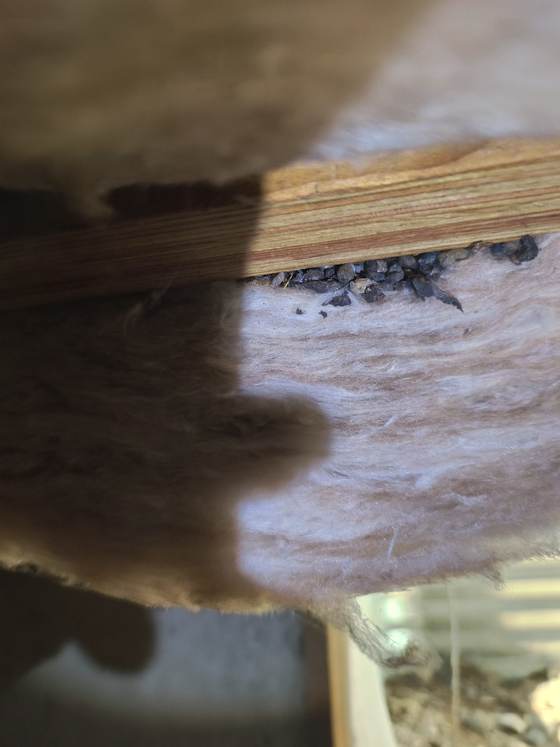
Winter. Rodent activity indoors at its height, and the season when autumn damage becomes visible: staining, chewed ducting, insulation disturbed, or a smell that is difficult to locate.
Spring. The ant call. Odorous house ants and pavement ants become active as soon as the ground warms, and in irrigated landscaping they frequently appear indoors before anyone has seen them outside. Wasp queens found nests, which is the cheapest possible moment to deal with them.
Summer. Wasp season, spider egg hatch, and the correct window for anything structural. In managed buildings it is also the heaviest turnover period, which makes it the right time to inspect units between tenancies.
Autumn. The decisive stretch. The rain returns, open ground saturates, and the population on the boundary moves toward buildings within a few weeks. Work done before this prevents the winter problem; work deferred becomes remediation.
Spiders, and the September calls
Giant house spiders bring the autumn calls here as everywhere in the city. They are harmless, they have been established across western Washington for generations, and the large fast ones people find indoors are wandering males searching for mates rather than anything seeking warmth.
No brown recluse has ever been recorded in this county, and Washington has no established population of them anywhere.
Exterior lighting matters more in a new neighborhood than most residents expect, because the fixtures are bright, numerous and uniform along the building lines. A light concentrates the insects spiders eat, and the spiders arrive to eat them. Changing a fixture or its color temperature frequently achieves more than a perimeter treatment would.
What we will not sell you
A guarantee about the field behind your fence. That population is permanent. We will seal your building, which is the part that actually works.
Quarterly service instead of a landscaping fix. If an irrigated bed against your wall is producing the ants, that is where the answer is, and we will say so even though it reduces what we can sell.
Single-unit treatment sold as a building solution. Where the population is shared, we say so before taking the work.
Anything with fur or feathers. Wildlife and birds are outside our scope. Insects and rodents are ours; for anything else we will give you a name to call.
How a visit here works
For a house we start outside and work the penetrations methodically — the vent, the bib, the line set, the electrical entry, the garage seal — then the grade and the landscaping, then the crawlspace or the attic depending on the phase, then inside. On a newer building that exterior walk usually finds the entire problem, and it is quick.
For a managed building or a commercial site we start with the manager and the constraints, then the exterior, waste and landscaping, then the affected units or areas.
Either way you get a plain account: what we found, what is driving it, what needs doing now, what can wait, and which items belong to a builder, a landscaper or a waste contractor rather than to us. On a five-year-old house that answer is frequently six penetrations and a bark bed, and telling you that is worth more than a service plan.
Assessment is free for every pest we handle except bed bug verification, and nothing here requires a term agreement.
Conditioned crawlspaces, and what changed
The newer phases here use sealed and conditioned crawlspaces rather than the vented ones that define most of Bellingham, and it is worth explaining what that actually buys you, because it is genuinely better and it is not a force field.
A conditioned crawl has a continuous sealed liner over the ground, insulation at the perimeter walls rather than between the joists, no open foundation vents, and often a small amount of conditioned air or a dehumidifier. The result is a space that stays dry, which removes most of the moisture-driven cast that fills our older-neighborhood pages: moisture ants, decay fungus, sowbugs and springtails all lose the conditions they need.
That is a real improvement and it is the single best thing about newer construction here.
What it does not do is exclude anything by itself. The liner is a vapor barrier, not armor, and a rodent that gets in through a rim penetration is now inside a warm, dry, sealed, undisturbed space with insulation on the walls. If anything, an animal that reaches a conditioned crawl is better housed than one in a vented one, and it is less likely to be noticed because there is no draft, no smell of damp earth and no reason for anybody to open the hatch.
So on these phases the exterior penetrations matter more rather than less, and the access hatch itself is worth checking — a hatch that no longer seats properly undoes a good part of the design.
Where a liner has been disturbed by a trade working under the house, we will say so. It is usually a cheap repair and it protects an expensive system.
Buying or renting somewhere new
A short note for anyone moving into this neighborhood, because the useful moment is early and almost nobody uses it.
The handover period on a new house, or the vacancy between tenancies on a rental, is when the exterior can be walked and the penetrations sealed without working around anybody’s furniture, schedule or landscaping. It takes an hour or two and it is the cheapest that work will ever be.
If a house is a year or two old and has never had that done, it almost certainly has the same handful of open penetrations as its neighbors, because the same trades built the row. That is genuinely useful to know — a problem in one house on a street is a reasonable prompt to check your own, and we will happily say what we found next door in general terms without naming anybody.
For a builder or a developer finishing a phase, sealing before handover is cheaper than warranty calls in the second autumn, and it is a straightforward addition to a punch list.
Frequently asked questions
Why does a brand-new house here get rodents?
Because the subdivision replaced open ground and the animals that lived on it are still local. The building is genuinely tighter than an old one, but a handful of service penetrations were closed with expanding foam, and foam stops drafts rather than teeth.
Our apartment complex treats units one at a time. Is that right?
For a rodent in a specific unit, often yes. For bed bugs or German cockroaches it is the wrong scope — they travel through wall voids and plumbing chases, so treating one apartment relocates the population. Those need a coordinated pass across the affected units.
Is the college a factor the way Western is in Happy Valley?
A smaller one, but real. There is turnover in the rental stock, and turnover moves furniture, which is how bed bugs travel. The difference is that here it is mostly larger managed buildings, which makes a coordinated response easier to organize.
We have irrigation and mulch beds. Do those cause ant problems?
They are usually the whole reason. An irrigated bed against a warm wall stays permanently damp and the bark never dries, which is close to ideal for the ants that then come in along the slab edge. Pulling mulch back and adjusting a sprinkler head does more than a treatment.
Why are there so many wasps in newer construction?
Vented ridges, continuous soffit venting and generous eave overhangs give sheltered cavities with easy access, and young landscaping has not grown in enough to compete for the space. Newer neighborhoods reliably produce more eave and soffit nests than older ones.
Do you work with medical and office buildings out here?
Yes. Those are documented programs built around access constraints and record-keeping rather than around a visit schedule, and the useful survey usually starts with the loading area, the waste enclosure and the landscaping rather than inside.
What does it cost to have you look?
Nothing, for every pest we handle except bed bug verification, which is charged and then taken off the treatment price. That includes walking the whole exterior, which on a newer building is where the answer usually is.
Pest problem in Cordata?
Family-owned, no long-term contracts, and every treatment is backed by our 100% Service Guarantee.
Most calls in Whatcom County are out within 1–2 days, about 3 during the late-summer peak.
Last updated