
Pest Control in Bow, Washington
Bow is open farm country running down to Samish Bay, and the work reflects it. Field rodents moving twice a year on the harvest and the rain, cluster flies by the thousand in sunny walls, older farmhouses with additions, and salt exposure on anything close to the water.
Call 360-410-2199 Request a free inspection
Bow on the map
Open ground, and what it means
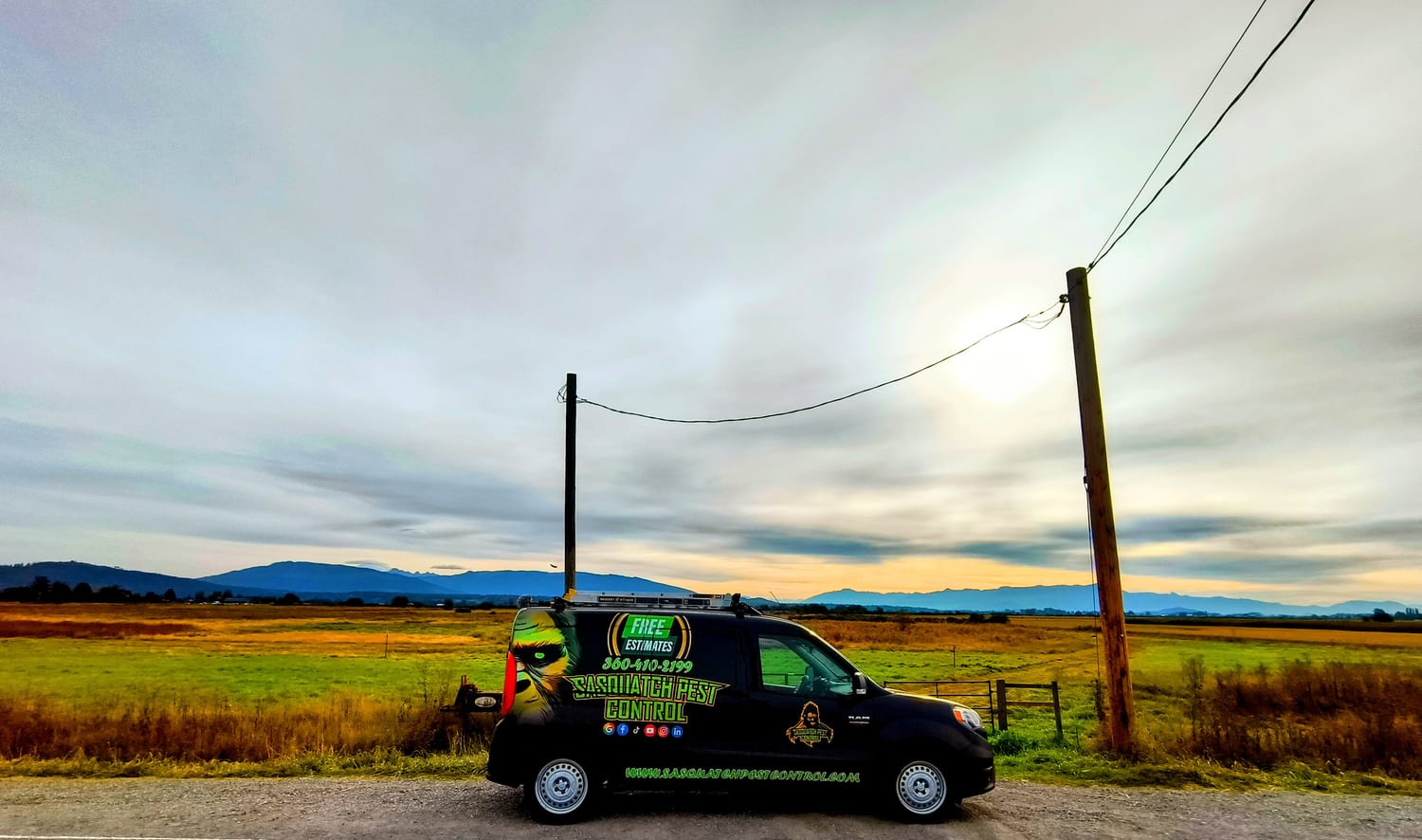
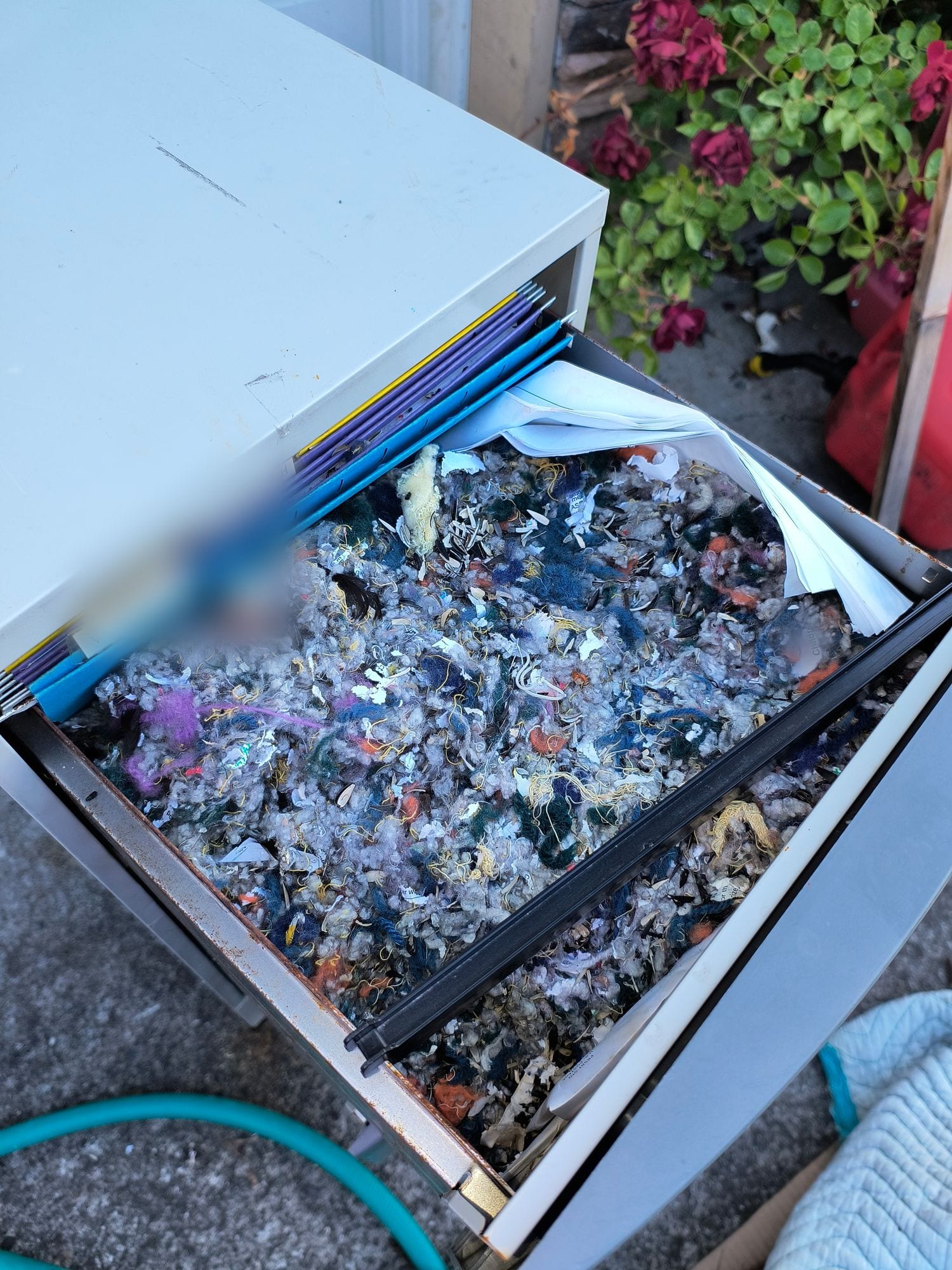
Bow is farm country. Open agricultural land through the Bow and Edison flats, running west to Samish Bay and rising into wooded ground along the Chuckanut edge, with scattered farmhouses, outbuildings and a small amount of village commercial.
That geography produces a very particular kind of pest work, and it is almost the opposite of what we do in a city. In Bellingham the problem is usually a building with a specific defect. Out here the building may be perfectly sound and still be under constant pressure, because it is standing in the middle of habitat.
The single most useful thing to understand if you live here: the population outside your fence is permanent. It is not going to be reduced, and nothing applied to your property will reduce it. What is achievable — and it is genuinely achievable — is making your buildings unattractive and properly sealed, which is a finite piece of work with an end point.
The harvest effect
This is the local mechanism that catches people out, and it has nothing to do with temperature.
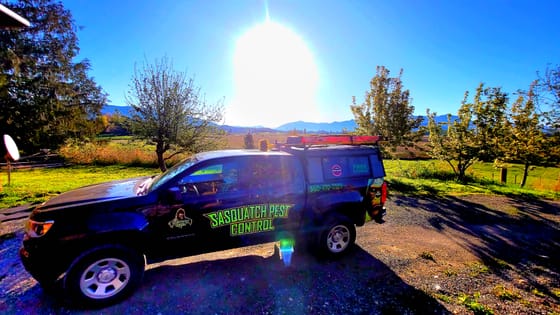
Open ground supports a large resident rodent population all season: voles, deer mice, house mice and Norway rats living in field margins, ditch banks, hedgerows and the crop itself. Nobody sees them and nobody has a problem.
Then a field is cut. Cover that existed in the morning is bare dirt by evening, and the entire population living in it needs somewhere else within hours. What is available is the nearest structure — your house, your shop, your barn.
Growers with a question about what is coming off the ground and when have WSU Extension’s Skagit County office down the road, and it is the right first call for the cropping side of this.
Then, a few weeks later, the autumn rain arrives, the low ground saturates, burrows flood, and it happens again with everything that was still outdoors. The monthly averages in NOAA’s US Climate Normals show how abruptly the wet season arrives in this valley.
So the rodent calendar here runs on cutting and rainfall rather than on cold, and the decisive weeks are September through November. Work done before that prevents the winter problem entirely. Work deferred to spring is remediation of a winter’s worth of damage.
Which is why we push exclusion in August out here harder than anywhere else. Dry ground, dry crawlspaces, easy exterior access, and the movement still weeks away.
Cluster flies, the classic Bow phone call
If you live surrounded by pasture and your windows fill with slow, clumsy, dark flies on the first mild afternoon of the year, you have cluster flies, and they are the most misunderstood pest in this kind of country.
They do not breed in your house. They have nothing to do with your rubbish, your drains or your housekeeping. The larvae are parasites of earthworms in the surrounding fields, which is exactly why the more pasture and cropland around a building, the worse it gets. A farmhouse in the middle of open ground gets them badly and it is not a reflection on the house.
The seasonal pattern is simple. In late summer and early autumn the adults look for somewhere to overwinter and choose the warmest available surface, which is a south or west-facing wall in afternoon sun. They enter through gaps in the siding, around window frames, under fascia, through unscreened gable and soffit vents, and settle into the wall void, the attic or the space behind trim to go dormant. On a warm day they wake, head for the light, and emerge on the interior side.
By February, killing the ones in the room accomplishes very little. There are thousands more in the wall and they will keep emerging on every sunny day until spring.
The work that matters happens in late August and September, on the outside: sealing the gaps, screening the vents, and treating the sunny elevations before they move in. Do that and the following February is quiet. Stink bugs and lady beetles follow the same pattern and respond to the same work.
Farmhouses and their additions
Much of the housing here is old, and nearly all of it has been added to.
That matters more than the age itself. Every addition created a junction between old framing and new — at the roofline, at the rim joist, where a new floor meets an old one, around whatever services were rerouted at the time — and those junctions are rarely sealed as well as either section is on its own. On a farmhouse that has grown three times over a century, there are a lot of them.
Underneath, the usual regional pattern: shallow crawlspaces over bare earth, vapor barriers that are absent or have been pushed aside, foundation vents whose screens failed decades ago, and framing that has taken water somewhere and now supports moisture ants.
The porch, the mudroom and the utility addition are worth specific attention. They are commonly the least well built parts of a rural house, frequently on piers or a shallow slab, often with the crawl access inside them, and they are where we find entry points more often than anywhere else.
Outbuildings, honestly
Every property here has them and the honest position is worth stating.
A pole barn with a gravel floor and a roll-up door was never going to be rodent-proof, and quoting as though it could be sealed is how somebody ends up disappointed by a program that could never have delivered.
The realistic hierarchy is: close the buildings that can genuinely be closed, protect what matters inside the ones that cannot, and monitor rather than pretend.
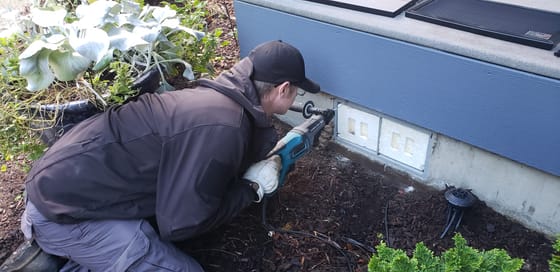
Feed is the pivot. Grain, pellets, seed and pet food in open storage will support a population indefinitely, and nothing we apply overcomes an unlimited food supply. Metal bins with tight lids, spillage cleaned rather than swept into a corner, pallets kept off the wall so runways stay visible, and a door that closes against a proper threshold are worth more than any product. On properties where that happens, everything else we do works.
Wiring is the priority that persuades. Damage to shop electrics, control panels and the harness on machinery parked for the season is expensive and occasionally dangerous. A warm engine bay full of insulation is exactly what a rat wants in November, and the bill for a rewired harness is the number that convinces a skeptical owner a program is worth having.
Placement is constrained. Anything used has to sit where livestock, poultry, barn cats and working dogs cannot reach it, which in practice means tamper-resistant stations anchored on the exterior and mechanical control inside. Where we use rodent control products at all we choose programs and active ingredients selected to limit secondary poisoning risk — this is raptor country, and the owls and hawks working these fields are doing free work we would rather not undermine.
Stored-product insects
Common on farm property and routinely misdiagnosed as a building problem.

Beetles and moths in grain, seed, flour, pet food and animal feed arrive inside the product rather than through a door. Treating a building perimeter for an insect that came in on a pallet accomplishes nothing, and money gets spent that way regularly.
The work is tracing back to the source: starting with whatever has sat longest and furthest back, checking spillage in seams, under racking and in the corners of a feed room. It is usually a single forgotten sack or an old spill that has been quietly producing adults for months. After that it is rotation, sealed containers, cleaning the residue out, and monitoring long enough to be sure.
The bay side and the exposure
Properties closer to Samish Bay pick up a set of coastal factors that inland Bow does not.
Salt and wind work on the building envelope continuously. Vent screens corrode. Fasteners fail. Sealants degrade. Trim and flashing loosen. Every one of those is an entry point, and out there they open considerably faster than they do a few miles inland.
That drives our material choices rather than our method. Ordinary galvanized hardware cloth is not adequate in that exposure — it corrodes, and an exclusion that fails in three winters was money wasted. Stainless mesh, appropriate fasteners and sealants specified for coastal use cost more at the outset and are the only version of the job worth doing. We would rather quote the durable specification and explain why than win the work with a cheaper one.
Wind-driven rain is the other factor. It goes into assemblies designed for rain that falls downward, which is how a wall on a weather elevation ends up persistently damp and supporting moisture ants in framing that looks fine from inside.
The Chuckanut edge
The western and northern edge of the area rises into wooded ground, and property up there behaves like forest edge rather than farmland.
Carpenter ants in softened cedar, with the parent colony out in a stump, a dead limb or a woodpile rather than in the house. Rodents using continuous cover to reach the buildings. Heavier spider and centipede pressure, driven by abundant insect production in damp wooded ground.
The fix is at the interface: trim the branch bridging to the roof, screen the vents properly, close the gap where a deck meets the house, and move the firewood off the wall. Firewood deserves the same mention it gets everywhere rural — stacked against a building it is harborage, it holds moisture, and it is frequently the carpenter ant parent colony we have been looking for.
The small commercial side
There is a modest amount of food and hospitality business through the area, and seasonal trade around it.
Seasonal operations deserve a program that scales with the season rather than an identical monthly visit year-round, which overserves the quiet months and underserves the busy ones. Waste handling is where most of the available progress sits, as it usually is with food service — a bin that cannot be closed or cardboard staged outside will support a rodent population that no service schedule overcomes.
Buildings in open country also get the full autumn movement described above, which for a commercial kitchen means the exclusion work needs doing before September rather than after the first sighting.
What we will not sell you
Wildlife of any kind. Birds, bats, squirrels, raccoons and everything else with fur or feathers are outside our scope. We do insects and rodents, and on a farm property we will tell you plainly which you have and who handles the rest.
Mole trapping. Constant request on open ground and not something we do. The methods that actually work are restrictively regulated in Washington, and most of what is sold to homeowners is theatre.
A rodent-free farm. Nobody can deliver one. What we quote is control over where the population is allowed to be and protection for the things that cost money when they are damaged.
A recurring program on top of an open feed supply. If the grain is in an open sack in an open shed, we are managing a symptom forever and we will say so at the first visit rather than the fourth.
Fly pressure where there is livestock
Where there are animals there are flies, and on a working property it is a production issue rather than a comfort one.
House flies breed in moist decaying organic material — manure packs, spilled silage, wet bedding, feed fermenting at the edge of a bunk — and move between waste and feed. Stable flies bite, taking blood from the legs of cattle, and a heavy population measurably reduces intake because animals spend the day stamping and bunching instead of eating.
Both develop fast. In warm weather the cycle from egg to adult runs a week to ten days, which means a breeding site missed on Monday is producing adults before the weekend. That short cycle is why fly programs succeed or fail on the sites rather than on the adults, and why a program built on knockdown alone quietly stops working every summer.
The sites are usually a small and predictable number: the wet margin of a manure pack, the ground under a leaking waterer, feed accumulating at the end of a bunk, bedding that has not been turned, the drainage low point that never dries. Finding and correcting those does more than any spray schedule, and on the operations where we get real results it is because somebody agreed to change a management practice rather than because we applied something new.
Where treatment has a place it is as support — targeted work on resting surfaces rather than blanket application, baiting placed away from feed and water, and attention to resistance, because rotating nothing is how a program stops working after two seasons.
Spiders and the domestic list
The household side out here is the standard regional set, with rural emphasis.
Giant house spiders bring the autumn calls, and the answer is reassuring: they are harmless, long established in western Washington, and the large fast ones are wandering males rather than an infestation. There is no brown recluse in this corner of the state. Exterior lighting on a rural house concentrates the insects they feed on, so a fixture change frequently does more than a treatment.
Silverfish, sowbugs and millipedes belong to the damp crawl and are reporting moisture. Wasps peak from late July, and on open ground a yellowjacket nest in a bank or under equipment is a genuine safety problem rather than a nuisance, because it is invisible until something disturbs it.
Ants, and reading them correctly
Two ants matter on farm property and the distinction changes everything.
Moisture ants colonize wood that is already wet and already decaying. They cannot establish in sound dry lumber, so finding them is genuinely useful information rather than merely a problem: the water is the disease and the ants are the symptom. On a farmhouse the source is usually a gutter that has been overflowing down a wall for years, a downspout discharging at the foundation, siding in contact with soil, or a porch addition with no flashing worth the name. Treat the ants without correcting that and a new colony arrives in the same timber within a season or two.
Carpenter ants prefer wood that has begun to soften and keep a parent nest outdoors — a stump, a fence post, a landscape timber, a woodpile. The satellites inside the building are what people see, and treating those while the parent sits untouched is why this work gets a reputation for returning.
In spring, winged carpenter ants get mistaken for termite swarmers constantly. The quickest tell is the waist: an ant is sharply pinched through the middle and a termite is not. After that, look at the antennae — elbowed on an ant, straight and beaded on a termite. Correct identification is the cheapest thing we do on a visit and it changes the entire approach.
How we work in Bow
Bow sits on scheduled route days rather than same-day availability, though being on the corridor makes it straightforward for us to reach.
On a working property we start with your operation — where we may drive, what may be placed and where, and what your calendar looks like — because those shape everything after them. On a house we start outside with grade and drainage, the vents and penetrations, the additions and their junctions, the firewood, and what the surrounding ground is doing.
Then underneath, properly and with a light, which on a rural house is nearly always where the answer is. Then the attic and the interior.
You get a plain account: what we found, what is causing it, what needs doing now, what can wait, and which items are a repair or a housekeeping change rather than a pest treatment. If the single biggest available improvement is a lid on a feed bin or a downspout moved three feet, that is what we lead with, before anything we would be paid for.
Inspections are free for every pest we handle, with bed bugs the one exception, and there is no long-term contract.
Frequently asked questions
Why does my house fill with slow flies in February?
Cluster flies. They spent the winter dormant in your south or west-facing wall and woke on the first mild afternoon. They breed in earthworms out in the fields rather than anywhere in your house, which is why this is a rural problem and why the fix is exterior work in late summer.
Why do rodents arrive all at once in autumn?
Two things happen close together. Cutting a field removes cover overnight, so everything living in it goes looking for the nearest structure. Then the rain floods the low ground and does it again, harder. Those few weeks decide what your winter looks like.
Is Bow actually on your routes?
Yes. It sits on the corridor between Bellingham and Mount Vernon, which makes it part of a run we already drive rather than a detour. We cover it on set route days, not same-day.
Does being near the bay change anything?
It changes the materials. Salt and wind corrode vent screens, fasteners and any previous exclusion work far faster than they do a few miles inland, so anything we install out there is specified for the exposure. An exclusion that fails in three winters was never worth paying for.
Do you work on farms and outbuildings here?
Yes, and most of the property out this way has some. The realistic goal is protecting the feed, the wiring and the buildings that can genuinely be closed, rather than promising a rodent-free barn, which nobody can deliver.
My farmhouse has been added onto several times. Does that matter?
It is usually where the entry points are. Every addition created a junction between old framing and new, and those junctions are rarely sealed as well as either section on its own. We look at them specifically.
Is the visit free?
Free for every pest we handle, bed bugs excepted — those carry a verification fee credited against treatment if you go ahead. On a working property we will look at the outbuildings as well as the house.
Guides
From the blog
Pest problem in Bow?
Family-owned, no long-term contracts, and every treatment is backed by our 100% Service Guarantee.
Most calls in Whatcom County are out within 1–2 days, about 3 during the late-summer peak.
Last updated