
Stink Bug & Overwintering Pest Control in Whatcom County
Stink bugs, boxelder bugs and conifer seed bugs all do the same thing: gather on warm south and west walls in October and work into the building to overwinter. They do not breed indoors, bite, or damage anything. The fix is sealing the gaps in late summer, and the treatment window closes once they are inside.
Call 360-410-2199 Request a free inspection
Overwintering bugs: the job at a glance
| What it covers | Stink bugs, boxelder bugs and conifer seed bugs that overwinter in walls and attics |
|---|---|
| Included | Exterior treatment on the walls they gather on, plus sealing windows, siding laps, soffits, vents and penetrations |
| Not included | Treating inside wall voids, which leaves dead insects that feed carpet beetles |
| Timing | Late August into September, before they gather; by November they are already inside |
| What it costs | Priced by how much wall and how many gaps need work; free estimate |
One behavior, several insects
Four different insects generate almost identical calls in this county every autumn, and they all want the same thing.
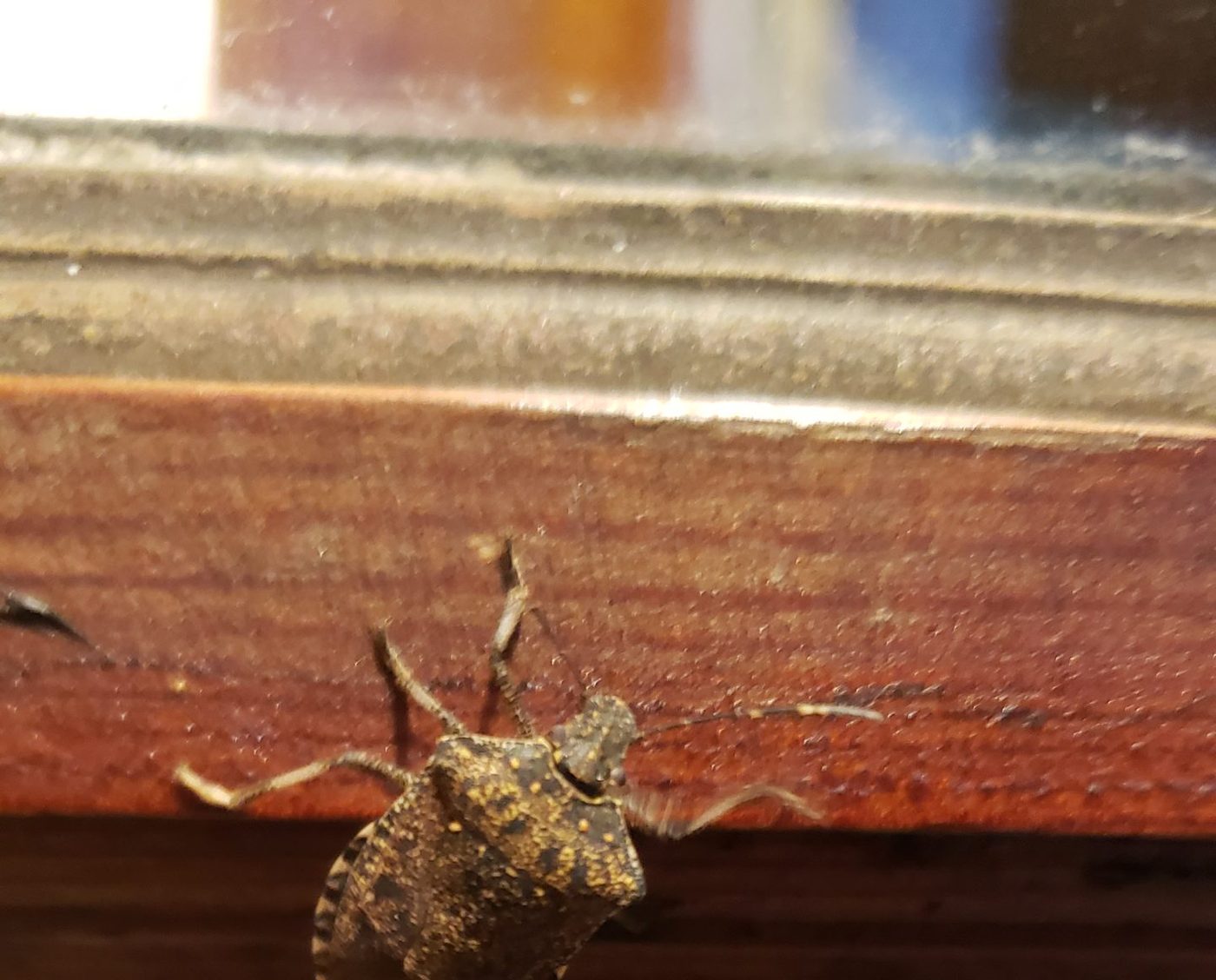
Brown marmorated stink bug. Shield-shaped, mottled brown, with distinctive alternating light and dark bands on the antennae and along the abdominal edge. Invasive, agriculturally significant, and established in Washington — though at an earlier stage of that than the mid-Atlantic news coverage suggests. There is a fuller account of what the state and county records actually say further down.
Western conifer seed bug. Long, narrow, brown, with noticeably flared hind legs. Native, associated with conifers, and a strong flier that lands with an audible thump. Frequently mistaken for a stink bug and occasionally for something far more alarming.
Boxelder bug. Black with distinct red or orange markings, gathering in large aggregations on sunny walls. Associated with boxelder and other maples.
Cluster flies, which behave identically and get their own treatment on the fly control page.
Different insects, one problem. In autumn they need somewhere sheltered to pass the winter, and a heated building with gaps in it is the best option available.
What actually happens
The sequence is the same every year and understanding it tells you when to act.
Late September and October. As nights cool, adults seek warmth. They locate it by temperature, which is why they mass on the elevations that hold afternoon sun — south and west walls, and particularly large unshaded ones. On a warm October afternoon a wall can be covered.
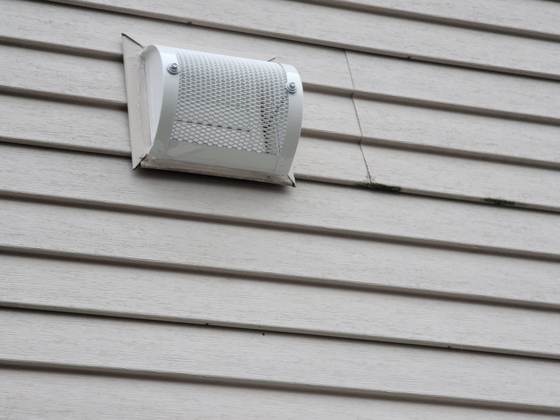
They work inward. Not by chewing — they have no capacity for that — but through gaps that already exist: around window and door framing, under siding laps, at soffit returns, through attic and gable vents, around utility penetrations, and under loose flashing. The openings they need are small.
They overwinter in the voids. Wall cavities, attics, and the spaces above ceilings, largely inactive. Most of the population is never seen.
They emerge on warm days. A mild spell in December, or the first real warmth of spring, raises the temperature in those voids. Some wake, become active, and move toward light — which means your windows, your light fixtures, and the inside of your house rather than the outside.
That last step is why people believe they are breeding indoors. They are not. Every insect appearing at your window in February entered the building the previous October.
And in spring the survivors leave, heading back outdoors to feed and breed. Nothing about the indoor phase involves reproduction.
What they do not do
Worth being explicit, because these calls come with more alarm than they warrant.
They do not bite or sting. They do not carry disease. They do not feed on anything inside a house — no food, no fabric, no timber, no paper. They do not damage the structure. They do not reproduce indoors. They do not infest in the sense that word usually carries.
What they do is arrive in quantity, which is genuinely unpleasant when the quantity is in the hundreds, and produce odor when disturbed or crushed.
We say this plainly because an aggressive and expensive treatment is easy to sell against a wall covered in insects, and it is mostly not the right purchase.
The odor, and why not to squash them
Stink bugs earn the name. Disturbed or crushed, they release defensive compounds that are strongly unpleasant and persistent, and on some surfaces the fluid stains.
So the working advice is: vacuum, do not crush. And for stink bugs specifically, use a vacuum you can empty outside immediately, because the odor transfers into the canister and then into every room you subsequently vacuum. A stocking or filter insert in the hose, discarded afterward, is the tidy version.
Boxelder bugs stain too — their crushed bodies leave marks on light-colored walls, curtains and upholstery.
Conifer seed bugs also produce an odor, milder than a stink bug’s.
Why we will not treat inside the walls
This is the most important thing on the page from a service standpoint, and it is a case where the obvious-sounding solution is the wrong one.
People frequently ask us to treat the wall voids where the insects are overwintering. We decline, because a treatment that kills a large aggregation inside a cavity leaves the bodies there.
A substantial accumulation of dead insects in a wall void is food. It attracts dermestid beetles — carpet beetles and their relatives — which develop in the accumulation and then move inward into the living space, where they damage textiles, carpets and stored natural fibers. Households that have a wall void treated for overwintering insects sometimes end up with a carpet beetle problem the following year, and that one genuinely does damage things.
So the honest answer once they are inside is unsatisfying but correct: vacuum the ones that appear, tolerate the season, and do the exclusion work in late summer so next winter is different.
The treatment that does work, and when
Exterior application in late summer, applied to the elevations they gather on before they arrive, does reduce how many get in. Timing is everything — it has to be in place before the aggregation starts, which in this county means late August into September. The same application in November is treating a wall the insects have already passed through.
One caveat on that exterior application: it is a residual sitting on siding, and siding here gets rained on. Autumn weather shortens how long it stays effective, which is another reason the sealing is the half that keeps working after the product has gone.
Exclusion is the durable half, and it is the one that keeps working. The gaps these insects use are the same ones that admit cluster flies, and closing them is exclusion and repair work: sealing around window and door framing, at siding laps and trim junctions, screening attic and gable vents with intact material, closing soffit returns, and sealing utility penetrations.
Because these insects are small and do not chew, sealant and screen are sufficient here — this is one of the few exclusion jobs where hardware cloth and sheet metal are not required.
And it overlaps with the rodent window. The right month to seal a house against overwintering insects is the same month to seal it against rodents moving in with the rain. One project, several problems, which is why we schedule this work in August and September.
Brown marmorated stink bug, specifically
Worth separating out because it is the one with a story beyond nuisance.
It is invasive and agriculturally significant. It feeds on a very wide range of hosts and damages tree fruit, berries, grapes, hazelnuts and vegetable crops by feeding on developing fruit, causing dimpling and corking that renders produce unsaleable.
It is also established in Washington, and that word deserves more care than it usually gets. WSU’s tree fruit entomology program, which keeps the state record, had the species in 30 counties by December 2022, concentrated along the I-5 corridor. Locally the picture is thinner and more recent than that number implies. The survey published in WSU’s Whatcom Ag Monthly turned up fewer than ten adults and no nymphs at all in Whatcom County in 2017, and its authors inferred local establishment largely from the confirmed populations across the line in British Columbia rather than from what they caught on this side of it.
So the accurate description is a species still filling in its range rather than one that has finished. That is a long way from the mid-Atlantic states, where covered walls became a routine autumn event within a few years of arrival, and it is why the count on a Whatcom wall in October is usually tens rather than the hundreds people have read about.
It is also why a sighting here is worth reporting. WSU builds the Washington distribution map from what the public sends in: a photograph, a general location and the address it was found at, to tfrec.reportBMSB@wsu.edu. Whatcom Ag Monthly adds that a suspect insect can be taken to a local extension office instead. When the county record rests on a survey that found single figures, one clear photograph from a kitchen window is a real contribution to a map that growers use, and it costs a minute.
That matters here because Whatcom County grows things. For a berry or tree fruit operation this is a production pest rather than a household nuisance, and the management conversation is entirely different from the one a homeowner in Bellingham needs.
For a homeowner: it is still just a bug on a wall in October, and the advice above is the whole advice.
If you are growing commercially and seeing them in numbers, that is worth discussing with WSU Extension as well as with us, because the monitoring and management guidance for agricultural settings is theirs and it is better than anything a pest control company should be improvising.
Around the county
Newer construction on open ground — Barkley, Cordata, King Mountain, and the newer stock around Ferndale and Lynden. Large unshaded south and west elevations are exactly what these insects locate, and modern housing frequently has more uninterrupted sunlit wall than older stock. The sealing is straightforward because the detailing is better.
Older city neighborhoods — Lettered Streets, Columbia, Sunnyland, York. Smaller elevations but far more gaps: original window framing, siding that has moved, unsealed soffits and penetrations added over a century. Fewer insects landing, more of them getting in.
The agricultural corridor — Lynden, Everson, Nooksack, Sumas. Both the household version and the production version, and boxelder bugs in quantity where maples are present.
Lake Whatcom’s wooded shoreline — Sudden Valley, Silver Beach, Edgemoor. Western conifer seed bugs dominate here for the obvious reason, and they are the species most often reported as something more alarming than they are.
Waterfront and seasonal — Blaine, Birch Bay and Semiahmoo. Houses closed up through autumn accumulate populations with nobody to notice, so owners return in spring to windowsills full of them.
What it costs
Quoted from the property, and priced as what it actually is: an exterior treatment plus sealing, scaled to how much wall and how many gaps.
The honest framing is that this is prevention rather than remediation. Money spent in August prevents a winter. Money spent in December buys a vacuum’s worth of relief and does not change what is already in the wall.
If you call us in midwinter with insects at every window, we will tell you that. We will book the exclusion work for late summer, and we will not sell you an emergency treatment that cannot deliver what the situation implies.
The estimate is free.
What you can do
Vacuum rather than crush, and empty it outside.
Seal in late summer. Windows, doors, siding laps, vents, penetrations. It is the entire solution and the timing is the whole trick.
Screen the vents — attic, gable, soffit and dryer — with intact material.
Fit or repair door sweeps and weatherstripping.
Cut back vegetation touching south and west walls, which gives them staging and shelter against the elevation.
Do not bug bomb. Total-release foggers do not reach wall voids, and killing insects in the cavity creates the dermestid problem described above.
Do not use exterior insecticide in November hoping to catch them. They are already in.
Telling them apart
Four insects, one behavior, and the identification only matters for the odor and for the agricultural question.
Shield-shaped, mottled brown, banded antennae — brown marmorated stink bug. The alternating light and dark bands on the antennae and along the edge of the abdomen are the reliable marks, because several native stink bugs look broadly similar and are not the invasive one.
Long and narrow, brown, with flared hind legs — western conifer seed bug. The flattened, leaf-like expansion on the hind leg is unmistakable once seen. Strong, noisy flier, and the species most often reported to us as something alarming.
Black with red or orange lines, gathering in dense groups — boxelder bug. Nymphs are bright red and cluster on sunlit surfaces in numbers, which alarms people more than the adults do.
Dark, hairy, sluggish, and a fly rather than a bug — cluster fly. See fly control.
None of them bites. None of them damages the structure. The only practical difference between them indoors is how badly they smell when crushed, and the answer for all four is to vacuum rather than find out.
Why the same house every year
Because nothing about the building changed.
These insects find warmth, and the elevation that held sun last October holds it this October. The gaps they used are still there. And for some species there is evidence of aggregation cues — chemical signals left by previous gatherings that make a site more attractive to the next generation, which is part of why a particular wall becomes reliably the wall.
The practical implication is encouraging rather than depressing: it makes the problem predictable. If a house had them last winter it will have them this winter, which means the sealing work can be scheduled in August on the basis of last year’s experience rather than waiting to see.
It also means the improvement is durable. Unlike a treatment that has to be repeated, a sealed elevation stays sealed, and the year after a proper exclusion job is usually dramatically different.
The overwintering calendar
August. The window opens. Nothing has gathered yet, the weather is workable, and this is when exterior treatment and sealing both do their most good. If a house had a problem last winter, this is the month to act on it.
September. Still workable, and the last comfortable point. Gathering begins late in the month in a warm year.
October. Peak aggregation. Walls covered on sunny afternoons, and insects working inward daily. Treatment now catches some of what is still outside and none of what is already in the cavity.
November and December. They are in. Nothing useful is applied to a wall at this point. First warm spell produces the first indoor appearances.
January and February. The confusing months, when a mild week wakes part of the population and people find insects at windows in the middle of winter with no apparent source.
March and April. Emergence in earnest as the voids warm, then departure. The population leaves on its own to feed and breed outdoors.
May through July. Absent from buildings entirely. A good window for the sealing work if late summer is not convenient, though August remains the ideal.
The shape of it is simple: the problem is created in a four-week window in autumn and experienced across five months of winter. Acting in the window is the entire strategy.
What people try that does not work
Bug bombs and foggers. They do not reach wall voids, which is where the population is. What they do reach is the living space, which is where the population is not. And on the rare occasion they do kill an aggregation in a cavity, that produces the dermestid problem described above.
Ultrasonic repellers. No effect, sold in volume.
Sealing in November. Understandable and counterproductive. The insects are already inside, and closing their exits keeps them there for the whole winter instead of letting some leave on warm days.
Treating the interior. These insects are not feeding indoors and are not traveling treated surfaces in any consistent way. Interior application achieves very little and puts product where people live for no benefit.
Waiting to see if it happens again. It happens again. The building has not changed, and a house that gathered them last October will gather them this October.
Screening only the obvious vents. They use gaps far smaller and less obvious than a vent — a lifted siding lap, the gap where a window frame meets the sheathing, a soffit return that was never closed. A partial seal produces a partial result.
If it is a rental
Worth a note, because these calls come from tenants as often as owners and the answer is usually structural.
The gaps that let overwintering insects in are a building condition, not a housekeeping one, and no amount of tenant behavior changes them. A tenant cannot seal siding laps or screen a gable vent, and a tenant treating the interior achieves nothing for the reason described above.
So the useful conversation is with whoever controls the building envelope. For a managed property that generally means the owner or the management company, and the work belongs in the same category as any other exterior maintenance.
The good news for an owner is that it is a one-time job with a durable result, and it closes the same gaps that admit rodents and cluster flies — so a single late summer project reduces three sources of tenant complaint at once.
Related work
Cluster flies do the same thing on the same schedule and are handled on the fly control page. The sealing work is exclusion and repairs, best done alongside the rodent-season sealing in late summer. If what you are finding is small, dark and damaging your carpets or clothing rather than just sitting on a window, that is beetle and pantry pest control and it is a genuinely different problem.
Frequently asked questions
Why do they pile onto one wall of my house every October?
They are looking for a warm, sheltered place to spend winter, and they find it by heat. South and west elevations hold afternoon sun longest, so that is where they gather before working into gaps around siding, windows, soffits and vents. It is the same wall every year for the same reason.
Are they doing any damage inside?
No. They do not breed indoors, they do not eat anything in your house, they do not bite, and they do not damage the structure or your belongings. They are a nuisance of quantity rather than a risk, which is worth knowing before anyone spends money on an aggressive treatment.
Should I squash them?
Not indoors, and especially not brown marmorated stink bugs. The odor is genuinely unpleasant and lingers, and crushed insects can stain surfaces. A vacuum is the right tool — and for stink bugs specifically, use one you can empty outside immediately, because the smell carries into the canister.
Can you spray inside the walls where they are?
We will not, and it is worth understanding why. Killing a large number of insects inside a wall void leaves them there, and the accumulation attracts dermestid beetles and other scavengers that then move into the living space. The dead insects become a second, worse problem.
When is the right time to deal with this?
August and early September, before the gathering starts. Sealing gaps around windows, siding, soffits and vents in late summer prevents the entire following winter. Calling in November means the population is already in the wall, and the honest answer at that point is a vacuum and a plan for next year.
Are brown marmorated stink bugs a problem beyond nuisance?
For a house, no. Agriculturally, yes — they are an invasive species that damages tree fruit, berries and vegetable crops, and they are tracked for that reason. For a homeowner in Bellingham the practical issue is still just numbers on a wall.
Guides
From the blog
Stink Bug & Boxelder Bug Control in Whatcom County?
Family-owned, no long-term contracts, and every treatment is backed by our 100% Service Guarantee.
Most calls in Whatcom County are out within 1–2 days, about 3 during the late-summer peak.
Last updated