
Pest Control in Sudden Valley, Washington
Sudden Valley is 1970s cedar built into a working forest edge, inside the watershed that supplies Bellingham's drinking water. That combination sets the job: carpenter ants in softened cedar, rodents off the treeline, damp crawlspaces on sloped lots, and real restraint about what we put on the ground.
Call 360-410-2199 Request a free inspection
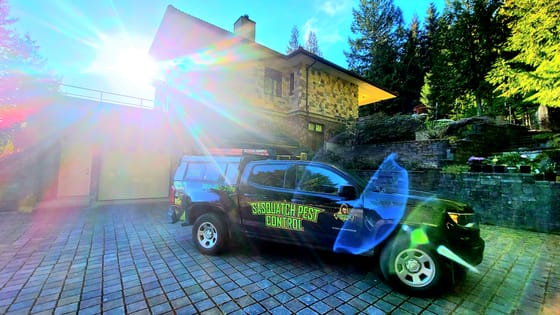
Sudden Valley on the map
Cedar, slope and forest
Sudden Valley is one of the most distinctive places we work, and its pest profile follows directly from three facts about how it was built.
It went up largely in the 1970s, as a recreational and second-home community around a golf course and a lake, on wooded and often steep ground. The construction of that era and that intent means cedar and wood siding, generous venting, split levels and daylight basements cut into slope, decks projecting over grade, and buildings placed deliberately close to standing timber because the trees are the point.
Fifty years on, most of it is full-time housing. The trees are larger, the cedar is weathered, and the same features that make the community attractive are the ones producing the work.
Carpenter ants, which are the signature problem
If Sudden Valley has one defining pest, this is it.
Carpenter ants do not eat wood. They excavate galleries in it to nest, and they strongly prefer wood that has begun to soften — which is precisely what weathered cedar trim, fascia, deck framing and the bottom edge of siding become after several decades in this climate.
The part that matters, and that most treatment gets wrong, is the colony structure. A mature carpenter ant population here almost always has a parent colony outdoors — in a stump, a standing dead tree, a fallen log, a landscape timber, a fence post, a woodpile — with satellite nests inside the structure. The satellites are what people see: workers on a counter, frass under a window, a rustling in a wall at night.
Treating the satellite while the parent sits twenty feet away in a stump gets you a quiet couple of months. That is the whole reason carpenter ant jobs develop a reputation for coming back.
So the work here is investigative before it is anything else. We are looking for the parent colony on the property: the stump nobody thinks about, the section of deck framing that stays wet, the dead limb over the roof, the timber retaining wall. Where we find it, the result holds. Where the parent sits on a neighboring lot or on common ground, we will say so plainly and plan around it rather than implying we have solved something we have not.
Frass is the useful diagnostic. Carpenter ants push out shavings, so the debris below a gallery is fibrous and often contains insect body parts. That is different from termite pellets and different from the fine powder a wood-boring beetle leaves, and the distinction changes the treatment entirely.
Mice, and why there are so many
Carpenter ants are the signature problem here, and mice are the volume one. Sudden Valley is houses set into standing woodland, and mouse pressure off woodland is a different order of magnitude from mouse pressure in a town — there is no edge to push back, because the forest starts at the deck. Deer mice come in off the trees and the ground cover, and they arrive in numbers rather than singly. The consequence for the work is that trapping alone is a treadmill here. The building has to be closed, or the woods simply send more.
The watershed, which constrains everything
Sudden Valley sits in the Lake Whatcom catchment, and Lake Whatcom is the drinking water reservoir for Bellingham and much of the surrounding area. A great deal of this community drains toward it.
We treat that as a real constraint on how we work rather than as something to mention and move past.
In practice it means we lead with exclusion, habitat modification and contained placements rather than anything broadcast, particularly on the lake side of a property. It means we pay attention to forecast rain before scheduling exterior work, because an application ahead of heavy weather in a catchment is a poor decision regardless of what the label permits. It means bait and rodent control products go in tamper-resistant, weather-protected stations rather than anywhere open. And it means that when the correct answer is a drainage correction, a regrade, a gutter repair or removing the wet timber that is feeding the problem, we say so, even though none of those is work we get paid for.
The raptor consideration reinforces the same approach. This is owl, hawk and eagle country, and those raptors hunt the exact population we are managing. Where we use rodent control products at all we choose programs and active ingredients selected to limit secondary poisoning risk to non-target wildlife and to pets, a point that matters more here than in most places.
None of this is a marketing posture. It is what working inside a drinking water catchment on a forest edge actually requires, and it is one of the clearer differences between a local crew and a route driver working a national script.
What the slope and the construction do
Steep lots change the building envelope in ways that matter.
A daylight basement means part of the foundation is buried and part is exposed, and the transition between them is where water and insects both find their way in. Sloped crawlspaces collect water at the low end and stay wet there long after the rest has dried, which is the classic moisture ant and decay fungus situation. Retaining walls and timber terracing hold moisture against structure and, when they are wooden and old, become parent colony sites in their own right.
Decks over grade create a sheltered, dry, undisturbed space underneath that is excellent harborage, and they attach to the house at a ledger — which in this housing stock is very frequently flashed badly or not at all. A poorly flashed ledger produces exactly the sustained wet framing that carpenter ants, moisture ants and decay fungus all require. It is the single most common structural defect we find in this community and it is worth checking on any house of this era.
Cedar shake roofs, where they remain, hold moisture and support moss, and the resulting damp roof deck is its own set of problems.
Working within the association
Sudden Valley is a covenanted community with an association, and exterior work frequently needs approval — vent covers, screening, netting, chimney caps and anything else that changes how a building looks from outside.
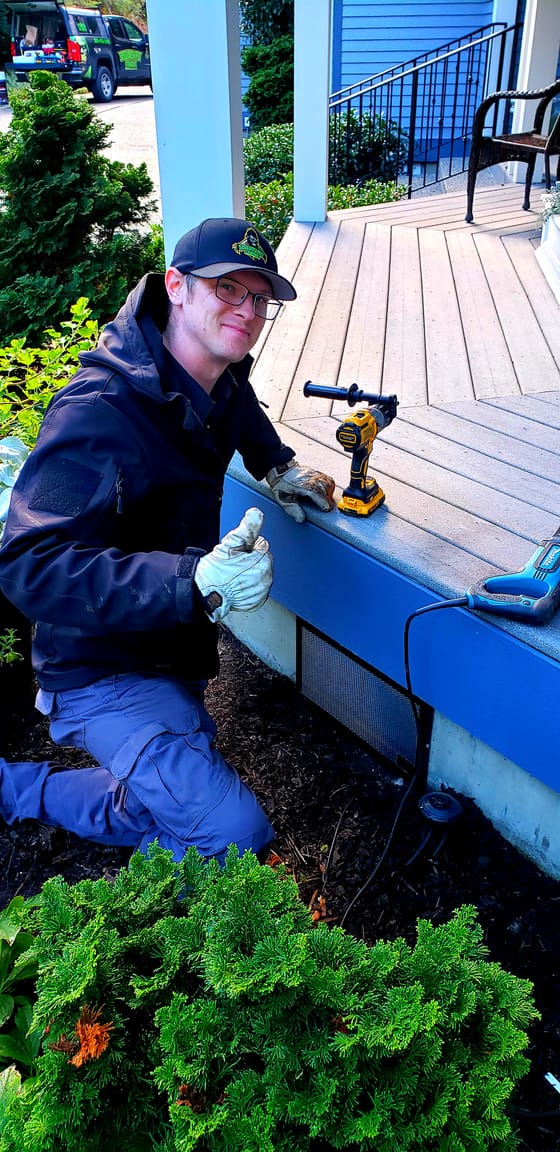
We are used to this and it is not an obstacle, but it does change the sequence. Tell us early if approval will be required, so we can specify the work in a form likely to be approved the first time rather than doing the paperwork twice. In most cases there is a way to do exclusion properly that is also visually acceptable, and where the choice is between an ugly effective solution and a tidy ineffective one we will tell you which is which and let you decide.
Where a problem originates on common ground rather than on your lot — a parent colony in a stump on a greenbelt, for instance — that is worth raising with the association, and we will set out the recommended work and its location in a form you can hand over. Where the organism is one of the wood-destroying group, note that a document recording findings of damage or infestation is a regulated report we do not issue; we will say so rather than hand the association something that resembles one.
Wasps and stinging insects on wooded lots
Wooded, sloped property generates a particular wasp problem and it is worth understanding before somebody meets it with a mower.
Yellowjackets nest in the ground, and on these lots the ground is banked, terraced, root-bound and covered in leaf litter — full of cavities. A nest in a slope beside a path or a driveway is invisible until it is disturbed, and late in the season a disturbed colony is a genuine medical problem rather than an inconvenience. They also take wall voids and the space behind skirting, entering through a gap in the siding or a failed vent screen.
Bald-faced hornets build the large gray paper nests people photograph, often in a tree or under an eave, and on a wooded lot they are frequently not noticed until the leaves come down.
Paper wasps under eaves, deck rails and in the corners of outbuildings are the mildest of the three, and where they are somewhere nobody goes we will often recommend leaving them alone rather than treating for the sake of it.
Oregon State runs the National Pesticide Information Center with the EPA, and its pest pages are a neutral place to read before anything gets applied in a watershed like this one.
The seasonal shift matters everywhere but especially here. Early in the summer colonies are feeding protein to brood and are largely uninterested in people. From late July they switch to sugar, the colony is at maximum size, and that is when they arrive at food on a deck and when defensive incidents happen.
The cheapest intervention by a wide margin is a spring walk of the eaves, decks and outbuildings, when a founding nest is the size of a golf ball.
The Sudden Valley year
Winter. Rodent activity indoors at its height, and the season when attic and crawlspace damage from the autumn becomes obvious — soiled insulation, chewed ducting, a stain in a ceiling.
Early spring. Carpenter ants become active, and because they have wintered inside damp framing the first sighting is usually indoors rather than out. Swarmers appear on windowsills and get mistaken for termites. Wasp queens begin founding nests, which is the cheapest possible moment to deal with them.
Late spring. Ant activity peaks and the moisture ants appearing indoors are reporting a water problem rather than an ant problem. On these sloped lots that usually means the low end of a crawlspace or a deck ledger that was never flashed properly.
Summer. Wasp season, spider egg hatch, and the correct window for everything structural. Dry crawlspaces, dry ground, and access to the exterior at its easiest. Anything preventive should be scheduled here.
Autumn. The busiest stretch. The rain returns and rodents move off the forest edge toward buildings within a few weeks. Spiders come indoors during the wandering season. Exclusion completed now is the difference between a quiet winter and a remediation job.
Rodents and the underfloor question
Rodent work here has its own character because of how the houses sit on the ground.
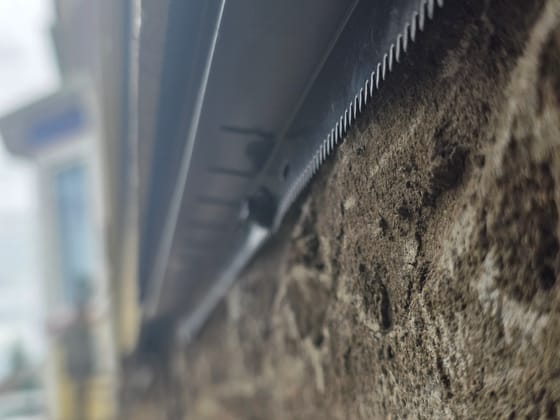
A daylight basement or a split level built into slope means the building meets earth on more sides and at more levels than a house on flat ground. Crawlspaces are often stepped, partly excavated and awkward to move through, and the low end holds water. Decks over grade give a sheltered approach right up to the structure. Utility runs enter at several elevations.
The result is that finding the entry point takes longer here than it does in town, and skipping that step is why so much rodent work on these lots fails. Placing traps where droppings were seen addresses the symptom. The animal is getting in somewhere, and on a wooded sloped lot that somewhere is frequently not obvious from standing height.
Insulation is the other recurring issue. A lot of the original 1970s insulation in this community has been supplemented, disturbed or partially replaced over five decades, and rodent-soiled insulation in a crawl or attic is both a contamination problem and an ongoing attractant. Where that is the situation the sequence matters: exclude first, remove and replace second. Doing it the other way round means installing new material into a building that is still open.
Deer mice specifically come off the wooded ground rather than from neighboring houses, which makes exclusion more effective here than it sometimes is in dense housing. Where droppings need clearing in an enclosed space we will tell you to ventilate the area first and avoid sweeping or vacuuming dry material, which is the sensible precaution regardless of what the risk turns out to be in a particular building.
Wet crawlspaces on sloped ground
This is the underlying condition beneath a large share of what we get called about here, and it is worth treating as its own subject.
A crawlspace cut into a slope does not drain evenly. Water moves through the soil downhill, arrives at the uphill foundation wall, and finds the low end of the crawl. What you get is a space that is dry at one end and persistently damp at the other, with the joists and subfloor above the wet end quietly taking on moisture for years.
Everything moisture-driven follows from that. Moisture ants colonize framing that has softened. Decay fungus runs where the wood stays wet, and decay rather than insects is what actually costs structural capacity in this climate. Keep framing below the moisture content the USDA Forest Products Laboratory’s Wood Handbook identifies as the threshold for decay and none of that starts. Sowbugs, millipedes and springtails live in the damp end and occasionally come up into the house. Dampwood termites need exactly these conditions and nothing else.
The corrections are drainage and grading work more than pest work: getting roof water discharged well away from the uphill wall, correcting grade that slopes toward the building, and re-establishing a vapor barrier over clean ground. Where a crawl has been wet long enough that insulation is hanging down or the barrier has been pushed aside, removal comes before anything else — wet fiberglass holds moisture, accelerates decay above it and makes excellent nesting material.
We will tell you when the person you actually need is a drainage contractor. It costs us the recurring service and it is the correct answer.
Access, and what it changes
Worth mentioning because it affects scheduling more than people expect.
The roads through this community are narrow and winding, a good number of driveways are steep, and many houses sit well below or above the road with the crawl access on the downhill side. That is not an obstacle so much as something worth telling us about when you call, because it changes what we can bring and how long a job takes.
Steep lots also mean the exterior work is genuinely physical. Walking a perimeter here is not a stroll around a flat rectangle; it is often a slope with retaining walls, terracing and mature planting held tight against the building. That is exactly where the interesting findings are — grade against siding, landscape timber in contact with structure, a downspout discharging onto a bank that drains straight back at the foundation.
What we will not sell you
Wildlife of any kind. Up here the call comes in all the time: a noise in the attic, something living under the deck, footsteps on the roof after dark. Our answer is the same every time: insects and rodents are ours, everything else belongs to a wildlife operator, and we will tell you which you have.
Repeated trapping against an open treeline. If the building is not sealed, trapping is a subscription rather than a result.
A recurring program over a wet crawlspace. Drying and drainage come first. Service laid on top of an unresolved moisture problem is an indefinite cost.
How we work here
Sudden Valley is about eight miles from our shop, though the last stretch is slower than the map suggests. Most calls are handled inside a day or two.
A visit starts outside and works the specific things this community produces: the cedar and its condition, the deck and its ledger, the stumps and standing dead wood on the lot, the roofline and the limbs reaching it, the vents, and the grade against the foundation. Then the crawlspace, then the attic — and on these houses the attic matters, because a soffit transition on a 1970s roofline is a common way in.
You get a plain account of what is happening and why, what should be done now, what is season-restricted and therefore has to wait, and which items are a building repair or a tree job rather than a pest treatment. On this housing stock a real share of the answer is carpentry and drainage, and we would rather say that than sell a recurring program around an unresolved water problem.
Inspections are free for everything we handle, bed bugs excepted — those carry a verification fee that is credited against treatment if you proceed. There is no long-term contract.
Frequently asked questions
Why are carpenter ants such a problem in Sudden Valley?
Because the community is cedar built against forest. Fifty years of weather softens cedar trim, fascia and siding into ideal satellite nesting material, and the parent colony is usually in a stump or a standing dead tree on the lot rather than in the house at all. Finding that tree is the job.
Does being in the Lake Whatcom watershed change what you use?
Yes, and we treat that as a genuine constraint rather than a talking point. We favor exclusion, habitat correction and contained placements over anything broadcast, we watch the weather before exterior work, and we are candid when the right answer is a drainage fix rather than an application.
Why do carpenter ant treatments here keep coming back?
Because the parent colony was never found. A mature population here keeps its parent nest outdoors in a stump, a dead limb or a landscape timber, with satellites inside the structure. Knock out the satellite and leave the parent twenty feet away, and what you have bought is a quiet month or two.
Do I need approval from the association for exclusion work?
Often, for anything that changes the exterior appearance — vent covers, screening, netting, chimney caps. We are used to working within that. Tell us early if approval is needed so we can specify the work in a way that is likely to be approved rather than having to redo the paperwork.
What comes in off the forest edge?
Deer mice and rats from the treeline, and the heaviest spider and centipede pressure we see anywhere in the county. Forest edge is why people live here and it is also a permanent supply of everything on that list, which is why the work is at the building rather than in the woods.
Are the steep lots and narrow roads a problem for scheduling?
Not usually, but they change the work. Daylight basements, sloped crawlspaces and decks over grade mean more of the building envelope is below or against earth, and access for equipment can be limited. It is worth mentioning your driveway when you call if it is a difficult one.
How far are you from Sudden Valley?
About eight miles from our shop, which makes it one of the quicker addresses in the county for us, though the last stretch is slower than the map suggests. Reckon on a day or two, and nearer three at the August and September peak.
Guides
Pest problem in Sudden Valley?
Family-owned, no long-term contracts, and every treatment is backed by our 100% Service Guarantee.
Most calls in Whatcom County are out within 1–2 days, about 3 during the late-summer peak.
Last updated