
Moisture Ant — Lasius spp.
Lasius spp. · Ants
Moisture ants are small yellow to light brown ants that colonize wood already in an advanced stage of decay. They cannot establish in sound dry lumber, so finding them locates a long-running water problem precisely. The useful response is drying and repairing that timber rather than treating the ants.
Call 360-410-2199 Request a free inspection
Sometimes worth treating, sometimes not — it depends on what is below.
Moisture ant at a glance
| Size | Three to five millimeters — every worker in the colony the same size |
|---|---|
| Color | Yellow through amber to fairly dark brown, most often the pale end here |
| How to tell it from a carpenter ant | Carpenter ants are black, larger and mixed in size, with a smooth thorax curve rather than a notch |
| Nest | Spongy, layered carton of chewed wood and soil that fills the cavity |
| Where it lives | Only in wood already at an advanced stage of decay — sills, rim joists, wet posts |
| Swarm season | Late summer to early autumn, roughly August into October |
| Do we treat it | Depends on the repair — fixing the water and replacing rotten wood comes first |
Signs you have them
- A sudden cloud of small winged ants inside a room in late summer or early autumn
- Small pale yellow ants in timber that a screwdriver sinks into without resistance
- Soft layers of papery carton, like damp cardboard, packed into a wall cavity or joist bay
- A citronella or lemon smell when ants are crushed or the nest is disturbed
- Rotten framing nearby showing cubical cracking, dark staining or white or brown fungal growth
An insect that functions as a measuring instrument
Most species in this library are here because of what they do to a building. This one earns its place because of what it tells you about one.
WSU’s extension bulletin on the group is unusually direct for a pest publication. Moisture ants require moisture to survive. Their colonies occur in decayed logs and stumps, sometimes in soil, and where they turn up in a structure the colony started in wood already at an advanced stage of decay. They are, in WSU’s own framing, not a primary structural pest, and long-term control depends on correcting the moisture problem and the wet rotting wood rather than on anything applied to the ants.
Read that as a diagnostic instrument rather than a pest description and it becomes valuable. A moisture meter tells you a wall surface is damp. A thermal camera tells you a region is cooler. A colony of Lasius tells you that this specific piece of timber, at this specific point, has been wet long enough for fungi to break down its structure — and it tells you that for free, with a precision no handheld instrument matches.
That is why this page spends most of its length on water and almost none on products. Treating the ant without answering the question it is asking is the single most common way money gets wasted on this species in Whatcom County.
What they look like
Small, and that is the first thing. WSU gives pest species of this group as three to five millimeters — roughly an eighth to a fifth of an inch, which is a fraction of a carpenter ant. Workers are monomorphic, so unlike carpenter ants every individual in the column is the same size as every other.
Color runs yellow through amber to a fairly dark brown. The paler end is the more common presentation here and it is the strongest field mark, because almost nothing else that shows up inside a wet Whatcom County wall is that shade.
Under a lens, the tell WSU relies on is the outline of the thorax seen from the side. Moisture ants carry a notch or dip along the upper surface. Carpenter ants carry an unbroken convex curve. That one contour separates the two genera reliably, and it is the check worth doing when size is ambiguous because a specimen has dried out or lost its abdomen.
Some members of the group release a distinct citronella or lemon smell when crushed or when the nest is disturbed — NC State Extension notes exactly that for the larger yellow ant, a close relative that shares habits with the structural species here. It is not universal across the group, so its absence proves nothing, but its presence is a strong confirmation.
The carton nest
The second identification is the material, and it is genuinely distinctive.
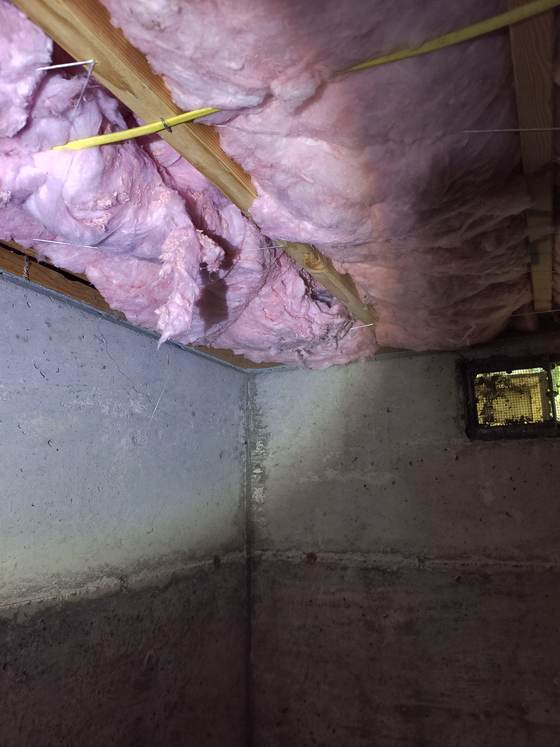
Where a colony has been established in a wall cavity, a sill or a joist bay for a while, it builds a spongy layered structure out of chewed wood mixed with soil. Opened up, it looks like coarse damp cardboard laid in sheets, and it fills the void rather than leaving it empty.
That is the direct opposite of what a carpenter ant leaves behind. Carpenter ant galleries are kept swept and open — smooth-sided, with the excavated fiber carried outdoors as frass. A cavity stuffed with soft papery layers has not been occupied by carpenter ants at any point, and finding that material settles the identification even with no live insect in front of you.
It also settles the question against termites in the same glance. Dampwood termites in this region leave hard pellets, described in WSU’s termite bulletin as about a twenty-fifth of an inch and slightly hexagonal, lying loose in the galleries or stuck to their sides. Pellets are granular and sit in a clean void. Carton is soft, fibrous and fills the void. Nothing about the two looks alike once you have seen both.
The swarm is usually the first anyone knows
Almost nobody discovers this species by finding a worker. What happens instead is that a room suddenly fills with small winged ants.
WSU puts reproductive swarming in late summer to early autumn, which in this county means roughly August into October and frequently on the first properly warm day after a wet spell. The emergence is concentrated — a mature colony releases its reproductives in one event rather than trickling them out — so the experience is dramatic and the numbers look alarming.
They are not. The winged forms do not bite, do not sting, cannot start a colony in a dry house, and are trying to get outside rather than to spread through the building. Vacuuming them is a perfectly good response.
The part that matters is where they came from. An emergence inside a room means the nest that produced them is inside the structure, not in the yard, and the exit point is directly connected to it — a gap at a baseboard, the joint at a window return, a light fitting, the seam around a bath panel, the edge of a bathroom fan housing. Note that point before you clean up, because it is a straight line to the wet timber, and by the following week nobody will be able to remember which side of the room it started on.
Keep a dozen specimens in a sealed bag while you are at it. An identification from a real insect takes half a minute and removes every guess from the visit.
One further point, because it is misread constantly: the size of the swarm is not the size of the problem. It reflects colony maturity and the weather on the day. A modest emergence from a nest sitting in a load-bearing sill plate is a more serious finding than a spectacular one from a rotting deck post.
What the presence of the colony actually proves
This is where the species pays for itself, so it is worth being precise about the chain of events rather than waving at “damp”.
Wood does not decay because it is wet on the outside. It decays because fungi colonize it, and fungi need free water inside the cell structure to do that. The Forest Products Laboratory sets the threshold at the fiber saturation point, which averages around thirty percent moisture content, and states that serious decay occurs only above it. Framing lumber in a functioning building sits far below that figure.
Temperature matters less here than people assume. The FPL puts optimum growth for most decay fungi near seventy-seven degrees Fahrenheit, which a Whatcom County crawlspace does not reach — but “slower” is not “stopped”, and a mild wet climate with no hard freeze gives the process nine or ten months a year to work in. Time substitutes for warmth.
Then the ants arrive, and only then, because the fungus has to do its work first. That sequence is what makes the finding informative. It is not evidence of a leak that started last winter. It is evidence of water that has been present long enough for a fungal colony to establish and to break down enough structure to make the wood workable — a process measured in seasons and usually in years.
The FPL’s strength figures explain why that history is the serious part. Toughness losses ran from six percent to over half by the time decayed specimens had lost one percent of their weight, and by ten percent weight loss most strength properties can be expected to be down by more than half. Wood that has lost strength to decay does not recover when it dries. It is spent, and the only remedy is replacement.
So a colony in a rim joist is not telling you that ants have damaged your house. It is telling you that a structural member has already lost capacity, and the insects have simply moved into the result.
Where the water is, in this county
The locations repeat, and the reason is climatic rather than anything to do with how a house is kept. Around thirty-five inches of rain spread across a long mild season means timber that gets wet here has no hot dry stretch in which to give the water back. A wall assembly that would recover in a fortnight in a continental climate can stay above the decay threshold from October through April.
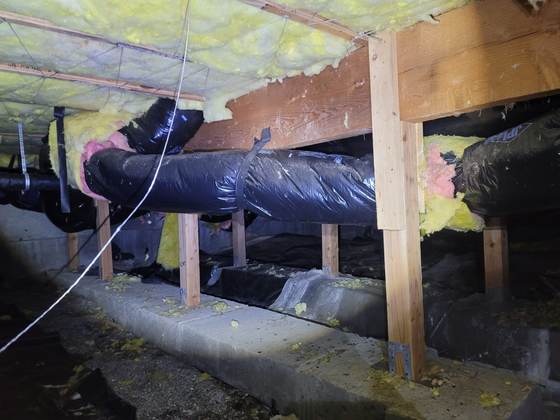
The findings cluster:
Sill plates and rim joists over an uncovered crawlspace floor. Bare soil in this climate gives up water continuously into the space above it. No leak is required and there is usually nothing to point at, which is why this one runs for decades before anybody looks.
Beneath a shower pan, a bath waste or a toilet flange. A slow failure that never shows on a ceiling keeps a joist bay saturated indefinitely.
Deck ledgers. The older housing stock here fastened decks to walls with no flashing at all, and the ledger and the rim behind it stay permanently wet.
Posts and stair stringers in ground contact, rotting upward from the base.
Below a window that has taken driven rain for a decade, where the sealant hardened, the flashing lifted or the sill lost its slope.
Around a chimney, a skylight curb or a vent boot, with the wet framing often a considerable distance from any visible stain because roof water tracks along members before it appears.
Under an exterior faucet, which delivers a small volume of water into exactly the wrong place every time the garden is watered.
Where a bathroom or kitchen fan discharges into an attic instead of through the roof or wall. Warm wet air hits cold sheathing, condenses, and runs down onto the framing. The householder is invariably surprised, because there is no leak anywhere in the building.
Grade and downspouts sit behind a good share of the rest. A great many lots in this county fall toward the building rather than away from it, either by original siting or through forty years of accumulated landscaping, and a downspout discharging at the foundation delivers the entire roof area’s rainfall to one corner of the sill.
Why the treatment verdict on this page is “depends”
WSU’s position is that chemical control is rarely advised for this group, and the verdict on this page could reasonably have read that way. It does not, and the reasoning is worth setting out because the deciding factor is not what the label suggests.
“Rarely warranted” on this site means the honest answer is usually a sealing or cleaning job. That is not this. Nothing about a moisture ant finding is fixed by caulk or a vacuum, and describing it that way would understate what is actually wrong with the building.
What it genuinely depends on is the repair.
Where the wet timber is being cut out and replaced, no treatment from us is warranted at all. The colony leaves in the skip with the joist. Paying a pest control company to treat wood that a carpenter is about to remove is spending money twice for one result, and we will say so.
Where the water is being corrected but the member is staying in place — sound enough to keep, with surface decay only — treatment is a reasonable adjunct while the assembly dries, because drying is slow here and a resident colony can keep extending into softened material in the meantime.
Where the colony is in structural material that cannot be reached or replaced promptly, treatment is warranted on its own terms while the repair is arranged, and so is a follow-up visit to confirm what the drying has actually achieved.
Where the source is condensation in an attic or a crawlspace rather than a leak, the work is ventilation, ducting and ground cover. Treating the ants there is close to pointless, and we will tell you which trade you actually need.
The order that works is the same in every one of those cases: find the water, establish how far the damage runs, repair it, replace what has lost strength, and only then decide whether anything remains to treat. Reversing that order gets you a quiet season, and it removes the marker that was pointing at the decay, which is a genuinely bad trade in a sill plate.
What they live on, and the lawn ants you can ignore
A point that surprises people: this group is not feeding on the wood either.
Like carpenter ants, moisture ants occupy timber for shelter rather than nutrition. Their food is largely honeydew — the sugary excretion of aphids and mealybugs — and NC State Extension notes that the closely related yellow ants feed primarily on honeydew from aphids and mealybugs working plant roots. A colony in a sill plate is running an agricultural operation somewhere in the soil outside and using the rotten joist as accommodation.
That matters for two reasons. It is why baiting is unreliable against them, since a colony with a dependable underground honeydew supply has little interest in what you put on a bait card, and NC State says outright that baits are not effective for this group. And it is why correcting the wood is the whole job: you cannot starve them out, but you can remove the housing.
It also explains a distinction worth drawing before anybody treats anything. The same genus is extremely common outdoors here and is entirely harmless in that setting. NC State describes those colonies forming large soil mounds in open ground, under logs, rocks, patio blocks, porches and concrete slabs, throwing up excavated soil as they work. Yellow ants under a paving stone in your lawn, or a mound at the edge of a bed, are not a structural finding and are not a reason to do anything at all.
The finding that matters is the one inside a structural member — in a rim joist, a sill plate, a post, a stair stringer or the framing under a wet room. The species may be the same. The meaning is completely different, and confusing the two is how people end up treating a lawn.
Reading the wood yourself
Most of what a technician does with a suspect member can be done by a homeowner with a flashlight and a screwdriver, and doing it before anyone visits shortens the conversation considerably.
Probe it. Push a blunt screwdriver into the timber with firm steady pressure, across the grain, at intervals along the member. Sound wood resists and the point barely marks it. Decayed wood gives under the same pressure. Wood that has failed lets the point sink in without resistance, sometimes to the handle.
Look for cubical cracking. Brown rot, the common failure mode in framing here, leaves a member checked into small blocks across and along the grain, and the material crumbles between the fingers when dry. It is unmistakable once you have seen it.
Look for discoloration and surface growth. White or brown fungal growth on a joist face, dark staining spreading outward from a fastener or a joint, or a bleached patch in an otherwise even surface.
Note what is above it. Decay is downstream of water, so follow the member upward and outward: what is above this bay, what penetrates the roof over it, what drains near it, what plumbing runs through it.
The FPL’s warning about early decay is the reason to probe rather than to look. Substantial strength is lost before there is much to see — losses in toughness ran from six percent to more than half at only one percent weight loss — so a member that appears sound and probes soft has already failed, and a visual pass alone will miss it.
If you find soft wood with pale yellow ants in it, you have completed the diagnosis. What remains is deciding how far it runs and who repairs it.
What we will not sell you
A treatment instead of a repair. It does not hold, and it quiets the one signal that was pointing at the decay.
A recurring plan around wet timber. A scheduled visit does not dry anything out, and billing for one over a leaking shower pan is a subscription rather than a solution.
A structural opinion. We will tell you what a probe finds and where the water is arriving from. What the member is carrying, and what it takes to replace it, belongs to a builder or an engineer.
Alarm. These ants do not sting, do not bite meaningfully, do no damage to sound wood, and are not a health concern. Every serious thing about this finding is in the timber.
What else lives with them
A cavity wet enough for this species supports a whole community, and recognizing the company is part of reading the finding.
Springtails in very large numbers, which are harmless and are themselves a reliable damp indicator. Sowbugs and pillbugs, which cannot persist anywhere dry. Millipedes, centipedes and silverfish. Fungus-feeding beetles working the same decayed material. Spiders in quantity, because all of the above is food.
And in the wood itself, the decay that started the sequence — visible in a crawlspace as discoloration, as white or brown growth on the surface, or as the cubical cracking pattern that brown rot leaves in a member as it fails.
Dampwood termites belong on that list too. They follow the same water into the same members, they are common in this region, and where both are present the identification has to be made carefully because the implications differ. Where a wood-destroying organism has been identified in your building by somebody qualified to do that, the treatment side of it is within what we are certified to carry out.
Telling them apart from carpenter ants
The two get confused in both directions and the distinction changes the entire response, so it is worth having straight.
Size is the fastest check and it is rarely close. These are three to five millimeter insects, all one size within a colony. Carpenter ant workers run from a quarter inch to a half inch in the same nest, and the majors are large enough that people photograph them.
Color separates them again — yellow to amber against black with reddish legs.
The thoracic profile is the check that survives a damaged specimen: notched here, smoothly convex on a carpenter ant.
The nest material is decisive where no insect is available. Carton, spongy and layered, means this species. A clean swept gallery with a heap of fibrous frass below the opening means carpenter ants.
The flight season is a further tiebreaker. These reproductives fly in late summer and autumn. Carpenter ant reproductives overwinter in the nest and emerge in spring.
And the meanings differ, which is the point of separating them. Carpenter ants will work timber that is merely damp and will extend into sound wood from there, and their parent colony is usually somewhere outdoors that has to be found. Moisture ants cannot begin without advanced decay, and their parent colony problem is a plumbing, roofing or drainage problem wearing an insect costume.
The one prevention measure that matters
Everything on the usual list — sealing entry points, moving woodpiles, trimming vegetation — is secondary here to a single item, and it is not a pest control measure.
Keep structural wood below the moisture content at which fungi can work. In practice that means ground cover over crawlspace soil, functioning crawl ventilation, downspouts discharging well clear of the foundation, grade that falls away from the building, flashing that is present and lapped correctly, fans ducted to the outside, and plumbing failures dealt with when they are small.
A member kept dry cannot host this species at all. A member left wet will host it again regardless of what was applied, how well it was applied, or how many times. That is not a limitation of the treatment. It is what the species is.
Frequently asked questions
Why is finding these ants described as useful?
Because they only occupy wood that is already rotting, their position marks decayed structural timber to within a few inches. A damp meter gives you a reading across a wall surface. A colony gives you the exact member that has failed.
How wet does the wood have to be?
Wet enough that decay fungi have already broken it down, which takes sustained saturation over seasons rather than a single leak. The ants follow the fungus, so by the time they arrive the wood has generally been wet for years.
Do they chew through good lumber to get there?
No. WSU describes them as not a primary structural pest, and the colony starts in wood already at an advanced stage of decay. They will extend into adjoining material as it softens, but they do not initiate the damage.
Why did a cloud of small winged ants appear indoors?
That is the reproductive flight, and WSU puts it in late summer through early autumn. Emerging inside a room means the nest is inside the building rather than in the yard, which is the part of the event that actually matters.
What is the papery material in the wall cavity?
Carton — a spongy layered construction the colony builds from chewed wood and soil. It is quite distinctive and it looks nothing like the clean sanded void a carpenter ant leaves, which makes it a reliable identification on its own.
If I fix the leak, do they leave?
Generally the colony fails as the wood dries, and where the decayed section is cut out and replaced it goes with it. What does not happen is the reverse: treating them while the water continues buys a quiet season and nothing more.
Are they related to the yellow ants in my lawn?
Closely. The same genus nests in soil, under stones and patio slabs, and around foundations, feeding on honeydew from root aphids. Those outdoor mounds are harmless and are not a reason to treat anything.
Sources
- WSU Extension EB1382E — Moisture Ants — read September 1, 2026
- USDA Forest Products Laboratory — Wood Handbook FPL-GTR-282, ch. 14: Biodeterioration of Wood — read September 1, 2026
- NC State Extension — Larger Yellow Ant — read September 1, 2026
- WSU Cooperative Extension EB0787 — Termites: Biology, Prevention and Control — read September 1, 2026
- PNW Insect Management Handbook — Nuisance and household pests: Ant — read September 1, 2026
Rules change. This page is scheduled for review against its sources by September 1, 2027. If you are reading it after that date and something looks out of step with the current rule, the rule is right and we are wrong — please tell us.
Pest problem in Whatcom County?
Family-owned, no long-term contracts, and every treatment is backed by our 100% Service Guarantee.
Most calls in Whatcom County are out within 1–2 days, about 3 during the late-summer peak.
Last updated