
Pest Control in Woods Point, Ferndale
Woods Point is a gated community of single-level homes for residents over 55. The housing is uniform and low, much of the surrounding ground is common rather than private, and a good deal of the ordinary self-inspection a homeowner would do is not reasonable to expect here.
Call 360-410-2199 Request a free inspection
Woods Point, Ferndale on the map
A gated community of single-level homes
Woods Point is a gated residential community of single-level homes for residents aged 55 and over, with private roads and a substantial amount of common ground managed on behalf of everybody rather than by individual owners.
Three things about that shape the work, and only one of them is about the buildings.
The housing is uniform, low and consistently built, which makes diagnosis fast. A good deal of the ground that matters is common rather than private, which decides who should be acting. And the routine self-inspection that a pest-control company quietly relies on from most homeowners — somebody putting their head into the crawlspace, climbing up to look at a soffit, moving what is stacked behind the shed — is not something anybody should be expecting here.
That last point is the one that changes the service most, and it is worth starting with.
What a scheduled look is actually worth here
Most pest problems in most houses are found by the householder, by accident, early. Somebody notices droppings behind something, hears movement overhead, sees a wasp using the same gap each afternoon, or goes into the crawlspace for an unrelated reason and finds fouled insulation.
That early-warning system is doing an enormous amount of work, and it depends on somebody being willing and able to get into awkward places.
Getting under a house is hard work. It is low, dirty, cold, and there are real hazards — old wiring, standing water, sharp edges, and occasionally an animal that is not pleased to see you. Nobody should be doing it to check on something, at any age, and certainly nobody should feel they ought to.
So on this development a scheduled inspection is not the same product it is elsewhere. It is replacing a service that in most neighborhoods is being provided free by the occupant. That is why an annual or twice-yearly look here finds things at a stage where they are still small, and why we would rather sell that than a treatment for something that got to be large first.
It also means that when we come, we go under and we go up, and we report what is there in plain terms with photographs where they help.
Two jobs: your home and the common ground
Every call here divides into work on your home and pressure arriving from ground that is not yours, and being clear which is which decides everything downstream.
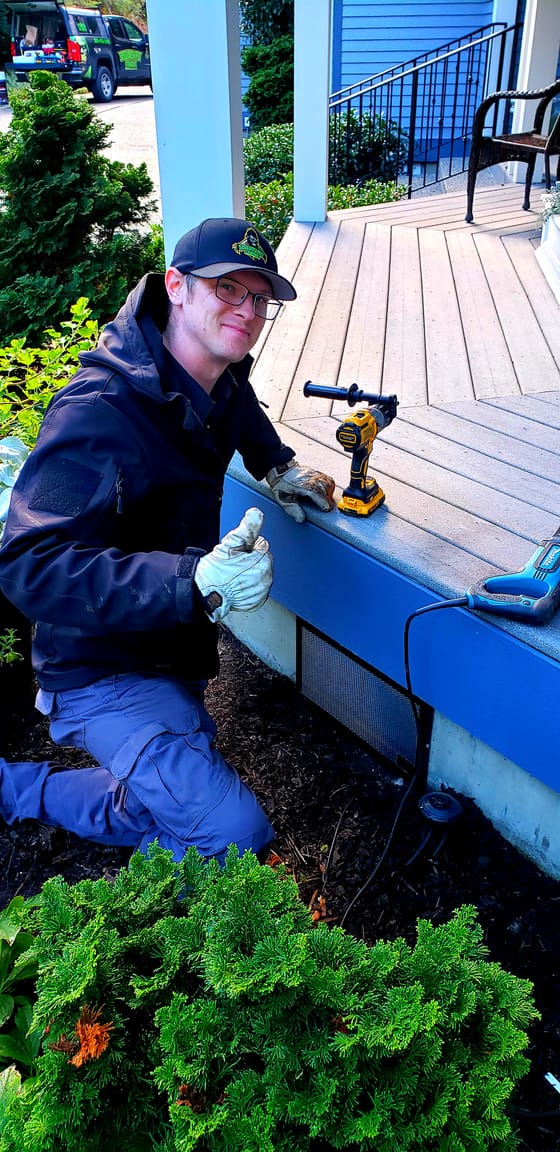
Your home and your lot is the building envelope, the garage, the crawlspace, the planting immediately against the walls, and what is stored outside your unit. That is where the durable work is and it is ours to do directly.
The common ground is the shared landscaping, the boundaries, the road verges, any greenbelt or buffer strips, and the shared storage areas. That ground supports populations, and populations do not stop at a line they cannot see.
We say this early rather than late for one reason: somebody who pays for a thorough job on their own home, next to an untouched source on common ground thirty feet away, will get a partial result and reasonably feel they were misled. Where the honest answer involves the management, we will say so and put it in writing so it can be handed over.
Single-level housing, and the crawlspace that runs under all of it
A single-story house on a crawlspace has a larger footprint at ground level than a two-story house of the same floor area. More perimeter, more vents, more penetrations, and a bigger under-floor space.
That matters in two ways. There are more openings to check, and once anything is under there it has a lot of continuous space to occupy without ever being heard from a living room.
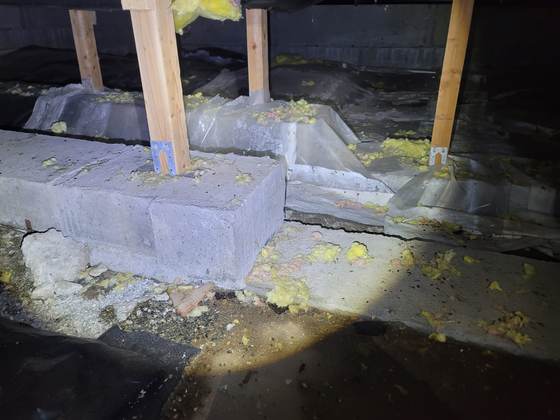
The specific things we find on housing of this kind are consistent. Vent screening that has been stapled over an opening rather than fixed into it, and has come away at a corner. Service penetrations sealed with expanding foam, which stops air and water and does not stop a mouse. A crawl hatch that is a board resting against an opening. Insulation sagging out of the joists, which is both a symptom and excellent nesting material. And the garage door corners, which on any door of a few years’ age will show daylight from the inside.
None of that is unusual or a sign of neglect. It is what this construction does, and the fixes are small, mechanical and permanent.
The garage, which is nearly always where it starts
On single-level housing the garage connects directly to the living space and it is the most productive place we look.
It is sheltered but unheated, it is quiet, it holds stored soft material, and it very frequently holds birdseed, pet food, bulbs or garden products in bags rather than in solid containers. A gap at a door corner leads straight into that, and from there into the house.
The fixes cost very little. A proper door seal. Stored food in sealed containers. A clear gap kept around the walls so the perimeter can actually be seen. That last one is worth as much as the other two, because a garage stacked to the walls cannot be inspected by anybody, including us.
Wasps, and why we would rather look in June
Wasps deserve their own section here rather than a paragraph, because the risk profile is different.
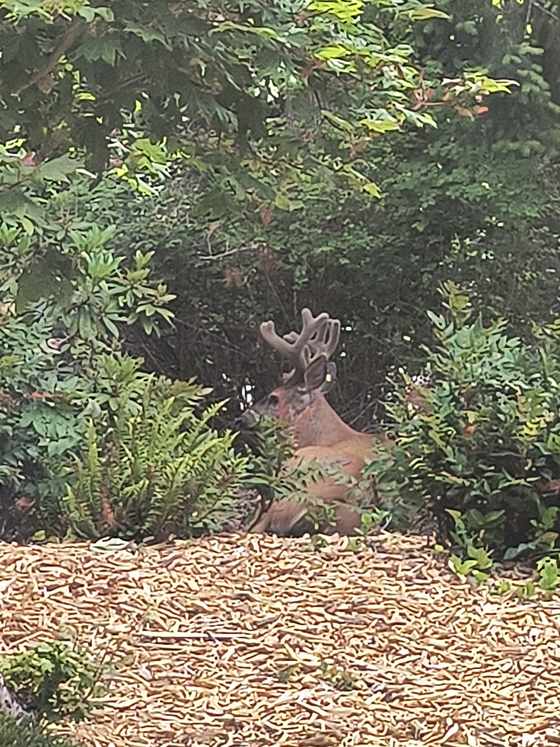
A sting is unpleasant for anybody. For somebody with a cardiac condition, on anticoagulants, with a known sting allergy, or simply less steady on their feet, an unexpected encounter with a ground nest while gardening is a materially more serious event.
Nests get found in August because that is when the colony is large and the traffic is obvious. They exist from spring, small and quiet, in soffit voids, at roofline junctions, in outbuildings, under deck rails, and in the ground along verges and boundary banks.
Gardeners who want to read up on them first can start with Hortsense, the WSU factsheet library for home gardens and landscapes.
A walk of the eaves, the soffit line, the outbuildings and the boundary ground in June finds most of them while they are still simple to deal with and before anybody has walked into one. It costs nothing, we would rather do it than not, and on this development we think it is the single most useful preventive visit of the year.
Ground nests along common boundaries are a maintenance hazard as well as a resident one and are worth reporting to the office rather than stepping around.
How we work in an occupied home
There are a few things worth putting in writing about conduct, because they matter more here than in most places.
We will tell you what we are applying before we apply it — what it is, where it goes, where it does not go, and how long to stay off a treated area. Not because you asked, but because that is how it should be done. Every product this company carries is published on this site with its EPA registration number, its full label and its safety data sheet, so anything we say can be checked against the document.
We will not use the word “safe”. It is unlawful to describe a pesticide in terms that differ from its accepted labeling and no label uses that word, so anybody who offers it to you is either unaware or hoping you are. What we can do is show you the label, explain the precautions, and choose an approach that suits the household.
Where there is a version of the job that uses less, or nothing at all — a repair rather than a treatment, a bait rather than a spray, hardware rather than chemistry — we will offer it before you have to ask. That is not a house style; it is the order the EPA recommends in its guidance on whether a pesticide is needed.
And we will turn up when we said, or tell you before the time we said that we cannot. Waiting in for somebody who does not come is a genuine imposition and it is the complaint we hear most often about this trade.
Visiting family, pets and where things go
Grandchildren visit, dogs visit, and both change placement rather than possibility.
Anything placed goes in enclosed, secured stations, away from where anybody small or four-legged goes. Interior work is planned around the rooms in use and around when visitors are expected. Tell us about a visiting dog rather than assuming we will know, because it is the kind of thing that decides where a station goes.
Downsizing, and what comes with the boxes
A great many people arrive here from a larger house, and a move like that brings decades of stored belongings into a smaller building all at once. That is worth mentioning, because it is the route for two things that surprise people.
Stored-product insects travel in pantry goods and in things that have sat in a garage or a basement for years: flour, rice, birdseed, pet food, dried flowers, wool, old fabric. Indianmeal moths and carpet beetles both arrive this way, already established, and emerge weeks after the boxes were unpacked. The answer is the cupboard rather than the building, and it is quick once it has been identified.
Secondhand and long-stored furniture is the main route for bed bugs, and nobody should feel accused by that. They travel on objects and on people rather than following how a home is kept. What matters is that they are found early, and in a community of closely spaced homes an early report protects everybody rather than only the household that made it.
If a move is coming up, the most useful thing anybody can do is check stored goods before they come in rather than after. We are happy to look at anything you are unsure about.
Reporting early, and why nobody should feel awkward
The thing that costs households most in a community like this is not the pest. It is the delay.
People wait because they think it reflects on them, because they do not want to make a fuss, or because they are not certain it is anything at all. By the time it is raised, a problem that would have been a small job has become a large one, and in closely spaced housing it may well have reached a neighbor.
Nothing on this page is a reflection on anybody’s housekeeping. Rodents follow gaps, wasps follow cavities, and bed bugs follow luggage. All three arrive at immaculate homes, regularly.
If you are unsure whether what you have found is anything, call and ask. We would far rather look at something that turns out to be nothing than be called three months later.
Rodents, and the ordinary way in
There is nothing exotic about how anything gets into these homes.
The routes are the vent screening, the penetrations, the crawl hatch, the garage door corners, and the gap where planting or stored material sits against siding. On a uniform development those exist in the same places on every unit, which makes a first visit fast and a repair specification reusable across the whole community.
The pressure comes off the common landscaping and whatever lies beyond the boundary, and it rises sharply whenever that ground is cut or cleared — the animals living in it relocate within days, and the nearest building with a gap is where they go. That is predictable, which means the sealing is best done before the maintenance rather than after.
Ants, and the ones that mean something
Ants along a foundation here are usually odorous house ants or pavement ants foraging on a warm, irrigated line. A nuisance rather than damage, and they respond to baiting along the trail. Spraying a trail often splits the colony and makes the next month worse, so an immediate visible result is the wrong measure.
Carpenter ants are a different animal and mean something different — they excavate galleries in wood. Moisture ants are a report about wet timber rather than a pest problem at all, and where we find them the answer is a moisture repair rather than a treatment.
They look broadly similar to most people, which is exactly why identification comes first.
Storage, and the shared areas
A development like this usually has some shared storage — for boats, trailers, RVs, or simply for the things that will not fit in a single-level home with no basement.
Concentrated stored material in a low-traffic building is reliably productive for rodents, and the damage tends to be discovered months later. Where that storage is shared, the work has to be done for the building rather than for one bay, because sealing one while the ones either side stay open moves the animals a few feet.
That is a management conversation and we are happy to have it, or to give you what you need to raise it.
What we would rather not sell you
We will not put a home on a recurring treatment schedule when the actual problem is a vent screen and a garage door seal. The hardware costs a morning and it does not repeat.
We will not treat around a home for a source that is sitting on common ground and tell you it is handled. We will say where it is and help you take it to the right people.
And we will not describe a nuisance as a danger. Cluster flies, lady beetles and house spiders are unpleasant and harmless, and a company that tells you otherwise to sell a program is doing something we would rather not compete with.
Between visits, and what is worth a phone call
Nothing here needs monitoring by the resident, and we would much rather you called about something that turns out to be nothing than watched it for a month wondering. A wasp using the same gap each afternoon, a smell that was not there last week, or droppings behind something in the garage are all worth a call the day you notice them rather than at the next scheduled visit.
How a visit works here
We start with the boundary — what is yours, what is common, how close the cover gets, and what has been cut recently.
Then the building at ground level: the whole perimeter, every vent and how the screen is fixed, the penetrations, the sweeps, the crawl hatch, and the garage door corners from the inside with the door shut.
Then underneath, properly, with a light, through the whole crawlspace. That is the part you should never be doing yourself and it is where most of the useful information is.
Then the soffit line and the eaves, especially in early summer.
You get a plain account in plain language: what is active, what is old, what is driving it, what needs doing now and what can wait, which items are building work rather than pest work, and what belongs to the community rather than to you. There is no fee for the visit or for the written report. Bed bug verification is billed and credited back, and nobody here is asked to commit to a schedule.
Frequently asked questions
I cannot get into the crawlspace myself. Does that matter?
Not to us, and you should not be trying. Getting under a house is awkward, dirty and genuinely hazardous work, and nobody should be doing it to check on something. It is a normal part of what we do on every visit, and it is one of the main reasons a scheduled look is worth more here than it is on a house where somebody is already down there twice a year.
Is the problem mine or the community's?
That is the first thing we establish and it decides who should be paying. If the source is on your lot or in your building, we deal with it for you. If it is in common landscaping, along a shared boundary or in a neighboring unit, work on your home alone will reduce what reaches you rather than end it, and the conversation belongs with the management.
How do you get through the gate?
You tell us the procedure when you book and we follow it. Some residents arrange access directly, some go through the office. We would rather have it sorted in advance than arrive and be turned away, which costs you the appointment.
I react badly to stings. Can you check before the summer?
Yes, and please ask. A June walk of the eaves, the soffits, the outbuildings and the ground along boundaries finds the nesting that becomes a problem in August, and for somebody with a sting reaction that is the difference between a scheduled job and an emergency. It costs nothing.
Will you tell me what you are putting down and where?
Every time, before it happens, without being asked. What it is, where it goes, where it does not go, and how long to keep away from the treated area. Every product we carry is published on this site with its full label and safety data sheet, so you can read it yourself if you would rather.
There are visiting grandchildren and a dog. Does that change placement?
Yes. Anything placed goes where children and animals cannot reach it, in enclosed and secured stations, and we would rather you tell us about a visiting dog than assume we will guess. Where a repair does the job instead of a product, we will recommend the repair.
Does an assessment cost anything?
No. The only exception is bed bug verification, which is charged and then taken off the treatment price. Here the assessment covers the crawlspace, the garage and the boundary, because those are the three places a resident cannot reasonably check themselves.
Pest problem in Woods Point?
Family-owned, no long-term contracts, and every treatment is backed by our 100% Service Guarantee.
Most calls in Whatcom County are out within 1–2 days, about 3 during the late-summer peak.
Last updated