
Pest Control in Malloy Village, Ferndale
Malloy Village is townhomes and family streets close to the freeway, and both halves of that matter. Attached housing means a problem is rarely confined to the address that reports it, and the highway verge alongside is continuous undisturbed rodent cover.
Call 360-410-2199 Request a free inspection
Malloy Village, Ferndale on the map
Attached housing beside a highway
Malloy Village is townhomes and family streets on the freeway side of Ferndale. Two features shape the pest work and they pull in different directions.
The housing is largely attached or closely spaced, built to a consistent standard over a short period, which means the buildings share structure and share failure points. And the development sits near the interstate corridor, which puts a long strip of undisturbed rough ground within easy reach.
One of those makes problems spread. The other supplies them.
The party wall is not a wall
The most useful thing anybody in attached housing can understand is that the wall between units is not the barrier it looks like.
Behind the drywall, an attached building is substantially continuous. The party wall cavity frequently runs uninterrupted from the foundation to the roof space. Plumbing and electrical chases pass vertically between floors and sometimes laterally between units. Soffits run the length of a row. Roof spaces, unless properly fire-stopped and sealed at every division, are effectively one volume with partitions in it.
A rodent or insect population living in that shared space does not recognize the addresses. It works a territory that includes several units and moves between them freely.
This explains the single most common experience in this kind of housing: a treatment works, and then it stops working. Activity drops for a couple of weeks because what was inside got dealt with. The population, undisturbed in the shared space, carries on and moves back in.
It did not fail. It was scoped to a unit when the problem was scoped to a building.
What can actually be done about that
The complete answer is coordinated work across the affected units and the exterior of the whole structure, arranged through the association or the property manager. Where that is possible it is much cheaper per household than everybody solving it separately, and it is the only version that finishes.
Where it is not possible — and often it is not, because one owner will not engage — there is still real work available on a single unit, and it is worth being clear about what it is.
Sealing the shared routes on your side limits what reaches you. That means the penetrations through the party wall for services, the point where the chase passes your ceiling, the gap where your unit’s roof space meets the next, and the exterior openings on your own elevation. None of that removes a population living next door. All of it reduces what arrives.
We will do that work and we will tell you plainly what it achieves, rather than selling it as a solution to somebody else’s untreated unit.
The highway verge
The strip beside a major road is one of the more reliable rodent habitats in any developed area, and almost nobody thinks about it.
It is continuous, it runs for miles, it is rough rather than maintained, nobody walks it, nothing disturbs it, and it collects litter — including food waste — along its whole length. It is, in effect, a linear reserve.
The properties closest to it take the most pressure, and the pattern is seasonal in the same way it is on farmland: when the verge is cut or cleared, the animals living in it relocate that week, and the nearest structures with a gap in them are where they go.
Cutting schedules, cover and what grows along a verge are all extension subjects, and in this county that work belongs to WSU Extension’s Whatcom office.
None of that can be fixed at the source, which is why the work here is entirely about the building. What matters is whether there is a route in, and on uniformly built housing the routes are consistent enough to be found quickly.
One construction era, one set of failure points
Almost everything about a single-period development is a disadvantage for originality and an advantage for diagnosis.
When a development goes up over a few years to a consistent specification, every building has the same details, the same materials and the same shortcuts. So when a problem is traced on one unit to a particular vent type, a particular garage door seal, the way a dryer vent was run, or a gap left where the siding meets the foundation, the odds are very high that the identical detail exists on every unit in the row.
That turns a search into a check. On a first visit we will find the route on your unit and then look specifically for it everywhere it should also exist, which is faster and more thorough than starting from scratch each time.
It also means that where an association is willing to act, a single well-chosen repair specification can be applied across the whole development and close a route on every building at once.
Garages, and the seal at the bottom corners
Attached and townhome housing nearly always has an integral garage, and the garage is the most consistently productive place we look in this kind of development.
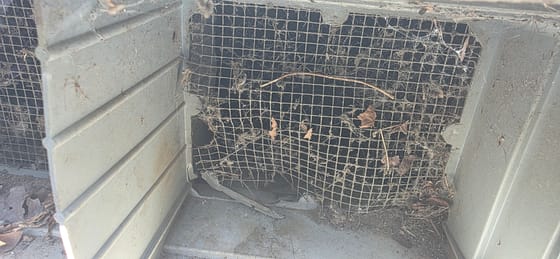
The bottom corners of a roll-up door are where the seal fails first, and the test costs nothing: stand inside with the door closed and look at the corners. Daylight means a gap, and a gap at floor level in a space that connects directly to the house is the most convenient possible entrance.
Everything else about a garage helps as well, from the pest’s point of view. It is unheated but sheltered, it is quiet, it holds stored soft material, and frequently it holds pet food, birdseed or garden products in bags rather than containers.
Fitting a proper seal is inexpensive and permanent, and moving stored food into solid containers costs nothing at all.
Ants along an irrigated foundation
Irrigated planting against a foundation is standard in developments of this kind, and it produces the most common non-rodent call we get here.
Odorous house ants and pavement ants forage along a watered, warm foundation line and come indoors along it. They are a nuisance rather than a structural problem, and they respond to the right approach quickly — which is baiting along the trail rather than spraying the trail, because a sprayed trail frequently splits a colony into several and makes the following month worse.
Carpenter ants are a different matter and the identification is the point. Carpenter ants excavate galleries in wood, and finding them indoors means something about moisture or a nearby colony rather than a passing trail. Moisture ants mean wet wood specifically. Three insects that look broadly similar to most people, with three different meanings.
Watering the foundation less, and keeping a gap between planting and siding, does more than most of what can be applied.
Waste, recycling and shared collection points
Where bins are shared or grouped, waste becomes the most important thing on the site and almost nobody treats it that way.
A shared bin store or a row of containers at a collection point concentrates food waste in one place, permanently, on a predictable weekly cycle. If the lids do not close, if bags get left beside rather than inside, or if cardboard is stacked against the containers, that will support a population no treatment can out-run.
The arithmetic is worth stating plainly. A treatment program costs money every month. Bin lids that close cost nothing after the first repair, and they remove the food supply rather than the individuals eating it.
Where collection is grouped this is an association matter rather than a household one, and it is the single highest-value thing an association can act on in this kind of development.
What renting changes, and what it does not
A share of this housing is rented, and the split of responsibility causes more delay than the pest problem does.
The pattern is familiar. A tenant reports something and waits. A landlord is uncertain whether it is a maintenance issue or a housekeeping one. Weeks pass while a problem that was small gets larger, and in attached housing it reaches next door in the meantime.
Our position is straightforward and we will put it in writing for either party. We report what we found, where it is, what is causing it, and which items are structural. A gap where a service passes through a wall is a building matter. Food stored badly is a housekeeping matter. Most reports contain some of each, and saying which is which lets people get on with it rather than argue about it.
Anybody can call us. We will not discuss a tenant’s home with a landlord, or the reverse, beyond what the person who booked the work has agreed to.
Wasps in new-construction soffits
Wasps are on the Ferndale list specifically for the soffits, and townhome rows are a good example of why.
Modern soffit and fascia construction creates long continuous voids with small access points at intervals — vents, joints, the gap where two runs meet, the end of a run at a gable. Those are exactly what a paper wasp or a yellowjacket queen is looking for in spring, and they are usually twenty feet up where nobody inspects them.
Because a soffit run can extend across several units, a nest in one is frequently reached most easily from another, which is one more thing that argues for treating the row rather than the address.
European paper wasps build small open combs under railings, deck rails and window frames and are markedly less defensive. Yellowjackets in a soffit void are not, and a nest above a front door in August is a genuine problem for a household with children.
Families, pets and where things get placed
This is family housing with small yards, and that shapes how work gets done here more than it does in most places we go.
Placement matters. Anything applied or placed goes where children and pets do not go, and where it cannot be reached — enclosed and secured stations rather than open placements, and interior work planned around the rooms that get used.
We will walk through the label before we treat, tell you which surfaces are involved and which are not, and tell you the re-entry directions rather than waiting to be asked. Every product we carry is published with its full label on this site, which is unusual and is meant to be.
And where there is a version of a job that uses less or nothing at all — a repair rather than a treatment, a bait rather than a spray — that is worth asking for, and we will offer it before you have to. The EPA puts that question first as well, in a short page on whether a pesticide is needed at all.
Bed bugs in attached housing
Bed bugs travel with people, not with housekeeping, and in attached housing they present the same structural problem as everything else here.
They arrive in luggage or on secondhand furniture. Under pressure in one unit, they will move along shared voids and service runs into the next. A treated unit surrounded by untreated ones does not stay treated.
Reporting early is the whole game and shame is the obstacle. Nobody should feel accused by finding them, and a development where an early report is treated as useful rather than as fault does far better than one where people wait.
We charge to verify and credit it against treatment. On a shared building that verification is valuable on its own — it establishes whether what somebody has been bitten by is actually a bed bug before several units get treated on an assumption.
Storage, and small yards with a lot in them
Small lots concentrate storage. A shed, a stack of firewood, garden furniture under a cover, bikes and toys against a fence, and bins that live at the side of the house because there is nowhere else for them.
Each of those is undisturbed sheltered material against a building, and collectively they are usually the most productive thing to change on a small lot. Not because any one matters much, but because there are six of them within twenty feet of the wall.
The one that consistently matters most is waste. Bins that do not close, or that are stored hard against the house, will support what no treatment will out-run.
What we would rather not sell you
We will not put a single unit on a recurring treatment for a problem that is living in the structure next door, tell you it is handled, and come back every six weeks. If that is what the situation is, we will say so on the first visit and put it in writing so you can take it to the association.
We will not spray an ant trail across a kitchen to make this week look better at the cost of splitting the colony.
And where the answer is a garage door seal, a bin lid and a gap between the shrubs and the siding, that is the answer, and none of it is billable.
Cluster flies, lady beetles and the shared roof space
The autumn invaders behave differently in attached housing than they do on a detached house, and it is worth knowing why before anybody starts spraying indoors.
Lady beetles, stink bugs and cluster flies overwinter in voids rather than in rooms, and in a townhome row the void they choose is frequently the shared roof space. They enter high, through a soffit vent or a gap at a gable end, settle in the attic over the whole row, and then filter down into individual units through light fittings, loft hatches and the gaps around service runs.
That is why one household can be overrun while their immediate neighbor sees almost nothing, and why treating a single unit’s rooms achieves so little. The population is above all of them.
None of these bite, breed indoors or damage the building, so the sensible work is at the entry points on the roof line and correctly timed exterior treatment in early autumn, done for the row rather than for an address. Where a management company will authorize that, it is much cheaper per household than eleven separate interior visits that do not fix anything.
How a visit works here
We start outside on your elevation: foundation line, vents, sweeps, service penetrations, garage door corners, and where planting or stored material meets the wall.
Then the shared boundary — where your unit stops and the structure carries on. Party wall penetrations, chases, the roof space division, and the soffit run. That is what decides whether this is your problem or the building’s.
Then inside and underneath, with a light, properly.
You get a plain account of what is active, where it is based, what is a route and what is a source, what we can do on your unit and what needs the association — the last of those in a form you can hand over. You are not charged for us to come and look. Bed bug verification alone carries a fee, refunded into the treatment price, and nothing commits you to a term.
Frequently asked questions
I treated my unit and it came back. Why?
Because in attached housing the population is usually not living inside your unit. It is in the shared voids, the party wall cavity, the roof space or the chase, and your unit is one of the places it visits. Clearing what is inside leaves the source untouched, so it refills. The fix is at the building level, not the unit level.
My neighbor will not deal with theirs. What can I do?
More than you might think. Sealing the shared route on your side — the party wall penetrations, the chase, the point where the roof space crosses — limits what reaches you even when next door does nothing. It is not as good as a coordinated job, and it is a great deal better than nothing. Where an HOA exists, this is exactly what it is for.
Is the freeway actually the source?
The verge is. A highway margin is continuous rough ground that nobody walks, mows closely or disturbs, running for miles, with cover and often litter. It supports a standing rodent population, and the properties nearest it get the most pressure. The road itself is irrelevant; the strip beside it is not.
Every house here looks the same. Does that help you?
It does, and it is one of the few genuine advantages of a single-era development. When one unit's problem turns out to be a particular detail — a vent type, a garage seal, the way a service was run — the odds are high that the same detail exists on the whole row. We can check it in minutes rather than searching.
Do you need to get into my neighbor's unit?
Sometimes, and we will always say so rather than pretend otherwise. Where a source sits in a shared void or under an adjoining unit, access matters. Often an HOA or a property manager can arrange it far more easily than a resident can.
Are ants along the foundation a real problem?
Usually a nuisance rather than damage, and worth identifying anyway. Odorous house ants and pavement ants along an irrigated foundation are common here and are a different matter from carpenter ants, which excavate wood. The identification decides whether this is a perimeter job or a building one.
Does an assessment cost anything?
No, other than bed bug verification, which is charged and credited against treatment. In attached housing the assessment is worth having even if you go no further, because it establishes whether the source is in your unit or in the structure — and that changes who should be acting.
Pest problem in Malloy Village?
Family-owned, no long-term contracts, and every treatment is backed by our 100% Service Guarantee.
Most calls in Whatcom County are out within 1–2 days, about 3 during the late-summer peak.
Last updated