
Pest Control in The Meadows, Ferndale
The Meadows is established larger-lot housing, and the age of the landscaping matters more than the age of the houses. Planting installed when these homes were new is now against the siding over deep beds of duff, and most lots have gained a deck, a shed and a shop.
Call 360-410-2199 Request a free inspection
The Meadows, Ferndale on the map
Established lots, and the thing that changed
The Meadows is larger-lot single-family housing that has been in the ground long enough to have settled into itself. The houses are solid and mostly well kept. The lots are generous. The streets are quiet.
And nearly every pest problem we deal with here is caused by something other than the building.
What changed on these properties is the ground. Landscaping installed when the houses were new is now forty years mature. Trees planted as saplings now reach the roofline. Beds have been topped up with bark year after year and are now deep and permanently damp. A deck went on at some point. A shed appeared, then a shop. Firewood found a wall to lean against.
None of that is neglect — it is what happens to a property somebody has been living in and improving for decades. But collectively it is a far more significant change than anything that happened to the structure, and it is where the work is.
Mature planting against siding
This is the single most productive thing to address on an established lot, and it is the one people are most reluctant about.
Shrubs put in eighteen inches from a wall as small plants are now touching it. Beneath them, four decades of leaf fall, needle drop and topped-up bark have built a bed that holds moisture permanently and is never turned over. Above them, foliage covers the wall.
That combination gives a continuous sheltered corridor at ground level, running past every opening in the building, over damp organic material, with the foundation line completely hidden. Rodents use it as a route. Ants, beetles and spiders live in it. Moisture sits against the siding. And nobody — homeowner or technician — can see or reach the wall behind it.
The fix is not removal, and we would rather say that clearly because people brace for being told to tear out a garden they have grown. What is needed is a genuine gap: daylight and air between planting and wall, beds pulled back, mulch kept off the siding, and enough clearance that the foundation line can be seen and reached the whole way round.
That can be staged over a couple of seasons. It costs nothing but time and it does more than anything we could apply.
What is living under the deck
Most lots here gained a deck at some point in the last thirty years, and on decks of that age the space underneath is almost never screened.
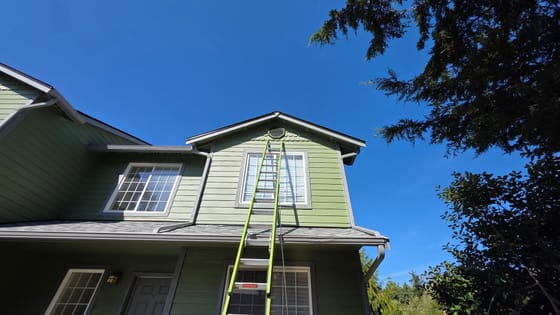
It is a nearly ideal space: dry, sheltered from weather and from view, undisturbed, and directly against the foundation. Rats in particular find it quickly. And because a deck usually runs along a substantial length of wall, it covers the one stretch of the building that cannot be inspected without dismantling something.
When a rodent problem on one of these properties does not add up — the crawlspace looks clean, the vents are sound, the garage checks out — the deck is where we go next, and it is very often the answer.
Screening the perimeter of a deck properly with quarter-inch hardware cloth, taken down to or below grade rather than tacked to the fascia, closes it permanently. It is a half day’s work and it is the highest-value single repair available on a lot with a deck.
Outbuildings, and the order things fill up
On a larger lot there is usually a shed, a shop, a detached garage, or several, and they change the shape of the job entirely.
Outbuildings sit closer to the cover at the back of the property and are built and sealed to a much lower standard than the house. They fill first, reliably. And once one is occupied, the house is not being colonized from the boundary — it is being supplied from forty feet away by something that already has a population, shelter and a food store.
That is why sealing a house while the outbuildings stay open does not do what people expect. It does not remove a population; it concentrates it and moves it closer to where it is unwelcome.
On a property with several buildings the honest unit of the job is the site. If somebody only wants the house done we will do it, and we will say plainly what that will achieve and what it will not, so the result in six weeks is not a surprise.
Trees at forty years
The planting that matters most for insects is the timber, and on lots this age there is a lot of it that nobody thinks about as timber.
Landscape ties. Old raised beds. A retaining wall built of sleepers. The original deck framing. Fence posts. A stump left when something came down. Fallen limbs stacked at the back. Firewood that has been in the same place long enough to have gone soft at the bottom.
Carpenter ants do not eat wood — they excavate galleries in it to nest, and they take softened, damp wood far more readily than sound dry timber. Every item in that list is exactly what they want, and every one of them is within a short distance of a building.
The living trees are usually not the problem, and we would not recommend removing them. What matters is deadwood, stumps, punky bases and that list of landscape timber, plus one thing about the living trees specifically: a branch touching the roof is a bridge that bypasses everything sealed at ground level. Rats climb well and they will use it. Trimming contact between vegetation and the building is worth as much as most foundation work.
What the crawlspace tells you
On a house of this age the crawlspace is the most informative half hour available, and most owners have not been down there in years.
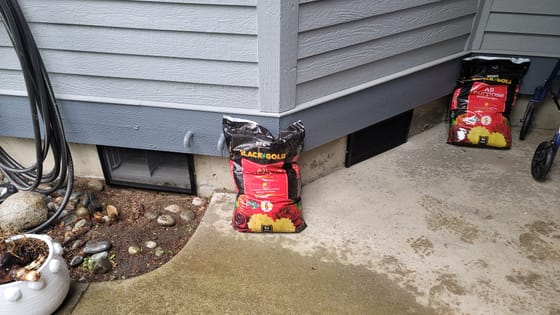
What twenty or thirty years does under a floor is predictable. A vapor barrier, if there is one, has been walked on by trades, torn, and pulled aside for access, and rarely put back. Insulation sags out of the joists, which is both a symptom and excellent nesting material. Vent screens corrode from the ground side, where nobody looks. Ducting gets damaged. And drainage changes as landscaping matures and beds are built up against the house, so ground that drained away from the building in 1990 may not now.
None of that announces itself upstairs until it is well advanced. A moisture problem under a floor becomes a decay problem, then a carpenter ant or wood-boring beetle problem, and by the time it is visible from inside there is real repair involved.
Going under and looking properly is the point of a first visit here, and it frequently changes the recommendation from a treatment to a repair.
The rural edge, and the seasonal arrival
Larger lots on the edge of town mean open ground is not far away, and Ferndale’s rodent pressure comes off adjacent farmland.
The pattern is the one every property near worked ground gets, and it is not about cold. Cover disappears when ground is cut or harvested, over a few days, and the population living in it relocates that week. The nearest structures with a gap are where a good share of it goes — and on these lots the nearest structures are the outbuildings.
Because it is event-driven rather than temperature-driven, it arrives suddenly and in numbers, weeks before there is any cold to blame. A property with nothing at all in July has a genuine problem by late August, and nothing about the house changed.
When the ground behind you gets worked is a farming question before it is a pest one, and WSU Extension in Whatcom County is the office that works with the growers running it.
The useful consequence is that it is predictable. The sealing work is worth doing before the ground behind you is next worked rather than after.
Water features, irrigation and drainage that has drifted
Established lots accumulate water as well as planting, and after thirty years the drainage rarely does what it originally did.
Ponds and water features attract what open water attracts: midges and other non-biting flies emerging in numbers on still evenings, frogs, and the animals that come to drink. Most of that is a nuisance rather than a problem, and where that is the honest answer we will give it rather than sell a treatment.
Irrigation matters more. Systems installed decades ago get extended, repaired and rerouted, and a head that has drifted to spray a wall instead of a bed will keep a strip of siding damp for years without anybody noticing. That is the beginning of the moisture story that carpenter ants and wood-boring insects depend on.
Grade is the third piece and the one most often missed. Beds get topped up annually, and forty years of mulch raises the soil line. Ground that fell away from the foundation when the house was built can end up level with it or higher, which puts damp soil against siding and, in bad cases, above the top of the foundation wall entirely. That one is worth checking with a straight edge rather than by eye.
Wasps on a larger lot
Yellowjackets here are a late-summer story and the dangerous ones are in the ground.
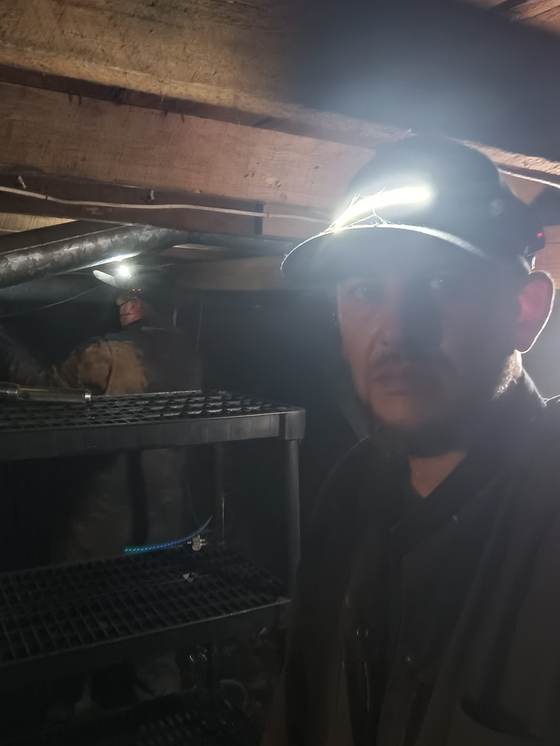
Ground nests along boundaries, banks, rough edges and beneath shrubs get found by machine rather than by eye — a mower, a strimmer, a tractor working a boundary — which is how people end up in an emergency room. On a lot with rough edges, knowing where the activity is before August is worth a great deal, and it costs nothing to have somebody look while they are already on the property.
Aerial nests in eaves, sheds and outbuildings are more visible and easier to deal with, though a nest in a shop doorway in August is still a problem. Bald- faced hornets build the large gray paper nests people photograph; European paper wasps build small open combs under railings and deck rails and are far less inclined to defend them.
Honey bees are not our work. If a colony has established in a wall or a chimney we will identify it and point you at somebody who removes them properly.
Spiders, and the fall wandering
Established lots with mature planting, outbuildings and a deck produce more spiders than a new subdivision does, and the autumn is when people notice.
Most of what turns up indoors is giant house spiders, and what people are seeing is males moving to find females rather than an infestation. That is why they appear singly, at speed, across a floor, in September and October. For anybody who would rather not take our word for it, the state health department describes Washington’s spiders without the theatrics.
Reducing them is largely a matter of reducing what they eat and where they get in: the same exclusion work as everything else, plus attention to exterior lighting, which concentrates the insects they hunt. Warmer, lower, more directed fittings do more than anything applied to a wall.
The autumn crowd
From late September the seasonal visitors gather on whichever elevation holds the afternoon sun. Multicolored Asian lady beetles on the warm siding, working into gaps around trim and vents. Brown marmorated stink bugs alongside them. Cluster flies in upstairs window channels.
The lady beetle is the only one that bites, and only if you handle it. None of them breeds indoors or damages the building, which is what decides the approach rather than a reason to shrug at them.
Because they do not reproduce inside, the number in the house depends entirely on how many got in. Sealing the openings and treating the exterior in the narrow window before the wave addresses the supply; spraying indoors through the winter addresses what is already in the room. On a mature lot the supply is larger, because the surrounding planting supports more of them.
Storage, firewood and the back of the property
Larger lots accumulate. Firewood, garden materials, a trailer, timber left over from a project, pots, and things put behind the shed with the intention of dealing with them.
Individually none of it matters much. Collectively it is a set of sheltered, undisturbed harborages spread across a property, and it is why a large lot can support a population that a small one cannot.
Firewood is the one that consistently matters most, because it is nearly always against a wall. Getting the stack off the building and off the ground, and bringing in what will be burned rather than a week’s worth to sit by the stove, removes a route that most households have without realizing.
What is worth paying for and what is not
The ranking on an established lot is unusually clear, and most of it is not a treatment.
The gap between planting and siding first, because it restores the ability to see and reach the building. Then the deck perimeter, because that is the stretch of wall nobody can inspect. Then the outbuildings, because that is where the population is. Then the crawlspace — vapor barrier, drainage, vent screens. Product, where it is needed at all, comes after those.
A recurring perimeter treatment on a mature lot with shrubs against the wall, an open deck and a full shop will produce a visible result every time and will never finish. We would rather quote the repairs.
The compost heap, and the one thing people get wrong about it
Nearly every established lot here has a compost heap or a green-waste pile somewhere at the back, and it is worth a paragraph because the advice usually given about it is wrong in both directions.
It is not a reason to stop composting, and anybody who tells you it is has an invoice in mind. A well-managed heap that is turned, kept damp rather than wet, and free of cooked food and meat is not a significant rodent attractant.
What does matter is a heap that has become a permanent unturned mound against a fence or a building, with kitchen waste going in, sitting undisturbed for years. That is shelter, warmth and food in one place, and it is usually the warmest spot on the property in January.
The fix is management rather than removal: turn it, keep it away from structures, and keep cooked food out of it.
How a visit works here
We start at the boundary and work in: what the lot backs onto, how close the cover gets, whether the ground beyond is worked, and what has accumulated at the back of the property.
Then the outbuildings, because on a lot with any of them that is usually where the population actually is.
Then the house at ground level — the whole perimeter, which on a mature lot means getting into the beds: foundation line, vents and screens, sweeps, penetrations, garage door corners, and the deck perimeter.
Then underneath, with a light, through the whole crawlspace rather than a look from the hatch, checking the vapor barrier, the insulation and the drainage.
You get a plain account of what is active, what is historic, what is driving it, what needs doing before the ground behind you is next cut, and which items belong to an arborist, a drainage contractor or a builder rather than to us. On an established lot a substantial share of the honest answer is grounds work, and we say so even though it is not work we are paid for. Attending and quoting costs you nothing. Bed bug verification carries a fee that is returned against the treatment, and no term commitment is asked for.
Frequently asked questions
The house is well maintained. Why is this happening?
Usually because the ground around it has changed rather than the building. Planting put in when the house was new is now mature and hard against the walls, over decades of accumulated leaf litter. That is permanent cover touching siding over damp organic material, and it is the most common driver on established lots regardless of how well the house itself is kept.
Do the shrubs really have to come out?
Almost never entirely. What matters is a genuine gap — daylight and air between the planting and the wall, and the foundation line visible and reachable. That is usually pruning and pulling beds back rather than removal, and it can be staged over a couple of seasons rather than done in one weekend.
What is under the deck?
Frequently the answer to a rodent problem nobody could otherwise explain. A deck built against a house creates a dry, sheltered, undisturbed space directly against the foundation, and on decks of this age it is almost never screened. It is simultaneously a route in, a place to live, and the one stretch of wall that cannot be inspected.
Should the shop and the shed be included?
Yes, and on a larger lot they are usually where the population is actually based. They sit nearer the cover, they are sealed to a much lower standard, and they fill first. Doing the house while they stay open concentrates the problem rather than reducing it.
We have big trees now. Are they the problem?
The living trees rarely are. What matters is standing deadwood, old stumps, fallen limbs, landscape ties and any timber that has been sitting damp for years — and branches touching the roof, which are a bridge over everything sealed at ground level. Most of that is dealt with without touching a healthy tree.
Is the crawlspace worth looking at if nothing seems wrong?
On a house of this age, yes, and it is the single most informative half hour available. Vapor barriers degrade, insulation sags, vent screens corrode from the ground side and drainage changes as landscaping matures. A crawlspace tells you what the last twenty years have done far more honestly than the living room does.
Does an assessment cost anything?
No fee for the visit. Bed bug verification is the sole exception and it is credited against treatment. On a larger lot the assessment covers the outbuildings, the deck and the boundary as well as the house, because that is usually where the answer is.
Pest problem in The Meadows?
Family-owned, no long-term contracts, and every treatment is backed by our 100% Service Guarantee.
Most calls in Whatcom County are out within 1–2 days, about 3 during the late-summer peak.
Last updated