
Pest Control in Downtown Ferndale
Downtown Ferndale holds the oldest building stock in the city, sitting on the Nooksack corridor. Post-and-pier foundations, decades of added services and a river running past the back of it produce a set of problems the newer subdivisions on higher ground do not have.
Call 360-410-2199 Request a free inspection
Downtown Ferndale, Ferndale on the map
The oldest part of the city
Downtown Ferndale is the original town — a compact commercial core with the oldest residential stock in the city around and behind it, on low ground beside the Nooksack.
Nearly all of the pest work here comes from two facts that have nothing to do with pests. The buildings are old, and they are close to the river.
Everything the newer parts of Ferndale get — the subdivisions on higher ground, the townhome developments, the estates on the edges — is a different job with different failure points. A technician who has spent the morning in Pacific Highlands and comes downtown in the afternoon is looking for entirely different things.
What a century of building does to a house
Age by itself is not a verdict. Plenty of the best-maintained buildings we work on downtown are the oldest ones. What age changes is the number of openings and how long it takes to find them all.
A house here has typically been through several generations of services. Knob and tube, then rewiring. A coal or wood system, then oil, then gas or electric. Galvanized supply, then copper, then possibly plastic. Waste lines replaced in sections. A phone line, then cable, then internet. A dryer vent cut through a wall in the seventies. An added bathroom, a kitchen moved, a porch enclosed, a window replaced with something a different size.
Every one of those was cut into the building by somebody focused on making the new thing work rather than on closing up behind it. Most were never sealed. Some were sealed with something that has since perished, and a few were stuffed with material that a rodent regards as an invitation rather than a barrier.
The result is a building with a great many small routes rather than one obvious one, and a survey that finds three of them has not finished.
Post-and-pier, and the space underneath
A large share of the older housing here sits on post-and-pier foundations — individual piers carrying beams, with a skirt of some kind closing the perimeter — rather than on a continuous foundation wall.
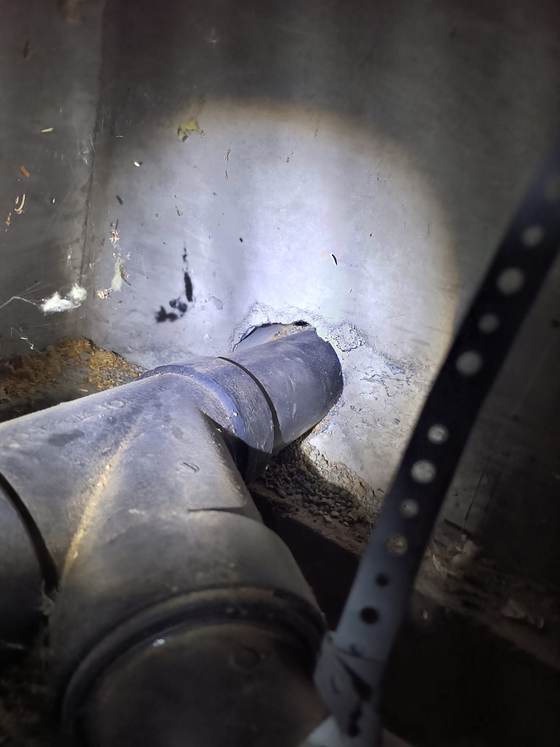
That construction has two consequences that matter enormously.
The first is that the perimeter is not structural. A skirt is a screen, and it is built and maintained accordingly: thin boards, lattice, sheet material, sometimes a partial course of blocks. It rots at the base where it meets the ground, it gets damaged by mowers and vehicles, and it gets opened up by tradespeople who never close it again.
The second is that the space underneath is generous. Unlike a shallow modern crawl, an old post-and-pier under-floor space is often tall enough to move around in comfortably. That is convenient for us and equally convenient for everything else.
The good news is that this is very fixable. Repairing the skirt properly, screening it with quarter-inch hardware cloth fixed rather than stapled, fitting sound vent units and closing the penetrations is a day’s work on most of these buildings, and it ends routes that have been open for thirty years.
The river corridor at the back of it
The Nooksack runs past this part of town, and the vegetated corridor along it is one of the best rodent habitats in the county: continuous cover, food, water and shelter, running for miles, with almost no disturbance.
It is worth separating the source from the route, because only one of them can be changed. The river is not going to stop being a river, and the corridor is not going anywhere. What can be changed is whether the animals living in it can get into your building, and that is always an ordinary gap.
The seasonal pattern is worth knowing too. High water displaces whatever lives in the bank, and the animals move to dry ground, which is where the buildings are. A property with no activity in the summer can have a genuine problem within days of the river coming up, and it has nothing to do with how the place is kept.
Moisture, and the ants that report it
Low ground near a river means a water table closer to the surface than it is on the ridges, and an old under-floor space over bare soil will hold moisture accordingly.
That matters because of what damp wood permits. Carpenter ants excavate galleries far more readily in softened timber than in sound timber. Wood-boring beetles and decay fungi need moisture content that dry framing never reaches. Those thresholds are set out in the Forest Products Laboratory’s Wood Handbook, which is worth a look if somebody has told you decay is simply what old houses do.
And moisture ants — which most people have never heard of and which we find constantly in this stock — are not really a pest problem at all. They nest in wood that is already wet and decaying. Finding them is useful information: it means there is a genuine moisture problem in that timber, and the ants are the symptom rather than the cause. Treating them and leaving the wet wood is treating a smoke alarm.
Getting a vapor barrier onto the soil and sorting out the obvious drainage is the highest-value work available on most of these houses, and a fair proportion of our downtown jobs involve no product at all.
The commercial core and the buildings that do two jobs
The center of town has attached commercial buildings, several of them with residential space above or behind, and those work differently from a detached house on the next street.
Behind the finished surfaces, an attached building is largely continuous — wall cavities that run past party walls, chases that pass vertically between floors, ceiling voids that span a whole floor plate, roof spaces that run the length of a terrace. A population living in that shared volume treats an individual unit as one room of a larger territory.
That is why a treatment in one unit can work and then stop working. It cleared what was inside; the source was never inside. The occupant reasonably concludes the treatment failed, and it did not — it was scoped to a unit when the problem was scoped to a building.
Where there is food service on the ground floor and residences above, the routes connecting them are almost always open: risers, extract runs, and the penetrations cut for gas, water, waste and power. Sealing those protects everyone in the building at once, and it is the cheapest thing available.
Rodents, and the ways in that actually get used
The openings downtown are ordinary and they are consistent.
At ground level: damaged skirting, a crawl hatch that is a board leaning against a hole, corroded vent screens, siding that stops short of the foundation, and the gap where a porch or a deck was built up against the house without screening underneath.
Higher up: where a roof meets a wall on a building that has settled, gable and attic vents with no screen behind them, and the point where a chimney passes the roofline on an old masonry stack.
And the one people never expect on older stock, which is the drainage. Disused or broken drain runs under and beside old buildings are a genuine route into a structure, and a rat problem that resists everything sensible at ground level is occasionally coming up rather than in.
Chimneys, and what lives in a disused one
Older housing here still carries masonry chimneys, and a good number of them have been out of service for years since the heating was changed.
A disused chimney is an open shaft from the roof into the building, and unless it was properly capped when it was decommissioned it is exactly that to anything that can climb or fly. Birds nest in them. Wasps nest in them. Rats and squirrels use them as a route into a roof space, and bats occasionally roost in them, which is a legally different matter that we will identify rather than treat.
The pest consequence is often indirect, which is what confuses people. An old bird nest in a flue holds mites and carpet beetles, and when the nest is abandoned those move inward, turning up in a bedroom weeks later with no apparent connection to anything.
Capping a decommissioned flue properly, with a cowl that still lets the stack breathe, closes all of that permanently. It is a roofer’s job rather than ours, and it is one we recommend regularly.
Basements, part-basements and the ground beneath
Some of the older houses here have a basement or a partial basement rather than a crawlspace, and they behave differently enough to be worth separating.
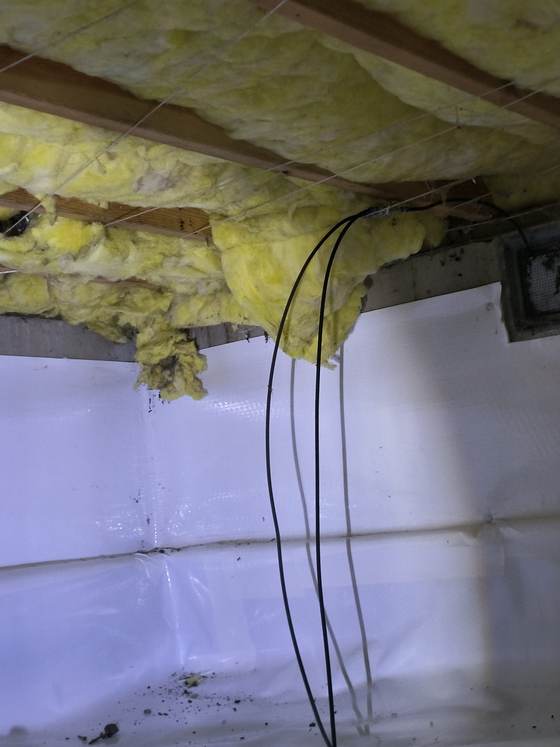
A basement on low ground near a river is a below-grade room in wet soil. Moisture pushes through masonry under pressure, older walls are rarely tanked to any modern standard, and drainage that was adequate in 1950 is frequently not adequate now that the ground outside has been landscaped and built up.
What that produces is a permanently humid space, usually with stored material in it, at the bottom of the building. Silverfish and firebrats do well there. Spiders do well on what they attract. Centipedes and pillbugs come in from the soil. And any wood in contact with a damp wall, from a stair stringer to an old workbench, is candidate material for wood-boring insects.
Pest work in a wet basement is nearly always second to the moisture work, and we will say so.
Spiders, and the fall wandering season
Old houses with generous under-floor spaces and a lot of ground-level openings produce more spiders indoors than new houses do, and downtown gets a noticeable wave of them in the autumn.
Most of what people find is giant house spiders, which look alarming and are not. The fall activity is males moving to find females rather than an infestation arriving, which is why they turn up singly, at speed, in the middle of a floor, in September and October.
Reducing them is largely a matter of reducing what they eat and where they get in — the same exclusion work that handles everything else, plus attention to exterior lighting, which concentrates the insects they are hunting.
Wasps on an old building
Old buildings offer more aerial nesting opportunities than new ones: open soffits, gaps at the roofline, disused chimneys, porch roofs, and the voids in outbuildings that come with older lots.
The complication downtown is access and the public. A nest in the fascia above a shop entrance or a shared walkway is a hazard to people who never chose to be near it, and dealing with it needs equipment and a time when there is nobody underneath.
For the household version of the same question, WSU keeps factsheets on wasps and other indoor and outdoor nuisances at Pestsense.
Honey bees are a separate matter and we do not treat them. An old chimney or wall cavity with a colony in it needs somebody who removes them properly, and we will point you at one.
Storage, outbuildings and the back of the lot
Older lots downtown often carry a shed, a detached garage, or an outbuilding that predates the house’s last three owners, and these are consistently where a population is actually based.
They are closer to cover, sealed to a much lower standard, and full of exactly the soft, undisturbed material that makes good nesting. A house forty feet from a full outbuilding is being supplied continuously, and sealing the house alone concentrates the problem rather than reducing it.
Firewood against a wall does the same thing on a smaller scale, and nearly every old house here has some.
Bed bugs in older rentals
A share of the older housing downtown is rented, sometimes divided into units, and bed bugs follow that pattern rather than any question of how a home is kept.
They arrive in luggage and on secondhand furniture. In a divided building they move between units along shared voids and service runs when pressure rises in one of them. So a single treated unit in an untreated building gets reinfested, and a single untreated unit undoes work everywhere else.
The obstacle is usually reporting rather than treatment. A tenant who expects to be blamed waits, and by the time it is raised the neighbors have it. A building where reporting early is treated as helpful costs nothing and saves a great deal.
We charge to verify bed bugs and credit it against treatment, and on a divided building verification is worth having on its own — it establishes what is actually there before several units get treated on an assumption.
What is worth doing first
On this housing stock the ranking is unusually clear.
Vapor barrier and drainage first, because the moisture is what several other problems depend on. Then the perimeter — skirting, vents, hatch, penetrations — because that ends the routes rather than the individuals using them. Then the outbuildings, because that is where the supply is. Product, where it is needed at all, comes after those three rather than instead of them.
A recurring treatment on an old house with an open skirt and a wet crawlspace will produce a visible result every time it is applied and will never finish. We would rather quote the day of hardware.
Alleys, back lots and the ground behind the buildings
The older grid downtown has back lanes, service accesses and awkward strips of ground behind buildings, and collectively they are the most productive place to look on this side of town.
They are out of sight, so they collect. Stored material, waste, disused equipment, timber from a project, and vegetation nobody manages because nobody is quite sure whose it is. They run continuously behind whole blocks, connecting properties that never share a boundary at the front.
For a rodent population that is a corridor with harborage every few yards, and it is why activity downtown tends to appear along a run of addresses rather than at one.
Almost none of that requires a technician to fix. Clearing a back lot, getting stored material up off the ground, and making sure waste is contained does more than anything applied to a wall — and where several neighbors do it at once, it removes the corridor rather than moving it along.
How a visit works downtown
We start with the perimeter and the ground: skirting, vents, hatch, drainage, what is stored against the walls, and how close the cover gets.
Then underneath, properly, with a light, through the whole under-floor space. On post-and-pier that is a real inspection rather than a look from the opening, and it is where most of the answers are.
Then the interior and the roof space, and in an attached or mixed-use building the shared routes — risers, chases and ceiling voids — because that is what turns one unit’s problem into a building’s problem.
You get a plain account of what is active, what is old, what is driving it, which items are building work rather than pest work, and what belongs to a landlord or a neighbor rather than to you. The survey costs nothing. Bed bugs are the single exception, billed for verification and credited back against treatment, and no contract is involved at any point.
Frequently asked questions
Our house is a hundred years old. Is it a lost cause?
Not remotely, and old houses are frequently easier to fix properly than people expect. What age changes is the number of openings and the time it takes to find them, because a century of plumbing, wiring, heating and remodeling has been cut into the building and rarely closed behind itself. It is findable work rather than hopeless work.
What is post-and-pier and why does it matter?
It is a foundation of individual piers supporting beams rather than a continuous perimeter wall, usually with a skirt around the outside. It matters because the skirt is not structural, it is often thin or damaged at the base, and the space under the floor is generous and easy to move around in — which suits rodents very well.
Is the river the reason we get rats?
It contributes a great deal. A vegetated river corridor is continuous cover, food and water running past the whole neighborhood, and it is among the best rat habitat in the county. What it does not do is get them into your building — that is always an ordinary gap, and that is the part that can be fixed.
We are above a shop. Does that change anything?
Yes. In a mixed-use building the routes between the commercial floor and the residential floors above are usually open — risers, extract runs and service penetrations nobody closed. Sealing that path protects everyone in the building, and either party can start it.
There are ants in the kitchen every spring. Are they carpenter ants?
Sometimes, and often they are odorous house ants or moisture ants instead, which look broadly similar to most people and mean very different things. Moisture ants in particular are a report about wet wood rather than a pest problem in their own right. Identifying which you have decides whether this is a treatment or a repair.
Can the crawlspace really be sealed on a house this old?
Usually yes, and it is the highest-value work available on this stock. Perimeter skirting can be repaired and screened properly, vents replaced with sound units, and penetrations closed. It is a day's work rather than a rebuild, and it ends routes that have been open for decades.
Does it cost anything to have somebody look?
No, other than bed bug verification, which is charged and comes off the treatment. On older stock the assessment genuinely takes longer than on a new house, and we would rather spend that time than guess.
Pest problem in Downtown Ferndale?
Family-owned, no long-term contracts, and every treatment is backed by our 100% Service Guarantee.
Most calls in Whatcom County are out within 1–2 days, about 3 during the late-summer peak.
Last updated