Odorous House Ant — Tapinoma sessile
Tapinoma sessile · Ants
Odorous house ants are small dark ants that smell strongly of rotten coconut when crushed. They damage nothing structurally, but colonies carry many queens and split into new nests when disturbed, so a repellent spray can turn one trail into several. Baiting is the response that works.
Call 360-410-2199 Request a free inspection
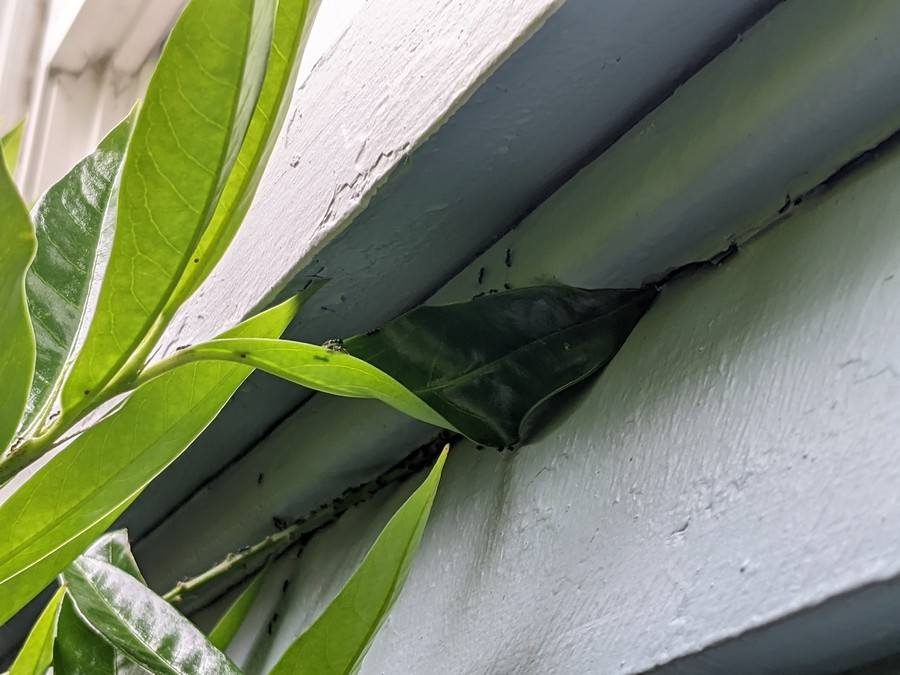
Sometimes worth treating, sometimes not — it depends on what is below.
Odorous house ant at a glance
| Size | A sixteenth to an eighth of an inch, all workers about the same size |
|---|---|
| Color | Brown to black and unshiny |
| Smell | Rotten coconut or blue cheese when several are crushed — the fastest identification |
| Waist | A single flattened node hidden under the abdomen, so it seems to have no waist |
| How to tell it from a pavement ant | Pavement ants have two waist nodes, grooved heads, and throw up soil mounds at slab cracks |
| Damage | No structural damage — food contamination and persistent nuisance only |
| Do we treat it | Depends — brief trails often end alone; established indoor colonies get baited, never sprayed |
Signs you have them
- A trail of small dark ants to a sink, dishwasher seal or pet bowl
- Ants appearing overnight in the kitchen after heavy rain
- Several separate points of activity in different rooms, especially after spraying
- Ants active indoors on mild days through winter
- Ants tending aphids on roses, birches or shrubs beside the house
The smell test
There is no other insect in this library that identifies itself by odor, and this one does it so reliably that it is worth leading with.
Crush half a dozen workers on a fingertip and smell them. WSU’s publication on the species describes the result as rotten coconut or blue cheese; Utah State Extension uses the same coconut comparison. It comes from glands at the rear of the abdomen, and once you have smelled it you will not need a second opinion about this species again. One worker rarely produces enough to register, which is why people try the test, smell nothing and conclude they have something else. Use several.
Everything else about the ant is unremarkable, which is precisely why the smell matters. WSU gives the workers at a sixteenth to an eighth of an inch; Utah State puts them at about three millimeters and notes that all workers in a colony are roughly the same size. They are brown to black, unshiny, and they look like a great many other small dark ants that walk across a counter in this county.
Under a lens, the structural check is the waist. Most ants carry one or two raised nodes between thorax and abdomen. This species has a single node that is flattened and tucked underneath the abdomen, so from above it appears to have no waist segment at all — a hidden, button-like node, in WSU’s description. The antennae have twelve segments and no club at the tip. That combination separates it from nearly everything else likely to be on the counter.
What it is native, and what that changes
This is a North American native, not an import, and the distinction has practical weight. Utah State records natural colonies containing something like fifteen to thirty workers — a genuinely small woodland ant living under bark and stones, tending aphids and getting on with a modest life.
Put the same species in a town and it behaves like a different animal. Urban colonies can hold tens of thousands of workers, and supercolonies hundreds of thousands, spread across many connected nests with many queens. The insect has not changed. The environment has removed the constraints that kept it small: year-round water, reliable food, heated voids to overwinter in, and ornamental plantings carrying the aphids and scale insects it milks for honeydew.
That is worth knowing because it explains why this species is a persistent suburban problem and a non-issue in the woods behind the house. It also explains why the population you are dealing with is nearly always larger than the trail suggests.
Why a spray makes it worse
This is the single most consequential thing on the page, and it is the reason so many households arrive at a professional with more ants than they started with.

Colonies of this species are polygyne — many queens — and polydomous, meaning the population occupies multiple connected nests rather than one. WSU records that colonies move frequently, often within twenty-one days, in response to weather, nesting substrate and available resources. This is an animal built to relocate.
Now apply a repellent product to part of that network. Utah State describes the mechanism plainly: repellent insecticides cut ants off from their nests, and an incomplete application to a nest with a repellent material may cause the nest to split, creating multiple nests. Because every fragment can carry queens, each one carries on as a functioning colony rather than dying out.
This is called budding, and the household experience of it is unmistakable. One trail behind the kitchen sink gets sprayed on three consecutive weekends. Within a month there are ants in the bathroom, ants in the utility room and ants coming up through the floor in a bedroom. Nothing has gone wrong with the product. It did what a repellent does, to a species that answers disturbance by dividing.
The PNW Insect Management Handbook makes the same point for the region and does not hedge it: over-the-counter sprays are highly repellent to ants and may scatter them throughout a structure, and baits are the best approach for ants in a structure, especially odorous house ants.
If you take one thing from this profile, take that. Do not spray this ant.
Where the nests actually are
The species nests opportunistically, in existing spaces rather than excavated ones, which is why the list is so long and why a single visit does not always find every one of them.
Outdoors, Utah State describes shallow nests in soil under objects — a paver, a stepping stone, a plant pot, a piece of scrap timber, a stack of bricks, the flat stones of a rockery. They are also found under bark, in mulch, in the cavities of retaining walls, and in the leaf litter of a bed built up against siding.
Indoors, they favor voids with moisture and warmth: wall cavities near leaking pipes, the space beneath a shower base, cabinet kickboards, the void behind a dishwasher, around water heaters, under insulation, and inside the housings of appliances that run warm. Utah State’s observation that they gather around leaking pipes, toilets and sinks matches what we find here almost exactly.
Two behavioral details are worth having, because they explain otherwise baffling patterns.
First, this species relocates its brood to the food rather than carrying food back to a fixed nest. So a colony may set up in a kitchen cabinet for a fortnight because there is a resource there, then leave entirely, then reappear somewhere else. People describe this as the ants “moving around the house,” and they are describing the biology accurately.
Second, Utah State notes that in winter the subcolonies tend to consolidate into a few overwintering nests. In this county, where nothing freezes hard, those overwintering nests are frequently inside a heated building, which is why activity here can continue on mild days through January in a way it does not in colder states.
Why they came in
The trigger is almost always weather rather than housekeeping, and it helps to know which pattern you are in.
After heavy rain. Shallow soil nests flood. The colony moves up and in, and a wall void is dry, warm and immediately available. This is the largest single driver of indoor calls here and it accounts for the classic pattern of ants appearing overnight in a kitchen where nothing has changed.
During a warm dry stretch. Now they are looking for water, not food, which is why a trail so often runs to a sink, a dishwasher door seal, a pet bowl or a condensating pipe with nothing edible anywhere along it.
When the honeydew supply shifts. These ants farm aphids and soft scales on ornamental shrubs, roses, birches and fruit trees. A heavy aphid year keeps a population high and close to the building; an aphid crash sends the same population looking elsewhere, which is frequently indoors.
In autumn, as outdoor resources decline and the consolidation into overwintering nests begins.
None of that reflects on a household. We are called to spotless kitchens for this species constantly, and the resource is usually something nobody would count as food — an unrinsed recycling bin, the gap beside a dishwasher, sticky residue on the outside of a honey jar, a pet bowl left down overnight.
What they cost you, honestly
Nothing structural. WSU is explicit that this species causes no structural damage, and it is worth saying so plainly on a pest control company’s website, because this ant is routinely sold against as though it were a threat to the building.
It does not excavate wood. It does not chew wiring. It does not carry a disease of household consequence. What it does is contaminate food, occupy a kitchen in numbers, and persist — and WSU notes the specific cost that comes from the budding behavior, which is that pest control expense rises when a colony fragments after a removal attempt.
So the case for treating is a nuisance and food-hygiene case, not a damage case, and anyone framing it otherwise is overselling.
Why the verdict here is “depends”, and on what
Two situations, and the difference between them is easy to establish.
Often no treatment is warranted. A short-lived trail after a storm, ants on a patio in July with nothing coming indoors, or a line running to one identifiable resource will frequently resolve on its own once the ground dries and the resource is removed. Wipe the trail with soapy water — which lifts the pheromone without dispersing anything — deal with the recycling, the pet bowl and the gap beside the dishwasher, close the entry point once activity stops, and a substantial share of these end there. That is not a job worth paying anybody for, and we would rather say so here than after a visit.
Sometimes it genuinely is warranted. The situation changes when the colony is established inside the structure rather than foraging in from outside, and the markers for that are specific: activity persisting for weeks after every food source has been removed; trails appearing in rooms with no food in them at all; ants active indoors through the cold months; several separated points of activity in one building; or a history of somebody having sprayed, which raises the likelihood that the population has already fragmented. Any of those makes correct baiting worth doing properly.
There is a third case that decides itself. In apartments, condominiums and any building with shared wall voids, utility chases and plumbing runs, this species does not respect unit boundaries, and treating one unit while the neighboring one is left alone moves the nest rather than reducing it. That is a building-level piece of work from the outset.
What correct treatment involves
Identify before choosing anything. The smell test plus the hidden node takes under a minute and it determines the entire approach, since the response for this species is close to the opposite of the response for a carpenter ant.
Bait, matched to the season. WSU points to sugar-based baits with slow-acting active ingredients in bait stations, and slow is the operative word — the material has to be carried back and shared before it acts. Colonies shift between sweet and protein preference through the year, and a refused bait is usually the wrong type rather than a resistant population.
Place bait beside the trail, not on it. On the route, near the entry, out of reach of children and pets, and not on a food preparation surface.
Remove the competition. Bait only works if it is the best thing available, so the crumbs behind the toaster, the unrinsed jars and the overnight pet bowl all have to go while it is down.
Use non-repellent materials where a product is needed, so workers move through treated zones and carry the material inward instead of being turned back at the boundary.
Work the exterior, which is where the network usually lives — under the pavers and stones, in the mulch against the foundation, in the rockery, and on the aphid populations feeding the whole operation. Managing the honeydew source is a genuine control measure for this species and is almost never mentioned.
Then seal. Once activity has dropped, close the entry route — the gap at the pipe under the sink, the crack at the window return, the joint at the kickboard. Sealing first, while a colony is active inside, simply hides the route.
And be patient with it. Two to three weeks is normal, and the first week usually looks worse rather than better. Utah State and the PNW handbook both note that baits take weeks to work; abandoning at day four and reaching for a spray is how a manageable situation becomes a distributed one.
How fast the population rebuilds
Part of why this species outlasts casual efforts is arithmetic, and the numbers are worth having.
WSU records four to five generations a year, with a worker developing from egg to adult in five to eleven weeks. Set that against a colony holding many queens laying simultaneously and you have a population that replaces losses faster than any approach aimed at the ants you can see. Killing foragers is not slow progress against this species; it is no progress, because foragers are the fraction the colony can most easily spare and the fraction it replaces fastest.
WSU also records something less comfortable, which is that this species shows higher insecticide resistance than several other household ants. That is another argument for bait over spray rather than against treating at all — a slow-acting material carried to the queens works on a mechanism that tolerance to a contact product does not defeat, and it reaches the part of the population that actually determines the outcome.
The relocation behavior compounds it. A colony that shifts nest sites within three weeks as a matter of routine will simply move away from a treated zone, which is the fundamental reason surface applications underperform here and baits do not.
The six things people have already tried
Almost everyone has done something before calling, and it helps to know what each of them actually accomplished.
A retail aerosol on the trail. Kills what it lands on, erases the pheromone route that would have led to the nest, and carries the specific risk described above of splitting the colony. This is the one that does real harm.
A perimeter spray around the outside of the house. Better placed than the aerosol, and occasionally useful, but a repellent barrier applied without knowing where the nests are mostly redirects traffic. Against a species with nests on both sides of the line, it can partition the population rather than reduce it.
Retail bait stations, left down for four days. The right idea abandoned at the wrong moment. Peak visible activity around a bait station happens before the result does, and pulling it during that window undoes the mechanism.
Cinnamon, vinegar, coffee grounds, chalk and essential oils. These interfere with the pheromone trail, which is why they appear to work for an afternoon. The column re-forms a few inches away or takes a different route through the wall. Nothing has reached the colony.
Ultrasonic plug-in devices. No effect on ants, and no mechanism by which there could be one.
Diatomaceous earth along a run. A genuine mechanism — it abrades the cuticle — and it does work slowly where ants cross a dry deposit repeatedly. It is useless once damp, which in a Whatcom County crawlspace or under a sink it will be, and it does not travel back to a nest.
If you have done several of these, say so, because a history of repellent treatment changes what we expect to find. A single trail that has been sprayed three times is more likely to be several nests than one.
The year, as this species runs it here
February and March. Overwintering nests break up as temperatures rise and subcolonies redistribute. The first indoor sightings of the year are usually a few scouts rather than a column.
April through June. Population builds, aphid numbers climb on ornamental planting, and honeydew becomes abundant. Colonies split and expand outward in the normal course of the season, which is when a nest first arrives in a wall void. Rain-driven incursions are at their most frequent in this stretch.
July and August. Peak numbers, peak trail activity, and the sweetest tooth of the year in most colonies. Also the period when a warm dry spell sends ants indoors for water rather than for food, which produces trails that lead to plumbing and nothing else.
September and October. Outdoor resources fall away and the aphid supply collapses. Foraging turns toward protein, bait preference shifts with it, and pressure on buildings rises sharply.
November through January. Consolidation into overwintering nests. In a climate with no hard freeze, those nests are often inside a heated structure, and activity on a mild January day is normal here in a way it is not further inland. Indoor sightings in midwinter carry the same meaning they do for carpenter ants: whatever you are seeing is living inside rather than visiting.
How to tell whether it actually worked
Worth stating, because the failure mode with this species is a household concluding too early that a treatment did not take.
In the first week, expect more ants at the bait and fewer everywhere else. In the second, expect the trails to thin and break up. By the third, expect little or nothing, with the occasional straggler for a while afterward.
What indicates a genuine problem is not slow progress but a changed pattern: activity appearing in a room that had none, two or three separate points of activity where there was one, or a trail re-establishing on a different route after going quiet. Those are the signatures of a colony that has divided, and the response is to look again at where the nests are rather than to reapply the same material harder.
Telling them apart
Carpenter ants. Not a close call once you look. Carpenter ant workers run from a quarter inch to a half inch and vary in size within the same nest; these are uniform and around three millimeters. Carpenter ants are black with reddish legs and produce fibrous frass below slit-shaped openings in timber. Crushed carpenter ants do not smell of coconut. And the implication is entirely different: one is a nuisance in a kitchen, the other is excavating structural wood.
Pavement ants. The confusion that actually happens, because both are small and dark and both come indoors to forage. Utah State gives pavement ants at two and a half to three millimeters, dark brown, with two nodes on the waist rather than one, a pair of spines on the thorax, and heavy sculpturing on the head and thorax that forms parallel grooves. The habits separate them too: pavement ants throw up small volcano-shaped soil mounds at cracks and expansion joints in slabs, paths and driveways, and they swarm in spring. Odorous house ants build no mounds and reproduce largely by budding. Crushed pavement ants have no distinctive coconut odor.
Moisture ants. Yellow to amber rather than brown-black, three to five millimeters, and found concentrated in wet decaying timber rather than trailing to a food source. Their presence is a statement about water in the building, which is a different conversation altogether.
Winged forms in spring. Small flying ants indoors raise the question of what produced them. This species does fly, but it also spreads by budding, so a flight is less diagnostic here than it is for carpenter ants — and a large emergence of winged ants indoors is more likely to be another species. Keep specimens and have them looked at rather than assuming.
The short version
Small, uniformly sized, brown-black, one hidden waist node, and unmistakable when crushed. It will not damage your house. It will not respond well to anything you spray at it, and spraying is the one intervention with a documented mechanism for making the situation worse. Bait it, feed it nothing else, close the route once it has gone quiet, and deal with the aphids on the shrubs by the wall.
And if it turns up once after a downpour and stops of its own accord a week later, that is the whole event. Not everything on this list needs a company attached to it.
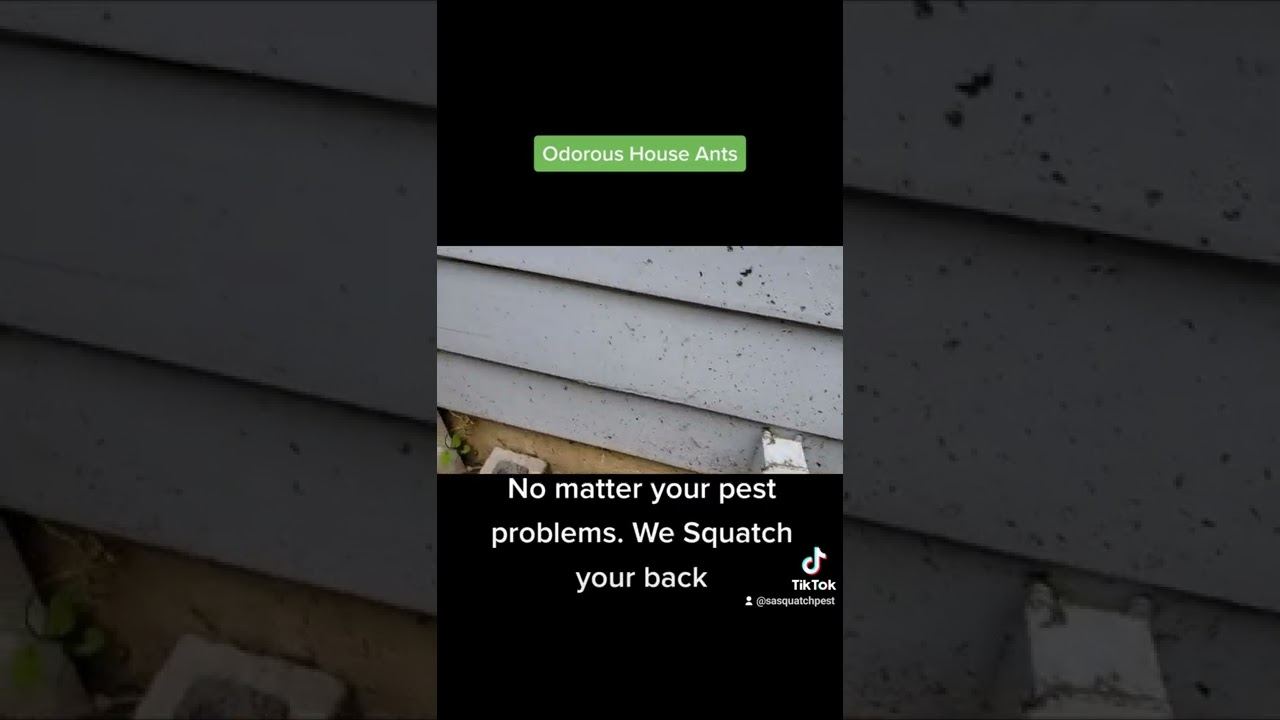
Odorous house ant, on video
Frequently asked questions
What exactly does the smell resemble?
WSU describes it as rotten coconut or blue cheese, and Utah State uses the same coconut comparison. Crush several on a fingertip rather than one, since a single small worker does not release much. It is the fastest identification available.
Why did spraying them make the problem spread?
Incomplete treatment of a nest with a repellent product can cause it to split, creating several nests where there was one. The colony already contains multiple queens, so each fragment can carry on independently rather than dying out.
Do they damage the building at all?
No. WSU records no structural damage from this species. They nest in existing voids and cavities rather than excavating anything, and the cost of having them is contaminated food and persistent nuisance rather than repair work.
Why are there suddenly so many after rain?
Their outdoor nests are shallow, sited under objects and in soil, and heavy rain floods them. The colony relocates to higher drier ground, and a wall void or a subfloor is exactly that. Warm dry spells push them indoors looking for water.
How long should baiting take to work?
Expect two to three weeks rather than days, and expect more ants visible in the first few of them. That increase is recruitment to the bait, which is how the material reaches queens and brood you cannot see.
The bait is being ignored. What now?
Usually the wrong formulation rather than a resistant colony. This species takes sweets and protein at different points in the season, so switching between a sugar-based and a protein-based bait resolves most refusals. Competing food nearby is the other common cause.
Are they the same as the ants nesting under my driveway?
Probably not. Ants throwing small soil craters up through cracks in slabs and paths are usually pavement ants, which have two waist nodes and grooved sculpturing on the head. Odorous house ants have a single hidden node and a smooth head.
Sources
- WSU Extension EB1550E — Odorous House Ant (Tapinoma sessile Say) — read September 1, 2026
- Utah State University Extension — Odorous House Ants — read September 1, 2026
- Utah State University Extension — Pavement Ants (Tetramorium immigrans) — read September 1, 2026
- PNW Insect Management Handbook — Nuisance and household pests: Ant — read September 1, 2026
Rules change. This page is scheduled for review against its sources by September 1, 2027. If you are reading it after that date and something looks out of step with the current rule, the rule is right and we are wrong — please tell us.
Pest problem in Whatcom County?
Family-owned, no long-term contracts, and every treatment is backed by our 100% Service Guarantee.
Most calls in Whatcom County are out within 1–2 days, about 3 during the late-summer peak.
Last updated