
Pest Control in Sterling Meadows, Lynden
Sterling Meadows is newer housing on Lynden's south side, built to one specification over a short period on ground that was farmed before it. The buildings are tight rather than sealed, and the pressure arriving at them is still agricultural.
Call 360-410-2199 Request a free inspection
Sterling Meadows, Lynden on the map
New housing on the south edge
Sterling Meadows is newer subdivision housing on the south side of Lynden, built over a short period to a consistent specification, on ground that was agricultural before it was residential.
Two facts drive everything here and they pull against each other.
The buildings are modern: continuous foundations, current materials, proper detailing, and a short list of failure points that are the same on every house. That is genuinely good, and it means the honest job on most of these properties is small.
The surroundings are not modern at all. Open ground is close on the south side, it is worked on an agricultural calendar, and the animals living in it behave exactly as they have always behaved.
Tight is not sealed
New construction is excellent at what it was designed for. It is airtight to a standard older housing never approached, it manages water intelligently, and it is insulated properly.
None of that is rodent exclusion. That is a different specification, with different materials, and it was not what anybody was checking on the way through.
The failures are consistent enough that we can predict most of them before arriving.
Service penetrations closed with foam. A new house here has at least a dozen — water, waste, gas, power, data, the heat pump lines, the dryer vent — and the builder almost always closed them with expanding foam. That is exactly right for air and water, and a mouse chews through it without slowing down. This is the single most common route we find on newer houses anywhere.
Crawlspace vent screening stapled rather than fitted. A screen tacked over an opening instead of mechanically fixed into it lifts at a corner within a few years. After that the vent is simply an opening.
Garage door corners. Close the door, stand in the garage and check the two bottom corners. Daylight means a gap at floor level, in a space that connects directly to the house.
Behind siding trim and at transitions. Where two materials meet, at corner boards, and behind the trim around a bay or a cantilever, there are voids that were never intended as access and work as it.
None of that is bad building. It is a building detailed for weather rather than for wildlife, and every one of those fixes is small and permanent.
The warranty question, worth asking early
On housing of this age some of what we find may not be a maintenance item at all.
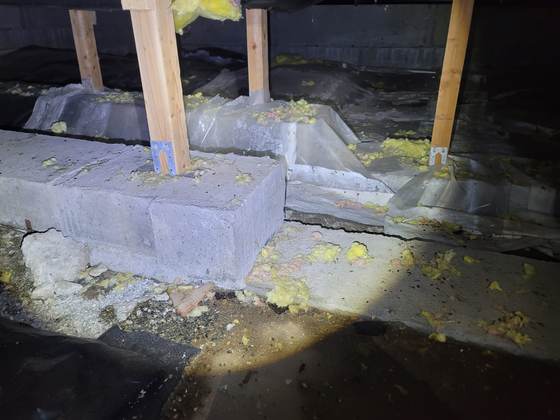
Missing or improperly fixed crawlspace screening, a garage door that does not meet the slab, an unsealed penetration through a rim joist, a soffit vent with no mesh behind it — depending on the age of the house and the terms, several of those can be warranty items rather than owner responsibility.
We are not the people to interpret your warranty and we will not pretend to be. What we will do is write down precisely what we found and where, in a form you can hand to a builder, before anybody decides who is paying to fix it. That costs you nothing and it occasionally saves a fair amount.
One era, one set of details, one advantage
Almost everything about a single-period development is a disadvantage for character and a considerable advantage for diagnosis.
When a development goes up over a few years to a consistent specification, every building has the same details, materials and shortcuts. So when a problem on one house traces to a particular vent type, a particular garage door seal, the way the dryer vent was run, or a gap where the siding meets the foundation, the odds are very high that the identical detail exists on every house in the street.
That turns a search into a check. On a first visit we will find the route on your house and then look specifically for it everywhere it should also exist, which is faster and more thorough than starting from scratch.
It also means a well-chosen repair specification can be applied across a whole street. Where neighbors want to do it together, the cost per household drops sharply and the result is better, because it removes the source rather than moving it next door.
Ground that was farmed, and ground that still is
Land does not stop being what it was because it has houses on it now.
The immediate effect is historical: ground that was cleared and graded for development displaced whatever was living in it, and the nearest structures at the time were the new houses. That is why so many people in newer subdivisions get mice within months of moving in, and why it feels like a verdict on the building when it is nothing of the kind.
The ongoing effect is agricultural, and it is the one that matters now. Farmland close to the south edge is worked on its own schedule. When it is cut or harvested, several hundred acres of cover becomes bare ground within a week, and every animal living in it has to be somewhere else immediately.
That arrives suddenly and in numbers, usually weeks before there is any cold weather to blame it on. A property with nothing at all in July has a genuine problem by late August, and the house has not changed.
Because it is event-driven, it is predictable, and the work to close a building is worth doing before the ground goes rather than after.
Drainage on former farm ground
Development on agricultural land inherits the drainage that was there, and it is worth a look on a property of this age.

Agricultural ground here was tiled and ditched over generations, and a subdivision built across it sits on top of whatever remains of that. Combined with new stormwater facilities, the result is usually fine and occasionally produces a wet corner nobody expected.
The reason it matters to us is that a persistently damp crawlspace, or ground that no longer falls away from a foundation, is the beginning of the moisture story that carpenter ants, wood-boring beetles and decay depend on. How wet wood has to be before decay starts is set out in the USDA’s Wood Handbook, and a house this new should be nowhere near it. On a house this new that should not be happening yet, and where we find it we will say so plainly, because it is a building issue rather than a pest one and it is much cheaper to address early.
Landscaping: the window that is open now
Right now the planting here is young, set back and open, and on most of these houses the foundation line can be seen and reached the whole way round.
That is a real advantage and it is temporary.
Every mature neighborhood in this county tells the same story: planting installed when the houses were new, allowed to grow, and now hard against the siding over a deep bed of accumulated material. That combination — permanent cover touching the wall, over damp organic matter — is the single most productive thing to fix on an older lot, and it takes years of growth to create.
Keeping a genuine gap between planting and siding now costs nothing. Fifteen years from now, getting it back means pulling out mature shrubs that someone has come to love.
Irrigation matters as much. New landscaping gets watered heavily to establish, and water applied against a foundation starts the moisture problem this ground otherwise would not have.
Oregon State’s Solve Pest Problems takes the same questions about planting, mulch and water from the gardener’s end, for this region rather than another one.
Heat pumps, line sets and modern mechanicals
Houses here carry equipment older housing does not, and it introduces routes and harborage nobody thinks to check.
The heat pump line set passes through the wall, and that penetration is frequently the largest single hole in the building envelope — usually foamed and covered with plastic trunking, which handles weather and does nothing about a mouse.
The outdoor unit sits on a pad against the wall, generally with a gap underneath. Dry, sheltered, undisturbed, directly against the building.
A condensate line and its drain keep a little standing water somewhere warm and out of the weather, which is all small flies need to breed.
None of this is difficult. It is simply newer than most of what gets checked, and somebody working from habit on older housing can walk past all three.
The first autumn, and every one after
From late September the sunny elevations collect the seasonal crowd, and on the edge of open ground there is nothing to intercept them.
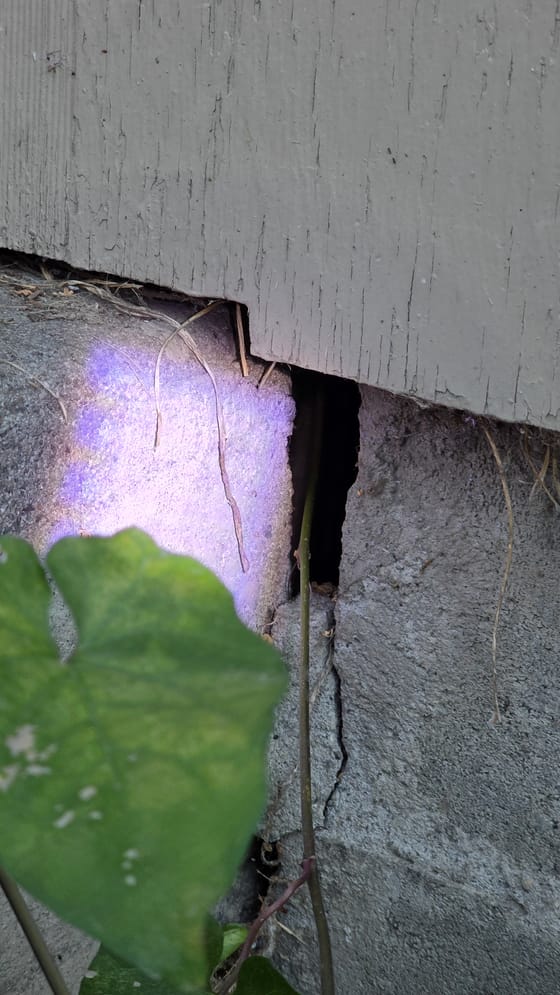
Cluster flies are Lynden’s particular version. They breed outdoors in soil, have nothing to do with hygiene or waste, gather on warm walls, work into gaps, and overwinter in wall voids and attics — then appear indoors on mild winter days in numbers that seem impossible relative to any visible opening. Multicolored Asian lady beetles and brown marmorated stink bugs do the same on the same walls.
The lady beetle can deliver a small bite; the stink bug cannot. Neither raises young indoors or harms the structure. Since they cannot reproduce inside, whatever ends up in the house got there by walking or flying in, and the count reflects nothing except how many openings were available — so the answer is sealing, plus exterior work timed to the short window ahead of the wave. Repeated interior spraying deals with what is already in the room and nothing else.
Timing is what goes wrong. Too early and the exterior work has faded; too late and they are already on the wall. Since it is the temperature rather than the calendar that starts it, the useful week moves by a fortnight or so each year, and a household that waits until it sees them has already missed it.
Wasps in the soffits
Modern soffit and fascia detailing creates long continuous voids with small openings at intervals — vents, joints, the end of a run at a gable — which is precisely what a queen is looking for in spring. They are twenty feet up, invisible from the ground, and nobody inspects them.
The result is a nest that goes unnoticed until midsummer, by which time it is established and frequently above a door or a patio.
Because every house shares the detail, a good nesting year produces nests along a whole street rather than at one address. That is normal and it is worth knowing before somebody concludes their house is unusual.
The useful move is looking in June rather than reacting in August.
Families, pets and how work gets placed
This is family housing with children and dogs in the yards, and that shapes placement rather than possibility.
Every placement sits in a locked, enclosed station out of reach of children and pets, and we plan inside work around whichever rooms the family is using.
We will show you the label before we treat, tell you what is being applied and where it is not being applied, and give the re-entry directions without being asked. You can read every product we carry on this site — EPA registration number, full label, safety data sheet — which few companies do, and we do on purpose.
Where a repair does the job instead of a product we will recommend the repair, even though it is the smaller invoice. On a house this new that is frequently the entire answer.
What is worth doing, in order
Close the builder gaps first: penetrations done mechanically rather than with foam alone, vent screening fixed into the opening, and the garage door seal. It takes a morning, and it does most of the work.
Keep the landscaping off the walls and the irrigation off the foundation while that is still easy.
Get the autumn exterior work timed properly for one season and then judge whether it is needed every year.
And from about the fifth year, start looking at the roof line, because that is when trees planted at handover begin to reach it, and a branch on a roof bypasses everything sealed at ground level.
Fence lines, and what collects along them
On lots this size the boundary between two properties is one of the more productive things to look at, and almost nobody does.
A fence line collects from both sides at once. Leaf litter builds against it. Shrubs get planted beside it and grow into it. Bins, firewood, garden furniture, bikes, offcuts and cuttings get stored there because it is out of the way.
The result is a continuous strip of sheltered, undisturbed material running the whole depth of the lot, joining whatever is behind the development to the buildings at the front. It functions as a route and a harborage in the same feature, and it exists on most lots in a development of this age once the first few years have passed.
Clearing a foot either side, and keeping stored material up off the ground, is free, takes an afternoon, and does more than most of what could be applied. Where two neighbors do it at once, the strip stops being continuous, which is the part that actually matters.
What we would rather not sell you
A recurring perimeter program on a five-year-old house whose real problem is a foamed line set and a garage door gap will produce a visible result forever and will never finish.
The honest quote on most rodent calls here is a morning of hardware. It ends the route and it does not repeat.
Where somebody has already sold you a plan, we will tell you what the plan is doing and what it is not, and you can decide from there.
When the street is worth doing together
Because every house here shares a specification, this is one of the few places where doing several at once is genuinely better rather than merely cheaper.
A route that exists on your house exists on your neighbors’, which means a population is not working one building — it is working a row, and closing one building pushes it along rather than removing it. Where three or four adjoining households have the same work done in the same week, the source goes rather than moving.
It is also the only situation in which a repair specification can be written once and reused, which is what makes it cheaper per household.
If neighbors have mentioned the same problem, say so when you call.
How a visit works here
We start outside at ground level, and on housing this uniform we largely know what we are looking for before we arrive: the foundation line, every service penetration including the line set, vent screening and how it is fixed, sweeps and thresholds, and the garage door corners from the inside with the door shut.
Then the elevations that hold the afternoon sun, because those decide the autumn, and the soffit line for wasps.
Then the boundary — how close the worked ground is and when it was last cut.
Then underneath and inside, with a light. Quick on a house this age, and worth doing anyway, because a crawlspace established as clean is a useful baseline for later.
You get a plain account of what is active, what is a route rather than a source, which items may be a builder’s responsibility rather than yours, and what is worth doing before the ground south of you is next worked. The assessment is free apart from bed bug verification, which is billed and credited back, and nothing requires a term agreement.
Frequently asked questions
The house is nearly new. How is anything getting in?
Because tight and sealed are different things. New construction is detailed for air and water, which it does very well, and rodent exclusion is a separate specification nobody was checking. The consistent gaps are service penetrations closed with foam, vent screening stapled rather than fitted, and the bottom corners of the garage door.
Is expanding foam a rodent barrier?
No, and it is the most common misunderstanding we meet on newer houses. Foam stops air and water, which is its job. A mouse goes through it without difficulty. A penetration needs something mechanical — hardware cloth, a proper escutcheon, or copper mesh packed in before the foam.
Every house on the street looks the same. Does that help?
It genuinely does. One specification means one set of details, so when we find the route on your house we know exactly where to look on the rest. That turns a search into a check, and it means a repair specification can be reused across a whole street if neighbors want it done together.
Why do we get farm pests inside the city?
Because a boundary line means nothing to a mouse. What matters is how far the nearest cover is and whether it gets worked. On the south edge, open ground is close, and when it is cut the population living in it relocates within days to the nearest buildings with a gap.
Does the builder's warranty cover any of this?
It sometimes does and it is worth checking before you pay anybody. Missing crawlspace screening, an unsealed penetration or a garage door that does not meet the slab can be a defect within a warranty period rather than a maintenance item. We will write down exactly what we found either way.
The landscaping is new. Should we do anything about it?
Keep a gap between planting and siding now, while it is easy. In fifteen years the same shrubs will be against the wall over a deep bed of accumulated material, which is the condition every mature neighborhood in this county is dealing with. Preventing it costs nothing; reversing it means removing plants somebody likes.
What does it cost to have somebody look?
Nothing, other than bed bug verification, which is billed and taken off the treatment. On a house this new the visit is quick, and doing it before the first autumn is worth far more than doing it after.
Pest problem in Sterling Meadows?
Family-owned, no long-term contracts, and every treatment is backed by our 100% Service Guarantee.
Most calls in Whatcom County are out within 1–2 days, about 3 during the late-summer peak.
Last updated