
Pest Control in Meadowview, Lynden
Meadowview is large-lot housing on the outskirts of Lynden with working farmland around it. The addresses are residential and the pest pressure is agricultural, which means outbuildings, boundaries and the harvest calendar decide the work more than the houses do.
Call 360-410-2199 Request a free inspection
Meadowview, Lynden on the map
Residential addresses, agricultural pressure
Meadowview sits on the outskirts of Lynden: large lots, spacious houses, views across open ground, and working farmland on most of the boundaries.
That combination is the whole of the work here. The houses are ordinary residential buildings and the pressure arriving at them is agricultural, which is not how either half was designed.
A house on a quarter-acre in the middle of a subdivision is dealing with its neighbors’ gardens. A house on an acre with a cut field behind it is dealing with several hundred acres of habitat that empties on somebody else’s schedule. The buildings are the same. The situation is not.
The harvest wave
The most predictable event in the Meadowview calendar is a sudden rodent problem in late summer, and the cause is misunderstood almost universally.
People assume cold weather drives animals indoors. Cold is a factor, but it is rarely the trigger, and the timing gives it away: the arrivals usually begin weeks before there is any cold worth mentioning.
What actually happens is that the cover disappears. A field that has supported a substantial population all summer is cut or worked over a few days. Several hundred acres of shelter becomes bare ground within a week, and every animal living in it has to be somewhere else immediately.
The nearest structures with a gap in them are where a good share of it goes. That is why a property with no activity at all in July has a genuine problem by the middle of August, and why the householder is convinced something must have changed about the house. Nothing changed about the house. Something changed about the field.
WSU Extension’s Whatcom County office is the local source on how this ground is cropped and when, which is the half of the problem that is not yours.
Because it is event-driven, it is predictable, and that is the useful part. The closing-up work is worth doing before the ground behind you is next worked rather than after the animals are already inside.
Outbuildings, and the order things fill
Once lots get to this size there is a shed, a shop, a barn, a detached garage, or all four, and they change the shape of the job entirely.

Outbuildings sit closer to the cover and are built and sealed to a much lower standard than the house. They fill first, reliably. And once one is occupied, the house is not being colonized from the field — it is being supplied from forty feet away by something that already has shelter, a population and somewhere to store food.
That is why sealing a house whose outbuildings stay open does not do what people expect. It does not remove a population; it concentrates it and moves it nearer to the building you care about.
Where there are several buildings, the property is the job rather than the address on it. If somebody only wants the house done we will do it, and we will say plainly what that will achieve and what it will not, so the result in six weeks is not a surprise.
What the buildings actually need
The openings out here are ordinary and there is nothing exotic about any of them.
Crawlspace vents with screening that has corroded from the ground side, where nobody looks. Service penetrations for water, waste, power and the dryer vent, drilled oversize and never closed. The bottom corners of a garage door, which show daylight from inside if you stand in there with the door shut. A crawl hatch that is a board leaning against an opening. The gap where siding stops short of the foundation. And on any outbuilding, the base of the wall where it meets a slab or the ground.
The work is unglamorous and permanent: quarter-inch hardware cloth mechanically fixed rather than stapled over, proper vent units rather than patched screening, sweeps that actually meet the ground, and penetrations closed with something that will not be chewed. That is a morning per building, and it ends the route rather than the individuals using it.
Rats as well as mice
Most residential rodent work in this county is house mice. On the agricultural edge it is routinely both, and the difference decides the approach.
Mice occupy small spaces, breed quickly and range very little, so a mouse problem is usually local to one building and one entry point and escalates fast once it starts.
Rats range considerably further, are markedly cautious about anything new in a familiar run, and cause a different order of damage — heavy movement in a floor or wall at night, gnawing that has gone through something structural, chewed wiring in a shop, a vent enlarged rather than merely used.
That caution is the practical difference. A rat will avoid an unfamiliar object in its run for days, so a placement strategy that works overnight on mice reads as failure on rats for a week, until somebody realizes what they are actually dealing with. We work it out from the droppings, the gnawing, the runs and the smell before anything goes down. Anybody who wants to read ahead of us can start with UC’s IPM material on rats, which sets out the same signs and habits.
Wells, septic and where things can go
Properties out here are frequently on a well and a septic system, and that shapes placement rather than limiting what can be achieved.

Nothing goes near a wellhead. Nothing goes over a drain field. Where work is needed close to either we will say so before we do it and explain what is being used and why.
This is a normal part of the conversation on rural property, and a company that does not raise it is not paying attention. Every product this company carries is published on this site with its full label and safety data sheet, so anything we tell you can be checked against the document rather than taken on trust.
Cluster flies, and the wall that faces the sun
Lynden’s particular autumn problem is cluster flies, and Meadowview gets them in quantity because of what surrounds it.
They breed outdoors in soil, parasitizing earthworms, which is why they have nothing whatever to do with hygiene, food or waste — a point worth making plainly, because people find them mortifying and should not. Open agricultural ground with good soil produces a great many of them.
In autumn they gather on warm, sun-facing walls, work into gaps around trim, siding laps and vents, and overwinter in wall voids and attics. Then on a mild winter day they appear indoors in numbers that seem impossible relative to any opening anybody can find.
Multicolored Asian lady beetles and brown marmorated stink bugs do the same thing on the same walls at the same time of year.
Not one of the three bites, reproduces indoors, or does any harm to the structure. Because they do not reproduce inside, the number in the house depends entirely on how many got in — so the answer is sealing the openings and correctly timed exterior work in the narrow window before the wave, not repeated interior spraying through the winter.
Timing is the part that goes wrong. Too early and the exterior work has faded before they arrive; too late and they are already on the wall.
Carpenter ants, and the wood on the ground
Large lots accumulate timber, and most of it is not thought of as timber.
Landscape ties. Raised beds. Old fence posts. A stump left when something came down. Fallen limbs stacked at the back. Firewood that has been in the same place long enough to have gone soft at the bottom. Pallets behind the shop.
Carpenter ants do not eat wood — they excavate galleries in it to nest, and they take softened, damp wood far more readily than sound dry timber. Every item on that list is exactly what they want, and every one is close to a building.
The pattern is a parent colony outdoors sending satellite colonies outward, with a rim joist or a wall void suiting a satellite as well as a log does. The signs are large black ants indoors in spring, winged ants emerging indoors later — which mean a mature reproducing colony — and frass, the sawdust-like material pushed out of galleries, which means an active nest directly above where it lands.
Getting damp wood up off the ground and away from buildings is most of the answer and none of it is billable.
Small-scale livestock and hobby farming
Plenty of properties out here keep a few animals — horses, chickens, a couple of beef, sometimes goats — and that changes the work in ways a purely residential lot does not.
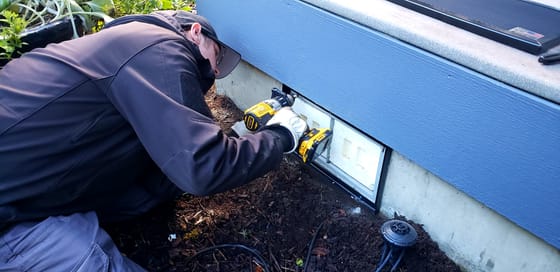
Feed is the whole of it. Grain, pellets, supplement and bedding stored in a shed or a stall is the best food source on the property by a wide margin, and it is nearly always kept in bags or open bins because that is convenient. Moving it into closed metal or heavy plastic containers is the single most effective thing available on a property like this, and it costs one purchase.
The second is spillage. Feed spilled and left around a bin or along a stall line supports a population continuously, and sweeping it is worth more than anything we would apply.
The third is manure and bedding management. Damp organic material that sits and warms is where flies develop, and the difference between a property with a fly problem and one without is usually how promptly that material gets moved rather than anything sprayed at the adults.
Chicken coops deserve a specific mention because they combine all three — stored feed, spillage, and warm bedding — and because rodents in a coop are a bird-health matter as well as a nuisance.
Fruit trees, gardens and what falls on the ground
Large lots grow things, and the produce is a pest factor people rarely connect to the problem they called about.
Windfall fruit left on the ground is a concentrated, high-value food source that appears in quantity every autumn — exactly when rodents are being displaced off cut ground and are looking for somewhere to settle. Picking it up is tedious and it genuinely changes the pressure on the buildings nearby.
Vegetable gardens, compost heaps and stored root crops do the same thing on a smaller scale, and a heap that has become a permanent unturned mound against a fence or a shed is shelter, warmth and food in one place.
None of this is an argument against growing anything. It is an argument for where things sit: fruit picked up rather than left, compost turned and kept away from structures, and stored produce in something closed.
Spiders and the fall wandering
Rural properties with outbuildings, mature planting and open ground around them produce more spiders indoors than a town lot does, and autumn is when people notice.
Most of what turns up is giant house spiders. What people are seeing is males moving to find females rather than an infestation arriving, which is why they appear singly, at speed, across a floor, in September and October.
Reducing them is largely a matter of reducing what they eat and where they get in: the same exclusion work as everything else, plus attention to exterior lighting, which concentrates the insects they are hunting. On a rural property with a yard light, that one change does more than anything applied to a wall.
Wasps on acreage
Yellowjackets here are a late-summer story and the ground nests are the dangerous ones.
They get found by machine rather than by eye — a mower, a strimmer, a tractor working a boundary — which is how people end up in an emergency room. On a large lot with rough edges, banks and fence lines, knowing where the activity is before August is worth a great deal, and it costs nothing to have somebody look while they are already on the property for something else.
Aerial nests in eaves, sheds and outbuildings are more visible and easier, though a nest in a shop doorway in August is still a problem. Bald-faced hornets build the large gray paper nests people photograph; European paper wasps build small open combs under railings and are far less inclined to defend them.
Honey bees are not our work, and in berry country they are worth more than we are. A colony in a wall gets identified and referred.
Firewood, and the thing nearly everyone does
Almost every property out here stores firewood, and almost all of it is stacked against the house because that is convenient in February.
Wood against a wall is a covered, dry, undisturbed harborage directly against a building, holding carpenter ants, spiders, beetles and rodents in whatever proportion the season provides. Bringing an armful inside brings whatever is in it inside with it.
The fix is small and unwelcome: get the stack off the wall and off the ground, keep it away from the building, and bring in what you will burn rather than a week’s supply to sit by the stove. That single change accounts for a measurable share of the winter callouts on this kind of property.
Getting service out here
The honest limitation is scheduling rather than distance. Meadowview is fifteen miles from us and it runs on route days rather than same-day availability, and we would rather say that at booking than take a job we cannot honor.
What that means in practice is that we will name a day, we will turn up on it, and if something moves we will tell you before you have spent an afternoon waiting. There is no rural surcharge in our pricing.
What is worth paying for, and what is not
The most valuable work here is physical and it finishes: vents, sweeps, penetrations, hardware cloth, and the outbuildings done at the same time as the house.
The least valuable is a recurring perimeter treatment on a property whose real problem is a quarter-inch gap and an open shop. It produces a visible result, it needs repeating forever, and it never closes the route.
Where the answer to a rodent problem is a morning with a drill rather than a schedule of visits, we will say so and quote the morning.
A note on timing
Most of the physical work here is best done between the end of harvest and the first hard weather.
How a visit works here
We start with the boundary and the cover: what is behind the property, how close it is, whether it gets worked, and what is stored between it and the buildings. That sets the expectation for everything else.
Then every outbuilding on the place, in the order they sit relative to the cover, because the one nearest the field is almost always the one holding the population.
Then the house at ground level — foundation line, vents and screens, sweeps, penetrations, garage door corners, and under any deck.
Then into the crawlspace with a light and all the way across it. A look from the opening is not an inspection and we will not describe one as though it were.
You get a plain account of what is active, what is old, what is driving it, what should be done before the ground behind you is next cut, and which items are building work rather than pest work. The assessment costs nothing except bed bug verification, which is billed and credited against treatment, and there is no term agreement anywhere in what we do.
Frequently asked questions
Why do the mice arrive all at once in late summer?
Because the cover goes all at once. Cutting and harvest strip shelter from a large area within days, and the animals living in it have to relocate that week. People blame the first cold nights, but the move has usually happened well before there is any cold to blame.
Should the shop and the barn be part of the job?
On a large lot, almost always, and it is the most common thing left out. Outbuildings sit nearer the cover and are sealed to a much lower standard, so they fill first and the house is then supplied from forty feet away. Working on the house alone concentrates the problem rather than reducing it.
We are on a well and septic. Does that limit what you can use?
It shapes placement rather than ruling things out. Nothing goes near a wellhead or over a drain field, and we will tell you before we work anywhere close to either. Out here that is a routine part of the conversation rather than an obstacle.
Does it matter that the field behind us is not ours?
For the source, yes; for the fix, no. The population lives in ground you do not control and there is nothing useful to be done about that. The route into your buildings is entirely on your property, and closing it is what actually changes the outcome.
What are the flies collecting in the upstairs windows?
Most likely cluster flies. They breed outdoors in soil rather than in your house, have nothing to do with cleanliness or waste, and gather on warm walls in autumn before overwintering in wall voids and attics. They do not bite, breed indoors or damage anything.
Do you charge more to come out here?
No. There is no rural surcharge in our pricing anywhere. What distance affects is which day we can be there rather than what it costs, and we will name a day rather than promise a window we cannot keep.
Is an assessment free?
Yes, apart from bed bug verification, which carries a fee that is credited against treatment. On acreage the assessment covers the outbuildings and the boundary as well as the house, because that is where the answer usually is.
Pest problem in Meadowview?
Family-owned, no long-term contracts, and every treatment is backed by our 100% Service Guarantee.
Most calls in Whatcom County are out within 1–2 days, about 3 during the late-summer peak.
Last updated