
Multicolored Asian Lady Beetle — Not the Ladybug You Grew Up With
Harmonia axyridis · Occasional invaders
The multicolored Asian lady beetle is an introduced predatory beetle that gathers on sun-warmed walls in October and overwinters inside buildings. It does not breed indoors or damage anything, but unlike native ladybugs it will bite, and it stains surfaces with a yellow fluid when disturbed.
Call 360-410-2199 Request a free inspection
Sometimes worth treating, sometimes not — it depends on what is below.
Multicolored Asian lady beetle at a glance
| Size and shape | Around seven millimeters, domed and oval |
|---|---|
| Color and spots | Pale yellow-orange to deep red, with anywhere from no spots to eighteen |
| How to tell it from a native ladybug | A whitish segment behind the head with a black M or W mark — and natives never mass on houses |
| When you see it | Gathering on sunlit south and southwest walls from early October; indoors on mild winter days |
| Bites and stains | Can nip hard enough to break skin; releases a smelly yellow fluid that stains when disturbed |
| Damage | None — it does not feed, breed or damage anything indoors |
| Do we treat it | Depends — sealing plus a timed exterior treatment helps heavy cases; wall voids are never sprayed |
Signs you have them
- Hundreds of orange beetles covering a pale, sun-facing wall on an October afternoon
- Beetles working into gaps around window trim, siding laps, soffits and vents
- Beetles appearing at windows and light fittings indoors on warm days in January or February
- Yellow spots and stains on paint, curtains or upholstery where beetles were disturbed or crushed
- An unpleasant smell where a group has been swept or squashed
The ladybug that is not a ladybug
Every October the same call comes in from all over this county. Hundreds — sometimes thousands — of orange beetles covering a wall that gets the afternoon sun, working their way into the gaps around trim and vents, and then turning up indoors on the warm days of late winter.
People call them ladybugs, and understandably: they look like ladybugs, they are the right size and shape, and everything anybody has ever been told about ladybugs is that they are charming and lucky and eat aphids.
This is a different insect. Harmonia axyridis, the multicolored Asian lady beetle, was introduced to North America as a biological control agent for aphids and is now established across most of the continent. Outdoors it does exactly the job it was brought here to do and does it well, and WSU Hortsense lists the adults and the larvae as aphid predators in Washington gardens. The difficulty is entirely about what it does in October, and about two habits that native lady beetles do not share.
It bites. And it leaves a stain.
Neither of those makes it dangerous. Both of them make the standard reassurance — that these are completely harmless — wrong in a way that matters to somebody standing in a bedroom with a hundred of them on the ceiling.
Recognizing one
Do not look at the spots. The name is literal: this beetle ranges from pale yellow-orange through to deep red, and carries anywhere from no spots at all to eighteen. Two individuals from the same wall can look like different species.
The identification is on the pronotum — the segment directly behind the head. On this species it is whitish with a black marking that reads as an M or a W depending on which way round you are looking at the insect. On darker individuals the marking can be filled in almost solid. That marking, plus the size at around seven millimeters and the domed oval shape, is what separates it from the native lady beetles that share the same gardens.
The other identification is behavioral, and it is the one most people actually use: native lady beetles do not gather on your house in the hundreds. If there is a mass of them on a wall in October, it is this species.
Why they are on the south wall
The behavior is specific enough to predict, and understanding it is what makes the timing of any treatment work.
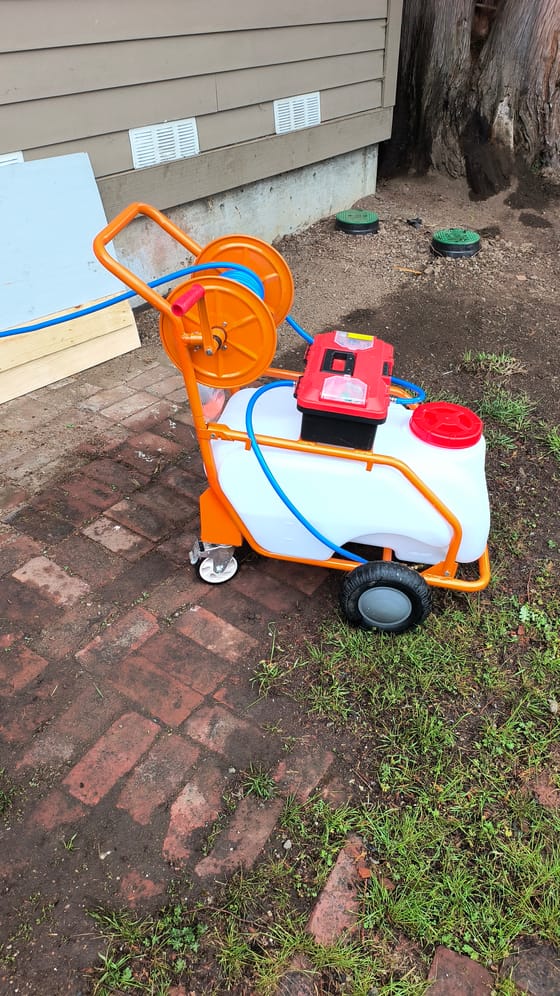
From about the beginning of October, on a warm sunny afternoon following a cold night, the beetles leave the fields and gardens and go looking for somewhere to overwinter. What they are orienting to is sunlight reflecting off a prominent, light-colored, sun-facing surface — in practice the south and south-west elevations of buildings.
That is not an accident of suburbia. In their native range they aggregate on south-facing rock cliffs and outcrops, and a pale house wall catching the low autumn sun is the same signal. Your house is not attracting them because anything is wrong with it. It is attracting them because it looks like a cliff.
Once they land, they work into whatever gaps are available — around window and door trim, under siding laps, at soffit and fascia junctions, through attic and gable vents, around utility penetrations. Behind that they settle into wall voids and attics, and Penn State records aggregations running to tens of thousands in a single structure.
Then they go dormant, and for most of the winter nobody hears from them.
What actually happens indoors
Nothing, is the honest answer, until it warms up.
They do not feed indoors. They do not breed indoors. They do not eat wood, fabric, stored food or anything else in the building, and they do no structural damage of any kind.
What they do is wake up. On a mild day in January or February, or when the heating raises the temperature in a wall, dormant beetles become active, orient toward light, and a proportion of them come out on the wrong side of the wall — into a bedroom, a bathroom, a light fitting.
This is why the number appearing indoors seems wildly out of proportion to any opening anybody can find. They are not coming in from outside in February. They came in months ago, and the house is simply leaking a few of them back out of its own walls.
The whole population indoors was set in October. Nothing done in February changes it. That single fact decides every sensible decision about this insect.
The bite
Native lady beetles are, for practical purposes, incapable of bothering anyone. This one is different, and the extension literature is consistent about it.
University of Minnesota Extension states plainly that some can bite hard enough to break human skin, causing minor and short-lived discomfort. Penn State records occasional biting of varying intensity.
What that means in a house: an occasional sharp nip, usually when one is trapped against skin — under a sleeve, in bedding, when somebody picks one up. There is no venom, nothing is injected, and there is nothing to treat afterwards. It is a pinch that surprises you.
It is worth being straight about this rather than repeating the harmless line, for two reasons. Somebody who has been bitten and then been told the insect cannot bite stops believing the rest of the advice. And a parent whose child has been nipped deserves to be told what happened rather than being told it did not.
The stain, and why not to squash them
When disturbed, the beetle releases a yellow fluid from its leg joints. The term for it is reflex bleeding, and it is the insect’s defense.

It smells. It stains — paint, plaster, curtains, carpet, light-colored upholstery — and the marks are difficult to remove once they have dried. Penn State notes that the secretion can raise localized welts on some people.
The practical consequences run in one direction: do not crush them. Do not sweep them into a pile and brush them. Do not swat them against a wall. Every one of those turns a nuisance into a mark on the decoration.
Vacuuming is the correct method indoors, and both Minnesota and Penn State say so. Minnesota’s specific tip is worth passing on: fit a nylon stocking into the vacuum hose as a bag so the beetles are captured without being killed or drawn into the machine, then tie it off and empty it outside away from the building. Change or empty it promptly, because a bag of dead beetles in a cupboard is its own problem.
Allergies, and the part nobody mentions
Continued exposure to these beetles inside a building can produce genuine allergic responses in some people. Penn State lists rhinoconjunctivitis, asthma and facial angioedema. Minnesota notes that exposure to dead beetles in a building can cause allergic reactions.
This is not common and it is not a reason for alarm. It is a reason to take a large indoor aggregation seriously rather than treating it as purely an aesthetic problem, particularly in a household where somebody already has asthma. It is also another argument against the approach in the next section.
Pets
Penn State records that animals which consume these beetles may sustain chemical burns inside the mouth.
In practice this is a dog that has eaten a mouthful off a windowsill rather than one that has crunched a single beetle. Signs would be drooling, pawing at the mouth, or obvious discomfort. That is a call to a veterinarian, not to a pest control company, and we would tell you the same on the phone.
Why we will not spray your wall voids
This is the most important practical point on the page and it is the one that costs us work.
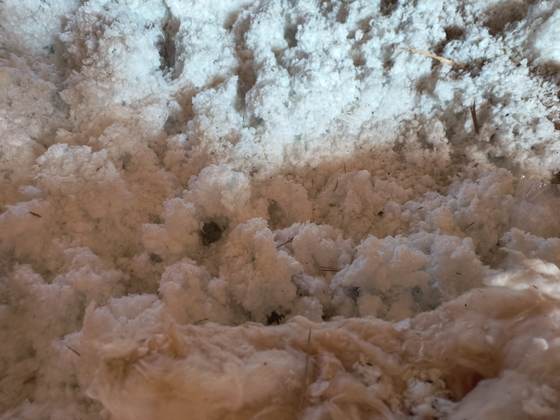
Once the beetles are in the wall voids and the attic, Penn State advises directly against using an insecticide on them. The reasoning is straightforward and it is worth understanding rather than taking on trust.
A large aggregation might be several thousand beetles inside a void. Kill them in place and you have several thousand carcasses in an inaccessible cavity. Dried insect bodies are excellent food for carpet beetles, whose larvae go on to eat wool, silk, feathers, stored fabric and taxidermy — and which then emerge into the living space as a fabric pest in their own right.
So the offer to “treat the infestation in your walls” is a trade: a seasonal nuisance that damages nothing, exchanged for a fabric-destroying insect with a year-round life cycle. We are not going to sell you that, and anybody who offers it either does not know or is hoping you do not.
The same logic applies to fogging or spraying rooms repeatedly through the winter. It kills the ones that have already emerged, does nothing about the thousands still dormant behind the plaster, and has to be repeated every time a warm day wakes another batch.
What does work, and when
Two things, and both of them happen before the beetles arrive.
Sealing is the durable half. Everything that got in used an opening. Caulking around window and door trim, closing gaps at siding laps and transitions, screening attic, gable and soffit vents, repairing damaged screens and closing utility penetrations all reduce the supply permanently. It is unglamorous work, it is finished when it is finished, and it also handles the stink bugs, the cluster flies, the spiders and a fair amount of the rodent pressure at the same time. That is the best value available on this problem.
Exterior treatment is the timed half. A correctly applied exterior application to the elevations they gather on, put down in late September or early October before they begin entering, reduces how many make it inside. Minnesota is specific about the timing and about concentrating on the south and west sides, around doors, windows and the roof line.
The timing is what people get wrong, in both directions. Applied too early it has degraded before the flight; applied once they are already on the wall, most of the benefit has gone. The window moves by a fortnight or more from year to year because it is driven by the first cold nights rather than by a date, which is why this is something to have arranged in advance rather than to react to.
So why is our answer “depends”
Because the honest recommendation varies with the building, and this site labels every species with what it actually warrants rather than with what we would like to sell.
Where a treatment is worth it: a building that gets a heavy annual aggregation, a household with somebody asthmatic or allergic, a property where the walls are pale and the staining is doing visible damage, or a place where the sheer number indoors in late winter has become genuinely difficult to live with. In those cases exterior work at the right moment, combined with sealing, makes a real difference and is worth paying for.
Where it is not: a handful of beetles on a windowsill in February. That is a vacuum cleaner and five minutes, and any company quoting a treatment program for it is selling you a schedule rather than a solution.
Where the answer is neither: if what you actually want is for them to stop landing on the wall, nothing achieves that. They are orienting to a large sun-facing surface, and the surface is your house.
Around this county
This is one of the two insects the owner of this company names when asked what autumn looks like here, the other being the brown marmorated stink bug, and the two arrive on the same walls within days of each other.
The pressure is heaviest where there is a lot of open ground producing them and a building standing exposed to the afternoon sun — which describes most of the agricultural edge of Whatcom County. Properties around Lynden, Everson, Nooksack, Sumas and out along both forks of the Nooksack toward Deming and Acme get it hardest. A sheltered street in the middle of Bellingham gets noticeably less.
Aspect matters more than address. Two houses on the same street can have completely different experiences of this insect depending on which way the long elevation faces and how much sun it holds into the afternoon.
What it is doing the rest of the year
Worth saying, because it changes how people feel about the insect and because it is true: for eight months of the year this beetle is doing something useful.
It is a predator, and an effective one. Adults and larvae both eat aphids in substantial numbers, along with scale insects and other soft-bodied pests, and it is a significant natural control in gardens, orchards and crops across the region. UC’s Statewide IPM Program lists it in its natural enemies gallery rather than its pest gallery, which tells you how it is regarded when it is not on somebody’s ceiling.
It was brought here deliberately for exactly that reason. The overwintering behavior came with it, and that is the whole of the complaint.
None of which helps in October. But it is the reason we are not going to recommend anybody try to eliminate them from their property, and the reason the work is about the building rather than about the insect.
The short version
It is not the ladybug you remember; it is an introduced relative that overwinters in buildings. It gathers on sun-facing walls in early October and gets in through ordinary gaps. It does not breed indoors, eat anything, or damage the structure.
Unlike native ladybugs it will bite, and it stains surfaces yellow if disturbed or crushed, so vacuum rather than squash. Heavy indoor exposure can cause allergic reactions in some people, and a pet that eats a mouthful can get mouth irritation.
Do not let anybody spray the aggregation inside your walls — the carcasses feed carpet beetles, which are a worse problem than the beetles were.
What works is sealing the openings, and exterior treatment timed to late September or early October, before they arrive.
One more note on timing
The window for exterior work is genuinely narrow and it moves with the weather rather than the date, so it is worth booking on a forecast rather than on a calendar. The trigger is the first run of cold nights followed by a warm, still afternoon, which is when the beetles gather on sunlit walls in numbers. Treat before that and the residual has weathered; treat after it and most of the population is already in the building.
Frequently asked questions
Do Asian lady beetles actually bite?
Yes, which is the main thing that separates them from the ladybugs people grew up with. University of Minnesota Extension records that some can bite hard enough to break skin, causing minor and short-lived discomfort. Penn State notes occasional biting too. It is a nip rather than an injury — there is no venom and nothing to treat — but it is real, and telling somebody these are harmless in every respect is simply inaccurate.
What is the yellow fluid they leave on the wall?
Defensive secretion released from the leg joints when the beetle is disturbed, which is why the trade calls it reflex bleeding. Penn State describes it as a stinky yellow chemical that spots walls. It stains paint, fabric and light surfaces, it smells, and on some people it raises a localized welt. It is also the reason squashing them is the worst way to deal with them.
How do I tell one from a native ladybug?
Look at the segment directly behind the head rather than at the spots. On this species it is white with a black marking that reads as an M or a W depending on which way up you are looking, sometimes filled in solid on darker individuals. The spots themselves are useless for identification — the name multicolored is earned, with anything from no spots to eighteen on a body that ranges from pale orange to deep red.
Will they breed inside my house?
No. They do not reproduce indoors, they do not feed indoors, and they do not damage the building, the fabrics or the food in it. Every beetle in your house in February walked or flew in through an opening the previous autumn, which is precisely why sealing works and spraying rooms all winter does not.
Are they dangerous to pets?
Worth knowing about, and not a reason to panic. Penn State records that pets which eat these beetles may get chemical burns inside the mouth. In practice that means a dog that has crunched a mouthful, not one that ate a single beetle. If an animal is drooling or pawing at its mouth after eating them, that is a call to a vet rather than to us.
Should I spray inside the wall void where they are?
No, and Penn State says so directly: once they are in the voids or the attic it is not advisable to use an insecticide on them. Killing several thousand beetles inside a wall leaves several thousand carcasses in there, and those feed carpet beetles, which will come out into the house and eat wool and stored fabric. You would be trading a nuisance for a fabric pest.
Can you get rid of them permanently?
We can substantially reduce how many get in, which is the only version of this anybody can honestly offer. Sealing the openings and a correctly timed exterior application in the narrow window before they arrive both address the supply. Nothing stops them landing on the wall, because the wall is what they are attracted to.
Sources
- Penn State Extension — Multicolored Asian Lady Beetle — read September 4, 2026
- University of Minnesota Extension — Multicolored Asian lady beetles — read September 4, 2026
- WSU Hortsense — Common Insects and Mites: Asian lady beetle — read September 4, 2026
- Purdue University Extension Entomology — Asian Lady Beetle (E-214) — read September 4, 2026
- UC Statewide IPM Program — Multicolored Asian Lady Beetle, Natural Enemies Gallery — read September 4, 2026
Rules change. This page is scheduled for review against its sources by September 4, 2027. If you are reading it after that date and something looks out of step with the current rule, the rule is right and we are wrong — please tell us.
Pest problem in Whatcom County?
Family-owned, no long-term contracts, and every treatment is backed by our 100% Service Guarantee.
Most calls in Whatcom County are out within 1–2 days, about 3 during the late-summer peak.
Last updated