
Pest Control near Fishtrap Creek, Lynden
Fishtrap Creek runs through the east side of Lynden with a greenbelt and trail along it, and established streets of mature trees back onto that corridor. A continuous vegetated strip through a built-up area is permanent habitat, and it passes directly behind the houses.
Call 360-410-2199 Request a free inspection
Fishtrap Creek, Lynden on the map
A creek running through a settled town
Fishtrap Creek runs through the east side of Lynden with a greenbelt and a public trail along much of it, and the streets that back onto that corridor are established: mature trees, settled gardens, schools and parks nearby.
The corridor is genuinely good to have. It is also, from where we stand, a continuous strip of vegetated, undisturbed ground with water in it, running behind a long line of houses.
That is the whole story here. Not a defect in the neighborhood — the opposite, in fact — but it explains why houses on these streets get pressure that houses four blocks west do not, and why the useful work is at the boundary and on the building rather than anywhere near the creek.
What a greenbelt corridor actually provides
Four things, all of them permanently.
Cover, in the form of continuous ground vegetation and undergrowth that is maintained lightly if at all. Water, year round. Food, from the vegetation itself and from what a corridor through a town collects. And connectivity — a route running for a considerable distance, linking populations that would otherwise be isolated in separate gardens.
That last one is the part people miss. An isolated patch of cover supports a small local population. A corridor lets animals move, recolonize, and reach a property from a source that is nowhere near it.
The houses immediately backing onto it take the most pressure, and that is visible in the pattern of calls from these streets. It falls off quickly with distance, which is itself useful information: if you are three streets away and having a problem, the source is probably closer to home than the creek.
The rodents that use it, and how they get in
It is rats as well as mice along a corridor like this, and telling them apart before anything is set matters.
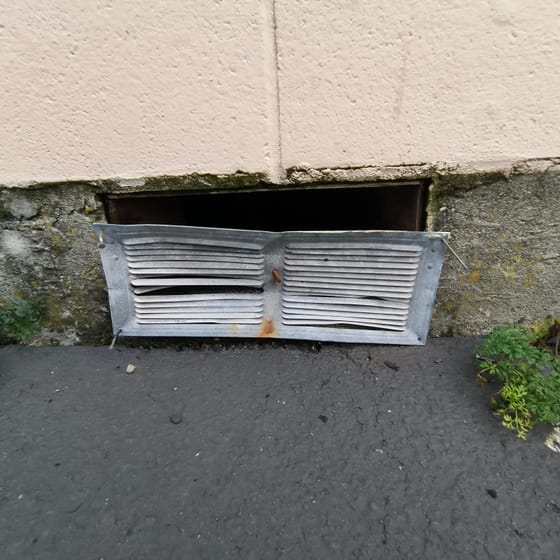
Mice live in small spaces, breed quickly and range very little, so a mouse problem is usually local to one building and one route. Rats range far further, are markedly cautious about anything new in a familiar run, and produce a different signature — heavy movement in a floor or wall at night, gnawing through something structural, chewed wiring, a vent opening enlarged rather than merely used.
That caution is the practical difference: a rat will avoid an unfamiliar object in its run for days, so an approach that works on mice within a night can read as complete failure on rats for a week. UC’s IPM notes on rats describe the same wariness, and it is why we do not judge a set of placements after one night.
The routes in are ordinary. Corroded crawlspace vent screens. Service penetrations. The bottom corners of a garage door. A crawl hatch resting against an opening. The unscreened space under a deck or porch. And on established lots, the planting against the wall that lets something reach all of them without crossing open ground.
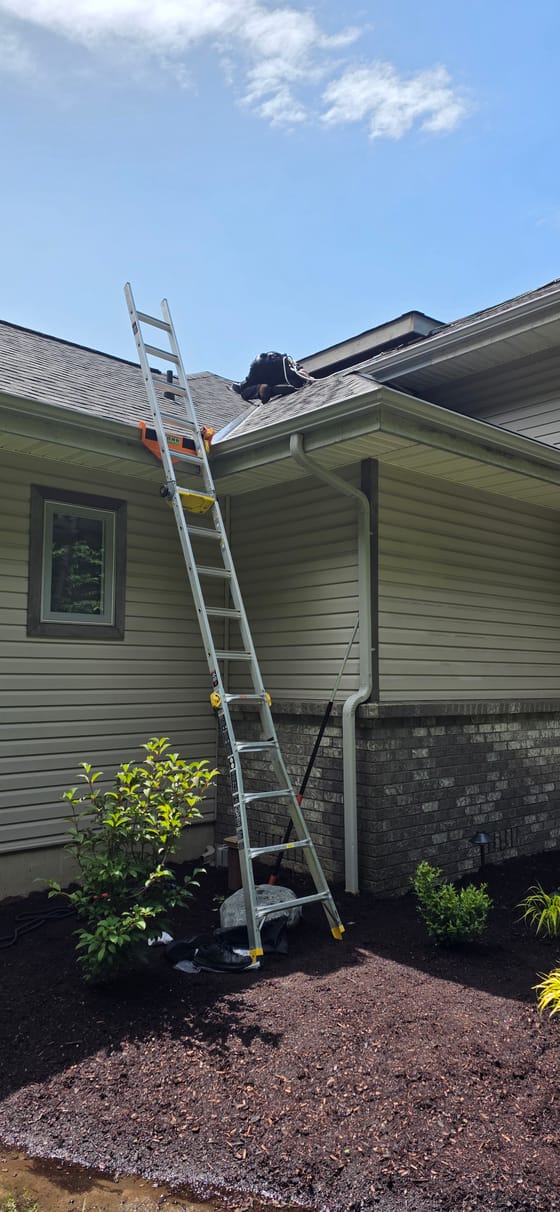
The one people under-rate on a street of mature trees is the roof. A branch touching a roofline is a bridge over everything sealed below, and rats climb well.
Where nothing gets applied
Work at a creek boundary has real limits and they are the correct ones.
Anything applied to ground that drains to the creek reaches the creek. So the perimeter treatment that would be routine around a foundation elsewhere is not the approach at that edge of a property. What replaces it is enclosed, secured stations, trapping, and physical exclusion of the building.
For rodents that is the more durable method regardless — it deals with the route rather than with the individuals crossing a surface — so the constraint pushes the work toward the better answer. What it means practically is that creek-side work is slower and more mechanical than a spray, and a quote that looks cheaper because it is a spray is not comparing like with like.
The trail, and who else is back there
A public trail behind a line of gardens changes placement more than it changes diagnosis.
Anything used near that boundary has to be sited where a member of the public, a child or a dog cannot reach it. That means enclosed and secured stations, placed deliberately, and it means nothing is left out between visits. We would rather you told us where people actually walk and where the fence is easy to get around than work it out from the property line.
It also means the boundary is not entirely yours to manage, and where a problem sits in the greenbelt itself rather than on your lot, that is a matter for the city rather than for a homeowner. We will say which it is.
Mature trees, and what actually matters about them
These streets have big trees, and people arrive at the conversation braced to be told they are the problem. They are usually not.
A living, healthy mature tree is rarely a carpenter ant nest. What supports colonies is standing deadwood, old stumps, fallen limbs left at the back of a lot, punky wood at the base of an ageing tree, and the landscape timber that accumulates on a settled property — ties, raised beds, old deck framing, fence posts, firewood that has gone soft at the bottom of the stack.
Carpenter ants do not eat wood. They excavate galleries in it, and they take softened damp timber far more readily than sound dry timber. Every item on that list is ideal, and every item is close to a building.
The two things worth doing are getting damp wood off the ground and away from the house, and trimming branch contact with the roof. Neither involves removing a tree anybody cares about.
Damp ground and what it permits
Ground near a creek has a water table closer to the surface than ground on higher land, and it moves seasonally. A vented crawlspace over bare soil in that situation stays damp regardless of how good the roof and gutters are, which is why people check the wrong things first.
Damp matters because of what it permits. Carpenter ants excavate softened wood far more readily than sound wood. Wood-boring beetles and decay fungi need moisture content that dry framing never reaches. And moisture ants — which we find regularly on ground like this — are not really a pest problem at all: they nest in wood that is already wet and decaying, so finding them is a moisture report rather than an infestation.
A ground-contact vapor barrier and sorting out the obvious drainage is the highest-value work available on a lot like this, and a decent share of our jobs along here involve no product whatever.
High water on a small creek
A creek through a town rises and falls, and what that does to the population along it is worth understanding because it produces a call every few years that nobody expects.
When water comes up, it floods burrows and low harborage along the bank. Whatever was living in them does not drown; it moves laterally and upward onto whatever ground stays dry, which is the gardens and then the buildings.
The arrival is sudden and it has nothing whatever to do with how a property is kept. Immaculate places get it as readily as neglected ones, and the timing follows the weather rather than the calendar.
Two things follow. The first is that this is an event with an end rather than a permanent condition to be managed indefinitely on a contract — the sensible response is to deal with the animals that arrived and close the openings they used, so the next rise has nowhere to go on your property.
The second is that anything stored low along a back fence is in the path of it. Timber, boxes, garden materials and firewood at the bottom of a lot that backs onto the corridor are exactly what a displaced population moves into first.
What a public trail brings with it
A trail behind a line of gardens is an amenity and it is also a source of something specific: food waste.
Litter along a public path — wrappers, drink containers, dog waste bags left beside a bin rather than in it, and whatever comes out of an overflowing receptacle at the end of a warm weekend — is a supplementary food supply running the length of the corridor. It is modest in any one place and continuous overall.
That is not an argument against trails and it is not something a homeowner can fix. It is the reason the pressure along here is steadier than the vegetation alone would explain, and it is worth reporting an overflowing bin to the city rather than assuming somebody else has.
The part you can control is your own boundary. A compost heap, a bird feeder, fallen fruit left on the ground, or pet food bowls outside are each a concentrated food source at the near end of a corridor that already has traffic on it, and any of them will make your lot the attractive end of the strip.
Oregon State’s Solve Pest Problems covers the yard and garden end of rodent work for this region, fruit and feeders included.
Wildlife that is not our trade
A greenbelt corridor through a town brings animals into gardens that a subdivision two miles away does not see, and it is worth being clear about where our work stops.
Raccoons, opossums, skunks and beavers are not pest control in the sense this company practices it. We will not take a booking for them, and we will say so rather than turn up and improvise.
What we can do is the part that overlaps: identifying what is inviting them — accessible waste, pet food outdoors, fallen fruit, an open crawl hatch — and closing the structural openings they are exploiting, which frequently is the whole of the practical answer. And we will point you at somebody who handles the animal itself.
Bats are a separate matter again and a legally protected one. If there is a roost we will identify it and stop there.
Schools and parks nearby, and what that means for placement
These streets are close to schools and parks, and there are children and dogs moving through the area constantly.
That decides placement rather than possibility. Anything placed goes in enclosed, secured stations where children and animals cannot reach it, and interior work is planned around the rooms in use.
We will show you the label before we treat, tell you what is being applied and where it is not, and give the re-entry directions without being asked. Every product this company carries is published on this site with its EPA registration number, its full label and its safety data sheet, which is unusual and is deliberate.
Where a repair does the job instead of a product, we will recommend the repair even though it is the smaller invoice. On a lot backing onto a corridor, that is frequently the whole answer.
The autumn arrivals
From late September the sunny elevations collect the seasonal crowd, and a street with a vegetated corridor behind it gets more of them than an open one.
Cluster flies are the Lynden specialty. They breed outdoors in soil and have nothing to do with hygiene or waste, and they gather on warm walls before working into gaps and overwintering in voids — then appear indoors on mild winter days in numbers that seem impossible relative to any opening anyone can find.
Multicolored Asian lady beetles and brown marmorated stink bugs do the same thing on the same walls. Spiders come in for their own reasons and get noticed at the same time; most of what turns up is giant house spiders, and the autumn activity is males moving to find females rather than an infestation arriving.
No member of that group bites, breeds under your roof, or damages anything structural. Because they do not reproduce inside, the number in the house is entirely a function of how many got in — so sealing plus correctly timed exterior work in the narrow window before the wave is the answer, and spraying rooms all winter is not.
Wasps along a corridor
Ground nests along the greenbelt edge, banks and rough boundaries are the ones that cause injuries, because they are found by mower or by somebody clearing a fence line rather than by eye.
On a lot backing onto a corridor there is usually more rough ground than on an interior lot, and knowing where the activity is before August is worth having. It costs nothing to have somebody look while they are on the property anyway.
Aerial nests in eaves, sheds and under deck rails are more visible and easier. Bald-faced hornets build the large gray paper nests; European paper wasps build small open combs under railings and are far less defensive.
Honey bees we do not treat. If there is a colony in a wall we will identify it and refer you.
Deciding whether the creek is really your problem
Because the corridor is the obvious feature, it gets blamed for everything, and on a fair number of jobs along here it is not the answer.
The test is distance and direction. Pressure from a corridor falls off sharply with distance from it, and it arrives at the boundary nearest the creek. If the activity is concentrated on the far side of the house, or you are several streets away, something closer to home is more likely — a neighbor’s woodpile, an open shed, a bird feeder, a compost heap, or a gap somebody made and did not close.
That distinction is worth making before anybody spends money, because the work is different. A corridor problem is answered with exclusion and a boundary strategy. A local problem is usually answered by finding one thing and removing it.
We will tell you which one you have rather than defaulting to the explanation that happens to be visible from the back fence.
What we would rather not sell you
We will not put a house backing onto a greenbelt on a permanent perimeter program and call it a solution. The corridor is not going away, so a program that only suppresses what crosses it is a subscription rather than a fix.
We will not treat for wildlife we do not handle.
And where the honest answer is a vapor barrier, a vent screen, a trimmed branch and a cleared fence line, that is what we will quote, even though it finishes.
How a visit works here
We start at the back boundary — how close the corridor gets, what has accumulated along the fence line, where the trail runs, and where people and dogs actually go.
Then the building at ground level: foundation line, vents and how the screens are fixed, sweeps, penetrations, garage door corners from inside, and the deck perimeter if there is one.
Then the roof line for branch contact, and the soffits.
Then underneath, with a light, through the whole crawlspace, checking the vapor barrier, the insulation and how the ground is draining.
You get a plain account of what is active, what is old, what is driving it, what is building work rather than pest work, and what belongs to the city rather than to you. The assessment is free unless bed bug verification is involved, in which case the fee is credited against the treatment, and nothing we do requires a term agreement.
Frequently asked questions
Is the creek why we have rats?
The corridor along it is. A vegetated strip with cover, food and water running continuously through a town is among the best rat habitat available, and it does not stop where the gardens start. The creek itself is not the problem and is not going anywhere. The route into your building is, and that is the part that can be closed.
Can anything be applied near the creek?
Not a perimeter spray, no, and that is the right restriction. Anything applied to ground that drains to the creek reaches it. Work at that boundary uses enclosed stations, trapping and physical exclusion instead, which is the more durable approach for rodents in any case.
There is a public trail behind our fence. Does that change anything?
It changes placement. Nothing goes anywhere a member of the public, a child or a dog on the trail could reach, so anything used near that boundary is enclosed, secured and sited deliberately. It also means we will not leave equipment or material out between visits.
Our trees are huge now. Should they come out?
Almost never. The living trees are rarely the source. What matters is deadwood, old stumps, fallen limbs and any landscape timber that has been sitting damp for years — and, separately, branches touching the roof, which are a bridge over everything sealed at ground level. Trimming the contact is worth far more than removing a tree.
We have had raccoons in the yard. Is that your work?
Not our trade, and we will tell you so rather than take the booking. What we can do is deal with what invites them and the openings they exploit, and be clear about which specialist handles the animal itself. There is more of that kind of wildlife along a greenbelt than elsewhere in town.
Why does the crawlspace stay damp here?
Ground near a creek has a water table closer to the surface, and it moves seasonally. Moisture wicks up through bare soil and a vented crawlspace over damp ground stays damp regardless of the roof. A ground-contact vapor barrier does more about that than any amount of guttering.
Is there a charge to have it assessed?
No, unless bed bug verification is involved, and that fee comes off the treatment. Here the assessment includes the back boundary and the crawlspace, which are the two places the answer usually turns out to be.
Pest problem in Fishtrap Creek?
Family-owned, no long-term contracts, and every treatment is backed by our 100% Service Guarantee.
Most calls in Whatcom County are out within 1–2 days, about 3 during the late-summer peak.
Last updated