
The Whatcom County Pest Year
Pest problems here run on a calendar, and the useful thing about a calendar is that it is predictable. Almost every problem people call about in October could have been prevented in August, for less money, in better weather, before anything got inside.
Call 360-410-2199 Request a free inspection
The short version
| Month that decides the year | The second half of August, before the rodent push, the spider walk and the overwintering insects |
|---|---|
| Crawlspace window | May or June, while the ground is dry: ground cover, drainage, downspouts, grade and buried vents |
| Wasp nests | Cheapest in April, when a founding queen alone is building something golf-ball sized |
| Spider wave | Mature males walk indoors looking for mates from September, for three to six weeks |
| Rodents | Climb from late September, peak in October and November, and do not decline once inside |
| January to March | Quiet for new arrivals, busy for finding what got in last autumn and sealing it |
| Bed bugs | No weather season; a September peak in Bellingham from student move-in, echoed in June |
| Decay fungi | Working whenever timber is wet and above about 50°F, which here covers most of the year |
- Set aside an hour in late July or early August for one slow walk around the house.
- Circle the foundation: crawl vents clear of soil and screened in intact metal, the crawl hatch latching, pipe and cable entries closed.
- Check the ground falls away from the house, no soil touches the siding, and every downspout discharges well out.
- Look for daylight under each exterior door, garage side and basement doors first, then scan the roofline with binoculars.
- Note plants touching walls or roof, and walk the neglected strip by the fence or treeline for ground nests.
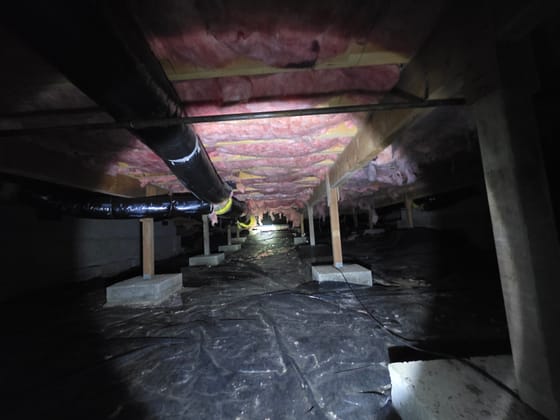
- If you are willing, go under the house: ground cover lapped, no standing water, sill plate firm under a probe.
- Write the findings down and work through the list in the last two weeks of August.
Pest problems here run on a calendar
Almost nothing that happens in a Whatcom County building is a surprise. The insects and animals that turn up follow the weather, the weather here is consistent enough to plan around, and the same calls arrive in the same weeks every year.
That has a practical consequence worth stating at the top. Almost every problem people call about in October could have been prevented in August, for less money, in better weather, and before anything got inside a wall.
Nobody does that, because in August nothing is wrong. This page is an attempt to make the calendar visible enough that somebody might.
January and February
Quiet for arrivals, busy for discoveries.
Nothing much is moving into buildings. What people notice now is what got in during the autumn: rodents established in a crawlspace or an attic, and overwintering insects — cluster flies, stink bugs, boxelder bugs, ladybird beetles — roused by a mild spell and appearing at upstairs windows. Those are not new arrivals. They are the autumn population being woken by warm weather, and they will keep reappearing on every warm day until spring.
Wasp and hornet colonies are gone. Only mated queens survive, dormant somewhere sheltered, and the paper nests in the trees are empty.
Decay in wet timber is slow but not stopped. The Forest Products Laboratory puts decay fungi at their optimum near 77°F, slowing markedly below 50°F. A crawlspace in February is at the cold end of that band — which means the process is continuing quietly rather than pausing.
What to do: interior work. Sealing the penetrations under sinks, behind appliances and at cabinet bases, where a crawlspace connects to a kitchen. It is warm, dry, indoor work and it is genuinely useful. Also: plan the summer exterior work now, while last autumn is fresh enough to remember.
March and April
The ground warms and things start moving.
Ant activity resumes as colonies become active. The first wave of kitchen ant calls follows the first stretch of warm days, and the second, larger wave follows heavy rain — shallow outdoor nests flood and the colony moves to higher, drier ground, which is frequently the inside of a building.
Overwintering insects that survived the winter become active and try to leave. This produces a second wave of indoor sightings that looks like a new problem and is the end of the old one.
Wasp queens emerge and begin founding nests. Each one is a single insect building something the size of a golf ball, and this is the cheapest and safest moment in the entire year to deal with a nest that would otherwise be a four-thousand-insect problem in September.
Spider egg sacs hatch and enormous numbers of spiderlings disperse. Almost nobody notices.
What to do: walk the property looking for founding wasp nests, in eaves, sheds, under rails and in the untended margins. Ten minutes in April is worth a great deal in September.
May and June
Growth, and the best month nobody uses.
Insect populations build. Wasp colonies expand quietly. Carpenter ant activity becomes visible — this is when frass appears below trim and workers turn up on counters after dark, because the colony is provisioning.
Dampwood termite and moisture ant findings surface as people open up buildings for summer work and look at timber they have not looked at since last year.
The ground begins to dry, which makes crawlspace and exterior work practical for the first time since autumn.
What to do: this is when the crawlspace work should happen. Ground cover, drainage, downspouts, grade, clearing buried vents. Dry ground and long days, and none of it is possible in December. Also the moment to book anything a contractor is involved in, before their season fills.
July and August
The peak of everything outdoors, and the window that matters.
Wasp and yellowjacket colonies are growing steeply. Foraging shifts from protein to sugar through August, which is when they arrive at fallen fruit, bins and outdoor eating.
Carpenter ants are at maximum visible activity.
Spider populations are building toward autumn, feeding on the summer’s insects. The number that make it to maturity is set now, which is why a warm summer reliably produces a heavy September.
Ants may come indoors looking for water rather than food during a dry stretch, which is why a spotless kitchen can get a trail in August with nothing left out.
What to do, and this is the single most important paragraph on this page:
The second half of August is the window. Exterior sealing before the rodent push. Crawl vents rescreened in quarter-inch metal. Door sweeps replaced, particularly on garage and basement doors. Roofline and soffit openings closed before overwintering insects arrive. A walk of the grounds for yellowjacket ground nests before autumn yard work finds them the hard way. Any exterior treatment for overwintering insects, which works applied before they move in and is largely wasted afterwards.
Everything on that list is cheaper, easier and more effective in August than at any other time, and every item on it prevents a call we will otherwise take between September and February.
September
The month everything arrives at once.
The spider wave begins. Mature males leave their webs to find females, they travel on foot, and they walk into buildings. It reads as an infestation and it is a mating season lasting three to six weeks.
Yellowjacket and hornet colonies reach maximum size and maximum defensiveness, in exactly the weeks people are outside doing late-season yard work. Nearly every serious sting incident we hear about happens in a four-week window now.
The rodent push starts as nights cool. Cover dies back, natural food declines, and a heated building with a quarter-inch gap becomes a considerably better proposition than it was in July.
Overwintering insects begin gathering on sunlit south and west walls.
In Bellingham specifically, student move-in concentrates travel, second-hand furniture and turnover into a few weeks, which is the local bed bug season.
What to do: if August was missed, do it now anyway — later is worse than August and much better than November. Check the building before sealing, because closing a building with something already inside is the one mistake that makes things worse.
October and November
The peak of the indoor year.
Rodent pressure at its height and staying there. This is when the scratching in the walls starts, when droppings appear in kitchens, and when crawlspaces get occupied.
Overwintering insects move into wall voids, attics and soffits, and the walls go quiet again.
Spiders taper through October and are largely finished by November.
Hornet nests become visible as leaves fall — and almost always the colony is already finishing, which is why the honest answer to a nest discovered now is usually to leave it.
Wasp colonies collapse with the first hard frosts.
What to do: respond rather than prevent, because the prevention window has closed. Trap before sealing. And note what happened and where, because that note is what makes next August productive.
December
Rodents settled in, everything else dormant.
What is inside is inside. Populations in crawlspaces and attics continue through the winter because the building supplies what the season does not.
Overwintering insects appear indoors on warm days.
What to do: deal with what is active, and resist the temptation to seal a building with a live population in it.
The same year, by pest
The month-by-month view above is how the year feels from inside a building. Here is the same information organized by organism, which is more useful if you already know what you are dealing with.

Rodents. Pressure climbs from late September, peaks October and November, and stays elevated all winter because the building supplies what the season does not. Effectively no seasonal decline once they are inside. Prevention window: August. Response window: whenever you notice, and sooner is much cheaper.
Carpenter ants. Visible activity from spring through late summer, peaking as the weather warms and again around the swarm period. A single large ant indoors in February is more significant than one in July, because it suggests something overwintering inside rather than wandering in. Prevention: keep timber dry and keep woodpiles, stumps and fallen wood away from the building, any time of year.
Moisture ants and dampwood termites. No meaningful season, because the driver is a wet building rather than the weather. Found whenever somebody finally looks. Prevention: the crawlspace work in May or June.
Yellowjackets and hornets. A single queen in spring, steep growth through July and August, maximum size and defensiveness late August into September, colony collapse with the first hard frosts. Nests are never reused. Prevention: a walk of the property in April, when a nest is one insect.
Spiders. Populations build all summer; males mature and walk from late August into October; over by November. Prevention: door sweeps and exterior lighting, done in August.
Overwintering insects — cluster flies, stink bugs, boxelder bugs, ladybird beetles, conifer seed bugs. Gathering on sunlit walls late September into October, dormant in voids through winter, roused by warm days, leaving in spring. Prevention: roofline and wall sealing plus an exterior treatment, late August. Nothing works once they are inside.
Household ants. Spring activity, a larger wave after heavy rain at any point in the season, and a further push in autumn. Driven by weather more than by anything in your kitchen.
Bed bugs. No weather season at all — they travel with people. The local pattern is a September peak in Bellingham driven by student move-in and second-hand furniture, and a June echo when it all goes back on the curb.
Decay fungi. Active whenever timber is wet and temperatures are above about 50°F, which in this county is most of the year. The one genuinely continuous process on this page, and the most expensive.
If you only do one walk a year
Make it late July or early August, allow an hour, and look at these in order.
The foundation line, all the way round. Every crawl vent: is it clear of soil and landscaping, is the screen intact, is it metal? The crawl access: does it actually close and latch? Every pipe and cable where it enters the building.
The ground itself. Does it fall away from the building? Is soil bridging up to the siding? Where does each downspout discharge, and is it far enough out?
Doors. Every exterior door, especially the garage side door and any basement door. Can you see daylight underneath?
The roofline, from the ground with binoculars if need be. Soffit and fascia junctions, gable and roof vents, anywhere a lower roof meets an upper wall.
Vegetation. Anything touching the walls or overhanging the roof. Climbers on siding.
The untended margin — the strip along a fence line or treeline that never gets attention. This is where ground nests are, and where stored material has been sitting on soil since spring.
Under the house, if you are willing. Ground cover intact and lapped, no standing water, sill plate firm under a probe.
Write down what you find. That list, actioned in the last two weeks of August, is the whole of preventive pest control in this county.
The pattern underneath
Three things drive nearly all of that.
Temperature. It sets when insects become active, when they overwinter, when colonies collapse and when rodents look for shelter. Our long mild autumn stretches the transition over weeks rather than days, which is why the season here has a long shoulder rather than a sharp edge.
Moisture. The wet season from October to April keeps timber wet, and wood that gets wet here does not get a hot dry stretch to dry out in. That is the engine behind every structural pest problem in the county, and it operates all winter while everything else is quiet.
Resource availability outdoors. Cover, food and water. When they decline in autumn, buildings become comparatively attractive. Nothing about the building changed; the alternative got worse.
What the preceding season predicts
Year-to-year variation is real and it is mostly set before you notice it.
A warm summer with good insect numbers produces more spiders reaching maturity, and therefore a heavier September.
A wet spring floods more shallow nests and produces more ant incursions.
A mild winter allows more overwintering survival across several species.
Local disturbance — clearing, construction, a hedge coming out, a neighboring property developed — displaces populations and pushes them into buildings within a couple of hundred feet, on whatever schedule the work happens.
None of that is predictive enough to plan around precisely. It is enough to know that a heavy autumn usually had a warm summer behind it, and that this is not a sign anything is wrong with your house.
Why the calendar differs across the county
Whatcom County is not one place, and the same month lands differently depending on where a building sits. The differences are consistent enough to plan around.
Wooded lots and the greenbelt edge. Everything arrives earlier and heavier. More carpenter ants, because the parent-colony material — stumps, deadwood, fallen timber — is permanently available. More spiders, because damp wooded ground produces insects in volume. Deer mice rather than only house mice. The autumn wave starts a week or two sooner and runs harder.
Waterfront and near-water property. Wind-driven rain on exposed elevations, salt air shortening the life of vent screens and flashing, and a permanent rodent corridor along any shoreline or creek margin. Rat pressure here is closer to constant than seasonal, because the corridor supplies water, food and cover through the winter.
Farm and acreage. Feed is the dominant factor and it operates year-round. Outbuildings multiply the number of ground-nest sites and the number of rodent harborages. The wasp risk in late summer is materially higher because people are operating machinery in exactly the ground where nests are.
Older in-town neighborhoods. Small lots mean a neighbor’s compost heap, feeder or neglected outbuilding is within a rat’s normal range. The building stock is the leakiest — original crawl vents, additions from three different decades, and trim that has moved.
Newer subdivisions. Better sealed, so fewer entries, but often built on ground that was cleared recently. Disturbance displaces established populations into the nearest structures, which is why a new development can have a heavier first two autumns than it ever has afterwards.
Low-lying ground near the rivers and sloughs. The water table responds to the season, so crawlspaces that are merely damp in August hold standing water in February. Everything moisture-driven is worse and earlier here.
None of that changes the shape of the year. It changes the amplitude, and it changes which items on the August list matter most for your particular building.
The version of this you can act on
If you take one thing from the calendar, take this: there are two months that decide the year, and neither of them is the month you will feel like calling.
May or June for the crawlspace: ground cover, drainage, downspouts, grade, vents cleared. Dry ground, practical weather.
Late August for the envelope: vent screening, door sweeps, roofline and soffit openings, the grounds walk for ground nests, and any exterior treatment for overwintering insects.
Do those two and the autumn is a quieter, cheaper season. Skip them and you will be phoning somebody in October along with everybody else, at the busiest point in the year, to deal with something already inside a wall.
We are aware this argues against our own October revenue. It is still the right advice, and a building sealed in August is a customer we would rather have than a subscription we have to keep justifying.
What we will do
Come out in the quiet months and walk the building with you — the crawlspace, the foundation line, the roofline, the grounds — and leave you with a list in priority order, with the items that are ours separated from the items that belong to a drainage contractor, a roofer or an afternoon of your own.
Assessment is free for everything except bed bug verification. There is no term agreement. And if the list comes back as four door sweeps and a bag of gravel, that is what we will tell you.
Frequently asked questions
When is the best time to do pest prevention here?
The second half of August, for almost everything. The rodent push has not started, spiders have not begun walking, overwintering insects have not moved in, the ground is dry and the weather is workable. Nobody books it then, because nothing is wrong in August.
Why does everything happen in October?
Cooling nights and declining outdoor resources. Rodents look for a warm building, spiders reach maturity and start walking, and several insect species look for somewhere to spend the winter. None of it is caused by anything you did.
Is there a quiet season?
Quiet for new arrivals, and not quiet for us. January through March is heavy rodent and exclusion work — it is when people notice what got in during the autumn, and when the sealing that stops it happening again actually gets done. If you want the exterior work booked without competing with the August rush, this is the window.
Do pests really die off in winter?
Some do. Wasp and hornet colonies collapse with hard frosts, leaving only mated queens. Overwintering insects go dormant rather than dying, and rodents do not slow down at all — they are in a heated building by then.
What single month should I put in the calendar?
August. Exterior sealing, vent screening, door sweeps and a walk of the grounds for ground nests. It is the month that decides how the following twelve go, and it is the one nobody thinks about.
Does a mild winter mean a worse year?
It can mean more overwintering survival, and a warm summer with good insect numbers reliably means more spiders in the autumn. The preceding season predicts the current one better than anything happening now.
Do you charge to come out and plan this?
No. Assessment is free for everything except bed bug verification, and a walk of the building in July or August with a list at the end of it is the most useful visit we do all year.
Sources
- USDA Forest Products Laboratory — Wood Handbook (FPL-GTR-282), ch. 14: Biodeterioration of Wood — read August 31, 2026
- WSU School IPM — Washington laws and best practices — read August 31, 2026
Rules change. This page is scheduled for review against its sources by August 31, 2027. If you are reading it after that date and something looks out of step with the current rule, the rule is right and we are wrong — please tell us.
Related guides
From the blog
Pest problem in Whatcom County?
Family-owned, no long-term contracts, and every treatment is backed by our 100% Service Guarantee.
Most calls in Whatcom County are out within 1–2 days, about 3 during the late-summer peak.
Last updated