
Bugs on the South Wall Every October
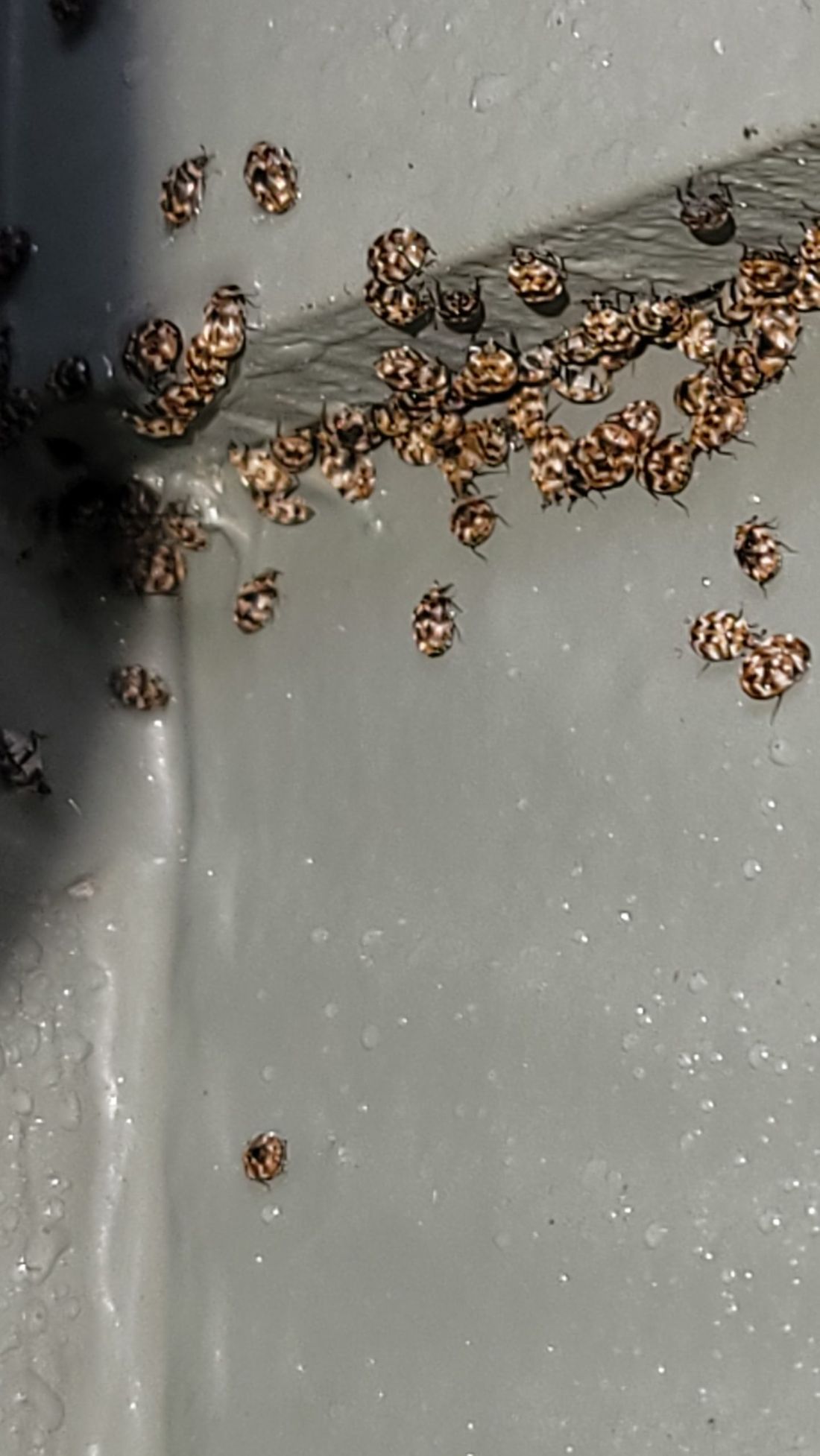
Insects massing on a sunlit south or west wall in October are looking for somewhere to spend the winter. Several species do it at once, they use the same gaps, and the work that reduces it is exterior sealing plus a treatment timed to late summer rather than autumn.
Call 360-410-2199 Request a free inspection
What to do, in order
- Photograph one bug from the wall on a flat surface beside something for scale, so the species can be named
- Vacuum the ones that get indoors with a spare vacuum or a stocking in the hose, and empty it outside sealed
- Do not crush stink bugs, spray inside or fog the rooms, because none of it reaches the bugs dormant in the wall
- Close the indoor gaps they emerge from, such as window frame edges, recessed lights, fan surrounds and the attic hatch
- Trim plants touching the sunny wall, clear leaf litter from the foundation and keep ivy off the siding
- Call for a free look at the south and west walls: we find the openings at height, check the attic for dead bugs and set a sealing plan
- Book the exterior treatment of those walls for late August or early September, before they move in; applied in late October it mostly misses them
The annual gathering
There is a particular week in most Octobers when somebody looks at the sunny side of their house and finds it covered in insects.
Not one species, usually. A mixture, all doing the same thing at the same time, for the same reason. They are looking for somewhere to spend the winter, and a warm wall is the staging post.
The mechanism is straightforward. As nights cool, insects that overwinter as adults become motivated to find shelter. On an autumn afternoon, a wall facing the sun is measurably warmer than the surrounding landscape — a light-colored south or west elevation particularly so — and that warmth is what draws them in and concentrates them.
Having gathered, they explore. Anything that offers a crevice gets investigated, and any gap that leads into a cavity gets used. Wall voids, attics, soffits, the space behind fascia, around window frames, under siding: all of them serve.
Then they become dormant and wait, and the wall goes quiet, and everyone assumes it is over.
Who is on your wall
The cast is fairly consistent in this county.
Brown marmorated stink bugs. Shield-shaped, mottled brown, roughly the size of a thumbnail, with pale banding on the antennae and the abdominal edge. An introduced species that has spread widely, and the one that produces the characteristic odor when disturbed or crushed. Also an agricultural pest, which matters locally.
Native stink bugs, including green species, doing the same thing in smaller numbers.
Boxelder bugs. Black with distinctive red or orange lines, gathering in dense clusters and strongly associated with boxelder and other maples nearby. Harmless and visually alarming because of the sheer numbers.
Western conifer seed bugs. Large, narrow, brown, with flattened leaf-like sections on the hind legs. Slow, clumsy fliers that make a loud buzz. Completely harmless and frequently mistaken for something far worse.
Ladybird beetles. Several species aggregate for the winter in large numbers, often in attics and wall voids. Some of them nip mildly, and they can stain surfaces with defensive fluid.
Cluster flies. Sluggish, dull gray, gathering on the same walls in the same weeks and entering the same openings. Different insect, identical behavior.
Paper wasp and yellowjacket queens, individually rather than in aggregations, looking for a sheltered spot to overwinter.
The important point is that these are one problem rather than six. They share the timing, the walls, the openings and the remedy.
Why your building
Households often feel singled out, and the profile of an affected building is fairly specific.

Orientation. South and west elevations get the afternoon sun and hold heat into the evening. North-facing walls are largely unaffected.
Color and material. Light-colored siding reflects less heat away and warms readily. Vinyl siding is a particular case because its construction leaves open channels and gaps at the J-channel and at panel ends, which are ideal entry points sitting exactly where the insects are gathering.
Height. Taller buildings present more warm surface and have more openings at height where nobody has ever looked.
Surroundings. Boxelder and maples for boxelder bugs. Conifers for seed bugs. Orchards, berry fields, ornamental trees and gardens for stink bugs. Lawn and pasture for cluster flies. A rural or edge-of-town property with any of these nearby will see more than a house in the middle of a subdivision.
Age and complexity. Older buildings with complex rooflines simply have more gaps. Additions, dormers, and changes of material all create junctions.
And the insects already inside. There is a second mechanism working alongside the building, and it belongs to the brown marmorated stink bug specifically. The National Pesticide Information Center records that when one of these insects finds a suitable place to spend the winter, it secretes an odor that draws other stink bugs to it. That is a settled insect signaling from a shelter it has already approved, and it is the part of the story that accounts for one house on a street collecting them season after season while the one beside it never does. The first arrivals recruit; the orientation, color and openings above decide whether there was anywhere worth recruiting to.
None of it has anything to do with how a house is kept, which is worth saying because people frequently assume it does.
What happens next
The wall clears, and a few weeks later they start appearing indoors, and this is the part that confuses people.
The insects in your wall cavity or attic are dormant rather than dead. Dormancy is temperature-driven and reversible. A mild spell in January, a sunny February afternoon warming that same wall, or a heating system warming the structure from inside will rouse a proportion of them.
Roused insects move, and most of them orient toward light. In a wall void or an attic, the light is a window. So they emerge into your rooms through whatever gap connects the cavity to the living space — the edge of a window frame, a recessed light housing, a bathroom fan surround, an unsealed attic hatch, the top of an interior wall.
Each warm spell produces another batch. From inside it looks like a continuing infestation. It is the same population being woken repeatedly, and it will continue until spring, when the survivors leave to feed and breed outdoors.
They do not reproduce indoors, they do not feed indoors, and the population does not grow. What got in is what you have.
The agricultural dimension
Worth a paragraph in this county specifically, because brown marmorated stink bugs are not only a household nuisance.
They feed on a wide range of crops — berries, tree fruit, corn, beans, ornamentals — and Whatcom County grows a good deal of what they like. Feeding damage on fruit shows as dimpling, corking and discoloration, which is a marketability problem rather than a plant health one.
For a household, that has one practical implication: properties adjacent to berry fields, orchards or large gardens see higher numbers on the wall in autumn, because the population that built up over the growing season is looking for somewhere to overwinter and your building is the nearest structure.
For a grower, it is a different conversation entirely and one involving monitoring and the extension service rather than a residential pest control visit. If that is your situation, say so and we will point you to the right resources rather than pretending a house treatment addresses it.
Timing is the whole thing
There is one honest point to make about treating for this and it is about the calendar.

An exterior application to the walls they gather on, made in late August or early September before the insects move in, genuinely reduces how many get into the building. Applied at the right moment, the difference over a winter is substantial.
The same treatment applied in late October, when the wall is already covered, achieves much less, because a large proportion of the population is already inside the cavity.
And once they are in the void, very little reaches them. Products applied into a wall cavity have poor access to insects wedged dormant in a gap, and treating a void full of insects leaves you with a void full of dead insects, which has its own consequences.
So the shape of a plan is: seal what can be sealed now, whatever the season, and put the exterior treatment in the calendar for the end of next summer. That is not what anybody wants to hear in November, and it is the accurate answer.
Sealing, which is the durable half
Exclusion works regardless of timing and it keeps working.
The openings that matter are mostly at height, which is why this problem persists on buildings where somebody has diligently sealed everything at ground level.
Soffit and fascia junctions, which almost always have gaps somewhere along their run and which lead directly into a roof space.
Gable, roof and attic vents with damaged, missing or overly coarse screening.
Around windows on the affected elevations — the frame-to-siding junction, failed sealant, and the trim returns.
The open ends of vinyl siding and the J-channel, which are a very characteristic entry and are easily closed.
Where an addition’s roof meets a wall.
Utility penetrations at height — service entries, brackets, vent boots, heat pump line sets.
Chimney flashing and the gap around a flue, and any unused flue left open at the top.
Disused vents and ducts that terminate in open air with nothing on the end.
And on the inside, the openings that let them out of the cavity and into your rooms. Sealing those will not stop them entering the building, but it stops them entering the room, and for most households that is the part that matters day to day.
Dealing with the ones indoors
Vacuum them. The most effective domestic method by a distance. They are slow and easily collected.
Use a dedicated vacuum, or a stocking trick. Stink bugs release their odor into a vacuum and it lingers. A cheap shop vacuum kept for the purpose, or a stocking secured inside the hose to catch them before they reach the machine, solves it.
Do not crush them. The odor is the obvious reason, and it is a good one: it lingers in a room, the fluid marks some surfaces, and a bug crushed against skin can leave a rash on a small proportion of people. What we will not tell you is that crushing one calls in others. The National Pesticide Information Center is explicit that killing a stink bug does not attract more stink bugs, and that the odor released will not attract other bugs. The advice is unchanged. The reason behind it was wrong, and it sat on this page until we went and read the source.
Empty the canister outside, sealed, because they are not necessarily dead.
Do not spray indoors. It kills what you can see and does nothing about the population in the cavity, while putting residue where you live.
Do not fog. Ineffective against insects in voids, and a great deal of product for no return.
Consider a light trap in an attic or an unused room, since they orient to light. Worth it in a badly affected building.
The spring aftermath
Two things follow in spring and it is worth knowing about both.
The first is a second wave of indoor sightings as the survivors become active and try to leave. It looks like a new problem and it is the end of the old one.
The second is the accumulation. A proportion of every overwintering population dies in the void, and in a building that has had this for years that means a quantity of dead insects in an attic or a wall cavity.
Dead insects are food. Carpet beetles and larder beetles breed in the accumulation and then disperse into the rooms below, where they damage wool and textiles, and where the shed bristly hairs of carpet beetle larvae irritate skin in some people in a way that is readily mistaken for bites.
So clearing an accessible accumulation is part of doing this properly rather than an extra. Where the material is in a closed wall void it may not be reachable, which is another argument for stopping them getting in rather than dealing with them afterwards.
What a realistic result looks like
We would rather set the expectation than oversell it.
A building with the profile described above will keep attracting insects in October, because the sun keeps rising and the surrounding landscape keeps producing them. What good work achieves is a large reduction: fewer entering, fewer emerging into rooms, and no growing accumulation in the structure.
On a well-sealed building with a properly timed exterior application, most households find the difference substantial — from a daily winter nuisance to an occasional one.
On an older, complex, tall building with many openings at height, complete exclusion is not realistic and management is the honest aim. We will say that at the start rather than after two disappointing seasons.
What we will not do is sell a monthly interior treatment through the winter, because it does not work on insects dormant in a wall.
Telling them apart in thirty seconds
People send us photographs of these constantly, so here is a field guide short enough to be useful while standing at a wall.
Shield-shaped, mottled brown, pale bands on the antennae, about the size of a thumbnail. Brown marmorated stink bug. Slow, deliberate, and smells when disturbed.
Shield-shaped and bright green. A native stink bug. Same behavior, fewer of them, generally less noticed.
Elongated black body with sharp red or orange lines forming a pattern on the back and wings. Boxelder bug. Often in dense clusters of dozens, sometimes hundreds. Look for a maple or boxelder within a hundred feet.
Large, narrow, brown, with obviously flattened widened sections on the hind legs. Western conifer seed bug. Flies noisily and clumsily, often indoors at night. Harmless despite looking alarming.
Small, domed, red, orange or yellow with spots. Ladybird beetle. Aggregates in large numbers, particularly in attics.
A fly rather than a bug — dull, slow, bumping at glass. Cluster fly.
Shiny, fast and metallic blue or green. Not part of this group at all. That is a blow fly, and in numbers indoors it usually means something has died in a cavity, which is worth investigating properly.
If you can photograph one on a flat surface with something for scale, we can almost always tell you which it is from the picture, and the species points at what is nearby and therefore at how much of this to expect next year.
The vegetation question
People frequently ask whether removing a tree would end it, and the answer is usually no.
For boxelder bugs, the association with boxelder and maples is genuine, and a mature specimen right beside a house does contribute. Removing a healthy mature tree to reduce an autumn nuisance is, in our view, a poor trade — the tree is worth more than the inconvenience, and the insects will still arrive from trees further away.
For stink bugs and seed bugs, the source is the wider landscape rather than any one plant, and there is nothing to remove.
What is worth doing is more modest. Cut back vegetation that touches or overhangs the affected wall, since it provides both cover and a bridge. Clear leaf litter and debris from against the foundation. Keep ivy and dense climbers off the siding, which is worth doing for the wall’s sake regardless.
And where a hedge or a shrub is shading a wall that would otherwise dry, opening it up helps with moisture, decay and insects at once.
What we will not sell you
A winter interior treatment. Product applied inside a house in January does not reach insects dormant in a cavity, and it puts residue in living space for no return.
A recurring plan through the overwintering months. Once they are in, the number is fixed. Repeat visits do not reduce it.
Fogging or bug bombs. No useful effect on insects in voids, considerable product in occupied rooms.
A promise that they will stop coming. The wall will still face the sun next October and the landscape will still produce them. We can substantially reduce what gets in. We cannot change the geometry of your house.
Tree removal. Not our call and rarely the right trade.
An urgent attic cleanout that is not urgent. Where accumulation is light it waits for the sealing work. Where it is heavy it should be dealt with, and we will show you which yours is rather than describing it over the phone.
A note on the smell
Since it is the thing people ask about most with stink bugs, briefly.
The odor is a defensive secretion released when the insect is threatened, crushed, or vacuumed roughly. Descriptions vary — coriander, burnt rubber, something acrid — and sensitivity to it varies a great deal between people.
It fades on its own within a day or so in a ventilated room. Where it has got onto a surface, ordinary soap and water deals with it, and it is worth doing promptly rather than letting it dry.
On fabric, wash normally. On a vacuum, the smell can persist for a long time, which is the argument for keeping a cheap one for the purpose or fitting a stocking inside the hose to catch them before the machine does.
The one thing worth avoiding is a large number crushed at once in an enclosed space, which is unpleasant out of proportion to the number of insects involved.
What we do
We look at the elevations they are actually using, find the openings above and around them, check the attic for accumulation and for the routes into your rooms, and identify which species you have — because a wall of boxelder bugs and a wall of stink bugs point at different things nearby.
Then a plan with dates on it: what to seal now, what needs an exterior treatment timed for the end of next summer, and what to do about anything already in the structure.
Assessment is free, there is no term agreement, and if you call in December we will tell you plainly that the useful treatment window has passed, what to do in the meantime, and when to call back.
Frequently asked questions
What are they actually doing on the wall?
Warming up and gathering. A sunlit wall radiates heat on an autumn afternoon, which draws them out of the surrounding landscape and concentrates them. From there they work into any gap and settle into the cavity behind it.
Why my house and not the neighbor's?
Large unshaded south or west elevations, light-colored siding, height, and plenty of small openings. A tall pale wall facing the afternoon sun with an open soffit above it is close to ideal, whatever else is nearby.
Do they breed inside?
No. They are dormant, not reproducing, and they do not feed indoors. That is why the population does not grow through the winter — what you have is what got in, being periodically woken by warm weather.
Should I squash the stink bugs?
Better not to, though not for the reason usually given. The National Pesticide Information Center, run by Oregon State University with the US Environmental Protection Agency, states that killing a stink bug does not attract more stink bugs and that the odor released will not attract other bugs. The reasons to avoid it are the lingering smell, the marks the fluid leaves, and the rash skin contact can cause. Vacuum instead.
When does treatment actually work?
Late August into early September, applied to the walls they gather on, before they enter. The same treatment in late October is largely wasted because they are already inside the cavity where nothing reaches them.
Are they damaging the house?
No. They do not chew, bore, nest or breed in the structure. The nuisance is the numbers, the odor from stink bugs, and the dead insects that accumulate in voids and feed carpet beetles later.
What does it cost to have someone look?
Nothing. We will look at the elevations they are using, find the openings above and around them, and tell you what would genuinely reduce it on your building and when to do it.
Guides
From the blog
Stink Bug & Boxelder Bug Control in Whatcom County?
Family-owned, no long-term contracts, and every treatment is backed by our 100% Service Guarantee.
Most calls in Whatcom County are out within 1–2 days, about 3 during the late-summer peak.
Last updated