
What Integrated Pest Management Actually Means
Integrated pest management is a decision process, not a product line. It requires identifying the species first, monitoring to know what is really happening, setting a threshold for action, and putting sanitation, exclusion and habitat change ahead of chemicals, with any application targeted rather than broadcast.
Call 360-410-2199 Request a free inspection
The short version
| What IPM is | A decision process: identify the species, monitor, set a threshold, change conditions, then treat narrowly |
|---|---|
| Action threshold | EPA's term for the pest level at which presence becomes a nuisance, a health hazard or an economic threat |
| Where zero is right | Bed bugs anywhere, cockroaches in commercial kitchens, rodents in food handling areas, stored-product pests in audited facilities |
| Order of tools | Sanitation and habitat first, then exclusion, moisture, mechanical control, and chemicals last |
| When chemicals are used | Baits before sprays, crack and crevice before broadcast, target-specific where an effective option exists |
| Quarterly perimeter spray | Not IPM on its own, since it runs on a calendar instead of on a finding |
| House monitoring | Same spots checked each visit plus what the homeowner reports; logged trap counts belong to commercial work |
| Record of what was applied | Washington law gives the land owner a copy: product, EPA registration number, amount, concentration, date and times |
The phrase that stopped meaning anything
Ask any pest control company in this county whether they practice integrated pest management and the answer will be yes. Ask what it means on their jobs and you will usually get a description of a quarterly perimeter spray with a web sweep attached, plus a sentence about using the least amount of product necessary.
That is not integrated pest management. That is a repeating application with a better name on it.
The term is worth rescuing, because the thing it describes is real, it is defined in public by people with no product to sell, and it genuinely produces better outcomes in this climate than the alternative. So this page does three things: sets out what the published definitions actually require, describes what that looks like on a real job in Bellingham or Ferndale rather than in the abstract, and gives you a way to check whether the company standing in your kitchen is doing it.
What the definition actually says
Start with the EPA, because it is the source everyone in the trade gestures at and almost nobody quotes.
EPA calls IPM “an environmentally friendly, common sense approach to controlling pests,” and describes it as focusing on pest prevention and using pesticides only as needed. It then sets out four steps, in order:
Identify pests and monitor progress. Correct identification first, and records of what was monitored, where, and on what schedule.
Set action thresholds. EPA defines the action threshold as “the pest population level at which the pest’s presence is a nuisance, health hazard; or economic threat.”
Prevent pests. Remove the conditions that attract them — food, water, shelter — through weatherization, sanitation and telling people what they are doing that keeps the problem fed.
Control pests. Only once the threshold has been crossed, and then using “the most effective, lowest risk options,” which EPA lists as trapping, heat or cold treatment, physical removal, or a pesticide application.
Washington State University’s IPM material lays out the same sequence with one addition worth noticing: evaluation. Check often to see whether you still have the problem, and work out which of the things you did was the thing that mattered. WSU’s landscape material describes urban IPM as an approach that “does not rely totally on pesticides,” and orders the tactics — cultural, sanitation, biological, mechanical, and chemical last.
The University of California’s program puts it as “an ecosystem-based strategy that focuses on long-term prevention of pests or their damage through a combination of techniques,” and is blunt about the decision at the center of it: monitor the numbers, then decide “whether the pest can be tolerated or whether it is a problem that warrants control.”
Three independent land-grant and federal sources, three ways of saying the same thing. Identify. Watch. Decide. Change the conditions. Treat narrowly and only where the decision says to.
Identification is not a formality
This is where most jobs are won or lost, and it is the step that gets skipped most often because it costs time and produces no invoice line.
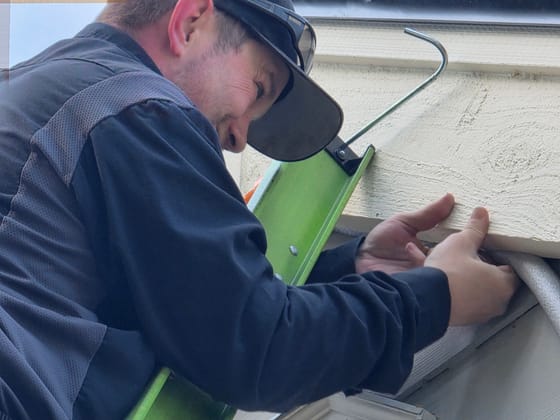
The category is not the answer. “Ants” is not an identification. In a Whatcom County kitchen in April, a trail of small dark ants is most likely odorous house ants, and the correct response is a bait matched to what the colony is currently feeding on plus a look at what is drawing them. If the same trail turns out to be moisture ants, the correct response is a moisture investigation, because moisture ants are a symptom of wet, decaying wood and treating them without fixing the water is buying a year. If it is carpenter ants, the question becomes whether you are looking at a parent colony outside in a stump or a satellite inside a wall, and the answer changes the whole job.
Same three-letter word, three completely different pieces of work, and no way to choose between them without a hand lens and someone who knows what they are looking at.
The rodent version is the same. Rat and mouse droppings are distinguishable by size and shape, the gnawing is different, the entry sizes are different, and the bait station placement that works for one is wasted on the other. Norway rats and roof rats use different parts of a building. A technician who says “we’ll put out some stations” without having established which animal is present has skipped the step the entire method rests on.
And identification is often the moment the honest answer turns out to be that nothing needs doing. A spider in the garage in October is an adult male walking in search of a mate and will be dead in weeks whatever you do. Cluster flies in an upstairs window in March are the ones that came in last September and are trying to get out. Neither of those is a treatment problem, and saying so is part of the method rather than a failure to sell.
Monitoring, and an honest word about it
Monitoring means knowing what is happening rather than assuming. In practice it is sticky traps in the places insects travel, snap traps or tracking patches set and then read, a record of where activity was seen and when, and comparing this visit to the last one.
In commercial work this is real. A food handling account has a device map, each device gets checked and logged, trend lines get looked at, and a rise in counts at the back door triggers a look at the back door. That is the version EPA’s records language describes, and it is the version an auditor asks to see.
In residential work, and here is the part the trade does not say out loud, it is usually much thinner. Nobody is logging trap counts monthly on a three-bedroom house in Sudden Valley, ourselves included. What residential monitoring honestly consists of is a technician checking the same locations on each visit, the customer reporting what they have seen since, and a comparison between the two.
That is not nothing — it is how you find out that the activity moved from the crawlspace to the wall cavity, or that what you did in September worked. But a company selling you a “monitoring program” on a house is, nine times out of ten, describing a scheduled visit. Ask what specifically gets monitored and how it gets recorded, and the answer will tell you which version you are buying.
Thresholds, which is the uncomfortable part
The action threshold is the piece of IPM that pest control companies quietly drop, because it is the piece that says some level of pest presence does not warrant a treatment.
Selling is easier when the threshold is zero. Zero is also achievable in very few places and expensive in all of them.
Where a threshold of zero is genuinely right: bed bugs anywhere, cockroaches in a commercial kitchen, rodents in any food handling area, and stored product pests in a facility subject to audit. In those settings, presence is the trigger and the argument is over.
Where zero is the wrong target: spiders in a garage or a crawlspace, a few foraging ants on a patio in June, cluster flies in an unheated attic, overwintering stink bugs on a south wall in October, sowbugs under a doormat, and most of what walks through a house in the fall. All of those are seasonal, externally sourced and largely unaffected by anything applied to a foundation. A company that treats each of them as an emergency has not set a threshold. It has set a schedule.
The honest position on a threshold is that it is partly yours. Your tolerance for a spider in a bathtub is not our decision, and WSU’s material puts this directly to the homeowner: work out what you can accept. What we can do is tell you which situations get worse if left, which ones resolve without help, and which ones are pointing at a building problem you would want to know about anyway.
The hierarchy, and why it is in that order
Every source above orders the tools the same way, and the order is not sentimental. It runs from most durable to least.
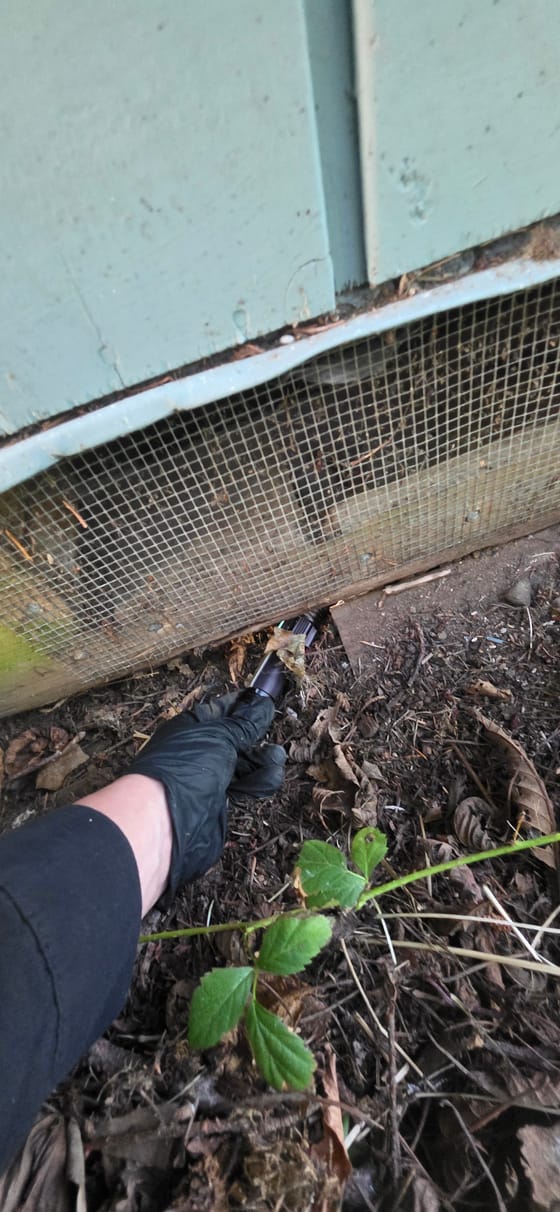
Sanitation and habitat modification first. Pet food left down, an open compost pile, a bird feeder twenty feet from the house, fallen fruit under an apple tree, laurel hedging pressed against siding, firewood stacked on the foundation, a garbage enclosure that does not close. Every one of those is a food or harborage supply, and none is affected by a product. UC IPM is explicit on cockroaches: insecticides “are most effective in controlling cockroaches when combined with sanitation and exclusion practices,” and removing other food sources “will greatly enhance the effects of baits.”
Exclusion second. Close the way in. A quarter-inch gap at a pipe penetration, a corroded crawl vent screen, a door sweep worn at the corners, an open crawl hatch, a gable vent with the mesh gone. Sealed properly in metal and mortar rather than foam, that work does not need repeating, which is the whole argument for it.
Habitat and moisture third, which in this county is nearly as important as the first two. A wet crawlspace produces moisture ants, dampwood termites, springtails, sowbugs and the spiders that follow them. Drying it removes several species at once, permanently, without a product.
Mechanical control fourth. Traps, physical removal, vacuuming, a nest taken down at the right time of day.
Chemical control last, chosen for the target and placed where the target goes.
The reason this order matters commercially is that the first three are mostly not our work. They are a homeowner’s afternoon, a gutter contractor, a builder, or a drainage job. A company whose recommendations never leave its own price list is not applying the hierarchy — it is applying the part of it that it bills for.
Where chemicals fit, precisely
The last step is not a lesser step. When the threshold is crossed, treating properly matters, and doing it narrowly is what makes the difference.
Baits over sprays, where a bait exists. UC IPM’s ant guidance says baits are “a key tool for managing ants and the only type of insecticide recommended in most situations,” and that “when properly used, baits are more effective and safer than sprays.” For cockroaches the same program states that bait products “are the primary pesticides used,” and that aerosols and total-release foggers “are often ineffective since they don’t reach the crevices where cockroaches harbor.”
Crack and crevice over broadcast. Product placed into the void, the gap behind the trim, the plumbing penetration, the wall junction — the places the insect actually travels — rather than a film across a surface people and animals touch. It uses a fraction of the material and puts it where it does the work.
Target-specific over broad-spectrum, where a target-specific option exists and is effective.
No application at all where the finding does not support one. This is the step with no product to defend it and it is the one that most distinguishes a program that is running on evidence from one running on a calendar.
What this looks like on a job here
Abstractions are cheap. Here is the shape of three actual local jobs.
Ants in a Ferndale kitchen, late April. The visit starts at the trail, not at the truck. Follow it back: along the counter, down the cabinet side, into the gap where the sink drain passes through the wall. Outside, the same wall carries a downspout discharging at the foundation and a hedge touching the siding. Under the sink the cabinet base is stained and the particle board is soft.
Identification says moisture ants, and now the job has changed. The treatment conversation is short and the building conversation is long: the downspout gets extended today, the hedge gets cut back, and the soft cabinet base is a symptom of a leak somebody needs to find. A perimeter spray would have knocked down the foragers, the customer would have been pleased for six weeks, and the wood would have kept rotting.
Rats in a Bellingham crawlspace, mid-October. Droppings and rub marks along a joist, insulation pulled down in two bays, and a crawl vent with the screen corroded through on the north side. The property has a plum tree dropping fruit, a compost bin without a lid, and a laurel hedge running the length of the fence.
The program has four parts and only one of them is a product. Habitat: fruit picked up, compost lidded, hedge cut back off the ground. Exclusion: the failed vent rescreened in quarter-inch metal, the hatch made to close, two pipe penetrations sealed. Mechanical: traps set on the runs rather than scattered. Chemical: exterior stations if the pressure warrants them, sited where they can be serviced and where a dog cannot reach them, and reviewed rather than left forever. The follow-up visit reads the traps and looks at whether new droppings have appeared since — which is the evaluation step, and it is the one people skip.
A wasp nest in Lynden, August. Identification first, and it decides everything. A honey bee colony in a wall is not our job and gets referred to a beekeeper. A paper wasp nest under a shop eave, thirty feet from any door, with nobody going near it, may need nothing at all — it will be empty by November. Yellowjackets in a ground nest beside the back step in August, with children using that step, is over the threshold and gets treated that day, at the nest, after dusk, rather than by spraying the eaves of the house.
Three jobs, three different answers, and in two of them the most valuable thing delivered was not an application.
How to tell whether you are getting it
Six checks, all of which you can apply from your own kitchen.
Did they name the species? Not “ants” or “spiders” — the species, or an honest “I want to look at this under magnification before I tell you.” Vagueness here predicts vagueness everywhere.
Did they go where the answer is? On the housing stock in this county that means the crawlspace, with a light, along its length. A visit that stayed on the lawn has not seen the building.
Did they tell you what is driving it? There is always a reason. Food, water, harborage, a way in. A company that cannot name the driver is treating a symptom.
Did they recommend something they do not sell? Extend that downspout. Cut the hedge back. Get the gutter looked at. Store the pet food differently. If every recommendation happens to be a service on their price list, the hierarchy is not being applied.
Did anything change between visit one and visit two? A program running on evidence looks different each time because the findings differ. A program running on a calendar looks identical, because it is.
Did you get a record of what was applied? Washington requires a commercial applicator to keep records of each application — location, date and start and end times, the product name as it appears on the registered label, the EPA registration number, the amount and concentration applied, and who made the application — and to provide a copy of those records to the owner of the land treated. That is a legal entitlement, not a courtesy, and it is the single most checkable thing on this list.
The technical reason repetition fails
There is an argument for this method that has nothing to do with values, and it is the one that persuades people who find the environmental case unconvincing.
Repeatedly applying the same class of material to the same population selects for the individuals that survive it. That is not a controversial claim; it is the reason the medical world worries about antibiotics, and insects reproduce considerably faster than bacteria do in a hospital. In structural pest work it shows up most sharply in bed bugs and in German cockroaches, both of which have well documented resistance to materials that worked reliably a generation ago.
An approach built on rotating a couple of products across a foundation four times a year is, at the population level, a training program. An approach that changes the food supply, closes the entry and uses a bait matched to the target does not create the same pressure, because most of the work is being done by something no insect can develop resistance to. You cannot evolve your way through a sealed vent.
Why the climate here sharpens all of this
The method matters more in Whatcom County than it would in a dry place, and the reason is that so much of what we deal with is a moisture problem wearing an insect costume.
Thirty-five inches of rain, a wet season running from October to April, and no hard freeze to interrupt it. Under those conditions a crawlspace with a torn ground cover or a blocked vent stays damp for six months at a stretch, the framing above it stays in the range where decay proceeds, and the species that require wet wood arrive on their own. Moisture ants, dampwood termites, springtails, sowbugs and the spiders feeding on them are all downstream of the same defect.
Treat that chemically and you are applying product to a building that is generating new conditions faster than you can respond to them. Dry the space and several problems leave at once and do not come back. That is the hierarchy doing what it is supposed to do, and it is the reason a company here that never talks about water is not really working on the problem.
Two claims to be skeptical of
“We use an IPM-based approach.” So does everyone, by their own account. The phrase carries no information. The follow-up question that does carry information is: what did the last job you ran here involve that was not an application?
“Our IPM program is a quarterly service.” A frequency is not a method. There are good reasons to visit a building on a schedule — seasonal pressure here is genuinely predictable, and a spring visit and a late-summer visit catch different things. But the schedule is a logistics decision. What happens on the visit is the method, and those are two different conversations that get merged on purpose.
Where we fall short of the ideal
A page that describes a standard and then implies the writer meets it perfectly is worth very little, so here is the gap.
We do not run logged, trend-tracked monitoring on single-family houses. Our residential thresholds are conversations rather than written numbers. We sell recurring programs, and a recurring program is exactly the structure that drifts toward calendar application if nobody is paying attention — the pressure is real, and the check on it is partly yours. And we have a commercial interest in your problem needing a treatment, which is a bias you should assume is present in every company that visits you, including this one.
What we can say is that the assessment is free and comes with no term agreement attached, that we would rather tell you to fix a downspout than sell you a plan on a wet crawlspace, and that we will put the reason we think a treatment is or is not warranted in plain language you can push back on.
The method is only worth something if the person applying it is willing to reach the conclusion that costs them the sale. That is the whole test, and it is not a difficult one to watch for.
Frequently asked questions
Does IPM mean no pesticides are used?
No. Every published definition puts pesticides in the toolkit and treats them as one option among several rather than the first one reached for. EPA describes control as using the most effective, lowest risk options once a threshold has been crossed.
What is an action threshold?
EPA defines it as the pest population level at which the pest's presence is a nuisance, a health hazard or an economic threat. Below that line you monitor and change conditions. Above it you act. Most residential work never states the line at all.
How can I tell whether a company is really doing this?
Ask them to name the species rather than the group, ask what is driving it, and see whether anything they recommend is something other than a treatment they sell. A visit that produces no non-chemical recommendation on an older house here is a visit that did not look.
Am I entitled to know what was applied?
Washington requires a commercial applicator to keep records including the product name, the EPA registration number, the location, the amount and concentration, and the date and times, and to provide a copy of those records to the owner of the land treated.
Is a quarterly perimeter spray integrated pest management?
Not on its own. A repeating application made on a calendar rather than on a finding is the opposite of the decision process every definition describes. It can be part of a program, but it is not the program, and a company that offers nothing else is not running one.
Does IPM cost more?
The first visit usually takes longer, and the recommendations frequently point at work another trade does. Over several years it is normally cheaper, because closing a building or fixing drainage is a one-off and a recurring application is not.
Do you run a monitoring program on a single-family house?
Not in the formal sense with logged trap counts, and neither does anyone else on ordinary residential work. What exists is a technician checking the same locations each visit and a homeowner reporting. On commercial accounts, documented monitoring is real and expected.
Sources
This is information, not legal advice. We are a pest control company, not attorneys. What follows is our reading of published rules, with links so you can check them yourself. For advice on your own situation, talk to a lawyer, to WashingtonLawHelp, or to your city or county code enforcement office.
- EPA — Introduction to Integrated Pest Management — read September 2, 2026
- WSU — What is IPM? — read September 2, 2026
- WSU Pesticide Education — IPM in the landscape — read September 2, 2026
- UC IPM — What is integrated pest management? — read September 2, 2026
- UC IPM Pest Notes — Cockroaches — read September 2, 2026
- RCW 17.21.100 — Records of pesticide application — read September 2, 2026
Rules change. This page is scheduled for review against its sources by September 2, 2027. If you are reading it after that date and something looks out of step with the current rule, the rule is right and we are wrong — please tell us.
Related guides
From the blog
Pest problem in Whatcom County?
Family-owned, no long-term contracts, and every treatment is backed by our 100% Service Guarantee.
Most calls in Whatcom County are out within 1–2 days, about 3 during the late-summer peak.
Last updated