
Millipedes — the Autumn Migration
Occasional invaders
A millipede indoors cannot feed or breed and dies within a couple of days from water loss. Mass movements across foundations follow heavy autumn rain saturating the soil they live in, and they end on their own. Two pairs of legs per segment, slow, harmless, and eating decayed leaves outdoors.
Call 360-410-2199 Request a free inspection
Rarely worth treating. Usually this is a sealing or cleaning job.
Millipede at a glance
| Size | Commonly about an inch long; larger ones in this region reach two inches |
|---|---|
| Body and color | Long, segmented and round in cross-section; dark brown to nearly black |
| Legs | Two pairs per body segment, moving in a slow wave down the body |
| How to tell it from a centipede | A centipede is flattened, fast, has one pair of legs per segment and hunts; a millipede coils and waits |
| How to tell it from a pillbug | A pillbug has seven pairs of legs and rolls into a ball; a millipede coils flat into a spiral |
| When you see it | October and November, in the days after heavy rain saturates the ground |
| Harm | Cannot bite and damages nothing; some release a fluid that stains and can irritate skin or eyes |
| Do we treat it | Rarely warranted — indoors it dies within two or three days, so a broom or vacuum is the answer |
Signs you have them
- Dozens or hundreds along the foundation, piled at corners and door thresholds after a wet week
- Slow, dark, worm-like animals crossing a garage or hallway floor
- Dead ones along a baseboard, still coiled like small dark washers
- Stains left on a floor or baseboard where one was crushed
This is a weather event, and it has already ended
A millipede in your hallway is not living there. It cannot live there. It got in during a wet week, it is losing water through its cuticle faster than it can replace it, and there is nothing inside a heated house that it eats.
University of Wisconsin’s horticulture extension puts the indoor survival time at two to three days and names the reason: lack of moisture. Penn State says they cannot long survive the dry atmosphere found within most buildings and adds that they do no damage beyond being a nuisance. UC IPM says the same in different words — indoors they usually die quickly, from dry conditions and lack of food.
So the correct emotional register for this page is cheerful, and we are going to keep it that way. There is no colony under your floor. There is nothing eating your house. There is a batch of animals that walked into a desert and will not be walking back out, and the job in front of you is ten minutes with a broom.
The reason it happens in October, and the reason it will happen again next October unless something changes outside, is the second half of this page.
Two pairs of legs, and why that one detail matters
Nearly every unnecessary call about this animal comes from confusing it with a centipede, so this section is the practical core of the page.
Legs per segment. Millipedes carry two pairs on each body segment — Penn State notes the exception, the first three segments, which have one pair each. Centipedes carry one pair per segment. That is the definitional difference and it survives on a specimen too dried out to identify any other way.
Body shape. Millipedes are round in cross-section, wire-like or cylindrical. Centipedes are flattened top to bottom.
Speed. Millipedes move slowly, in the undulating wave UC IPM describes, where you can watch the legs travel down the body in ripples. Centipedes move in fast bursts and stop dead. If it startled you, it was not a millipede.
Response to being disturbed. A millipede coils into a flat spiral and waits. A centipede runs.
What they eat. Millipedes are detritivores — rotting leaves, rotting wood and other moist decaying plant material. Centipedes are predators that hunt insects and other invertebrates.
Risk. A millipede has no capacity to bite. UC IPM notes that some species exude a defensive liquid that can irritate skin or burn the eyes, and that is the whole of the hazard. Centipedes are a different conversation: UC IPM records that some large ones can inflict a painful bite.
Get the identification right and the correct response is obvious in both directions. Get it wrong and people either panic about a harmless detritivore or shrug at something worth understanding. The centipede and millipede page covers the predator’s side of it.
Why this profile has no binomial
Every other entry in this library names a species. This one names a group, and that is deliberate rather than lazy.
Millipedes are a whole class of arthropods — Diplopoda — with thousands of described species, and the ones arriving at a Whatcom County foundation in November are several different animals that behave identically from a householder’s point of view. The Pacific Northwest handbook names Julus species and Orthomorpha gracilis among the ones that turn up around Northwest buildings, and there are others in the leaf litter here that nobody has any practical reason to separate.
Naming one species would imply we had identified it, and it would imply the answer changes if it turns out to be a different one. It does not. Every millipede in this region eats decaying plant material, needs damp, dies indoors within days and is harmless. That is the whole of what a homeowner needs, so the profile covers the group and says so.
What one actually looks like
Shape. Long, segmented and round in cross-section — Penn State describes the body as cylindrical and wire-like. Under a hard outer shell, which is what makes the coiled ones feel like small springs when you sweep them.
Size. Penn State gives the common species as about an inch long and a sixteenth of an inch across. The Pacific Northwest handbook allows up to two inches for the larger ones in this region. Anything much longer than that in a Northwest garden is worth a photograph.
Color. Dark brown to nearly black in most of what arrives at a door here, sometimes with a paler stripe or a reddish edge along the segments.
Legs. Many, short, pale, and in continuous motion — the wave running down the body is the most recognizable thing about a living millipede, and it is completely unlike the scuttle of anything else that gets into a house.
Posture when disturbed. A flat coil, like a watch spring, held until the animal decides the threat has passed. A dead one stays coiled, which is why the ones found along a baseboard days later look like small dark washers.
Speed. Slow. Slow enough that a coffee cup is adequate equipment.
The autumn migration
The pattern here is seasonal, dramatic and entirely normal.
Millipedes spend their lives in soil, leaf litter, mulch, compost and rotting wood, working through the decaying plant material there. The population is largest where that material is deepest. For most of the year they are invisible, because they are under things and active at night.
Then the ground saturates. Penn State links their movement to cooler weather or heavy rain. The Pacific Northwest handbook puts it in regional terms: under wet conditions, millipedes move toward foundations to get away from wet soil. When the pore space in the litter layer fills with water, the animals leave it, and because the trigger is weather rather than anything individual, they all leave at the same time.
What they meet is your building. A foundation is a long, dry, slightly warm linear obstacle running across their path, so they follow it, pile up at the corners and the door thresholds, and a proportion find a gap.
In Whatcom County that means October and November, in the days following a genuinely heavy rain after the ground has already taken on water. It is reliable enough to plan around.
Two other things worth knowing. The Alabama extension service records the same mass movement following heavy rain that arrives after a hot dry spell, which is the reverse trigger — a dry August here can produce a small version of the same event, and it surprises people because they associate this insect with wet. UC IPM frames the general case as migration when the food supply dwindles or the living space becomes either too wet or too dry. And Penn State notes that migrating millipedes will climb, ascending trees and walls to something like six feet, which is why they occasionally arrive at a second-story window or a deck rather than at a threshold.
So: get a broom
Written as its own section because it is the recommendation, not a throwaway.

Sweep them up. Or vacuum them, which is tidier and avoids the crushing. Empty it outside, well away from the foundation, and get on with your day. If they are along an exterior wall, a dustpan and a walk to the back of the garden handles a wall’s worth in a few minutes, and they were heading somewhere anyway.
Vacuum rather than stamp. Some species release a defensive fluid that stains and can irritate skin or eyes, and the Alabama extension notes an offensive odor along with the staining. A line of crushed millipedes along a baseboard is a worse problem than the millipedes were.
Do not treat the inside. There is nothing to treat. The animals present are in a two-to-three-day decline whatever anybody applies, and there is no reservoir behind the wall producing more of them.
Expect it to stop. The migration is a discrete event driven by a weather pattern. When the ground drains and the front passes, it ends, and a treatment applied on day three of a five-day event will be credited with a result the weather produced. That is worth being alert to whoever you call.
If you would rather not kill them at all, that is a perfectly reasonable position and it costs you nothing. A cup and a piece of card works. They are not fast.
What actually changes next autumn
The work that reduces next year’s event is outdoor, cheap and unglamorous. All of it is about how much habitat sits against the building and how wet it stays.
Thin the mulch and pull it off the wall. The Pacific Northwest handbook recommends decreasing mulch thickness and keeping it at least six inches from structures. The Alabama extension puts a workable depth at two to four inches. Deep bark run to the siding is a food supply, a nursery and a humid refuge in one strip, positioned exactly where you least want the population to be.
Clear the leaf litter off the foundation line. Not the whole garden — the band against the building. Litter banked at a wall through a Northwest autumn does not dry.
Get things off the soil. Boards, pallets, pots, firewood, landscape fabric. Anything flat on damp ground is harborage.
Open up the planting. The handbook suggests trimming shrubs to improve air circulation at the foundation, which sounds fussy and genuinely works, because the mechanism is drying.
Move the water away. Downspouts discharging well clear of the building, gutters clear, grade falling away from the foundation, and irrigation that is not soaking the strip beside the wall. Most of the saturated soil that starts a migration is soil somebody is inadvertently watering.
Dethatch the lawn where thatch has built into a mat, which is another litter layer holding another population.
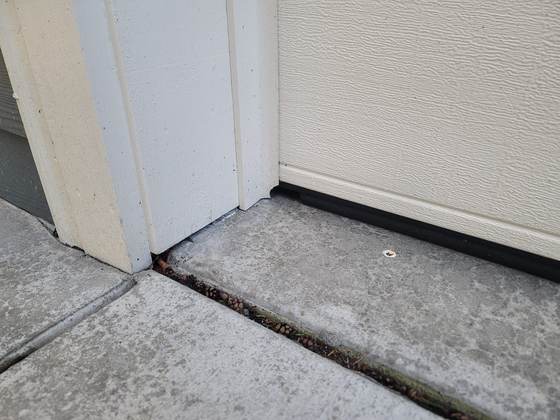
Seal at the threshold. A door sweep stops most of what walks in. Add weatherstripping, vent screening and sealed utility penetrations and you have closed the routes for several unrelated things at once — which is exclusion and repair work rather than treatment.
That list is the entire durable answer. UC IPM’s summary of it is blunter than ours: pesticide use is rarely justified.
Millipedes and pillbugs
The two get mixed up constantly, they turn up under the same board, and the answer for both is the same — but they are not remotely the same animal.
A pillbug is a crustacean, not an insect and not a myriapod. It is a land-living relative of crabs and shrimp, it breathes through gill-like structures that have to stay moist, and it carries seven pairs of legs beneath a segmented armored back. Disturbed, it rolls into a tight ball. Its non-rolling relative the sowbug has two small tail projections and cannot make the ball.
A millipede is longer, distinctly worm-like, with far more segments and far more legs, and it coils flat into a spiral rather than closing into a sphere.
Both are detritivores working the same decaying plant material, both need constant damp, both die indoors within days, and both are outdoor animals that wandered into the wrong place. If you have one you very often have the other, and neither is a reason to treat the inside of a building.
The confusion is harmless as long as it does not turn into a purchase.
Which properties get hit hardest
Three property types account for most of the heavy events we hear about, and the common factor is depth of organic material rather than anything about the house.
Lots against woodland, greenbelt or field. Sudden Valley, Silver Beach, Edgemoor, the greenbelt margins, and the rural blocks out toward Everson and Sumas. A mature litter layer next door is a reservoir with no upper limit, and the building simply happens to be the first obstacle in the way.
Recently landscaped developments. The newer stock around Barkley, Cordata, King Mountain and Ferndale, where deep fresh bark was laid to the siding across an entire subdivision in one season. Those properties tend to see their heaviest autumns a few years in, once the bark has decomposed into something that holds water and feeds a population rather than sitting on top of the soil.
Sloped or low-lying ground where water collects. Anywhere the lot falls toward the building, or the downspouts discharge at the corner, or an irrigation zone soaks the strip beside the wall. The saturation that starts a migration is often local and often self-inflicted.
The prewar city housing produces a different version of the same call. Those foundations are more permeable — original vents, aged sweeps, a crawlspace hatch that has not seated properly since the seventies — so a moderate migration outside becomes a large number inside. On those houses the fix is the envelope rather than the yard.
Things that do not work
Interior baseboard sprays. The animals are transient and dying. There is nothing behind the wall to reach.
Bug bombs. No effect on the mulch bed, which is the only place a millipede population exists, and product distributed through living space for nothing.
Broadcast diatomaceous earth outdoors, in this climate. It works by abrading the cuticle so the animal dries out, which means it only functions while it is itself dry. Scattered around a foundation during a Whatcom County October it cakes in the first rain and is finished. In a dry crawlspace or under a covered deck it has a genuine narrow use.
Sealing without clearing. Worth doing, and not sufficient on its own. A tight house standing in a saturated bark bed still has a large population pressing against every joint in it.
Waiting for winter. Mild wet winters are the reason the litter layer here stays productive through the cold months. Nothing gets reset.
The wider group this belongs to
Millipedes sit in a small set of animals that share one requirement and one message. Silverfish, sowbugs, pillbugs, springtails and the moisture-following ants all need sustained damp, none of them can hold a population in a dry space, and none of them causes structural harm on its own.
What they collectively report is water, and water is the expensive part. A crawlspace damp enough to keep millipedes alive through a winter is damp enough for decay fungi to work on the joists over it, and decay is what actually takes strength out of a building here.
That is the reason this page exists in the shape it does. The millipede is not worth treating and is barely worth thinking about. The condition that produced several hundred of them at your door is worth understanding, and it is usually about six inches of bark, a downspout and a length of grade.
When it is genuinely worth treating
Having spent the page recommending a broom, here is the honest other side.
Repeated heavy migrations into a property where the ground cannot be changed. Some sites cannot fix the cause — a lot backing onto woodland or a field margin, a strata-managed landscape, a house downhill of everything. A perimeter application timed to autumn, before the ground saturates rather than during the event, genuinely reduces what gets through.
Where the crawlspace is a reservoir rather than the yard. If millipedes are coming up through the floor rather than in under the door, the space below is wet enough to sustain them continuously, and that has implications well past this insect. The crawlspace guide explains what a wet under-floor space does to the framing above it, and the fix is crawlspace work rather than pest control.
A commercial or institutional setting with a zero tolerance — food handling, healthcare, hospitality — where an animal on a floor is a problem regardless of its biology.
A basement or lower floor where the numbers are constant rather than seasonal. A steady year-round presence is a different finding from an October wave, and it means something in the building is holding water.
Outside those four cases, the verdict at the top of this page stands, and it is the reason we would rather publish this than sell an autumn plan to everybody whose driveway filled up after a storm.
What the migration tells you about the building
The insect itself is telling you almost nothing — millipedes coming to a foundation after heavy rain is what happens on healthy ground with a healthy litter layer, and a garden that produces them is a garden that is decomposing properly.
What is worth reading is how many got in, because that is a measurement of the building rather than the weather.
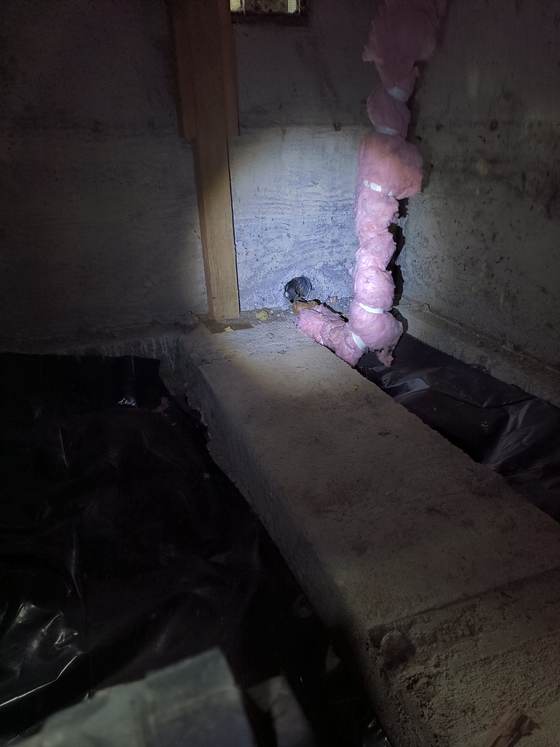
A house that collects a dozen on the garage floor after a storm week has normal gaps. A house that takes several hundred, or that takes them in rooms away from an exterior door, has an open route — a failed door sweep, an unscreened foundation vent, a gap at a sill plate, a crawlspace hatch that no longer seats. Those routes are not specific to millipedes. Everything else on this website uses them too, and rodents use them in November for reasons that cost a great deal more to fix.
So the useful thing to do during a migration is not to reach for a product. It is to note where they are getting in, because for once you have several hundred small animals mapping your building envelope for you, free, in a single week. Write down the doorways. Then fit the sweeps in the dry weather afterward.
What we will not sell you
A treatment for insects that are already dying. Everything indoors during a migration is on a two-day clock.
Credit for the weather. A perimeter application on the last day of a migration produces a dramatic improvement the following morning, and it would have happened anyway. We would rather tell you that in advance than take the call-back thanks.
An annual program for a seasonal event that a rake and a door sweep reduce more effectively and permanently than we can.
A story about damage. There is none. Not to structure, not to fabric, not to food, not to plants indoors. The staining from a crushed one is the whole ledger.
What to tell us if you call anyway
Which animal. Slow and coiling, or fast with long legs. That single detail sends the conversation in two completely different directions.
Where they are entering, if you can tell — a specific door, a garage, a particular wall, or up through the floor.
Whether it followed rain. If the answer is yes and the calendar says October, we will very likely tell you what this page tells you and not book anything.
Whether it is happening in July. A midsummer wave means the trigger is something other than seasonal weather, and that is worth a look.
What the crawlspace is like, if you know. A musty smell at the floor vents or standing water below points at a reservoir under the house rather than a migration across the lawn, and that changes the answer entirely.
Frequently asked questions
How long will a millipede survive inside my house?
Two or three days at most. University of Wisconsin horticulture gives that figure directly and attributes it to lack of moisture, and Penn State notes they cannot long survive the dry atmosphere inside most buildings. There is nothing indoors for them to eat either.
Hundreds appeared along my foundation overnight. Is that an infestation?
No, it is a migration and it is normal here. Heavy rain saturates the soil and leaf litter they live in, they move in numbers looking for ground that is not waterlogged, they meet your foundation and follow it. The event runs for days, not weeks.
How do I tell a millipede from a centipede?
Count legs per segment and watch it move. Millipedes carry two pairs per segment, are rounded, move slowly and coil into a spiral when disturbed. Centipedes have one pair per segment, are flattened, and are startlingly fast. Millipedes eat decaying plants; centipedes hunt.
Should I sweep them or vacuum them?
Either works, but a vacuum is tidier. Some species release a defensive fluid that can stain a surface and irritate skin or eyes, and crushing a line of them along a baseboard is how that happens. Empty the canister outside afterward.
Will they damage anything in the house?
Nothing at all. They do not bite, do not chew wood, fabric or food, do not nest and do not reproduce indoors. The only mark they leave is the stain from a crushed one, which is why sweeping beats stamping.
What actually reduces next autumn's numbers?
Work on the ground outside. Thin the mulch and pull it back from the siding, clear leaf litter off the foundation line, get boards and pots off the soil, move the downspout water away, and fit a door sweep. That combination does more than any perimeter treatment.
Why does this happen so much more here than where I used to live?
Rain and mild temperatures. Around thirty-five inches a year with no hard freeze keeps the litter layer productive year-round, so the population going into autumn is large, and October rain saturates the ground it lives in reliably every year.
Sources
- Penn State Extension — Millipedes — read September 2, 2026
- PNW Insect Management Handbook — Nuisance and household pests: Millipede — read September 2, 2026
- UC IPM Pest Notes 7472 — Centipedes and Millipedes — read September 2, 2026
- University of Wisconsin–Madison Extension, Horticulture — Millipedes — read September 2, 2026
- Alabama Cooperative Extension System — Preventing and Controlling Home-Invasion of Garden Millipedes — read September 2, 2026
Rules change. This page is scheduled for review against its sources by September 1, 2027. If you are reading it after that date and something looks out of step with the current rule, the rule is right and we are wrong — please tell us.
Pest problem in Whatcom County?
Family-owned, no long-term contracts, and every treatment is backed by our 100% Service Guarantee.
Most calls in Whatcom County are out within 1–2 days, about 3 during the late-summer peak.
Last updated