
Pest Control on Semiahmoo, Blaine
Semiahmoo is a sand spit with saltwater on both sides and a large share of its buildings unoccupied for months at a time. Nobody is there to notice a problem starting, salt works the building envelope open, and much of the housing shares walls with its neighbors.
Call 360-410-2199 Request a free inspection
Semiahmoo, Blaine on the map
A strip of sand with water on both sides
Semiahmoo is a spit — a narrow bar of sand reaching out between Semiahmoo Bay on one side and Drayton Harbor on the other, with a resort, two golf courses, a marina of some three hundred slips, condominium blocks and gated waterfront housing strung along it.
Nothing here is far from saltwater. That single fact drives more of the pest work on the spit than the housing stock does, and it drives it in two directions at once: what the salt does to a building, and what the shoreline supports right up against it.
The second defining fact is occupancy. A large share of the housing here is second homes, seasonal residences and rentals, which means a great many buildings sit closed for months with nobody walking through them. That changes the nature of the work more than any construction detail does, and it is worth starting there.
An empty building is a different problem
Pest problems in occupied houses get caught early, and they get caught by accident. Somebody sees a droppings trail on a counter, hears something in a wall at two in the morning, notices a wasp coming in and out of the same gap every afternoon. None of that requires expertise. It requires a person being present.
Remove the person and the whole early-warning system goes with it. A mouse that gets in during the first week of November is not discovered in November. It is discovered in April, by which time it has bred, the insulation is fouled, there is a smell in the wall and the entry point has been widened by use.
The practical consequence is that seasonal property should be inspected on a schedule rather than on symptoms, because the symptoms are not going to reach anybody. Two visits a year covers it for most buildings here: one in early autumn before it is closed up, one in spring before it is reopened.
The autumn visit is the valuable one. It is the point at which the openings can still be closed before the animals that are about to use them try.
What the salt does to a sealed building
Exclusion work is the most durable pest control there is. Seal an opening properly and it stays sealed, which is why so much of what this company does is physical rather than chemical.
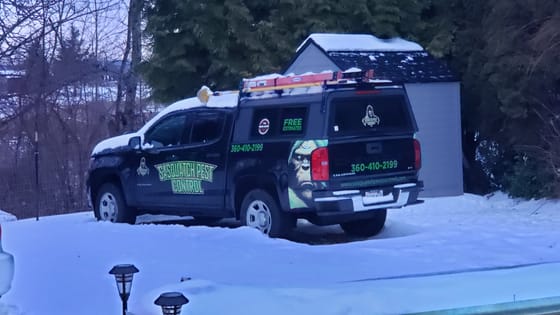
On the spit that has to be qualified, and we would rather qualify it than let somebody discover it themselves in three years.
Salt-laden air on both sides of a narrow strip of land attacks the specific materials exclusion depends on. Galvanized mesh corrodes from the cut edges. Fasteners rust and lose their grip in the substrate. Door sweeps and weather seals harden, crack and pull away. Flashing lifts as the fixings behind it degrade. Vent screens go first, and they go from the ground side where nobody looks.
None of that is a failure of the work. It is a coastal building doing what coastal buildings do, and the answer is stainless or coated hardware where it matters, and an honest expectation that a sealed building on a spit needs looking at on a cycle rather than once. We would rather quote a maintained result than promise a permanent one and be wrong.
Condominiums, and why a unit is not a building
A substantial part of the housing here is attached — condominium blocks, attached waterfront homes, buildings where several households share a structure.
That changes the arithmetic of a treatment completely, and it is the single most common source of frustration we hear about on the spit.
A shared-wall building is continuous behind the drywall. Wall voids, plumbing and electrical chases, soffits, attic spaces and crawl areas frequently run between units without a break. A rodent or insect population living in that shared volume does not recognize your unit as a separate place. It treats it as one room in a larger territory, and it moves between rooms freely.
So when a single unit is treated in isolation, what happens is predictable. Activity in that unit drops. The population, undisturbed in the shared space, carries on. Within weeks the unit is reoccupied, and the owner reasonably concludes the treatment failed.
It did not fail. It was asked to do something it cannot do.
The work that actually resolves this is done at the building level, with the association or the manager, addressing the shared voids and the exterior of the whole structure. That is a harder conversation to start than a single service call, and it is the one worth having. Where an owner wants unit-level work anyway, we will do it, and we will tell them plainly what it will and will not achieve.
The marina and everything stored around it
A marina concentrates the four things that produce rodent populations, in one place, permanently.
There is food — bait, catch, galley stores, waste containers. There is water. There is continuous shelter in gear lockers, storage units, covered walkways and the boats themselves. And there is very little disturbance, because most of that storage is opened occasionally rather than daily.
Add the seasonality of the housing around it, and there is a large sheltered resource with nobody watching it for long stretches.
What makes marina work different from house work is that the unit of the job is the site rather than the building. Lockers stand in rows sharing walls and roofs. Sealing one while the two either side stay open does not remove anything; it relocates it a few feet. Useful work here means agreement across the operator and the tenants, coordinated placements, and attention to waste handling — which is unglamorous and does more than anything applied from a can.
Boats themselves are worth a separate mention. A vessel laid up for the winter with soft furnishings, stored food and no traffic through it is an extremely good place to be a rodent, and the damage found in spring is routinely to wiring and upholstery rather than anything obvious.
Carpenter ants out of the driftwood
Carpenter ants are on the Blaine list for a reason the owner of this company gave directly: on this shoreline a meaningful share of them come out of beach wood rather than out of the forest.
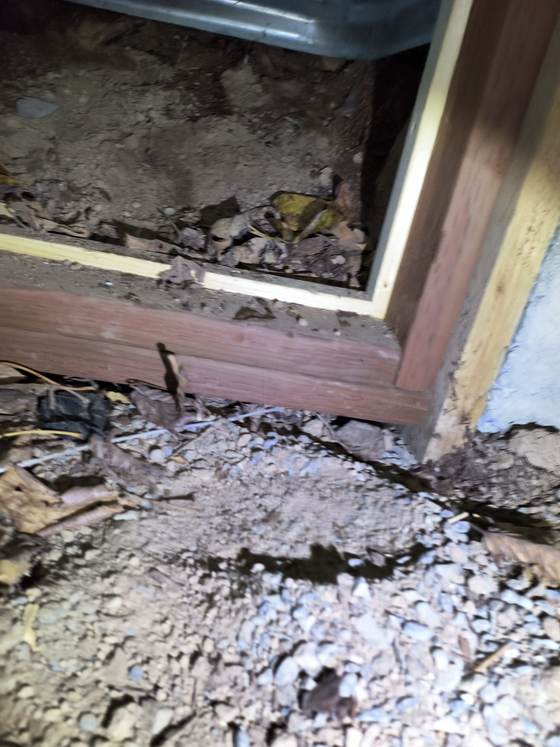
It makes sense once stated. Carpenter ants do not eat wood — they excavate galleries in it to nest, and they excavate softened, damp wood far more readily than sound dry timber. A drift pile that has been sitting on a tideline for years is exactly that material, in quantity, and it is often within a hundred feet of a building.
The building side of it is the usual story: a mature colony outdoors pushes satellite colonies outward, and a wall void or a rim joist suits a satellite as well as another log does. What is unusual here is how close the source can be and how little it looks like a nest.
Practically, that makes ground clearance a real part of treatment on this shoreline rather than a suggestion. Where large accumulations of beach wood and stacked material sit close to a structure, moving them is often the largest single thing that can be done, and it is not something we charge for doing.
Landscaping on a spit, and what it hides
Planting here has to survive salt and wind, which pushes people toward dense, tough, low evergreen material planted thickly and allowed to fill in.
It works, it looks appropriate, and it produces a continuous band of permanent ground cover directly against the building — which is a rodent corridor and a moisture trap in the same feature.
We are not going to tell anybody to tear out their planting. What is worth doing is far smaller: keep an actual gap at the base of the wall so the foundation line can be seen and reached, keep material off the siding rather than resting against it, and accept that where a bed runs tight to a building the wall behind it cannot be inspected and will not be.
What to plant and how close to the wall to put it are questions WSU Extension’s Whatcom County office takes from gardeners in this county.
Irrigation matters here too. On free-draining sand, planting gets watered, and water applied against a foundation is the beginning of the moisture story that carpenter ants and wood-boring insects need.
One more thing about the planting that is specific to a spit: what gets swept or blown into a bed against a wall stays there. Wind here moves sand, leaf litter and beach debris continuously, and a dense bed against a foundation collects all of it into a deepening layer of damp organic material that nobody turns over. Clearing that out once a year does more for the wall behind it than anything applied to the wall itself.
Gulls, and the birds nobody wants to discuss
Shoreline property attracts shoreline birds, and on the spit that means gulls in numbers, along with the nesting they do on flat roofs, parapets and sheltered ledges.
The pest consequence is not really the birds. It is what accumulates: nesting material in gutters and drains, droppings on surfaces, and the insects that live in old nests and then move inward when the nest is abandoned. Bird mites and carpet beetles both do this, and both are frequently diagnosed as something else entirely because the connection to a nest twenty feet up is not obvious.
Keeping gulls off a roof is bird work, which we do not take on. Where a nest is driving a problem indoors we will say so, point you to somebody who handles the birds, and deal with the mites and beetles it has sent inward.
The under-floor space and the ground it sits on
Sand drains fast, which is a genuine advantage, and it makes people assume moisture is not an issue here. Under a closed-up building it can be.
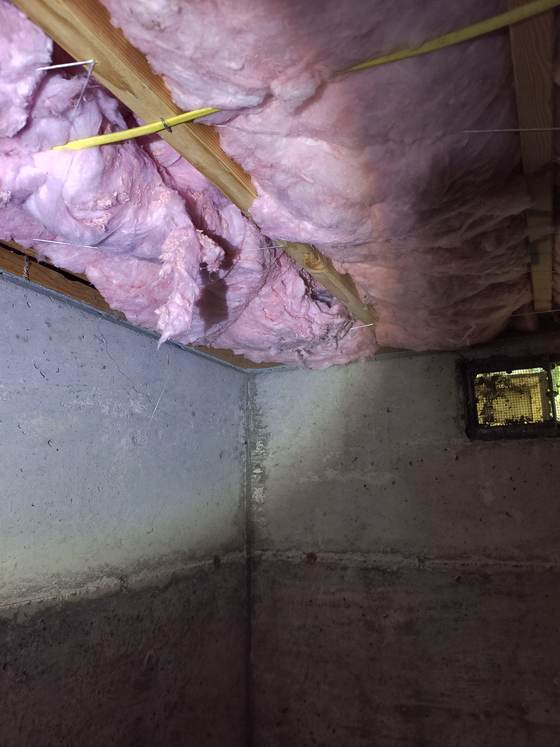
An unoccupied house has no heating cycle, no air movement and no one opening a door. Marine air is humid year-round on this shoreline, and a cold, still, unventilated under-floor space in that air will hold moisture regardless of how well the ground drains. The USDA’s Wood Handbook is the reference for what sustained moisture does to framing, and it does not care how the water got there.
That is how a spit property ends up with the same softened rim joist and the same fouled insulation as a house in a wet inland valley, by an entirely different route. It is worth looking at properly on the spring visit rather than assuming the sand has handled it.
Access, discretion and getting in at all
A fair amount of the property here is gated, managed, or behind an association, and much of it is empty when we arrive. That is a logistical matter rather than a complaint, but it changes how a visit has to be set up.
Access needs arranging in advance — through the owner, a property manager or the association — and it needs arranging for everything, not just the front door. Storage, garages, crawl access and any outbuilding are exactly where the work is, and a visit that reaches only the living space is half a visit.
Where we work on an empty property we report in writing rather than leaving a card behind a door nobody is going to open for four months. You get what we found, what we did, what is still open and what we recommend, in a form you can read from wherever you actually are.
Discretion is worth stating as well. Some of this housing is high-value, some of it is rented out, and nobody wants a marked vehicle parked outside for an afternoon announcing a problem. We can work around that if you tell us it matters.
Bed bugs, turnover and short lets
Anywhere with a high rate of people arriving and leaving with luggage has a bed bug exposure, and a good deal of the housing on the spit is let short-term or lent to visitors between owner stays.
Two things are worth understanding about that. The first is that bed bugs have nothing whatever to do with cleanliness — they arrive in a bag, they are a transport problem, and an immaculate property is exactly as exposed as any other. Nobody should feel accused by finding them.
The second is that in an attached building they are a structural risk rather than a unit-level one, for the same reason everything else here is: they will move along a shared void or a service run into the next unit if the pressure in the first one rises.
For a property that is let, the practical measures are unglamorous and they work. Encasements on mattresses and box springs, so an early problem is visible rather than hidden in a seam. Bed frames and headboards checked between guests rather than only when somebody complains. Reported bites treated as a reason to verify rather than a reason to argue.
We charge to verify bed bugs, and that fee comes off the treatment if there is a problem to treat. That is deliberate: verification on a let property is genuinely a job, it protects the owner from paying for a treatment they did not need, and it protects the next guest from arriving into a problem nobody confirmed either way.
What we will not sell you on the spit
Two things, and they are both easy money we would rather not take.
We will not put an empty building on a year-round recurring treatment plan. Product applied to a structure nobody enters for five months is largely spent before anybody benefits from it. Scheduled inspection plus exclusion is the service that actually fits a seasonal property, and it costs less.
And we will not sell a unit owner in a shared building a treatment we know will be undone by the void behind their wall, without saying so first. If the honest answer is that this needs to go to the association, we will say that, put it in writing, and help make the case if it is useful.
How a visit here works
We start outside, and on the spit we start at ground level: the foundation line, vents and screens, the sweeps and thresholds, penetrations, and the state of any exclusion already in place — which on this shoreline means checking what the salt has done to it since anyone last looked.
Then storage. Garage, locker, shed, boat if it is part of the property. That is where an unoccupied building’s problems start and where they are still cheap.
Then underneath and inside, properly, with a light, and in a shared building with attention to where your unit stops and the structure carries on.
You get a plain account: what is active, what is old, what is driving it, what needs doing before the building is closed up, and what belongs to the association rather than to you. We do not charge to come and look at anything except bed bugs, where the verification fee comes off the treatment, and no term agreement is required to have work done.
Frequently asked questions
We are only here in summer. When should the property be checked?
Late September or early October, before you close it up, and again before you come back. The autumn check catches the openings insects and rodents are about to use; the spring one finds what got in over winter while it is still a small problem. A place inspected only on arrival is a place where every problem has had five months to develop.
Why does everything on the spit corrode so fast?
Salt-laden air on both sides, and no distance from it. Vent screens, sweeps, flashing, fasteners and mesh all degrade faster here than they do a mile inland, and the failure is progressive rather than sudden. Exclusion work on the spit is not a permanent fix so much as a maintained one, and we say so rather than pretending otherwise.
I am in a condo. Can my unit be treated on its own?
It can be treated, but you should understand what that does and does not achieve. In a shared-wall building, voids, chases and soffits run between units, and a population living in that shared space treats your unit as one room of a larger territory. Unit-level work handles what is in your unit. It does not remove the source when the source is in the structure.
There are rodents around the marina. Is that normal?
It is common wherever there is gear storage, food, waste and continuous cover in one place, and a marina has all four year-round. It is manageable, but it is a site-level problem rather than a boat-level one — sealing one locker while the ones either side of it stay open moves the animals rather than removing them.
Are the carpenter ants really coming out of driftwood?
Often, yes, and it surprises people. Beach wood that has been sitting damp for years is exactly the softened timber a colony wants, and a large drift pile within a hundred feet of a building is a genuine source. It is one of the few places where clearing material off the ground is most of the treatment.
Can you get in while we are away?
Yes, and a great deal of our work here is done that way. We will need access arranged in advance through you, a property manager or the HOA, and we will send you what we found and what we did rather than leaving a card on a door nobody is behind.
Is there a charge to come and look?
Not for anything we handle other than bed bug verification, which is charged and then credited against the treatment. On the spit that assessment should include storage, any outbuilding and the crawl or under-floor space, because those are where an unoccupied building's problems begin.
Pest problem in Semiahmoo?
Family-owned, no long-term contracts, and every treatment is backed by our 100% Service Guarantee.
Most calls in Whatcom County are out within 1–2 days, about 3 during the late-summer peak.
Last updated