
Carpet Beetle — The Adults Are Not the Problem
Anthrenus spp. · Fabric and pantry pests
Adult carpet beetles feed on pollen and nectar and collect at windows on their way out, so killing them changes nothing. The larvae are bristly, tapered and hidden, they digest keratin, and the brown hollow skins they shed while molting are the most reliable evidence a household can find.
Call 360-410-2199 Request a free inspection
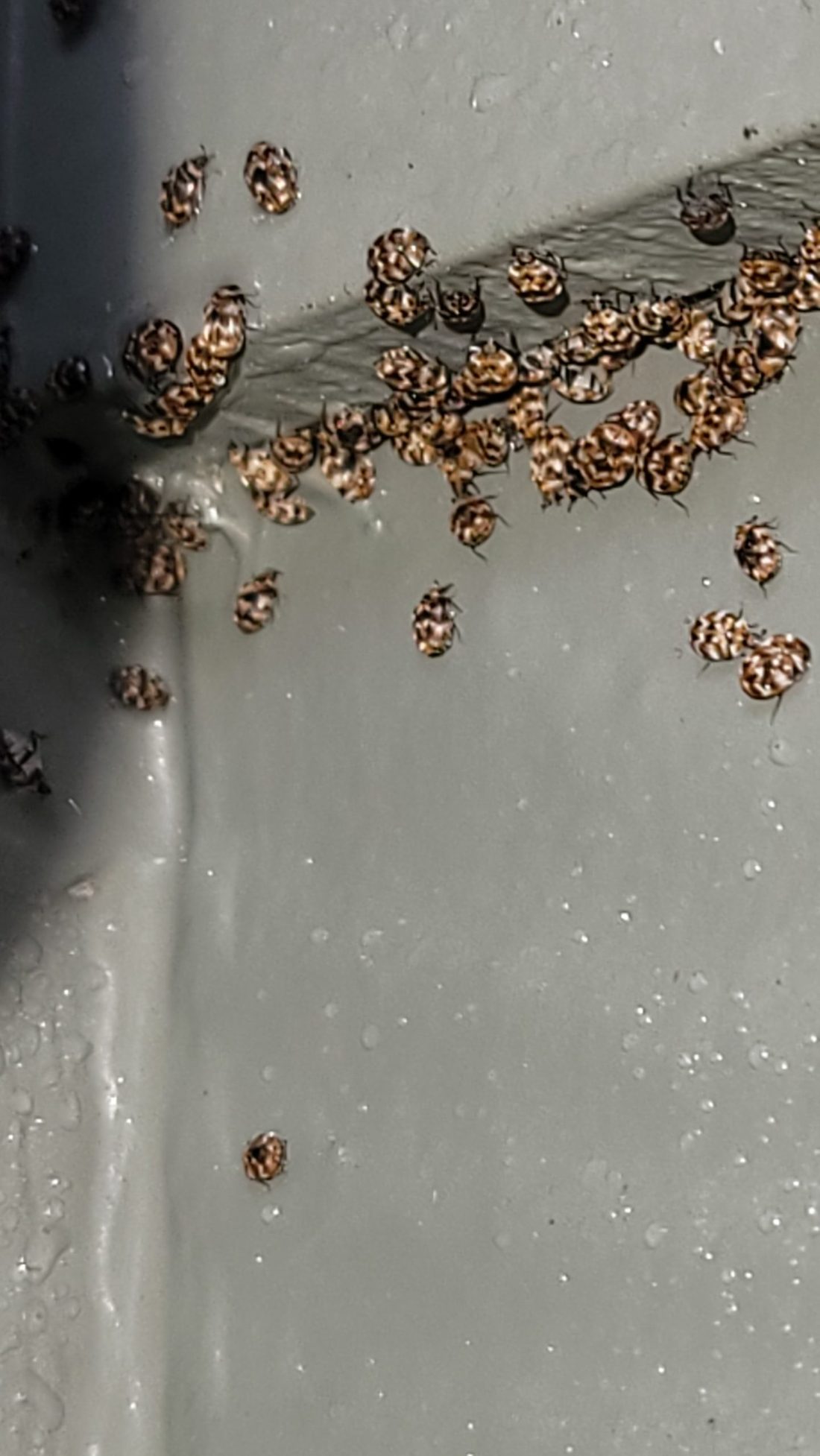
Sometimes worth treating, sometimes not — it depends on what is below.
Carpet beetle at a glance
| Adults | One sixteenth to one eighth of an inch, oval, black or mottled with white, brown and yellow scales |
|---|---|
| Larvae | One eighth to one quarter of an inch, tan to brown, tapered and densely bristly |
| Which stage does damage | Only the larvae — adults feed on pollen and nectar and head for the windows |
| What larvae eat | Wool, felt, fur, silk, feathers, leather, hair, lint, old nests and dead insects |
| How to tell it from a clothes moth | Bristly hollow skins and no webbing; silk patches or tubes mean moth |
| How to tell it from bed bugs | No dark spotting on the mattress, and skins in the carpet rather than at bed seams |
| Health | Cannot bite; larval hairs can cause an allergic skin rash in some people |
| Do we treat it | Depends — most fabric cases are a cleaning job; a nest or carcass in a void is ours |
Signs you have them
- Small round beetles on windowsills, drapes or panes in spring
- Brown, hollow, bristly cast skins piled at a rug edge, closet floor or baseboard line
- Thinned, grazed patches in carpet pile where furniture never moves
- Damage at the collars and cuffs of wool clothing put away since a move
- Slow, tapered bristly larvae that curl when touched
- Beetles returning every spring in a house with no wool, pointing to a nest or dead insects in a void
You are looking at the wrong life stage
Nearly every carpet beetle call starts with beetles on a windowsill, and nearly every one of those beetles is harmless.
UC IPM puts it plainly. Adults of all three common species seek out pollen and nectar, and they are generally found outdoors. The varied carpet beetle in particular is typically seen near windows, on sills, on drapes or on the panes themselves. Kentucky’s fact sheet says the same thing from the other direction: adult carpet beetles feed on flower pollen and do not damage woolens and other fabrics.
So the insect a household finds, photographs and kills is a pollen feeder trying to get back outside to a flower. Removing it accomplishes almost nothing, which is exactly why so many people report that they have been killing beetles for months and the rug keeps thinning.
The damage is done by larvae, somewhere else in the building, in the dark. Find those and the problem becomes solvable. Keep working the windowsill and it does not.
That inversion is the single most useful thing on this page, and everything below is a way of acting on it.
It came in with something, or it was already here
Before any of the searching, it is worth settling where this problem comes from, because the answer changes what money is worth spending.
This is not a building failure. A carpet beetle problem does not mean a house is poorly sealed or poorly kept, and no amount of caulking prevents one. What happens is that a food supply and an egg-laying female end up in the same still, dark place — and the food supply came in through the front door inside something somebody bought, inherited or brought home.
A secondhand wool rug. A box of textiles out of a parent’s attic. A taxidermy piece, a feather trim, a sheepskin, a natural-bristle brush, a bag of vintage clothing. Adults also fly in on their own from flowers outside, which is how a brand new house with a new wool carpet acquires them.
Or the supply was already inside the structure and nobody knew: a nest in a soffit that has been there since before the current owners, or a pocket of dead insects in a wall cavity.
Either way, the work is finding the source. Treating the room where the beetles were noticed, without finding what they are eating, is the most expensive mistake available on this species and it is made constantly.
What the adults and larvae actually look like
Worth separating properly, because they look like two unrelated animals.
Adults. UC IPM gives the varied carpet beetle at about one tenth of an inch, black with an irregular pattern of white, brown and dark yellow scales. The furniture carpet beetle is slightly larger and rounder with a mottled look from black spots interspersed among white and orange scales, and the black carpet beetle runs from one eighth to three sixteenths of an inch, shiny black to dark brown with brownish legs. Kentucky’s summary is oval beetles of one sixteenth to one eighth of an inch, in black or various mottled patterns.
They are small, round, hard and slow. Nothing about them looks dangerous, and nothing about them is.
Larvae. Kentucky describes them at one eighth to one quarter of an inch, tan to brownish, densely covered with hairs or bristles. UC IPM adds that varied carpet beetle larvae are slightly longer than the adults, covered in dense tufts of hair, and that when disturbed they raise those tufts upright into a round plume. They carry alternating light and dark brown bands, broad at the rear and narrow at the front — the furniture species is shaped the other way round, and the black carpet beetle larva is smooth and hard rather than fuzzy, reaching as much as five sixteenths of an inch.
The word people reach for is caterpillar, and the movement is right for that: slow, deliberate, tapered, curling when touched. The bristles are what makes it distinctive, and they matter again further down this page.
The cast skins are the evidence
If you remember one search instruction from this profile, make it this one.
Carpet beetle larvae molt repeatedly as they grow, and each molt leaves the old skin behind intact. UC IPM describes those skins as brown, shell-like and bristly-looking, and says that finding them together with an absence of webbing is usually a good clue that carpet beetles rather than moths are responsible. Kentucky simply notes that shed skins are left behind.
They are far easier to find than the larvae. A larva hides and moves away from light and disturbance. A cast skin sits where it was abandoned and stays there until something removes it, so skins accumulate at the feeding site and record months of activity that nobody witnessed.
What that gives you is a map. Run a light along carpet edges, lift the rug where it disappears under the sofa, pull out the bottom of the closet, check the baseboard line behind furniture and look inside heating vents. Where the hollow bristly shells pile up is where the larvae have been eating.
They also sit at the center of the bed bug question later on this page, so it is worth learning to recognize one.
Keratin, and the soiling exception
The diet is the same protein the clothes moth is after, and the list is short enough to memorize.
Kentucky gives wool, felt, fur, silk, feathers and leather, plus lint, hair and debris, plus bird nests, animal carcasses and dead insects. UC IPM adds hair brushes with natural bristles, pet hair and feathers, and notes that these larvae occasionally feed on stored products such as certain spices and grains.
Cotton, linen and synthetics are not on that list, and a larva put on clean polyester has nothing to work with. The exception is soiling: sweat, body oils and food residue deposit digestible material onto fibers that had none, which is why a blended or synthetic item that was put away dirty can be damaged while a clean one beside it is not.
That single rule explains the pattern of loss in a house. It is why a wool rug is grazed only at the edge that lives under furniture, why the damage in a wardrobe is at collars and cuffs, and why an item worn regularly is effectively safe while one folded away in a box since a house move is not.
It also explains the difference in damage style between this beetle and a moth. Beetle larvae tend to graze irregular patches and thin the pile of a carpet rather than punching a clean hole, and they will work in areas with more light than a moth larva will tolerate.
The rash that gets read as bites
This is why the bed bug profile sends people here, and it deserves careful handling rather than a confident one.

Penn State Extension documents carpet beetle dermatitis as a real clinical entity. The larvae of several dermestid genera, Anthrenus among them, carry lancelet-shaped hairs with sharp ends, and Anthrenus species in particular carry modified spear-shaped hairs clumped on the rear abdominal segments. The reaction involves those hairs and the insect’s hemolymph, and Penn State describes what people present with as itching, pruritic, papulovesicular eruptions — with some also reporting irritation of the respiratory tract and eyes. It is characterized as an acquired allergic reaction, which is to say sensitization builds over long exposure rather than appearing on first contact.
Now the honest part, and it is the same principle the bed bug page is built on.
A mark on skin does not identify what caused it. That is true of bed bugs, it is true of fleas, and it is true here. Somebody waking with itchy welts cannot reason backward from the welts to the animal, and neither can a photograph of them, and neither can we. A reaction is the body’s response, and different bodies respond differently to the same cause and identically to different ones.
What can be settled is physical evidence. Bed bugs leave dark fecal spotting at mattress seams and frame joints, smooth oval cast skins, cemented eggs and, sometimes, the insects. Carpet beetles leave bristly hollow skins in carpet and closet floors and no spotting on bedding whatsoever. Those two sets of findings are easy to tell apart and they are what the search is for.
So the useful sequence is: search the bed properly first, and if nothing is there, search the floor. Welts plus larval skins in the carpet plus a clean mattress is a coherent picture. Welts alone is not a diagnosis of anything, and treating a bedroom on the strength of it is how households spend a lot of money on the wrong problem.
If the reaction is severe, spreading or not settling, that is a physician’s question. Our part is finding out what is in the room.
The source nobody thinks of
When there is a beetle problem and no wool anywhere, the answer is almost always something dead.
Dermestids are scavengers by trade — in nature they are the insects that clean carcasses and old nests. Kentucky’s food list names bird nests, animal carcasses and dead insects explicitly, and includes cluster flies, lady beetles, stink bugs and wasps among the dead insects in question.
In a Whatcom County house that translates into a short list of places.
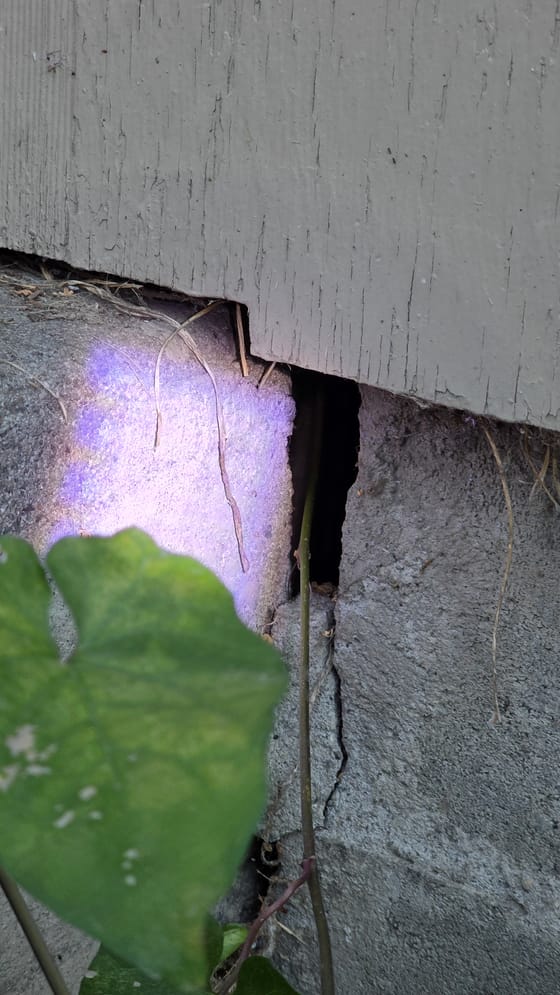
An old bird nest in a soffit, gable vent, dryer vent or eave. Feathers, dropped food, insect remains and sometimes dead nestlings. One abandoned nest feeds a population for years and sends new adults into the living space every spring.
A rodent nest, or a rodent that died in a void. Same material, same result.
A wasp nest in a wall. Old comb, dead brood and dead adults.
An accumulation of dead overwintering insects in a cavity. Cluster flies and conifer seed bugs come into wall voids by the hundred here, and what dies there becomes food.
The reframe that resolves these calls is to stop asking which fabric is being eaten and start asking what died in the building and where. It also explains a pattern people find baffling: beetles appearing every spring in a house with wood floors, tile and not a scrap of wool in it.
When they show up here
Development is slow, and our climate makes it slower.
UC IPM’s life-cycle table is worth reading for the scale of it. The varied carpet beetle spends 220 to 630 days as a larva. The furniture species runs 70 to 94 days, and the black carpet beetle 166 to 330. Eggs hatch in roughly one to three weeks and pupation takes eight to seventeen days, but the larval stage dominates everything, and adult females live only a matter of weeks.
Whatcom County has no hard freeze to interrupt any of that and a long cool damp season that pushes every figure toward the slow end of its range. Unheated storage — a garage in Blaine, a crawlspace in Sudden Valley, an uninsulated attic over an older Bellingham house — holds larvae comfortably through winter without killing them.
The visible event is spring. Kentucky notes that adults often appear on windowsills in springtime, and that is when the calls arrive: a household sees beetles at the glass in April and assumes the problem started in April, when in fact the larvae have been feeding since the previous year.
The practical consequence is about patience rather than urgency. Against a larval stage measured in hundreds of days, a quiet fortnight after a cleaning is not evidence of anything, and a clear result has to be judged across a season.
Carpet beetle or clothes moth
They eat the same protein and damage the same items, so the separation is done on leftovers.
Webbing means moth. Silk patches, tubes or a matted crust of fiber and frass stuck to the surface of the material. UC IPM’s clothes moth guidance describes the webbing species as producing patches of silk webbing that accumulate waste and fabric particles.
Bristly hollow skins with no webbing means beetle.
The damage differs too, though less reliably. Moth larvae work in genuinely dark undisturbed places and tend to produce defined holes or a grazed patch under silk. Beetle larvae thin the pile of a carpet across an irregular area and are less fussy about light.
Finding both is common in an old house with wool and a nest in a void, and where that happens the two need addressing together. The webbing clothes moth profile covers the other half.
The cleaning that does most of the work
For a straightforward fabric case, the household does more than any application does, and it is worth being specific about the order.
Vacuum thoroughly and repeatedly. UC IPM calls frequent thorough vacuuming an effective way of removing food sources along with eggs, larvae and adults, and Kentucky notes that vacuuming floors, carpets and inside heating vents removes larvae. This is not tidying — it is the physical removal of the population and the lint, pet hair and dead insects feeding it. Work carpet edges, under and behind furniture that never moves, closet floors, baseboard lines and vents, and empty the machine outdoors afterward.
Launder or dry clean what can take it. Kentucky’s line is that dry cleaning or hot laundering kills any eggs or larvae present, and UC IPM says thorough laundering in hot water or dry cleaning kills all stages.
Freeze what cannot be washed. UC IPM gives two weeks below eighteen degrees Fahrenheit for an object sealed in a plastic bag, and ten to fourteen days for trophies and mounted specimens. Kentucky gives zero degrees for at least a week, or seventy-two hours at minus twenty. The Pacific Northwest handbook, writing about material in storage, gives three or four days in a freezer before discarding. Bag it, press the air out, and give a valuable item a second freeze after it has warmed fully through.
Heat, where the object tolerates it. UC IPM gives at least thirty minutes at one hundred twenty degrees Fahrenheit or higher in an oven. That suits very few household textiles and a lot of them will be damaged by it, so freezing is the safer default.
Then store properly. Clean items only, into containers that actually close.
When treatment is warranted, and when it is not
The verdict here is depends, and it splits cleanly in two.
A cleaning job. Damage traceable to identifiable fabric, a findable feeding site, no unexplained recurrence. Vacuum hard, launder, freeze, re-store, and check again in a few months. Most households in this situation do not need to pay anybody, and we would rather say so than book a visit that adds nothing.
A treatment job. Fixed carpet or a large rug where the feeding site is under furniture that cannot practically be moved. A collection with real value at risk. Repeated seasons of damage after genuine cleaning. And, most often, a source inside the structure.
That last case is the one where calling makes obvious sense, because the food is somewhere a vacuum does not reach. Getting an old nest or a dead animal out of a soffit or a wall void is the actual work, and the beetle treatment around it is a minor part of the job. Where a rodent is involved that runs through rodent control, and the exclusion side matters because sealing an entry without removing what is inside leaves the food supply in place.
It is also the reason we decline to treat overwintering insects inside wall voids. A few hundred dead flies in a cavity is precisely the material this beetle develops in, and killing them there creates the next problem.
Where we do apply anything, it goes on harborage — carpet edges, under fixed furniture, closet structure, baseboard voids. Not on textiles, and not broadcast across a floor people live on.
Where they turn up around the county
The pattern here follows housing stock and bird habit more than it follows any map of climate.
Older city housing — the Lettered Streets, Columbia, Sunnyland, York, South Hill. Wool rugs over fir floors, a century of lint and hair packed under baseboards and behind trim, and eaves that have hosted nesting birds through several owners. This is where the cases turn out to be structural rather than textile, and where the search goes upward rather than into the closet.
Lake Whatcom and the wooded edges — Sudden Valley, Silver Beach, Edgemoor. Cedar construction with generous soffits, second homes where textiles sit untouched for months, and heavy bird and rodent nesting pressure against the building.
Rural properties — Lynden, Everson, Nooksack, Sumas. Barn and outbuilding material, working wool, feed storage, and animal remains at a scale a town lot does not produce.
Any house with feeders. Feeding birds brings birds close to the structure, and birds close to a structure eventually nest in it. That is a slower and less obvious route into a beetle problem than a bag of seed is into a pantry one, but it is the same principle.
Newer construction is not exempt, because the adults fly in from flowers and because a new wool carpet is as edible as an old one.
What we will not do
Broadcast product across the floor of a room people live in. Application belongs in harborage, and a treated floor does not reach a larva under a rug edge anyway.
Treat around a nest instead of removing it. Leaving the food in place while killing what is currently eating it produces a repeat, and charging for the repeat is not a business we want.
Spray a valuable textile. Where the right answer is a conservator rather than a pest control company, that is what we will say.
Call a single visit finished. With a larval stage that UC IPM measures in hundreds of days, one clean visit is not proof of anything, and a follow-up is part of the honest plan rather than an upsell.
Sell a house-wide treatment for a localized problem. If the answer is one rug edge, one closet, or one nest in a soffit, that is what gets dealt with.
Where to start
Collect a specimen if you can. A larva or a cast skin on clear tape, or a sharp photograph next to a fingertip for scale, settles the identification faster than any description.
Tell us where the larvae and skins are rather than where the beetles are. Skins in a rug edge point at the site; adults at a window point at the exit.
If there is no wool in the house at all, say so early, because it moves the search off the contents and into the structure.
And if the reason you are reading this is welts rather than fabric damage, look at the bed bug profile alongside this one and search the bed properly before assuming either answer.
The service page for this work is beetle and pantry pest control, and if what you find is silk rather than shed skins, start at moth control instead. The estimate is free, and where the honest answer is a thorough vacuuming and a lidded box, that is what you will be told.
Frequently asked questions
I vacuum the beetles off the windowsill every week and the damage continues — why?
Because the adults are not eating your fabric. UC IPM states that adult carpet beetles seek out pollen and nectar and are generally found outdoors, and Kentucky's fact sheet says outright that adults feed on flower pollen and do not damage woolens and other fabrics. The larvae elsewhere are doing all of it.
What do the cast skins look like and where do they collect?
Brown, hollow and bristly — UC IPM describes them as brown, shell-like and bristly-looking, left behind when the larva molts. They look like a dried empty version of the insect and they pile up wherever feeding has been going on, which is usually a rug edge, a closet floor or a baseboard line.
Can carpet beetles bite me?
No. They have no interest in people and no capacity to bite one. What some people get is an allergic skin reaction to larval hairs and hemolymph, which Penn State Extension describes as itching and papulovesicular eruptions. It is a contact reaction rather than anything the insect did to you deliberately.
Could my bed bug bites actually be this?
They could be, and no one can settle it from the skin. Bed bugs are confirmed by fecal spotting, cast skins, eggs or live insects around the bed. If a careful look at the mattress and frame finds none of those, and there are bristly larvae or shed skins in the carpet, the beetle explanation deserves a serious look.
There is no wool anywhere in my house, so where are they feeding?
Usually on something dead. Kentucky lists bird nests, animal carcasses and dead insects among their foods, and a soffit nest or a pocket of dead cluster flies in a wall cavity is a richer supply than most carpets. When there is no fabric to blame, the question becomes what died and where.
How long does a carpet beetle take to grow up?
A long time, and that is why patience is required. UC IPM's table gives the varied carpet beetle a larval stage of 220 to 630 days, against 70 to 94 days for the furniture species and 166 to 330 for the black carpet beetle. A quiet month proves very little against numbers like those.
What freezing temperature actually kills them?
UC IPM gives two weeks in a freezer below eighteen degrees Fahrenheit for an infested object sealed in a plastic bag, and ten to fourteen days for trophies and museum pieces. Kentucky's figures are zero degrees for at least a week, or seventy-two hours in a freezer running at minus twenty.
Do I need the whole house treated?
Almost never. This is a localized problem with a specific feeding site, and treating a whole building for larvae living under one rug edge spends money in the wrong place. The exception is where the feeding site turns out to be inside the structure, and then the work is getting that material out.
Sources
- UC IPM Pest Notes 7436 — Carpet Beetles — read September 2, 2026
- University of Kentucky Entomology ENTFACT-601 — Carpet Beetles — read September 2, 2026
- Penn State Extension — Carpet Beetle Dermatitis — read September 2, 2026
- Pacific Northwest Insect Management Handbook — Nuisance and household pests: Carpet beetle and hide beetle — read September 2, 2026
- UC IPM Pest Notes 7435 — Clothes Moths — read September 2, 2026
Rules change. This page is scheduled for review against its sources by September 1, 2027. If you are reading it after that date and something looks out of step with the current rule, the rule is right and we are wrong — please tell us.
Pest problem in Whatcom County?
Family-owned, no long-term contracts, and every treatment is backed by our 100% Service Guarantee.
Most calls in Whatcom County are out within 1–2 days, about 3 during the late-summer peak.
Last updated