
Bed Bug — What Confirms It, and What Does Not
Cimex lectularius · Biting pests
Bed bugs cannot be diagnosed from bites, because reactions differ from person to person and roughly thirty percent of people never react at all. Confirmation comes from fecal spotting, cast skins, eggs and live insects. They arrive on luggage and furniture, and they have nothing whatever to do with housekeeping.
Call 360-410-2199 Request a free estimate
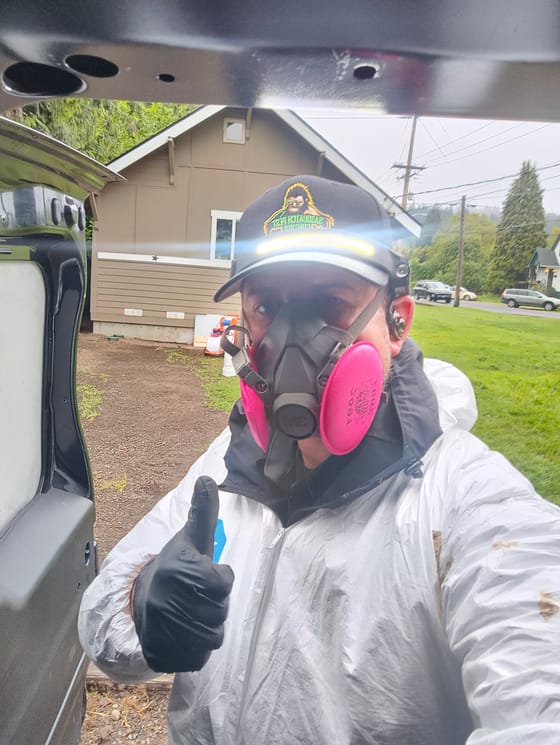
We treat this, and finding it usually warrants treating.
Bed bug at a glance
| Size | About three-sixteenths of an inch — roughly half a pencil eraser |
|---|---|
| Color and shape | Reddish-brown, oval and flat; swollen, longer and brighter red after feeding |
| Movement | Walks quickly; cannot fly and cannot jump |
| How to tell it from a carpet beetle | Smooth oval body and dark spotting on bedding — carpet beetle larvae are bristly and leave none |
| Where it lives | Close to a sleeper: mattress seams, box spring, frame joints, headboard |
| Bites | Cannot confirm it — about thirty percent of people never react |
| Health risk | No known cases of infectious disease spread by bites; the toll is on sleep |
| Do we treat it | Yes, after a paid verification visit, with follow-ups planned from the start |
Signs you have them
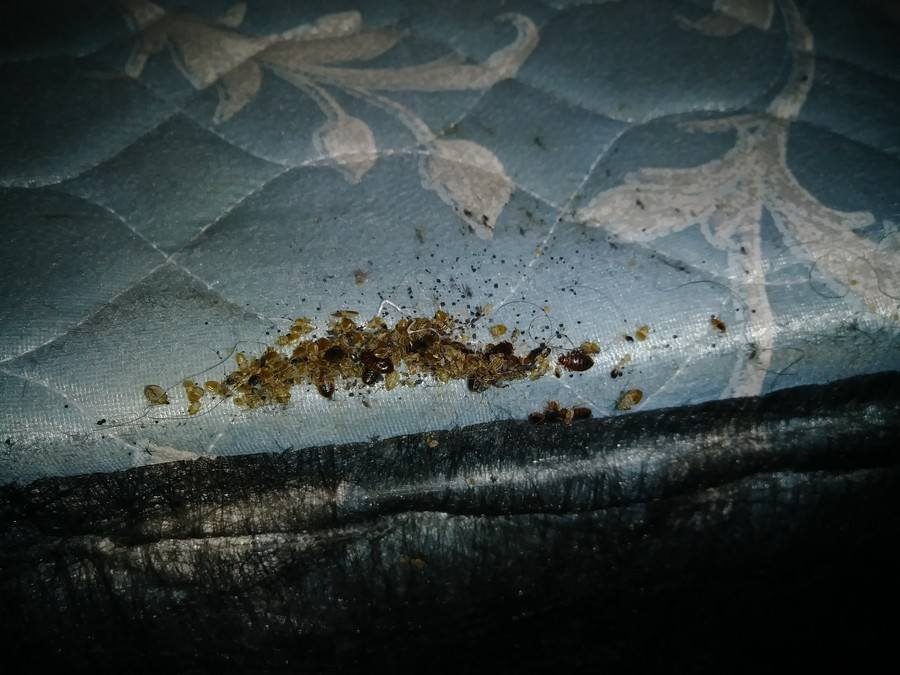
- Dark, ink-like spots soaked into mattress seams, piping or the tape edge of a box spring
- Small raised dark specks on a painted slat, frame joint or the wall behind a headboard
- Pale, translucent bug-shaped cast skins in the deepest part of a seam or joint
- Pearly eggs about a millimeter long cemented in cracks, which will not brush off
- Live flat reddish-brown insects in seams, joints or loose baseboard
- Insects caught in interceptor cups under the bed legs
The one thing to take from this page
Bites do not confirm bed bugs. Nothing else on this page matters as much as that sentence, and almost every expensive mistake made with this insect starts by ignoring it.
A person can be bitten nightly for months and show nothing on their skin. A person can wake covered in welts that were caused by a detergent, a mite, a spider beetle’s cousin or nothing external at all. The two situations look identical from inside the household, and no amount of squinting at a forearm separates them.
What separates them is physical evidence: fecal spotting, cast skins, eggs and the insects themselves. Those either exist in a room or they do not, and finding them is a search rather than a judgment call.
The second thing worth carrying away arrives immediately behind the first, and it is the reason this page is written the way it is. Bed bugs are not a hygiene problem.
They are not a cleanliness problem, and the shame is expensive
Washington’s Department of Health describes people bringing bed bugs into their homes on infested luggage, furniture, bedding or clothing. That is the whole mechanism. There is no dirt in it, no neglect, and no correlation with how a household is kept.
The reason is biological rather than charitable. This insect eats blood and only blood. Crumbs on a counter, dishes in a sink, dust under a bed — none of it is food, none of it is shelter it particularly wants, and none of it changes the odds that a suitcase carried something home from a hotel. An immaculate house and a chaotic one are equally available to an insect that is looking for a sleeping mammal and a crack to sit in.
What clutter genuinely does change is how hard the insect is to reach once it is established. That is a treatment problem, not a cause.
We put this near the top because the delay it produces is measurable. People sit on a suspicion for weeks because of what they think finding bed bugs would say about them, and those weeks are exactly when a single introduction in one bed turns into a population spread along a baseboard and into the room next door. The embarrassment costs more than the treatment does.
What the insect actually looks like
The University of Kentucky puts an adult at about three-sixteenths of an inch, reddish-brown, with an oval flattened body — apple-seed coloring on something closer to a lentil in size. The Pacific Northwest handbook describes them as roughly half the size of a pencil eraser, which is the more useful comparison for somebody holding one on a piece of tape.
Flatness is the identifying quality. Unfed, the body is thin enough to sit in a gap you would not think of as a gap. After feeding, which Washington’s health department describes as taking three to ten minutes, the body swells, lengthens and turns a brighter red, and the insect looks like a different animal altogether. People who have seen a fed bed bug and an unfed one often think they have found two species.
They cannot fly and they cannot jump. They walk, quickly, on flat surfaces.
Immatures pass through five molts, and Kentucky notes that each of the five requires a blood meal first. A newly hatched nymph is close to translucent and about a millimeter long, which is why the small ones go unseen for months in rooms that have been looked at repeatedly.
Eggs are whitish, roughly the size of a speck of dust, and hatch at about a week at room temperature.
Fecal spotting, cast skins, eggs, insects
These are the four findings that establish an infestation, and they are worth knowing individually because they appear at different stages and in different places.
Fecal spotting is the most reliable and the earliest to appear in volume. It is digested blood rather than a solid pellet, so on fabric it soaks in and feathers at the edge like ink on blotting paper, and on painted wood or metal it dries as a small raised dark bead. Look at the mattress piping and seams, the tape edge of a box spring, the underside of a slat, the joint of a frame, and the wall immediately behind a headboard. A scatter of dark dots in a line along a seam is what a resting group leaves behind, and it is far easier to see than the insects that made it.
Cast skins are the pale, translucent, bug-shaped shells left after each of the five molts. They are more brittle than the insect and they collect in the deepest part of a harborage. Their significance is specific: a shed skin means something grew up in that spot, which means breeding rather than a single insect that arrived last week.
Eggs are about a millimeter, pearly, and cemented rather than loose — they do not brush off. They sit in cracks and seams in small clusters and they are genuinely hard to see without a light held at an angle. They are also the reason one treatment is rarely the end of the job.
The insects are the least reliable of the four to go looking for, because they are nocturnal, they are good at being in cracks, and their absence proves very little. Finding them is confirmation. Not finding them is not a clearance.
Where they actually are in a room
Bed bugs stay close to a sleeping person. That is the single most useful organizing fact about searching for them, and it is why an infestation in a detached house is usually a bedroom problem rather than a house problem.
Working outward from the sleeper, the order is roughly this. The mattress, along every seam, both faces, and around the label and the handles. The box spring, which is a better harborage than the mattress and is where a great deal is missed, particularly under the dust cover and inside the corner protectors. The frame, at every joint, bolt hole and slat pocket, and especially where two pieces of timber meet with a hairline gap between them. The headboard, front and back, and the wall behind it if it is fixed there — an upholstered headboard is first-rate accommodation.
Then the room. The nightstand, underside and drawer runners. The carpet edge where it turns up against the wall. Loose or separated baseboard. Outlet and switch plates. The backs of pictures and mirrors. Any upholstered chair somebody naps in.
The Pacific Northwest handbook makes the point that low-level infestations stay near the bed and spread outward through the dwelling as the population grows. That is why extent matters so much to what a job costs: an early one is contained, and a long-running one is not.
How they get from one place to another
They are carried. Bed bugs do not come in from the yard, they are not drawn by food waste, and they do not arrive on the wind.
Luggage and belongings. A bag that spent a night on a hotel floor, a backpack left in a dorm room, a coat on a theater seat. This is the dominant route and it is the one that produces our January calls, after holiday travel puts a lot of Whatcom County suitcases through a lot of other buildings.
Secondhand and moved furniture. Upholstered items, mattresses, bed frames and anything with joinery. This is the dominant route in Bellingham’s student housing, where an enormous quantity of furniture changes hands in June and again in September on an academic rather than a seasonal calendar.
Shared construction. In a duplex, an apartment block or an old house subdivided into rooms, the boundary between one tenancy and the next is a legal idea rather than a physical barrier. Wall voids, the gaps around supply pipe and cabling, the space behind a loose baseboard and the underside of a door all connect one unit to the next. Treating the complaining room while the room on the other side of that wall goes untouched is the standard way a shared-building job fails.
People, occasionally. Rarely on a body, more often on a bag somebody set down.
Bed bug or carpet beetle
This is the confusion that costs the most money in both directions, and it is worth separating carefully.
A carpet beetle larva is elongated rather than oval, bristly rather than smooth, and it moves like a tiny caterpillar rather than scuttling. It is often golden or banded brown. It lives at carpet edges, in closet floors, under furniture and in stored wool and textiles, feeding on animal fiber, lint, pet hair and feathers rather than on blood.
The reason it lands on this page is that some people react to the larval hairs and to the insect’s hemolymph, producing itchy welts with no bite involved at all. Penn State Extension characterizes carpet beetle dermatitis as an acquired allergic reaction rather than a simple irritation, meaning sensitization builds up over long exposure instead of appearing on first contact — which is why one person in a household can be covered in welts while everybody else sleeping in the same building notices nothing. Somebody with those welts, looking for a cause in a bedroom, finds a small insect in the carpet and arrives at bed bugs.
The way to tell is not the insect. It is the evidence around it. Carpet beetles leave shed larval skins that are bristly and hollow, and no fecal spotting on bedding. Bed bugs leave dark spotting at seams and joints, and the shed skins are smooth and oval. If a room has welts and beetle larvae but no spotting anywhere on the bed, the answer is very unlikely to be the one everybody is afraid of.
Spider beetles, booklice and fleas fill out the list of things mistaken for this insect. Fleas are the frequent one, and the giveaway is where the marks are — around ankles and lower legs rather than on skin exposed above the covers — and that a flea jumps, which a bed bug is entirely unable to do.
What they do to people, and what they do not
Washington’s Department of Health is direct: there are no known cases of infectious disease spread by bed bug bites. That is not a hedge, and it is genuinely reassuring in a way the internet is reluctant to be.
What they cause is a local skin reaction in the people who react, a stronger allergic response in a minority, and secondary infection where welts are scratched open. The health department also names anxiety, insomnia and irritability, and in our experience that is the half of the problem that people underrate before they have lived with it.
The reason to treat this quickly is not medical danger. It is that somebody who knows there are insects in their bed stops sleeping, and stops sleeping for weeks, and that has real consequences at work and at home. Speed is the kindness here.
If a reaction is severe or spreading, that is a physician’s question rather than ours. We deal with the insect.
Heat, cold and the numbers behind them
The domestic tools that work on this insect work because of temperature, and the figures are worth having.
Purdue Extension gives the thermal death point at around forty-five degrees Celsius, with practical heat treatment run in the range of one hundred twenty to one hundred twenty-five degrees Fahrenheit for twenty to thirty minutes. For a household, that translates into one instruction: hot water and detergent followed by at least twenty minutes in a dryer on high heat kills every stage, eggs included.
The dryer is the part doing the work. A wash cycle spends much of its time cooler than that, and an egg cemented into a seam sits protected inside wet fabric. Anything that cannot be washed but can be tumbled should still go through.
Cold is far less useful than people hope. Purdue records that bed bugs tolerate five degrees Fahrenheit for short periods and survive at or below freezing continuously for several days; practical freezing means below zero Fahrenheit for at least four days. A cold garage in a Whatcom County winter does not come close.
And waiting them out does not work either. The Pacific Northwest handbook states that a bed bug can live up to a year without a blood meal, and Kentucky puts survival at a year or longer at fifty-five degrees or below, with one to four months more typical in a heated building. An empty room does not clear itself.
Preparing for treatment, which is most of the outcome
This is the part households are least warned about and the part that most often decides whether a job holds.
A treatment applied to an unprepared room is close to wasted. Clutter on a floor gives the insects harborage that cannot be reached. Bedding that has not been laundered and dried hot puts the population straight back into the room. Furniture jammed against a wall hides the junction that most needs working on. Belongings in open boxes are both harborage and a transport mechanism into whichever room they get carried to next.
What preparation actually involves, in rough order:
Launder and heat everything textile in the affected rooms, then bag it sealed and leave it sealed until after the work is finished. Clean items returned to an untreated room are simply re-exposed.
Reduce clutter rather than relocating it. Bagging and consolidating within the room is useful. Carrying an armful of belongings to the spare room is how a one-room problem becomes a two-room problem, and it happens constantly.
Pull the bed away from the wall and get bedding off the floor, so the legs are the only route up onto it.
Leave the evidence alone. Stripping and scrubbing a bedroom before a search removes exactly what the search is looking for. Change the sheets if you must, but keep the old ones rather than laundering them.
Do not spray anything first. Retail products scatter a population into voids and into adjoining rooms, and they disturb the spotting and skins that would otherwise confirm what you have.
We give you the list in writing beforehand, and where a room is not ready we reschedule rather than working around it. That decision occasionally annoys people on the day and it is right every single time.
What the work involves
Treatment is aimed at harborage rather than sprayed across surfaces, because that is where the insect spends its life. Seams, joints, voids, frame hardware, the underside of furniture, the edges of the room and the penetrations that connect one room to the next.
Which method fits depends on the room, the furniture, how far the population has spread and what kind of building it is. A single bedroom in a detached house on Alabama Hill and a third-floor unit near campus with activity on both sides of a wall are different problems, and they should not receive the same answer just because a company owns a particular piece of equipment.
Follow-up visits are planned from the start rather than added when somebody complains. Purdue’s interval — a check ten to twenty-one days after each control effort — is the shape of it, and the reason is eggs, which are protected and which hatch on their own schedule regardless of what happened in the room.
Seeing activity in the days after a treatment is ordinary and is not a sign of failure. Disturbed insects move more. What matters is the trend across the follow-ups rather than any single night.
We do not promise a room will be clear after one visit, and we are wary of anybody who does. What we commit to is telling you the method, the reason for it and the follow-up schedule before you agree to anything.
Encasements on the mattress and box spring are usually part of it. They trap what is inside, remove the best harborage in the room, and give you a plain pale surface where new spotting shows up immediately. Purdue specifies covers of at least 0.08 millimeters, left on for a minimum of a year.
Monitoring, and what a clear result actually means
Between a suspicion and a certainty there is a gap that a household can close cheaply, and it is worth knowing what is in it.
Light-colored encasements on the mattress and box spring do three jobs at once. They shut in anything already living in those items, they take away the seams and piping that make a box spring such good accommodation, and they leave a plain pale surface where any new dark spotting shows up without a search.
Interceptor cups under the bed legs are the other half. They are shallow traps that an insect climbing toward the bed falls into and cannot get out of. They are passive, they cost almost nothing, and over a few weeks they turn a question into an answer. They only work if the legs are the only route up, which means the bed away from the wall and nothing — bedding, clothing, bags — bridging to the floor.
Retail detectors and lures are a different matter and we would skip them. Performance varies enough that a negative reading from one is worse than having no device at all, because it manufactures confidence.
On what a clear search means: it means no evidence was found in the places evidence collects, and for this insect that carries real weight, because it is much better at hiding itself than at hiding its spotting and its skins. It is not proof against an introduction that arrived last week. Continued monitoring for a few weeks is the sensible follow-through, and it is a far better use of money than treating a room on suspicion.
Shared walls change the scope
In a duplex, an apartment or a subdivided old house, the extent of the problem is a property question rather than a tenancy question, and the arithmetic is unforgiving.
An insect that lives in the crack at the base of a wall does not distinguish between the side of that wall it started on and the side it did not. It follows carbon dioxide and warmth along the path of least resistance, which is the wall line, the gap under a door, the opening cut for a supply pipe, and the void behind a run of baseboard. Older Bellingham housing supplies all four generously, because a century of movement has separated the trim from the plaster and every retrofit since has cut new holes.
The consequence is that treating the room that complained, while the room sharing its wall goes untouched, buys a result determined by whether the neighbor happened to be affected too. Where the population is established, the scope that works follows the structure: the confirmed room, the rooms sharing a wall with it, and the shared living space where somebody naps on a couch.
That is a larger number at the outset and a much smaller one across a year, and in a multi-unit building the decision belongs to whoever manages the building rather than to the occupant who found the spotting.
What it costs, and why we verify first
Bed bugs are the one service here that begins with a paid visit rather than a free one, and the figures live on the bed bug control page rather than on this one, where they would drift out of date.
The reasoning is short. A meaningful share of bed bug calls are not bed bugs. A proper search means stripping a bed, going over both faces of a mattress and box spring, taking a frame apart where necessary and working the room edges with a light, and that is a real piece of work whether or not it finds anything. Charging for it and crediting it against treatment is what lets it be done thoroughly instead of quickly, and it means a household that turns out not to have bed bugs has bought a definite answer rather than a treatment.
When it is not a bed bug
If the marks are around ankles and calves and the insect jumps, look at the cat flea instead, and start by asking what animal has been living in or under the building.
If the larvae are bristly and the bedding carries no dark spotting at all, the answer is likely a carpet beetle, and the fix is a cleaning and storage job rather than a bedroom treatment.
If biting started abruptly in one upstairs room a couple of weeks after noise in a ceiling stopped, consider mites left behind by a nest that has been abandoned. That is a structural search rather than a bedroom one, and it is squarely our work.
And if a thorough search of the sleeping area turns up no spotting, no skins, no eggs and no insects, that is a real result rather than a failed visit. It closes off the branch that was keeping somebody awake, and it is worth taking to a physician as information.
Where to start
Tell us what you have found, where, and what changed in the weeks before it started — travel, a piece of furniture, a guest, a move. Photograph anything you find and keep a specimen on clear tape if you can, because a physical sample settles in seconds what a description takes twenty minutes to circle around.
Then leave the room roughly as it is until somebody has looked at it.
The service page covering scope, preparation and the published rates is bed bug control. The three situations people most often arrive with have pages of their own: after a trip, in a student rental, and bites with nothing found.
Frequently asked questions
Can a doctor or a photograph tell me these are bed bug bites?
No. A mark on skin is a reaction, and reactions to bed bug bites are not distinctive enough to identify the cause. The University of Kentucky reports that about thirty percent of people show no reaction even when bitten repeatedly, and the rate of non-reaction is higher still in older adults.
What does bed bug fecal spotting look like?
Dark, almost black marks that soak into fabric with a slightly feathered edge, because the material is digested blood rather than a dry pellet. On a mattress seam or a slat they read as ink dots; on a painted surface they sit as raised dark specks.
Does finding bed bugs mean my house is dirty?
It does not, and this is worth stating flatly. Bed bugs feed on blood alone, so crumbs, dust and clutter are irrelevant to whether they arrive. Washington's health department describes them as being carried in on luggage, furniture, bedding and clothing, which is a matter of movement rather than of standards.
How long can a bed bug survive in an empty room?
Longer than most people assume. The Pacific Northwest handbook states a bed bug can live up to a year without a blood meal, and Kentucky puts survival at a year or more below fifty-five degrees. Closing a room and waiting is not a strategy that works.
Why does treatment need more than one visit?
Eggs. They are cemented into cracks, they are about a millimeter across, and they do not respond the way a mobile insect does. Purdue's guidance is to re-check infested sites ten to twenty-one days after each control effort, which is the interval a hatch runs on.
Will a hot dryer actually kill them?
Yes, and it is the most useful thing a household owns. Purdue gives at least twenty minutes on high heat as lethal to all stages. The dryer is doing the work rather than the wash, so items that cannot be washed but can be tumbled should still go through.
Is it worth throwing out the bed?
Almost never, and doing it early makes things worse. The population is rarely confined to the mattress, a discarded item sheds insects along the route it takes out of the building, and the replacement goes into a room that has not been dealt with.
Can bed bugs give me a disease?
Washington's health department states there are no known cases of infectious disease spread by bed bug bites. What they do cause is skin reaction, occasional secondary infection from scratching, and a genuine toll on sleep and nerves that is often the worst part.
Sources
- Washington State Department of Health — Bed Bugs — read September 2, 2026
- University of Kentucky Entomology ENTFACT-636 — Bed Bugs — read September 2, 2026
- Purdue Extension — Control Strategies for Bed Bugs — read September 2, 2026
- Pacific Northwest Insect Management Handbook — Public health pests: Bed bug — read September 2, 2026
- Penn State Extension — Carpet Beetle Dermatitis — read September 2, 2026
Rules change. This page is scheduled for review against its sources by September 1, 2027. If you are reading it after that date and something looks out of step with the current rule, the rule is right and we are wrong — please tell us.
Pest problem in Whatcom County?
Family-owned, no long-term contracts, and every treatment is backed by our 100% Service Guarantee.
Most calls in Whatcom County are out within 1–2 days, about 3 during the late-summer peak.
Last updated