Wasps and Hornets of Washington State
Washington has yellowjackets, paper wasps, the bald-faced hornet and a long list of solitary wasps that almost never sting. WSU names German, western and aerial yellowjackets, European and golden paper wasps, and the bald-faced hornet, which is a yellowjacket rather than a true hornet. The northern giant hornet was declared eradicated.
Call 360-410-2199 Request a free inspection
The short version
| Yellowjackets WSU names here | German (introduced), western and aerial — the last of which is a Dolichovespula, not a Vespula |
|---|---|
| Paper wasps | Native paper wasps, the introduced European paper wasp, and the native golden paper wasp |
| True hornets | None established. The bald-faced hornet is a yellowjacket; the northern giant hornet was eradicated |
| Northern giant hornet | Four nests found in Whatcom County 2020–2021, none detected 2022–2024, declared eradicated end of 2024 |
| Yellow-legged hornet | One live hornet photographed at the Port of Vancouver, WA in April 2026; WSDA trapping, not established |
| The dangerous months | Late summer and fall, when colonies peak and workers switch from protein to sugar |
| Solitary wasps | Most wasp species here are solitary, have no colony to defend, and sting people very rarely |
- Work out first whether the nest is in the ground, in a wall, hanging in the open or a small comb under an eave — the answer changes everything.
- Watch the entrance for two minutes from a safe distance and count the traffic rather than guessing from one or two wasps.
- Leave anything you cannot reach from the ground, and leave anything in a wall void entirely.
- Do not plug the hole of a nest in a wall; blocked wasps come through the ceiling instead of giving up.
- If nobody is being stung and the nest is away from paths and doors, consider leaving it — the colony dies at the first hard frost.
- Call us for ground nests near a path, wall nests, anything above head height, and anywhere a stung person would be in real trouble.
Which wasps and hornets actually live in Washington
Fewer than the internet suggests, and the dangerous list is shorter still.
WSU Hortsense sets out the family for this state, and it divides cleanly into two halves. On one side, the social wasps: German, western and aerial yellowjackets, the bald-faced hornet, native paper wasps, the introduced European paper wasp and the native golden paper wasp. These build colonies, they defend them, and they account for essentially every sting anybody in this county is going to receive.
On the other side, the solitary wasps — potter and mason wasps, mud daubers, digger wasps, grass-carrying wasps — which WSU notes make up most of the family by species count. Each female works alone, provisions a few cells and leaves. There is no colony to defend, no alarm response, and almost no reason for one of them to sting a person.
That split is the single most useful thing on this page. Nearly every anxious phone call about a large frightening wasp turns out to be a solitary species going about its business, and nearly every genuine problem turns out to be a yellowjacket colony in the ground or in a wall.
Yellowjackets, which are what people usually mean
Stout, banded yellow and black, in numbers, and the reason wasp control exists.
WSU names three for Washington. The western yellowjacket is the native one and the usual culprit in a lawn or bank — the species page is at western yellowjacket. The German yellowjacket is introduced and is the one most associated with wall voids and structures. The aerial yellowjacket is a Dolichovespula rather than a Vespula, builds a papery gray nest out in the open in a shrub or under an eave, and is on the library at aerial yellowjacket.
Yellowjacket nests hold thousands of wasps by late season, and WSU describes them as nesting underground or behind walls. Both of those placements are the difficult ones, for opposite reasons: a ground nest is where somebody mows, and a wall nest is where nobody can see what is happening.
The two problem scenarios each have their own page, because the right answer differs completely: yellowjackets nesting in the lawn and a wasp nest inside a wall void.
Bald-faced hornet, which is not a hornet
Black and white, big, with the football-shaped paper nest everybody photographs.
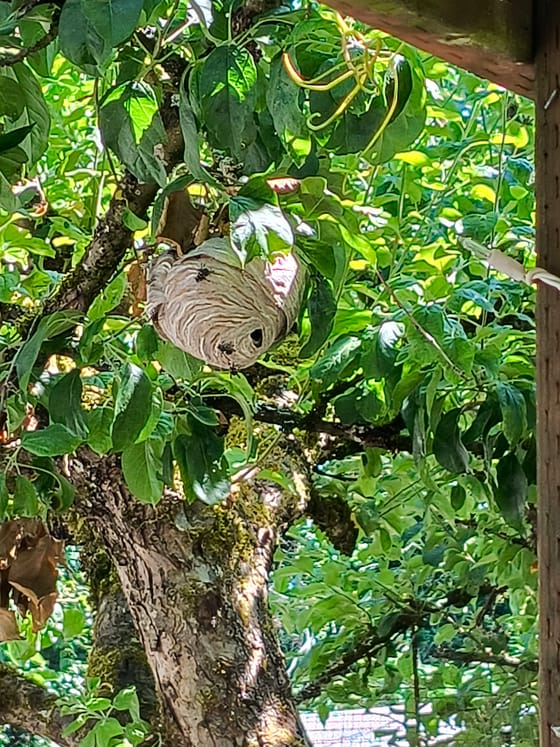
WSU is direct about the taxonomy: the bald-faced hornet is technically a yellowjacket rather than a true hornet. That matters less than the behavior, which is the part people get right — WSU describes it as aggressively defending its nest, and that reputation is earned.
The nest is the giveaway: a large enclosed gray paper sphere hanging from a branch, a soffit or occasionally a fence, growing through the summer to the size of a basketball. Unlike a yellowjacket nest in the ground, you can see exactly what you are dealing with, which is both reassuring and misleading. A visible nest is not a safe nest.
There is a species page at bald-faced hornet, and the practical version — when it needs removing and when it genuinely does not — is at a bald-faced hornet nest in a tree.
Paper wasps, including the European one that took over
Long-legged, slender, hanging a small open comb from a stalk under a sheltered edge.
A paper wasp nest looks nothing like a yellowjacket nest. It is a single downward-facing comb with the cells visible, no paper envelope around it, hung from a short stalk under an eave, a deck rail, a window frame or inside a shed. WSU describes colonies of roughly six to twenty.
The European paper wasp is the one that changed the picture here. It is introduced, it is identified by its bright orange antennae, and WSU describes it as aggressive — unusually so for a paper wasp — and recommends removing its nests in winter. It has become common in and around buildings across this region, and because its nest is often tucked somewhere tight rather than hanging in the open, people meet it by accident. The species page is at European paper wasp.
Native paper wasps and the golden paper wasp, which WSU describes as golden yellow and active April to October, are far more easygoing. WSU notes paper wasps generally do not sting unless the nest is somewhere people pass closely. A paper wasp comb under a quiet eave is a genuine case for doing nothing.
Black wasps in Washington, and what they are
One of the most-searched wasp questions in this state, and the answer is almost always something harmless.
Mud daubers. Slender, long-waisted, often blue-black with a metallic sheen, and the builders of the tubular mud nests on the underside of eaves and in sheds. Solitary, essentially never aggressive, and they hunt spiders. See mud dauber.
Great golden digger wasp. Large, black, with orange-red on the legs and abdomen, nesting in bare soil. Alarming at close range and uninterested in people. See great golden digger wasp.
Grass-carrying wasp. Black, slim, and the reason dried grass appears stuffed into the track of a storm window. Solitary and harmless. See grass-carrying wasp.
Bald-faced hornet. Black and white rather than black, and much stockier than any of the above. This is the one on the list that will sting you, and the nest tells you immediately which you have.
Potter and mason wasps. WSU describes them as mostly black or brown with yellow or white markings, building mud or sand brood chambers in existing cavities. Solitary again.
The pattern worth noticing: if it is black, slender and alone, it is almost certainly solitary and almost certainly not a problem. If it is black and white, stocky, and there are many of them going to one place, that is a colony.
Are there murder hornets in Washington?
No. And the local part of this story is worth telling properly, because it happened here.
The northern giant hornet — the insect the press named the murder hornet — was found in Whatcom County. WSDA located and destroyed four nests between 2020 and 2021, all in this county, and then detected nothing at all in 2022, 2023 or 2024. At the end of 2024, WSDA and the USDA declared the species eradicated from Washington and from the United States, on the strength of those three clear years.
So the honest position for anybody in Bellingham, Lynden, Ferndale or Blaine is: it was here, it is not here now, and the people who removed it are the ones who say so. Anything large and frightening in your garden this summer is a bald-faced hornet, an aerial yellowjacket, or one of the big solitary wasps above.
WSDA’s own framing is worth keeping, though. They got here once, and they could do it again, which is why the reporting system still exists. If you genuinely believe you have seen one, WSDA wants a photograph or a specimen — they cannot confirm a report without one — plus the location, the date and the direction it flew, through their Hornet Watch report form, hornets@agr.wa.gov, or 1-800-443-6684.
The yellow-legged hornet, and the 2026 interception
The current item, and most pest pages in this state have not caught up with it.
In April 2026 a live yellow-legged hornet was photographed at the Port of Vancouver, Washington. WSDA records it as an interception rather than an establishment, and is running trapping and outreach in that area to confirm nothing else is present.
That is the whole of what is known, and it is worth stating exactly that narrowly. One hornet, at a port, hundreds of miles from here, with the response already underway. The species is a serious honey bee pest in Europe, where WSDA notes losses of up to 30% of hives, which is why an interception gets this level of attention.
What it is not is a reason for anybody in Whatcom County to worry about the wasps in their garden. If you keep bees, WSDA’s email updates on the invasive hornet project are the thing to sign up for.
Telling a wasp from a bee, and why it matters
Because the two go to completely different places in this business.
Wasps have narrow waists, smooth or sparsely haired bodies, and legs that hang in flight. Bees are rounder, visibly furry, and carry pollen. A honey bee swarm is a tight cluster of thousands on a branch; a wasp nest is a structure.
The distinction decides the work. We do not treat honey bees — a swarm or a colony goes to a beekeeper — and bumble bees and mason bees are left alone as a matter of policy rather than as a favor. That position is set out at bee removal and the identification detail is in bees vs wasps vs hornets.
If you are not sure, a photograph settles it in under a minute and costs nothing.
Why late summer is when everything goes wrong
The season has a shape, and knowing it explains most of what people notice.
A yellowjacket colony starts in spring as a single overwintered queen. Through early summer it is small, busy hunting caterpillars and flies, and almost invisible. By August it has reached its maximum size — thousands of workers in a mature nest — and then the behavior changes. WSU describes the queen dying in late summer and the workers switching from seeking protein to seeking sugar.
That switch is why wasps appear at barbecues, on fallen fruit, around bins and inside drink cans in late August and September, having been no trouble at all in June. It is not that they have become aggressive. It is that there are far more of them and they are now looking for exactly the things people take outdoors.
The whole colony dies at the first hard frost except next year’s queens, which disperse and overwinter alone. Nothing survives in the nest, and the nest is never reused. The seasonal picture across every pest here is in the Whatcom County pest year.
When a nest matters, and when it does not
Not every nest is a job, and we would rather say which is which.
Leave it, usually: a paper wasp comb under a quiet eave away from doors; a bald-faced hornet nest high in a tree at the back of a property; any nest found in October that will be dead within weeks; mud dauber tubes; anything solitary.
Deal with it: a ground nest beside a path, a gate or anywhere a mower goes; anything in a wall void, which gets worse rather than better; a nest at a door, a window that opens, or a child’s play area; any nest where somebody in the household has a sting allergy.
Do not do it yourself: anything you cannot reach standing on the ground, anything in a wall, and anything where retreat is awkward. The emergency room visits from this come overwhelmingly from ladders, not from stings.
And never plug the entrance of a wall nest. Wasps that cannot get out the way they came in will work their way inward, and the next place they appear is a bedroom ceiling.
What we do about wasps
The work is set out properly on wasp control, and the short version is that nest removal is a different job from a perimeter spray and we price it as one.
What is worth knowing before you call: where the nest is, roughly how high, how long it has been there, and whether anybody in the house reacts badly to stings. Those four things decide the method and the urgency, and they are the questions we are going to ask anyway.
If it turns out to be a solitary wasp, a bee, or a nest that will be dead before anybody uses that part of the garden again, that is what we will tell you. It is a short conversation and it costs you nothing, and it is a better outcome than treating something that was never a problem.
Frequently asked questions
What wasps live in Washington state?
WSU Hortsense names German, western and aerial yellowjackets, the bald-faced hornet, the introduced European paper wasp and the native golden paper wasp, plus a large number of solitary potter and mason wasps. Mud daubers and digger wasps are here too. Only the first group is responsible for most stings.
Are there hornets in Washington?
No true hornets are established here. The bald-faced hornet, which is the one everybody means, is technically a yellowjacket rather than a hornet. The northern giant hornet was found in Whatcom County and then eradicated, and a single yellow-legged hornet was intercepted at the Port of Vancouver in April 2026.
Are murder hornets still in Washington?
No. WSDA and the USDA declared the northern giant hornet eradicated at the end of 2024, after three years with no confirmed detections. Four nests were found and destroyed in Whatcom County in 2020 and 2021, and nothing was detected in 2022, 2023 or 2024.
What are the big black wasps in Washington?
Usually one of the solitary ones. Mud daubers are slender and often blue-black, the great golden digger wasp is black with orange on the legs, and the bald-faced hornet is black and white and much stockier. The first two are not aggressive and sting people very rarely.
What is the difference between a wasp and a hornet?
Less than the words suggest. Hornets are a particular genus of large social wasps, and none is established in Washington. What people call a hornet here is almost always a bald-faced hornet, which WSU describes as technically a yellowjacket, or an aerial yellowjacket building a similar papery nest.
Why are wasps so aggressive in August and September?
Because the colony is at its largest and its diet has changed. WSU describes the queen dying in late summer and the workers switching from hunting protein to seeking sugar, which is what puts them on your drink and in your fruit tree. More wasps, closer to people, with less to do.
Do wasps do any good?
Quite a lot. WSU describes vespids as dominant generalist pollinators, and paper wasps hunt caterpillars and beetle larvae to feed their young. A paper wasp nest under an eave away from a doorway is doing useful work in the garden, which is a real argument for leaving some nests alone.
Will a wasp nest come back to the same place next year?
The nest itself is not reused. What happens is that the same sheltered spot gets chosen again, so an eave, a wall cavity or a bank that produced a nest this year is likely to produce one next year. That is a reason to deal with the access rather than only the nest.
Sources
- WSU Hortsense — Vespidae: paper wasps, yellowjackets, hornets and potter wasps — read November 12, 2026
- Washington State Department of Agriculture — Hornets — read November 12, 2026
- WSU Extension — Yellowjackets and paper wasps (PDF) — read November 12, 2026
- UC IPM Pest Notes 7450 — Yellowjackets and other social wasps — read November 12, 2026
Rules change. This page is scheduled for review against its sources by November 12, 2027. If you are reading it after that date and something looks out of step with the current rule, the rule is right and we are wrong — please tell us.
Related guides
Pest problem in Whatcom County?
Family-owned, no long-term contracts, and every treatment is backed by our 100% Service Guarantee.
Most calls in Whatcom County are out within 1–2 days, about 3 during the late-summer peak.
Last updated