
Bald-Faced Hornet Nest in a Tree
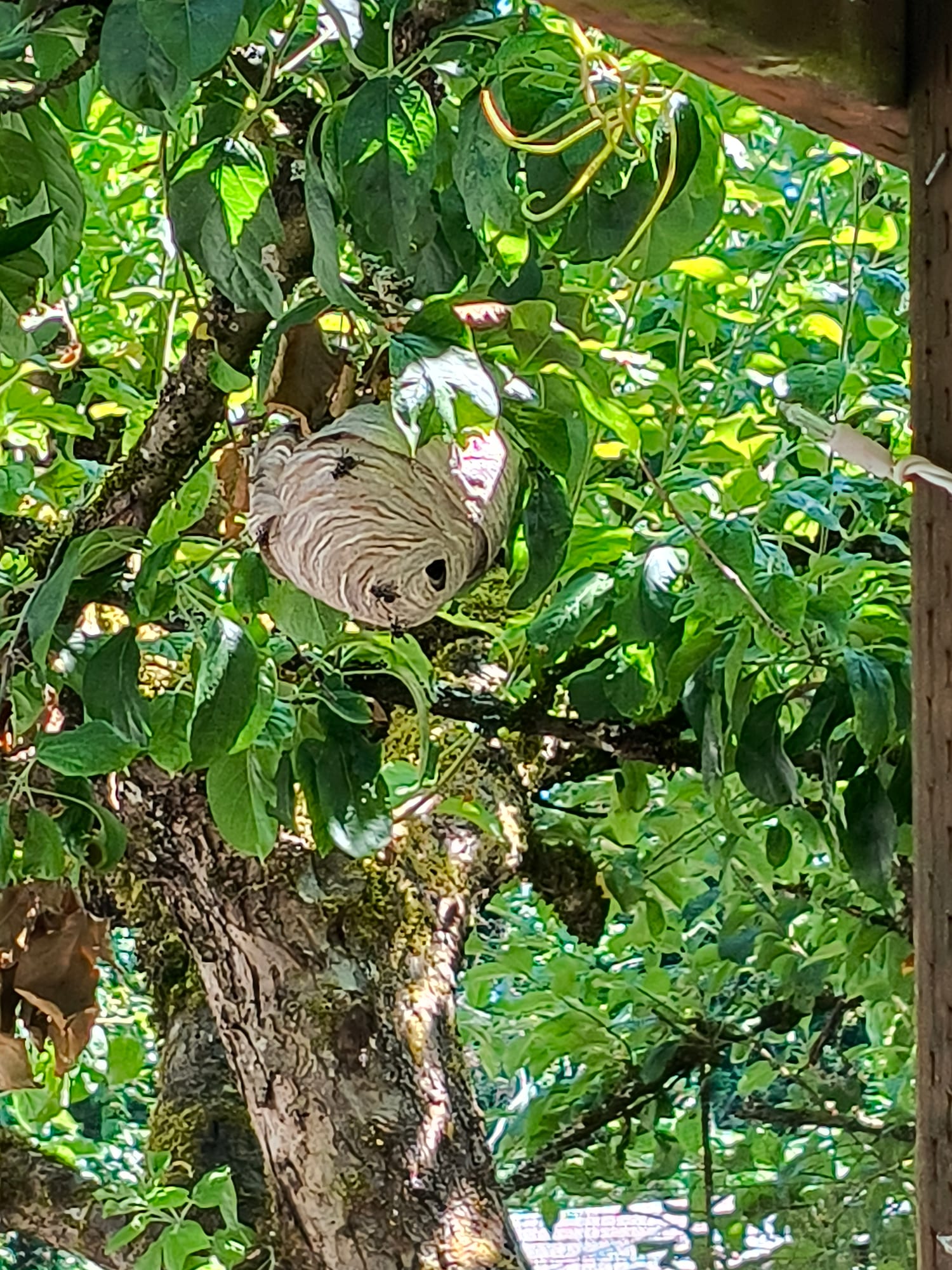
A bald-faced hornet nest is the large gray paper football in a tree or shrub. It looks like the most serious wasp problem on a property and is frequently the least urgent, because the colony is annual, it is often found at leaf fall when it is already finishing, and it is not reused.
Call 360-410-2199 Request a free inspection
What to do, in order
- Stay outside the roughly ten-foot radius around the nest, and keep family and visiting trades off its flight line
- Check the season: a hornet nest first spotted at leaf fall has hung there all summer, and the colony is already finishing
- Check the position: a nest by a door, path, play area or work area, low in a hedge, or on a building should come out
- Do not knock, spray, shoot, burn or wrap the hornet nest, and never go at it from a ladder
- If anyone in the house carries an epinephrine autoinjector for stings, treat a nest near living space as urgent
- Call for a free look when position makes it a hazard: we treat at dusk or before dawn in full protective gear and take the paper shell down on a later visit
The nest everyone recognizes
Of all the stinging insect situations on a residential property, this is the one that produces the most immediate alarm, and it is easy to see why. A mature bald-faced hornet nest is a gray, layered, papery structure the size of a football or larger, hanging visibly in a tree, a hedge, a shrub or occasionally against a building.
It looks like a serious problem. It looks like something that must be dealt with today.
Quite often it is not, and the reason is worth understanding before anybody spends money on it.
What they actually are
Despite the name, bald-faced hornets are not true hornets. They are a large black and white species of yellowjacket, closely related to the ones that nest in the ground, and their behavior sits between the two. UC IPM handles them under yellowjackets and other social wasps rather than under hornets, for that reason.
They are markedly larger than a common yellowjacket, patterned in black and ivory white rather than yellow, with the pale face that gives them their name.
The nest is built from chewed wood fiber mixed with saliva, layered into a distinctive gray papery shell around several tiers of comb, with a single entrance near the bottom. A mature nest may contain several hundred workers, occasionally more.
They are aerial nesters by preference — trees, shrubs, dense hedges, and sometimes the eaves, soffits or wall face of a building. Height varies from around head level up to well into a canopy.
The annual cycle, which decides everything
Almost every practical question about these nests is answered by the life cycle, so it is worth setting out clearly.
In spring, a single queen that mated the previous autumn and overwintered somewhere sheltered emerges and begins a nest alone. At this stage it is the size of a golf ball and contains one insect.
Through early summer she raises the first workers, who take over construction and foraging. The nest grows steadily as they add layers to the outside and comb within.
Through July and August growth accelerates sharply. This is when the nest becomes the recognizable large structure, and when the colony is at its most populous and most defensive.
In late summer the colony produces new queens and males, which leave to mate.
With the first hard frosts the colony dies. The workers, the old queen, the brood — all of it. Only the newly mated queens survive, dispersing to overwinter in leaf litter, under bark or in a sheltered cavity.
And critically: the nest is never reused. Next spring’s queens each build somewhere new. An old nest hanging in a tree in January is an empty paper shell that weather will break up over the winter.
Why the leaf-fall discovery is usually a non-event
The single most common version of this call goes like this: the leaves came down in October, and there is an enormous hornet nest fifteen feet up in the maple that nobody knew about.
Think about what that means. The nest has been there since spring. It reached full size in August. The household has been living, gardening and eating in that yard all summer, and nothing happened. The nest was invisible because the foliage hid it, and the colony was going about its business without any conflict.
Now it is late October, the colony is already in decline or finished, the frosts will complete it within weeks, and the structure will not be occupied again.
In that situation the honest recommendation is usually to leave it alone. You can knock the empty nest down in winter if you want the tree tidy, at which point it is just paper.
We say this knowing perfectly well it is a job we are declining. It is still the right answer, and a company that treats every visible nest as an emergency is telling you more about its sales process than about hornets.
When it genuinely should come out
Position and timing decide it, not size.
Proximity to a doorway, a path, a driveway or steps. A nest within a few feet of somewhere people pass every day is a hazard, because eventually somebody will brush the branch, bang a door, or walk into the flight line.
Low nests. A nest at head height in a hedge or a shrub is far more likely to be disturbed than one twenty feet up in a canopy, and hedges get trimmed.
Play areas, patios and outdoor seating. Anywhere children or guests are regularly present within the defended radius.
Working areas. Near a shed, a workshop, a woodpile, a vegetable garden, a fence line that needs maintenance, or anywhere power tools get used.
Where somebody in the household has a sting allergy. This changes the calculation entirely and we treat it as urgent.
Mid-season discovery. A nest found in June or July has months of growth ahead of it. Dealing with it then is a much smaller job than dealing with it in September.
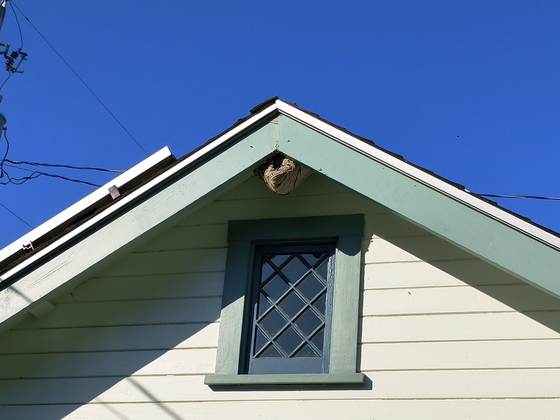
Against a building. A nest on a wall, soffit or eave is closer to occupied space and more likely to interact with people and windows.
If none of those apply, leaving it is a legitimate choice and often the better one.
How defensive are they, honestly
Somewhere between the reputation and the reassurance.
Bald-faced hornets defend the nest at a greater distance than most stinging insects here — commonly cited as roughly a ten-foot radius, though it varies with the colony, the weather and the time of season. Within that, disturbance provokes a response. Beyond it, they are largely indifferent to people.
They can sting repeatedly, unlike a honey bee. Some individuals will also spray defensive fluid toward the eyes of a perceived threat at the nest, which is unpleasant and worth knowing about.
They will pursue an intruder some distance from the nest, and alarm signaling recruits others.
Away from the nest, foraging workers are not aggressive. They are predators of other insects — flies, caterpillars and other soft-bodied prey — and a hornet working a shrub in your garden is not a threat to anyone.
The practical translation: respect the radius, do not disturb the nest, and the colony will not seek you out.
What not to do
Do not knock it down. A dislodged nest releases the whole colony at once, on the ground, next to you. This is the classic way people end up with dozens of stings.
Do not spray it from below with a hardware store aerosol. The jet reaches ten to twenty feet at best, the shell absorbs a great deal of it, and you are standing directly beneath an entrance you have just provoked, in the open, with nowhere to go.
Do not shoot it. People do. It produces the same outcome as knocking it down with the added benefit of holes in something behind it.
Do not burn it. A paper nest in a living tree is an obvious fire risk, it rarely kills the colony cleanly, and it can damage or kill the tree.
Do not seal it or wrap it. Whatever you have wrapped it in will not hold.
Do not do any of it from a ladder. A ladder removes the one thing that keeps people safe in this situation, which is the ability to move away quickly.
What removal actually involves
Where a nest genuinely needs treating, the work is straightforward for somebody properly equipped and genuinely unwise for somebody who is not.
Full protective equipment — a suit, veil and gloves rated for it, not a jacket and a hat.
Treatment at dusk or before dawn, when nearly the whole colony is in the nest rather than out foraging. This single decision changes the job more than anything else.
Application through the entrance and into the nest structure with equipment that can reach the height involved, rather than from directly underneath at close range.
A period of settling before anything is removed. Returning foragers arrive for a day or so, and the nest is left in place until traffic has stopped.
Then, where the nest is to be taken down, removal of the structure itself — a separate visit, usually, and one that is genuinely uneventful once the colony is gone.
Height and access are the variables that decide cost. A nest at eight feet in an open shrub is quick. A nest twenty-five feet into a canopy over a neighbor’s fence is a different proposition, and occasionally the honest answer is that it cannot be reached safely and should be left to the frosts.
If somebody has been stung
Most stings from this species are a local event and resolve on their own, but it is worth knowing what normal looks like and what does not.
A normal reaction is immediate sharp pain, redness, and swelling around the sting site that develops over a few hours and subsides over a day or two. Cold applied to the area, an antihistamine and a simple painkiller cover it. Bald-faced hornet stings are, by most accounts, more painful than a common yellowjacket’s, which is a function of size rather than of anything more serious.
A large local reaction — swelling extending well beyond the site, sometimes across a whole limb, developing over a day or two — is uncomfortable and alarming but is not usually dangerous. It is worth mentioning to a doctor, particularly if it recurs.
What needs emergency care immediately is any sign of a systemic reaction: difficulty breathing, tightness in the throat or chest, swelling of the face, lips or tongue, hives spreading away from the sting, dizziness, faintness, or sudden nausea and vomiting. That is anaphylaxis and it is a call to emergency services, not a call to us.
Multiple stings from a disturbed colony also warrant medical advice regardless of allergy status, simply because of the total venom load.
If anyone in the household carries an epinephrine autoinjector for insect stings, a nest anywhere near living space is not a judgment call. It comes out, and we will prioritize it.
What we tend to find on a property
When we come out for one nest, we look at the whole property, because these rarely occur in isolation and the other findings change the advice.
Paper wasp nests under eaves, deck rails, in open sheds and under garden furniture — usually small, usually leaveable, worth knowing about.
Yellowjacket ground nests in banks, borders, under structures and along the untended margin, which are the genuinely hazardous ones because nobody sees them before a mower does.
A second aerial nest, which is common enough to be worth checking for once the first one has been found.
The food and habitat features that concentrate foraging insects near living areas: open bins, unpicked fruit, exposed compost, and outdoor eating areas positioned under fruit trees.
And, since we are walking the grounds anyway, the things that matter for everything else we do — timber on soil, harborage against the foundation, vegetation touching the building, and where water is going.
None of that is upselling. It is what a proper look at a property produces, and you are free to do nothing with any of it.
Telling it apart from other nests
Paper wasps build small, open, umbrella-shaped nests with visible cells and no outer shell, usually under eaves, rails and in sheds. Much smaller colonies and considerably less defensive.
Yellowjackets in the ground or in a wall void are the same family but a different job entirely, with no visible structure.
Honey bee swarms are sometimes mistaken for a nest — a large clustered mass of bees hanging from a branch, with no paper structure at all. That is a temporary resting swarm looking for a home, it is not aggressive, and it belongs to a beekeeper rather than to us. Call one; most are pleased to collect it.
Mud dauber nests are small tubes of dried mud on walls and under eaves, made by a solitary wasp that is essentially harmless and does not defend anything.
An old nest from a previous year, which is weathered, faded, often torn open by birds, and empty. If it is winter and there is no traffic, that is what you are looking at.
Living alongside one
For the nests that do not need removing, a few sensible measures make the rest of the season straightforward.
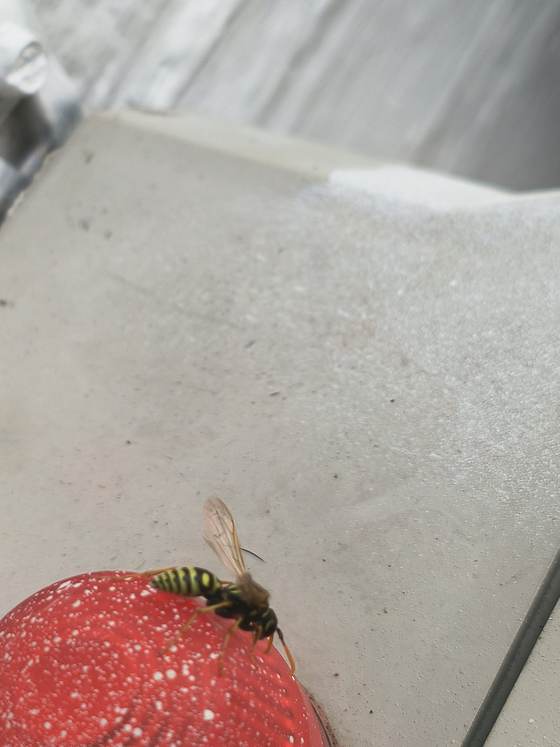
Know where the flight line runs and stay off it. Mark the tree so visiting trades, gardeners and family know.
Avoid running loud vibrating equipment directly beneath it — a mower passing is usually fine, a chainsaw in the same tree is not.
Keep the food sources that draw foragers close to seating under control: covered bins, fallen fruit picked up, drinks lidded in late summer.
And accept the trade. A hornet colony spends the summer removing a substantial volume of flies, caterpillars and other insects from your garden. That is worth something, and for a nest in a far corner of a property it is worth more than the cost of removing it.
Nests on buildings rather than in trees
A proportion of these end up on a house rather than in a tree, and the calculation shifts when they do.
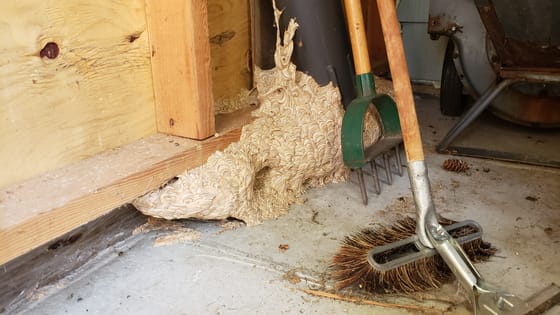
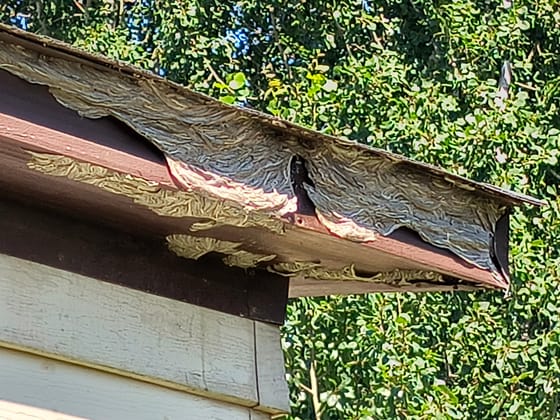
Under a soffit or a deep eave is the most common building position, usually tucked where the overhang gives shelter from rain. Against a gable end, above a porch, under a deck, in a carport and inside an open shed or barn all occur.
Three things change. Proximity is greater, so the defended radius overlaps with doors, windows and walkways that people use daily. Access is often easier, which makes the work more straightforward. And the nest is attached to something you own, which raises the question of what it leaves behind — a paper nest removed from siding leaves a stained patch that generally washes off, and one left in place will shed material through the winter.
A nest on a building near an entrance is one of the clearest cases for removal. A nest under a barn eave forty feet from anywhere anybody goes is not, and the same seasonal logic applies as anywhere else.
One position deserves particular caution: a nest inside a shed, garage or barn that people enter. An enclosed space removes the ability to back away, and it is worth simply not using that building until the nest has been dealt with.
Trees, pruning and next year
Two practical points about the tree itself, since that is where the nest is.
Treating a nest does not require damaging the tree, and it should not. Anybody proposing to cut a limb to reach a nest is solving the wrong problem — the colony ends in weeks either way and the limb does not grow back.
Pruning is worth thinking about for the season after, though. Dense low branching, unmanaged hedging and shrubs that have grown into a solid mass are exactly the sheltered structure a founding queen looks for in April. Ordinary maintenance pruning, done in winter when nothing is nesting, reduces the number of suitable sites without anybody treating anything.
The same goes for the general habit of walking the property in late spring. A golf-ball nest with one insect in it in May is trivially dealt with. The same colony in September is the thing people call about.
What we will do
We will look at it, tell you what it is, tell you how close it is to anything that matters, and give you an honest recommendation — which is frequently that it can stay.
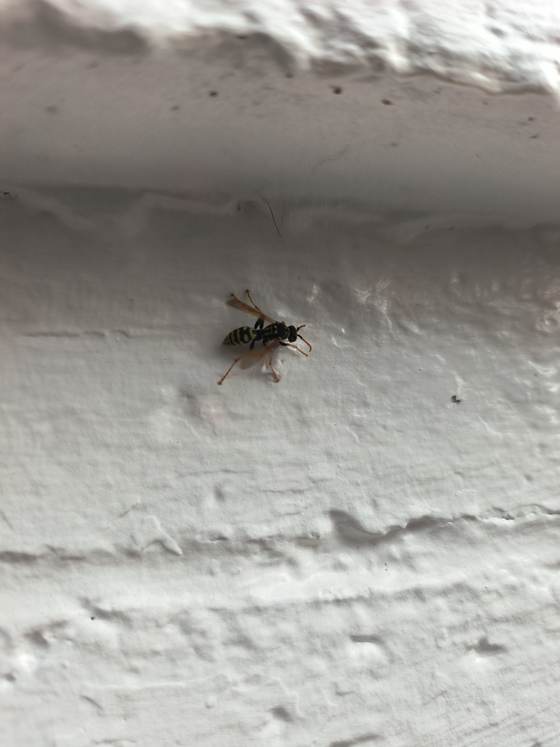
Where it does need to come out, we will do it at the right time of day, with the right equipment, from a position that is safe, and we will come back for the structure rather than pulling a live nest out of a tree.
Assessment is free and there is no term agreement. If your nest is twenty feet up, discovered in October, and nobody has been stung all summer, you will get that answer rather than an invoice.
Frequently asked questions
Is it as dangerous as it looks?
It is a defended nest and it should be respected within about ten feet. Away from that radius the colony is not interested in you. The risk is far more about proximity and disturbance than about the nest simply existing.
We only noticed it when the leaves fell. Do we still need it removed?
Usually not. A nest that becomes visible in late autumn has almost always been there all summer without incident, and the colony is finishing naturally. Nests are never reused, so an empty one is just paper.
Can I knock it down or spray it myself?
We would strongly advise against it. Bald-faced hornets defend at a greater distance than most wasps, they sting repeatedly, and a nest that is dislodged rather than treated releases a large number of very agitated insects at once.
Do they reuse the nest next year?
No. The colony dies with the frosts and only mated queens survive, each starting a new nest somewhere else in spring. An old nest left in a tree over winter is inert, and weather usually breaks it up.
Are they actually hornets?
Not in the strict sense — they are a large black and white yellowjacket, related to the ones that nest in the ground. The name comes from the size and the white face, and their behavior sits somewhere between the two.
What if it is right beside the front door?
Then position decides it and it comes out. A nest within a few feet of a door, a path, a play area or anywhere people work is a genuine hazard regardless of how well behaved the colony has been so far.
What does removal cost?
It depends almost entirely on height and access, which is why we quote after seeing it. Assessment is free, and if the honest answer is that this one can be left alone, that is what we will tell you.
Wasp & Hornet Control in Whatcom County?
Family-owned, no long-term contracts, and every treatment is backed by our 100% Service Guarantee.
Most calls in Whatcom County are out within 1–2 days, about 3 during the late-summer peak.
Last updated