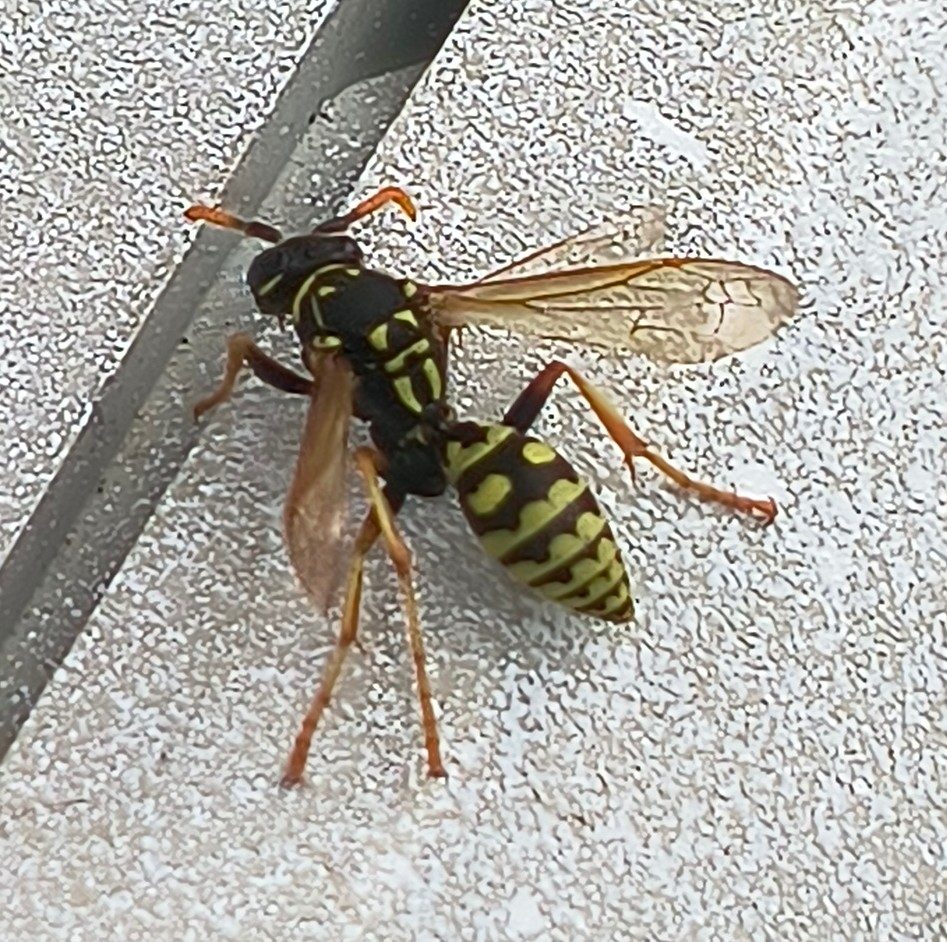
European Paper Wasp
Polistes dominula · Stinging insects
The European paper wasp arrived in Washington in the late 1990s and is now common across this county. It builds an open comb of bare cells with no paper envelope, in cavities and under railings, and it is far less defensive than the yellowjacket it resembles. Most nests can be left.
Call 360-410-2199 Request a free inspection
Rarely worth treating. Usually this is a sealing or cleaning job.
European paper wasp at a glance
| Size and color | About half an inch, black and yellow striped |
|---|---|
| Antennae | Bright orange — the only paper wasp here with them |
| How to tell it from a yellowjacket | Slim, thin-waisted, with long hind legs trailing in flight; yellowjackets look short and stocky |
| Nest | One layer of open cells on a short stalk with no paper envelope, usually under a hundred cells |
| Where it nests | Grills, tube ends, railing undersides, vents, meter boxes, mailboxes and light fixtures |
| Stings | Rarely — almost always when a nest is disturbed without the person knowing it was there |
| Do we treat it | Rarely warranted; only nests where hands go, over doorways or in vents are worth removing |
Signs you have them
- A comb the size of a coaster on the underside of a barbecue lid
- An upside-down umbrella of open hexagonal cells under an eave, soffit or deck rail
- Wasps going in and out of a patio furniture leg, fence rail end or gate post
- Slender yellow and black wasps cruising a fence line with their back legs dangling
- Old paper comb left in a sheltered cavity from the previous year
A wasp that was not here when most of this county was built
There is a specific conversation we have with people who have lived in Whatcom County for forty years, and it goes like this: there did not used to be this many wasps under the eaves.
They are right, and the reason is not a change in the weather or in what anybody’s neighbor is doing with their bins. It is a species that was not here.
Polistes dominula is European. It reached North America in the 1970s, first recorded near Boston, and moved west across the northern states over the following two decades. WSU PestSense dates its introduction into Washington to the late 1990s, and by the time WSU’s own extension bulletin on yellowjackets and paper wasps was written it was already being described as widespread and abundant throughout the state. Colorado, for comparison, got its first record in 2001. This is a recent arrival everywhere west of the Rockies, and it has moved fast.
What that means for a household here is that a genuinely common wasp on your property may be one your parents never dealt with, and that most of the folk knowledge about wasps in this county — where they nest, how they behave, what provokes them — was formed before it arrived and does not describe it.
It also means the identification is worth getting right more often than usual, because this insect looks like the species that causes the real trouble here and behaves nothing like it.
Why everybody calls it a yellowjacket
Because at a glance it is a yellow and black wasp about half an inch long, and in this county that description belongs to something else.
WSU’s bulletin puts it directly: this species is quite similar in color pattern to yellowjackets, which is precisely why it gets reported as one. PestSense describes it as black and yellow striped and roughly half an inch. On a phone photograph taken from ten feet away, it is a yellowjacket.
Three things separate them, and none of them requires being close.
The legs in flight. This is the reliable one. Colorado State describes the long hind legs of paper wasps trailing below the body in flight, and Penn State puts the same observation as legs hanging in an extended fashion. Nothing in the yellowjacket group does that. A wasp that appears to be dangling its back legs as it cruises along a fence line is a Polistes, full stop.
The build. Penn State describes the waist as very thin. WSU’s contrast is between paper wasps, which are more slender with longer legs, and yellowjackets, which appear short and stocky. Held side by side the difference is obvious; described over the phone, “does it look narrow-waisted or does it look solid” gets there most of the time.
The antennae. WSU Hortsense records this as the only paper wasp here with bright orange antennae, which is a genuinely useful field mark on a clear photograph and one almost nobody thinks to look for.
There is a fourth tell that is not about the insect at all, and in practice it settles more cases than the other three combined: look at what it built.
The open comb, which nothing else here makes
A yellowjacket nest is a sealed object. Whether it is underground, inside a wall or hanging in a shrub, the comb is wrapped in a paper envelope and all you ever see from outside is a structure and an entrance hole.
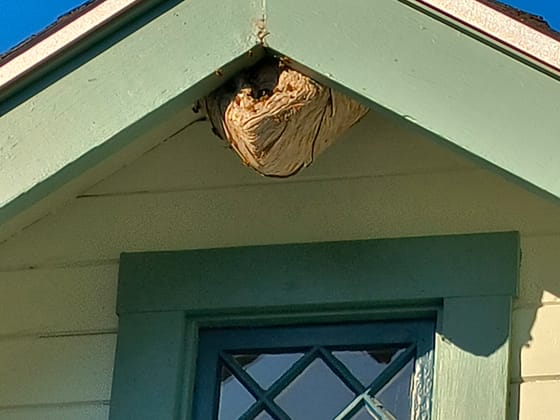
This species builds nothing of the kind. PestSense describes nests containing only one layer of cells and not enclosed with paper as yellowjacket nests are. The result hangs from a short stalk, cells downward, like a small upside-down umbrella, and you can stand underneath it and count the cells and see the larvae and see every adult sitting on the comb.
That is not a subtle difference. If you can see individual hexagonal cells, you are not looking at a yellowjacket nest, and most of the advice you have read about wasps does not apply to what you have.
Size is modest. WSU’s bulletin describes these nests as often less than a hundred cells and possibly four hundred cells and more at the top of the range, while UC IPM puts paper wasp colonies generally at fifteen to two hundred individuals. Colorado State’s account of several dozen adults by the end of summer, on a comb that has grown to a hundred cells or more, is a good description of the typical version on a Bellingham porch.
Set that against the several thousand workers a mature ground-nesting colony carries by September and the practical difference stops being academic.
Where it puts the comb, and why that is the whole problem
If this wasp only built under eaves it would barely register as a pest. Its actual site selection is what generates calls, because it favors small enclosed cavities, and small enclosed cavities on a residential property are mostly things people put their hands into.
WSU’s bulletin lists roof shakes, meter boxes, bird houses, outdoor grills, mail boxes, eaves, chairs, benches and shrubbery. Penn State adds attics and wall voids, exterior light fixtures, parking meters and vehicles. Colorado State notes dark cavities such as grills and pipes alongside the undersides of porch decks and overhangs. PestSense’s list is under lawn furniture, in light fixtures and mailboxes, and under soffits and deck railings.
Read together, the local pattern is consistent, and here it is as somebody in this county actually encounters it:
The barbecue. Open the lid in June to a comb the size of a coaster on the underside. This is the single most common version we get called about.
The open end of anything tubular. Patio furniture legs, fence rail ends, scaffold tube, a length of downpipe standing in a corner, the cut end of a gate post.
The underside of a deck or porch railing, particularly a wide flat cap rail that somebody’s hand goes on as they come up the steps.
Wall vents, dryer vents, gable louvers and unscreened crawl vents, which matter more than the others because they connect to the building.
Meter boxes, junction boxes and outdoor light fittings.
Mailboxes, bird boxes and anything with a hinged lid that stays shut most of the week.
A shed or garage door track, a rolled-up awning, an upturned wheelbarrow, a stack of empty plant pots, a boat cover.
The common factor is a small dark space with an opening, sheltered from the rain, that nobody looks into between one season and the next. What makes it a nuisance is not the wasp. It is that the wasp has excellent taste in exactly the places people reach into without looking.
Telling it from the paper wasp that was already here
Washington had paper wasps before this one arrived, and the native is still around, so the comb under your eave is not automatically the introduced species.
The one you are most likely to meet is the golden paper wasp, Polistes aurifer. WSU’s bulletin separates it from yellowjackets on coloring — yellow and dark brown rather than yellow and black — and puts workers at up to three quarters of an inch and noticeably more slender. Its combs run to around two hundred cells, with the largest probably under four hundred, and it builds under eaves as well as in logs, under rocks, within shrubs and grass clumps, and inside pipe. WSU also notes that it frequently overwinters in the attics of homes, which is the source of a certain number of confused midwinter phone calls about a large wasp in an upstairs room.
Three things separate the two in practice. Color: brown-toned bands read as warmer and duller than the sharp black and yellow of the introduced species. Antennae: bright orange on dominula, dark on the native. And size, since the native runs slightly larger.
Does the distinction change what you should do? Almost never. Both are open-comb wasps with small colonies and low defensiveness, and the honest recommendation for both is usually the same. It matters for a different reason: the introduced species has been displacing natives across its new range, Penn State records evidence of an adverse impact on native Polistes, and part of the mechanism is the head start described further down this page. Knowing which comb is which is how anybody would ever notice that happening on a particular property.
If it matters to you, photograph the antennae. That is the whole test.
How defensive it actually is
Considerably less than the insect it resembles, and being straight about this is most of the value of the page.
Colorado State describes the European paper wasp as relatively non-aggressive, and adds the observation that matters most: stings from this species occur almost exclusively when nests are accidentally disturbed. Penn State’s version is that they detect a threat at twelve to twenty feet but do not typically attack unless somebody is very close. UC IPM’s general statement about paper wasps is that most species are relatively unaggressive and rarely sting people.
So the profile of a sting from this wasp is not somebody being pursued across a lawn. It is somebody lifting a grill lid, gripping a rail, opening a meter box or pulling a tarp off a stack of furniture, and finding out that way.
There is a caveat and PestSense states it plainly: more docile than yellowjackets unless startled, at which point they will react fiercely. That is a fair description. This is not a stingless insect and a comb held in one hand is a bad place for a face. But the behavior is reactive rather than territorial, the defended radius is small, and the colony is a few dozen insects rather than a few thousand.
The practical consequence is that a comb ten feet up under a soffit, or on the underside of a shed roof, or in a shrub away from a path, is very unlikely to produce a sting in an entire season. The same comb inside the handle recess of a sliding door is a matter of time.
The head start, and the one place the annual rule bends
Every wasp colony in this county is annual. A queen that mated the previous autumn starts alone in spring, the colony builds through summer, new queens and males leave to mate, and the rest of it — workers, males, the founding queen — does not survive the cold. Only mated queens carry over, sheltering somewhere else entirely.
That holds for this species too. But there is a wrinkle, and it is the one place in this whole subject where the received rule needs a footnote, so it is worth stating carefully.
The rule everywhere else is that the nest is single-use. WSU’s bulletin says so of yellowjackets without qualification: the abandoned nests decompose over the winter and are not used again. For this species the picture is different in one respect. Penn State records queens of Polistes dominula establishing colonies earlier than native species partly by taking over the previous year’s structure, and WSU notes that paper wasps may build new combs adjacent to old ones. WSU PestSense’s phrasing is that queens occasionally reuse old structures although they typically construct new nests.
So: the colony still dies. Nothing overwinters in the comb. But the paper is capable of outlasting the season in a sheltered cavity, and a founding queen the following April may adopt it or build alongside it rather than starting from nothing.
That is not a technicality. It is one of the mechanisms by which this species got established so quickly, because Penn State connects the early founding to a head start — workers on the wing before the native paper wasps have their colonies going, and a broader prey range than the natives, with development from egg to adult in as little as forty days.
It also gives you something to act on. A comb removed in winter, from a cavity that is then closed, is a site that does not get a running start in spring. That is the single most effective thing anybody can do about this wasp, and it involves no treatment of any kind.
Why the identification changes the answer
Here is the reason this profile exists.
Somebody sees a yellow and black wasp going in and out of a hole in the side of their house and calls it a yellowjacket. Under that name, the answer is serious: a colony in a cavity that cannot be seen, potentially several thousand insects by September, a real hazard if the entrance is sealed while it is alive, and a job for somebody with the right equipment.
Under the correct name, the same situation is usually a few dozen wasps on an open comb four inches inside a vent, ending on its own in a couple of months, that has never bothered anybody and probably will not.
Those two answers cost very different amounts of money. The identification is what stands between them, and it is free.
The reverse error happens too and is worth guarding against. A genuine yellowjacket colony in a wall gets waved off as “just paper wasps,” the entrance gets caulked in August by somebody being helpful, and the colony chews inward through drywall. When there is any doubt about which one you have, the safe assumption is the yellowjacket, and the safe action is to do nothing to the opening until somebody has looked.
What it does for you
Not nothing, and it belongs on the ledger.
Colorado State describes these wasps preying on caterpillars and sawfly larvae and acting as a natural control on many kinds of yard and garden insects. Penn State’s account is broader still — a wide prey range across several insect orders, which is precisely the trait that gave the species its advantage here. That breadth is also the source of the ecological concern about it, since somebody’s cabbage worms and somebody’s butterfly caterpillars are the same resource, and the same source records evidence of an adverse impact on native Polistes.
For a household deciding what to do about a comb under a shed eave, though, the practical fact is that it is removing insects from your garden all summer at no charge, and a great many of these nests are worth exactly the amount of attention required to walk around them.
When it is genuinely worth dealing with
The verdict at the top of this page is that treatment is rarely warranted, and the exceptions are specific rather than vague.
Anywhere hands go. A door handle recess, a gate latch, a stair rail, a mailbox, a grill, a garden tool store, the tubing of the chairs somebody is about to set out.
Vents and openings that connect to living space. Not because the wasp is dangerous but because a cavity a queen finds attractive is worth closing anyway, and because adults working their way inward through an unsealed penetration turn up at an upstairs window.
Doorways, and any comb over a threshold where the flight path crosses somebody’s route several times a day.
Play areas, and low nests in shrubs at the height a child moves through.
A household where somebody carries an epinephrine auto-injector for stings. That removes the calculation, the same as it does for every other species in this group.
Numbers. One comb under a soffit is unremarkable. Eleven of them around one elevation, which happens on properties that suit the species, is a different conversation and usually a sealing conversation rather than a spraying one.
Everywhere else — a shed roof, a fence corner, the underside of a deck nobody goes under, a hedge away from the path — leaving it is the right answer and it costs nothing.
What we would actually do
For an accessible comb in a bad position, the work is small. The right hour is early morning or after dusk, when the adults are on the nest and slow rather than out foraging, and the comb comes off its stalk. Where there is no cavity involved, that is frequently the whole job.
For a comb inside a cavity — a vent, a pipe end, a meter box — treating the comb is the easy half and the useful half is closing the cavity afterwards so the site is not chosen again. Screen the vent in metal, cap the pipe, fit the box properly. That is exclusion and repair work, it holds for years, and it is the reason this species carries a rarely-warranted verdict rather than a treatment one.
The best time to do all of it is the cold half of the year. Nothing is on the comb, nothing is defending anything, old paper comes out of the cavities that hold it, and the openings get closed before a queen is looking. WSU Hortsense’s own suggestion for discouraging this species is removing the nests during winter, and it is the cheapest advice on this page.
Where a property has a genuine concentration of nests we will walk the elevations and deal with the sites rather than the insects, because on this species the sites are the problem.
What we will not sell you
A perimeter spray for paper wasps. They do not walk your siding; they fly to a cavity. Wetting the wall does very little and it does it to a great many insects that were not the point.
A recurring plan for a seasonal comb. A nest under an eave is a discrete thing that ends in autumn.
Removal of every comb on an acre. On rural property here that is a full day of work against an insect that is mostly earning its keep, and we would rather do the four that matter.
Treatment of a comb in November. It is finished. Take it down if you like the look of the eave better without it.
A yellowjacket price for a paper wasp job. They are not the same work and should not be quoted as though they were.
Around the county
Older Bellingham housing. Porch rails, shakes, meter boxes and a century of odd penetrations in the siding. The highest density of nests per property that we see, and the highest proportion of them that can safely be ignored.
Newer subdivisions in Cordata, Barkley and King Mountain. Vinyl trim, vented soffits, gas grills on small patios and a lot of tubular outdoor furniture. Fewer nests, more of them in places people touch.
Lynden, Everson, Nooksack and the working properties. Equipment yards, implement sheds, gate posts, stacked pipe and fence rails. Nests by the dozen, almost all of them harmless, and the ones that matter are on machinery controls and around stock handling.
Blaine, Birch Bay and the seasonal homes. Everything shut for months is everything a founding queen wants, and the discovery happens when the covers come off.
Sudden Valley and the wooded lots. More natural nest sites in the surrounding cover, which paradoxically means fewer of them on the buildings.
Related work
The seasonal picture across all the stinging species sits on wasp and hornet control. If what you have is going into a hole in a wall rather than sitting on an open comb, read wasp nest in a wall void before anybody seals anything. The species most often confused with this one is the western yellowjacket, which nests in the ground, and the aerial yellowjacket is the other. Closing the cavities this wasp nests in is exclusion and repairs.
Frequently asked questions
When did this wasp turn up here?
WSU PestSense dates the introduction into Washington to the late 1990s, and EB0643 already describes it as widespread and abundant throughout the state. Anybody who gardened here in the 1980s was not seeing this insect, which is why it feels new to people who have lived here a while.
How do I tell it from a yellowjacket without getting close?
Watch the legs in flight. Long hind legs hang and trail below the body, which no yellowjacket does. The build is slimmer, the waist is noticeably thin, and Hortsense notes it is the only paper wasp here with bright orange antennae.
The nest has no covering on it. Is that normal?
That is the species signature. It builds a single layer of open cells hanging from a short stalk, with no paper envelope around it at all, so you can see straight into the comb from below. Yellowjacket nests are always enclosed.
Are they going to sting us?
Rarely, and almost always by accident. Colorado State Extension records stings from this species occurring almost exclusively when a nest is disturbed without the person realizing it was there. Away from the comb they show essentially no interest in people.
There is a nest inside the barbecue. What do we do?
Do not open the lid and light it. Wait for a cool morning, look first, and if the comb is small it can be knocked out with a pole from a safe distance and the grill left open afterward. A closed grill is one of the sites this wasp chooses most reliably.
Do they use the same nest again the following year?
The colony does not survive, but the paper sometimes does. Penn State records queens of this species establishing early by taking over the previous year's structure, and WSU notes new combs built alongside old ones — which makes it the one local exception to the rule that wasp nests are single-use.
Is it worth treating them if they are eating my garden pests?
Usually not, and that trade is real. Both Colorado State and Penn State describe this wasp taking caterpillars, sawfly larvae and a wide range of other insects to feed its brood, so a comb under a shed eave is doing unpaid work all summer.
Sources
- WSU PestSense — European paper wasp — read September 2, 2026
- WSU Cooperative Extension EB0643 — Yellowjackets and Paper Wasps — read September 2, 2026
- Colorado State University Extension — European paper wasp — read September 2, 2026
- Penn State Department of Entomology — European paper wasp — read September 2, 2026
- WSU Hortsense — Vespidae: paper wasps, yellowjackets, hornets and potter wasps — read September 2, 2026
- UC IPM Pest Notes — Yellowjackets and Other Social Wasps — read September 2, 2026
Rules change. This page is scheduled for review against its sources by September 1, 2027. If you are reading it after that date and something looks out of step with the current rule, the rule is right and we are wrong — please tell us.
Pest problem in Whatcom County?
Family-owned, no long-term contracts, and every treatment is backed by our 100% Service Guarantee.
Most calls in Whatcom County are out within 1–2 days, about 3 during the late-summer peak.
Last updated