Bald-Faced Hornet
Dolichovespula maculata · Stinging insects
The bald-faced hornet is not a hornet. It is a large black and white yellowjacket in the genus Dolichovespula, and the gray football-shaped paper nest hanging in a tree or under an eave is its work. Whether it needs treating comes down to where that nest hangs and how late the season is.
Call 360-410-2199 Request a free inspection
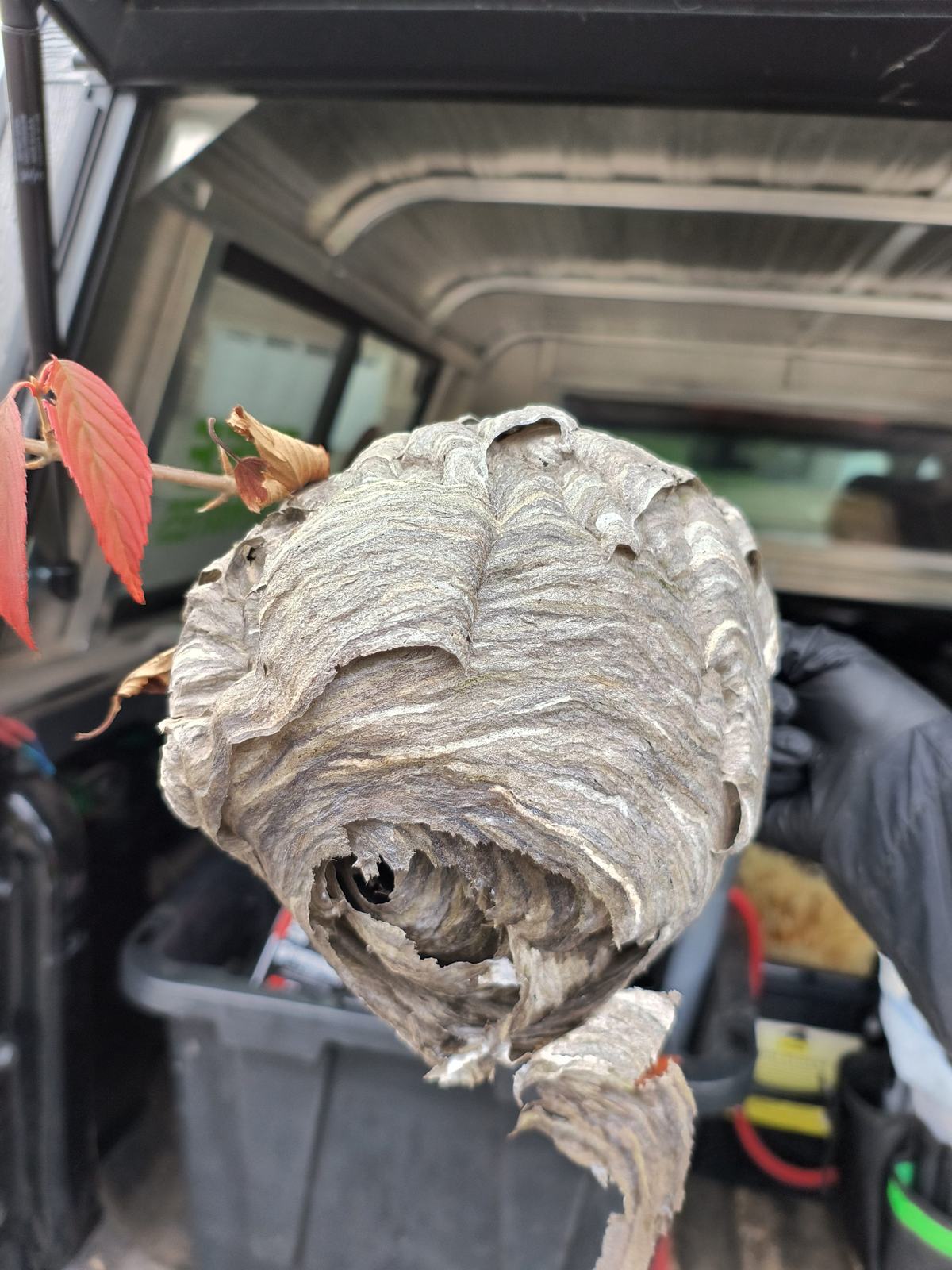
Sometimes worth treating, sometimes not — it depends on what is below.
Bald-faced hornet at a glance
| What it really is | A large yellowjacket in the genus Dolichovespula, not a true hornet |
|---|---|
| Size | 13 to 20 millimeters by caste — a worker around three quarters of an inch |
| Color and markings | Black with ivory-white face, banding and leg markings; no yellow anywhere |
| Telling it from an aerial yellowjacket | Look at the insect, not the nest: black and white here, banded yellow and black there |
| Nest | Gray layered paper football with the entrance low on the underside, in trees, shrubs or eaves |
| Colony size | About one hundred to four hundred workers by late summer |
| Scavenging | Stays a predator all season and is not the wasp at your picnic table |
| Do we treat it | Depends on position — near a door or at head height, yes; high in an open tree, often not |
Signs you have them
- A gray, football-shaped paper nest in a tree, shrub, eave or open outbuilding
- Large black and white wasps flying in and out of a single hole at the bottom of the nest
- A nest that shows up in a bare tree once the leaves drop in autumn
- A golf-ball-sized starter nest under a porch roof or eave in spring
- Black and white wasps working flowers or hunting along a fence line in late summer
The name is wrong, and the mistake is expensive
Almost everything people believe about this insect follows from a word that does not apply to it.
It is not a hornet. WSU Hortsense states the point without hedging — technically a yellowjacket, not a hornet — and it belongs to the genus Dolichovespula, which makes it a first cousin of the aerial yellowjacket and a slightly more distant relative of the ground-nesting species that causes most of the trouble in this county. What it has is the size, the coloring and the reputation of something rarer and more dangerous.
True hornets are Vespa. Penn State Extension records only one established in North America, the European hornet, and its range is the eastern half of the country rather than anything on this coast. The other Vespa that reached Washington, the northern giant hornet, was found in this county and dealt with: four nests located and destroyed in 2020 and 2021, three subsequent survey years without a detection, and a formal announcement in December 2024 that the species is no longer present in the United States.
So when somebody in Ferndale photographs a large black insect and calls it a hornet, the accurate answer is that they have a big yellowjacket and the county has no hornets in it at all.
That correction is not pedantry, and it changes three practical expectations.
It changes what you expect from the colony. People assume a nest that large holds a proportionate number of insects. It does not, and the numbers further down this page are the reason.
It changes what you expect from the behavior. A hornet in the popular imagination hunts people. This insect defends a radius and ignores everything outside it.
It changes where you expect to meet it. The wasp at an outdoor table in September is not this species, and knowing that stops a good deal of unnecessary alarm about a nest in a tree that has nothing to do with the problem at the table.
What it looks like
Bigger than anything else in the family here, and the color is the giveaway before the size is.
The body is black, marked in ivory white rather than yellow — a broad pale pattern across the face, which is where the name comes from, and further white banding on the thorax, the legs and the last segments of the abdomen. Penn State puts colony members at 13 to 20 millimeters depending on caste, with queens the largest, so a worker is somewhere around three quarters of an inch and a queen seen in spring is genuinely startling.
The flight is heavier and slower than a common yellowjacket’s, which is part of why the insect reads as a different order of thing to people who have only ever seen the small yellow ones.
There is no yellow on it anywhere. That single fact resolves most identifications sent to us as photographs.
The nest, which is the thing people actually see
Very few households ever identify the insect. They identify the structure, and it is the most recognizable object in this whole subject.
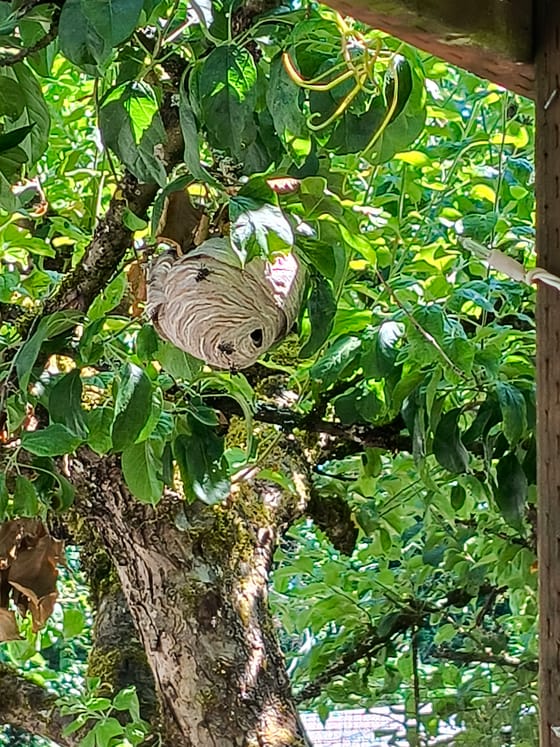
Chewed wood fiber worked into a gray, layered, papery envelope, roughly spherical to teardrop-shaped, with tiers of horizontal comb suspended inside it and a single entrance low on the underside. Penn State records nests reaching 24 inches in height and 18 inches across in Pennsylvania, though most of what turns up on residential property here is smaller than that.
Position varies more than people expect. Penn State describes nests in bushes and shrubbery at least three feet off the ground, and in trees as high as sixty feet or more. WSU’s own bulletin puts the species in trees or on the outside eaves of buildings, which is the version that generates most calls, because a nest on a house is a nest somebody walks under.
The envelope grows outward through the season as workers add layers, so a nest that looked like a golf ball in May and a grapefruit in July is a football by the end of August. The size you find it at is a record of how long it has been there, not of how dangerous it is.
The number that surprises everybody
Here is where the hornet framing does the most damage.
Penn State describes bald-faced hornet colonies growing through the summer to somewhere between one hundred and four hundred workers, with Pennsylvania colonies commonly running to about three hundred individuals. That is the whole population of that enormous gray structure.
Now set it against the species that causes most of the stings in Whatcom County. WSU’s Extension bulletin records western yellowjacket nests reaching as many as five thousand workers and fifteen thousand cells at their August and September peak — a colony an order of magnitude larger, living in a hole in a lawn that nobody can see.
The insect that looks like the serious problem has the small colony and advertises its position. The insect nobody notices has the large one and hides it under the grass. That inversion is worth carrying around, because it is the opposite of how these two get ranked by everybody who has not thought about it.
None of which makes a bald-faced hornet nest harmless at close range. Several hundred defensive insects is plenty. It does mean that the alarm a big paper nest generates is out of proportion to the colony inside it, and that a household deciding what to do should be weighing position rather than volume.
What it does with its summer, and where it does not go
This is the most useful thing on the page and it is almost never said.
UC IPM makes a distinction between the two groups of yellowjackets that matters enormously in practice: the aerial nesters do not become scavengers at the end of the season. The ground-nesting species flip to sugar and meat scavenging as brood rearing winds down, which is what puts them at bins, fallen fruit, cans and plates from mid-August. Dolichovespula does not make that switch. It stays a predator through to the end of the colony.
So the black and white wasp with the nest in your maple is not the reason wasps are on the picnic table. It never was. Those are almost always Vespula, from a nest in the ground or in a wall, and treating the visible nest in the tree will not change anything about the table.
We say this often enough on the phone that it is worth putting in writing, because the sequence goes the same way every year. Somebody is being bothered by wasps at an outdoor eating area in late summer. Somebody else spots the big gray nest twenty feet up in the same yard. The two get connected, the nest gets treated, and the wasps at the table carry on exactly as before, because the actual colony is an unmarked hole in a bank behind the shed.
What this species does instead is hunt. Workers take flies, caterpillars and other soft-bodied insects, and they will take other yellowjackets given the chance, which is a service worth having on a property in the same season the ground nesters are at their worst. WSU also records the adults visiting flowers in late summer, which is where most people encounter one away from the nest and never realize what they are looking at.
Defensiveness, in proportion
The reputation is earned close in and unearned everywhere else.

Within a few paces of the nest this is a species that responds hard and in numbers, sustains the response for a while, and follows. Penn State’s practical threshold — nests within about ten feet of a building entrance are the ones to deal with — is a reasonable working figure for how much space the colony considers its own.
Step outside that and the picture reverses completely. A worker foraging on a shrub, on a flower head or along a fence line is not defending anything and has no interest in whoever is standing there. People share gardens with these colonies all summer without incident, which is exactly what makes the leaf-fall discovery so common: the nest was never a problem, it was simply invisible.
The conditions that shorten the fuse are worth knowing. Vibration through whatever the nest is attached to, which means hedge trimmers, a ladder against the same wall, a chainsaw in the same tree. Direct light at the entrance after dark. Repeated close passage along a flight line. Weather that keeps the colony at home. And the last few weeks of the season, when there is nothing left to gain from tolerance.
The nest hanging in a bare tree in December
This is where a pest control company either tells you the truth or takes your money, so here it is plainly.
The colony is annual. It runs from a single overwintered queen in spring to several hundred workers in late summer, produces new queens and males, and then ends with the cold. WSU’s bulletin describes the abandoned nests decomposing and disintegrating over the winter, and states that they are not used again.
Not “usually not.” Not “sometimes.” A bald-faced hornet nest is a single-use structure. Next April’s queens each start something new somewhere else, and a queen that overwintered forty feet from last year’s football has no more interest in it than you do.
Which means the nest that becomes visible when the leaves come down in late October or November is, in the great majority of cases, already finished or within weeks of it. There is nothing in it to treat. There will not be anything in it next year. Weather and birds take it apart over the winter, and if it irritates you to look at, it can come down with a pole in January at no risk to anybody.
How to tell whether it is genuinely done, from the ground and from a distance:
Watch the entrance for a few minutes on a mild afternoon. A live colony produces continuous two-way traffic at the hole. A finished one produces nothing, however long you stand there.
Look at the envelope. An active nest is clean, layered and pale gray. A finished one weathers to a mottled brown, softens in the rain, and frequently shows a torn opening where a bird has been through the side of it for the brood.
Consider the date. Once we are past a hard frost or two, the arithmetic is already decided.
If somebody has quoted you for removing a nest in December without mentioning any of that, the quote is for taking down a paper shell, and you are entitled to know that is what you are buying.
The April version of the same nest
Everything on this page describes an August problem, and there is a version of it in April that almost nobody acts on because almost nobody looks.
In the first warm stretch of spring, a queen that mated the previous autumn and spent the winter under bark or in a sheltered cavity comes out and starts building on her own. There are no workers. There is one insect, a stalk, a few cells and a thin paper cap around them, and the whole thing is the size of a golf ball or smaller. She forages, builds, lays and broods the first generation herself, and until those workers emerge the colony has no capacity to defend anything.
That window runs roughly from the first settled weather through May, and it is the cheapest moment in the entire year to deal with this species. A starter nest under a porch roof or in the crotch of a shrub can be knocked off with a pole, from a distance, by a homeowner, with essentially none of the risk that the same location carries in September.
The reason it does not happen is that nobody is looking at the underside of their eaves in April. So here is the short version of where to look, once, on a mild afternoon in spring: the sheltered face of every eave and soffit return; the inside of an open shed, carport or barn; the underside of a deck and its rails; the top of a porch or a bay window roof; and the dense middle of any evergreen shrub near the house.
Ten minutes, once a year. It is worth more than any product anybody can sell you, and it applies equally to every wasp on this site that builds where you can see it.
Aerial yellowjacket, and why the nest will not tell you
The one species this gets genuinely confused with is its close relative, and the confusion runs in a direction people do not expect.
Both build an enclosed gray paper envelope above ground. Both hang it in a shrub, a tree or under an eave. Both put the entrance at the bottom. Looking at the nest, from any normal distance, will not separate them — which is why “football-shaped gray nest” is a description of a genus rather than a species.
The insect separates them instantly. Black with ivory-white markings is this page’s species. Banded yellow and black is the aerial yellowjacket, which is smaller, builds a smaller envelope, and is more inclined to put it somewhere awkward — inside a void, low in a hedge, tight under a deck rail.
Getting it right matters less than usual here, because the handling is broadly the same. It matters for expectations: an aerial yellowjacket nest is more often in a position that forces the issue, and its occupants are more often the ones somebody blunders into while trimming.
Two other things get called bald-faced hornets and are neither. The elm sawfly is a large dark wood wasp, harmless, with no colony at all. And a western yellowjacket coming out of a hole in a lawn is sometimes reported as a hornet purely on the strength of how much it hurt.
Where the nest sits is what decides the job
Species is not the variable that matters. Position is, and it sorts these nests into four practical categories.
High in an open tree. The easiest case to decide and the one people worry about most. Well up in a canopy, away from the house, away from paths, it is a predator colony that will be gone by winter. Height also makes treatment awkward, and the honest math frequently comes out on the side of doing nothing.
Low in a shrub or a hedge. The genuinely hazardous version, because the nest is at or near head height in something that gets cut, and hedges get cut in August. A nest a person can walk into is a different proposition from the same nest thirty feet up, and this is the position we move fastest on.
On the building. Under a soffit, against a gable end, above a porch, in a carport, tucked into a deep eave out of the rain. Access is usually better than in a tree, which makes the work easier, but the defended radius now overlaps with a door, a window or a walkway that gets used daily.
Inside a structure people enter. An open shed, a barn, a garage left ajar through the summer, a covered moorage. This one deserves its own line because an enclosed space takes away the ability to back off, and the sensible interim measure is simply not to use that building.
Everything else — the color of the wasp, the size of the envelope, whether anybody has been stung yet — is secondary to which of those four you have.
When we would leave it, and when we would not
The case for leaving it: a nest away from paths, doors, seating, play areas and anything anybody has to maintain; nobody in the household reacting badly to stings; a colony that has already spent the summer removing insects from the property without a single incident; and a date past the middle of September, when the whole thing has weeks left regardless.
The case for treating it: a nest within a few paces of a door, a gate, a driveway, steps, a play area, a vegetable bed, a woodpile or an outdoor table; a nest at head height in anything that gets trimmed; a nest attached to a building near a window that has to open; a household where somebody carries an epinephrine auto-injector for stings, which removes the judgment call entirely; and a discovery in June or July, because acting on a small nest early is a smaller piece of work in every respect than acting on the same colony in September.
That is why this profile carries a verdict of depends rather than treat. The insect does not decide it. Where it built decides it.
What the work involves
Where a nest does need dealing with, the shape of it is set by the fact that the target is enclosed and elevated.
Proper protective equipment, which for an aerial nest means a suit and veil rated for the job rather than heavy clothing and optimism, because the response comes from above and from all sides of a structure rather than from a single hole in the ground.
Work at dusk or before first light, when the great majority of the colony is inside the envelope rather than distributed across the neighborhood. Treating in the middle of a warm afternoon leaves a large population of foragers arriving back to a nest that is no longer functioning, which is worse for everyone in the vicinity.
Delivery through the entrance and into the interior of the nest, with equipment that reaches the height involved. Standing directly beneath an entrance at close range with a hardware store can is the version that produces the stories.
Then a pause. Foragers keep returning for a day or so, and the structure stays where it is until that traffic has stopped rather than being pulled out of a tree on the same visit.
Taking the envelope down afterwards is optional and usually a separate, uneventful piece of work. On a building it is worth doing, because a nest left attached to siding sheds material through the winter and leaves a mark. In a tree it is entirely cosmetic.
Height and access set the difficulty. A nest at eight feet in an open shrub and a nest twenty-five feet into a canopy over a boundary fence are different jobs with the same insect in them.
Around the county
Sudden Valley, Geneva and the Lake Whatcom margins. Mature trees, dense understory and a lot of properties where the boundary between garden and woodland is a suggestion. Most of the high-in-a-tree nests we are asked about are here, and most of them get left alone.
Older Bellingham streets. Deep eaves, open soffits, porch roofs and mature street trees, on lots small enough that a nest anywhere is a nest near something. The building-attached version turns up here more than anywhere else.
Lynden, Everson, Nooksack and Sumas. Barns, equipment sheds, open-fronted outbuildings and shelter belts. The nest inside a working structure is the local pattern, and the people who find it are usually already inside the building when they do.
Blaine, Birch Bay and the seasonal properties. A colony builds from April with the place empty, and somebody opens up in September to a full-sized nest under the eave over the deck.
Barkley, Cordata, King Mountain and the newer hillside stock. Young landscaping offers fewer good sites, so what we see is soffits, deck framing and the ornamental shrubs planted close to the front elevation.
Related work
The county-wide picture and the rest of the season sit on wasp and hornet control, and the specific case of a big paper nest in a tree gets its own detailed treatment on bald-faced hornet nest in a tree. If the wasps bothering you are at ground level rather than overhead, that is yellowjackets in the lawn and the western yellowjacket profile. A colony that has gone into a cavity instead of hanging in the open is wasp nest in a wall void. And if it turns out to be a hanging cluster of bees rather than a paper structure, nothing here applies — see honey bee.
Frequently asked questions
Is a bald-faced hornet actually a hornet?
No. WSU Hortsense puts it plainly — technically a yellowjacket, not a hornet. It sits in the genus Dolichovespula, alongside the aerial yellowjacket, and the only thing hornet-like about it is the size and the reputation.
How many insects are in one of those big nests?
Fewer than the structure suggests. Penn State Extension describes colonies growing over the summer to somewhere between a hundred and four hundred workers. A ground-nesting western yellowjacket can run to several thousand in the same weeks.
Is this the wasp landing on my food in September?
Almost certainly not. UC IPM notes that the aerial nesters do not turn scavenger at the end of the season the way ground yellowjackets do. A wasp working its way around a plate is a different insect with a different nest.
The leaves came down and there is a nest in the bare tree. Now what?
Nothing, in most cases. By the time a tree is bare here the colony has finished, and next spring's queens build somewhere else entirely. Paying to treat a nest in December is paying to treat an empty paper shell.
How do I tell it from an aerial yellowjacket?
Color, not nest shape. Both build an enclosed gray envelope above ground, so the structure will not separate them. This species is black with ivory-white markings on the face and body; the aerial yellowjacket is banded yellow and black.
How far away do I need to stay?
Penn State treats nests within roughly ten feet of a building entrance as the ones worth acting on, and that distance is a reasonable working radius generally. Beyond it, foraging workers have no interest in people at all.
Could this be a northern giant hornet?
It is the insect most often reported as one, and no. Four northern giant hornet nests were found and destroyed in Whatcom County in 2020 and 2021, and after three survey years with no detections state and federal agencies declared the species gone from the country in December 2024.
Sources
- Penn State Extension — Baldfaced hornet — read September 2, 2026
- WSU Hortsense — Vespidae: paper wasps, yellowjackets, hornets and potter wasps — read September 2, 2026
- UC IPM Pest Notes — Yellowjackets and Other Social Wasps — read September 2, 2026
- WSU Cooperative Extension EB0643 — Yellowjackets and Paper Wasps — read September 2, 2026
- Penn State Extension — European hornet — read September 2, 2026
- Washington Invasive Species Council — Northern giant hornet — read September 2, 2026
Rules change. This page is scheduled for review against its sources by September 1, 2027. If you are reading it after that date and something looks out of step with the current rule, the rule is right and we are wrong — please tell us.
Pest problem in Whatcom County?
Family-owned, no long-term contracts, and every treatment is backed by our 100% Service Guarantee.
Most calls in Whatcom County are out within 1–2 days, about 3 during the late-summer peak.
Last updated