Bees vs Wasps vs Hornets: How to Tell What's Buzzing Around Your Bellingham Home
Call 360-410-2199 Request a free inspection
The quickest way to tell them apart: bees are round and fuzzy and usually golden-brown, wasps are slender and smooth with a pinched “waist” and bright yellow-and-black markings, and hornets are simply large wasps. That difference matters more than it seems — bees are pollinators worth protecting, while wasps and hornets are predators that can sting repeatedly and are the ones we usually remove. Here’s how to identify what’s buzzing around your Bellingham home and exactly what to do about each.
How can you tell a bee, a wasp, and a hornet apart at a glance?
You don’t need to be an entomologist. A few features separate them almost every time:
- Body shape: bees are round and stout; wasps and hornets are slender with a narrow, pinched waist.
- Hair: bees look fuzzy; wasps and hornets look smooth and shiny.
- Color: bees are muted golden-brown; wasps and hornets are brighter yellow-and-black or black-and-white.
- Legs in flight: wasps often dangle their long legs; bees tuck theirs in.
- Size: hornets are the largest of the three.
What does a bee look like — and why do bees matter?
Bees are robust and noticeably fuzzy, which helps them carry pollen. Around Bellingham you’ll mainly see honeybees, big fuzzy bumblebees, and gentle mason bees. They’re focused on flowers, not on you, and they’re rarely aggressive unless directly handled or their hive is threatened.
Bees are also essential pollinators, and honeybee populations have struggled in recent years. A honeybee can only sting once — its stinger tears free and the bee dies — so bees have little reason to sting casually. For all these reasons, the right response to bees is almost never extermination. When honeybees settle somewhere inconvenient, they can usually be removed alive and relocated by a local beekeeper.
What does a wasp look like?
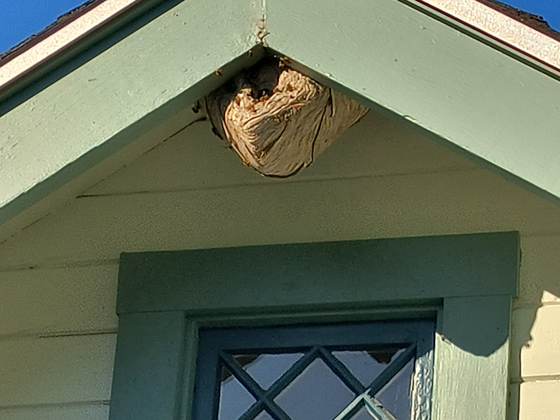
Wasps are slim and smooth, with a sharply pinched waist and a shiny body in bright yellow-and-black. In the Bellingham area, the two you’ll meet most are paper wasps, which build open umbrella-shaped nests under eaves, and western yellowjackets, which nest in the ground or in wall voids and swarm food and drinks in late summer. Unlike honeybees, wasps can sting repeatedly, and yellowjackets in particular are quick to defend their nest.
What exactly is a hornet?
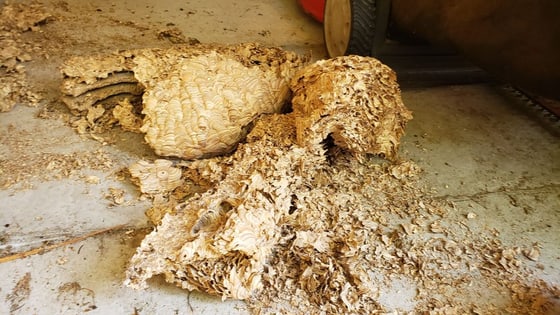
Here’s the part that confuses people: hornets are just a type of wasp — larger, and often more defensive of their nests. The one you’re most likely to see around Bellingham is the bald-faced hornet, which despite its name is a large relative of the yellowjacket. It builds the gray, football-shaped paper nests that hang from trees, shrubs, and eaves, and its colonies can grow large and defend the nest vigorously.
How do their nests differ?
Bee nests
Honeybees build nests of wax comb, usually inside a cavity like a hollow tree, wall void, or chimney. Bumblebees nest in small colonies in the ground or in insulation, and mason bees are solitary, using small holes and tubes. Wax comb is a giveaway that you’re dealing with bees, not wasps.
Wasp and hornet nests
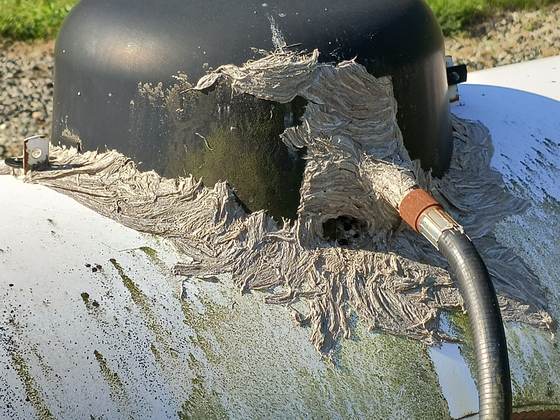
Wasps and hornets build nests out of chewed wood fiber that looks like paper. Paper wasps make open, umbrella-shaped nests with visible cells. Yellowjackets and bald-faced hornets build fully enclosed nests — footballs in the air or hidden chambers in the ground and walls. Paper, not wax, means wasp or hornet.
How does their behavior and sting differ?
Bees are defensive rather than aggressive, and a honeybee sting costs the bee its life, so they sting only when they feel truly threatened. Wasps and hornets are predators that can sting again and again, and they grow markedly more aggressive in late summer and early fall as colonies peak. A wasp’s stinger carries no barb and a colony turns more defensive as it grows and its food supply tightens, both of which UC IPM sets out in its note on social wasps. For anyone with a sting allergy, that seasonal aggression makes early nest removal a genuine safety issue, not just a nuisance fix.
Which of these are common around Bellingham homes?
- Honeybees, bumblebees, and mason bees — beneficial pollinators, protect these
- Paper wasps — open umbrella nests under eaves
- Western yellowjackets — ground and wall nests, aggressive in late summer
- Bald-faced hornets — gray football nests in trees and eaves
What should you do if you find a nest — and do you have to kill bees?
First, identify before you act. If it’s honeybees, don’t spray them — they can often be removed alive and relocated by a beekeeper, and killing pollinators should be a last resort. If it’s wasps or hornets near doors, decks, play areas, or walls, that’s when removal makes sense, and it’s best handled by a professional rather than a can of spray.
Sasquatch focuses on safely removing wasps and hornets while protecting pollinators like honeybees. If you’re not sure what you have, we’ll come out and take a look, tell you what it is, and explain your options in plain English, across Bellingham, Ferndale, Lynden, Blaine, and the rest of Whatcom County.
Common questions
Can a bee sting more than once?
A honeybee can only sting once — its barbed stinger tears free and the bee dies. Bumblebees can sting more than once but rarely do. Wasps and hornets, by contrast, have smooth stingers and can sting repeatedly, which is what makes an aggressive wasp nest more dangerous than a beehive.
Are honeybees protected in Washington?
Honeybees are not classified as a pest, and given how important they are as pollinators, the responsible approach is live removal and relocation by a beekeeper rather than extermination. We do not treat honeybees. When someone calls us about a honeybee colony, we point them toward a local beekeepers association that can take the bees, and we keep our own removal work to wasps and hornets.
What’s the difference between a hornet and a yellowjacket?
Both are wasps, and they’re closely related. Yellowjackets are smaller and typically nest in the ground or in wall voids, while bald-faced hornets are larger and build the gray, football-shaped paper nests you see hanging in trees and under eaves. Both can sting repeatedly and defend their nests.
Do carpenter bees damage homes?
They can. Carpenter bees bore round holes into wood — decks, eaves, and railings — to nest, and repeated use of the same timber can cause cosmetic and structural wear over time. They are much less common in the Bellingham area than in warmer parts of the country, so a large bee hovering near your woodwork is more often a bumblebee. If you see one actually drilling into the wood, it is worth having somebody come out and take a look.
Should I get rid of bees in my yard?
Usually not. Bees foraging on your flowers are beneficial and will move on. Only when honeybees establish a hive somewhere problematic — inside a wall or chimney — do they need to be addressed, and even then live removal by a beekeeper is preferred over extermination.
Who do I call for a bee swarm versus a wasp nest?
For a honeybee swarm or established hive, a local beekeeper can often collect and relocate them, and that is who we will refer you to. For wasps or hornets — paper wasps, yellowjackets, or bald-faced hornets — call a pest professional. If you’re not sure which you have, we can come out and identify it and point you the right direction.
Originally published on our previous website at
/bees-vs-wasps-vs-hornets-identification/. Brought across August 31, 2026, with the text
left as it was written apart from corrections to anything that is no longer
accurate.
Related posts
- Are Black Spiders in Washington State Dangerous? What You Need to Know
- Brown Recluse Spiders: Separating Fact From Fiction in Washington State
- Bumble Bees in Washington State: Essential Pollinators and How to Safely Manage Them
- Carpenter Ants vs Sugar Ants: What's the Difference and Which Do You Have?
- Clover Mites Invading Your Home? Here's What Bellingham Homeowners Need to Know
- Understanding and Combating Flea Infestations in Your Home
Pest problem in Whatcom County?
Family-owned, no long-term contracts, and every treatment is backed by our 100% Service Guarantee.
Most calls in Whatcom County are out within 1–2 days, about 3 during the late-summer peak.
Last updated