
Wasp Nest in a Wall Void
A wasp nest inside a wall void is hidden, and the single worst response is sealing the entrance. A colony blocked from its own doorway will often chew inward through drywall into the room. The nest is treated through the hole it uses, then closed once activity has stopped.
Call 360-410-2199 Request a free inspection
What to do, in order
- Watch the hole from a safe distance on a warm afternoon to confirm a steady two-way stream into the siding or soffit
- Do not foam, caulk, tape or board over the entrance while wasps use it, or they may chew inward through the drywall
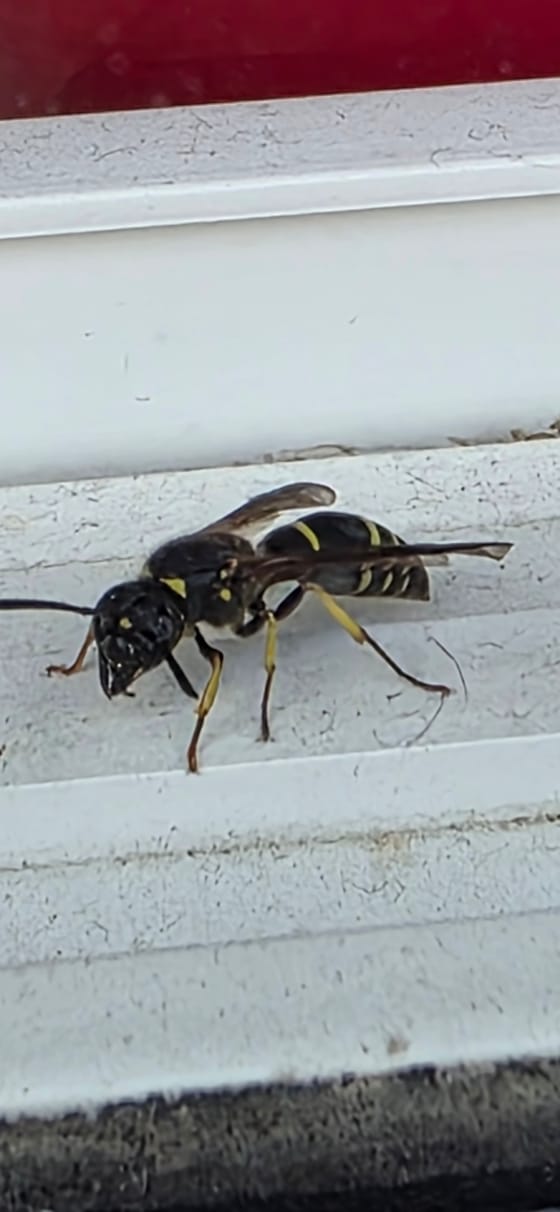
- Photograph the insects from a distance, because honey bees in a wall need a beekeeper rather than treatment
- Keep people off the flight path, close windows on that side, and do no drilling, painting or pressure washing on that wall
- If wasps turn up indoors, keep that room's door shut and still leave the outside hole open
- Call for treatment through the existing hole from outside at dusk or early morning, with sealing on a later visit once traffic stops
What you are looking at
The usual description goes something like this: wasps are going in and out of a small hole in the siding, under a soffit, at the corner of a window trim, beside a dryer vent, or where a cable enters the wall. There is no nest visible. Just traffic.
That is a void nest, and it is one of the more common wasp calls we take here. What has happened is that a founding queen in spring found a small opening in the weather envelope, went through it into the cavity behind, and built inside a space that offers everything a nest needs: enclosure, shelter from rain, thermal stability, and a defensible single entrance.
From the colony’s point of view it is an excellent site. From yours it has three specific problems. You cannot see how big it is. You cannot get to it. And the thing separating it from the inside of your house is a sheet of drywall.
The one thing not to do
We will put this before everything else because it is the mistake that turns a manageable job into a bad afternoon.
Do not seal the entrance while the colony is active.
It is the intuitive response — the wasps are getting in through that hole, so close the hole. What actually happens is that the colony finds itself shut in. Wasps chew. They will work at the material around the blocked opening looking for a way out, and they will take the path of least resistance.
From inside a wall cavity, the path of least resistance is very often not back out through siding, sheathing and your patch. It is inward, through half an inch of drywall, into a bedroom.
We have been called out to exactly this, more than once, and the version where a colony emerges into an occupied room is considerably worse than the version where they were going in and out of a hole in the siding.
The same logic applies to spray foam, caulk, tape, a plug of steel wool, or a board screwed over the opening. The entrance stays open until the colony is dealt with.
Working out what is in there
Before anything is treated, it is worth establishing which insect you have, because the answers diverge sharply.
Yellowjackets are the most common wall-void occupant here. Smooth, bright yellow and black, fast, and arriving in a steady stream at a single point. The colony can be large by late season. UC IPM lists wall voids and other enclosed cavities among their usual nest sites in its pest note on social wasps.
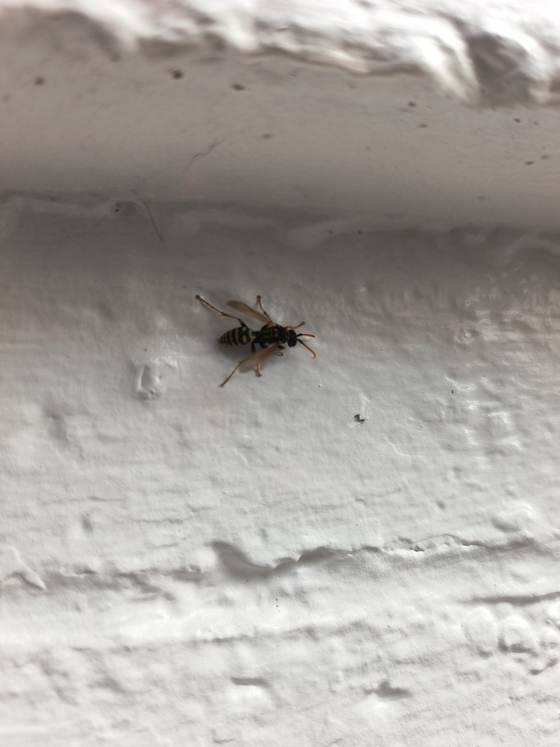
Paper wasps occasionally use a void but more often build the small open nests under eaves and rails. Slimmer, longer-legged, and less numerous.
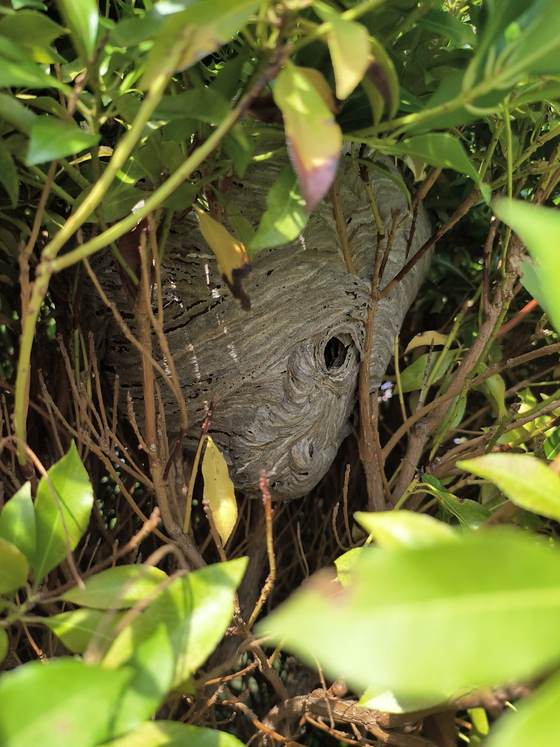
Bald-faced hornets normally build the enclosed gray nests in trees and shrubs and are less likely in a wall, though not impossible.
Honey bees are the important exception. If what is entering your wall is a furry, amber and brown, moderately slow insect arriving in very large numbers, and particularly if the activity has been there for more than one season, that is a honey bee colony and it is a completely different situation. Honey bees are not a pest control job. The colony belongs to a beekeeper, and the comb and stored honey must be removed from the cavity — several pounds of honey left in a wall will ferment, seep through drywall, stain and attract a second wave of insects for years. Treating a honey bee colony in place and walking away is a serious disservice and we will not do it.
Bumble bees sometimes occupy a void, usually low down or under a structure. Large, round, very furry, in small numbers. Generally worth leaving alone; the colony ends naturally.
A photograph from a safe distance usually settles it.
Reading the entrance
The hole tells you things, and you can gather all of it from a safe distance on a warm afternoon.
Rate of traffic. A few insects a minute suggests a small or early-season colony. A continuous stream in both directions suggests something substantial.
Number of entrances. Most void nests use one. Where there are two or three active openings, the cavity is likely to be larger, or connected to other cavities, which matters for how the treatment is delivered.
Height and position. A nest in a soffit at the top of a two-story wall is a different job from one at knee height beside a garage door — access and equipment change.
Where the void goes. This is the part people cannot assess and we can. A stud bay is a contained space. A soffit runs the length of a building and may connect to the attic. A box-out around ducting can connect to several rooms. Whether the cavity is closed or continuous changes both the treatment and the risk.
The material. Wood siding, vinyl, fiber cement, brick veneer and stucco all behave differently, and some of them make sealing afterwards a more involved piece of work than others.
What treatment involves
The approach that works is unglamorous and it is done from outside.
Protective equipment, properly — a suit, veil and gloves. A void nest at an entrance is a defended position and the colony reacts to disturbance at the opening.
Product delivered into the cavity through the entrance, generally as a dust that distributes through the void and onto insects moving through it, rather than a liquid that wets a small area near the hole. The mechanism matters: returning foragers carry material inward, which is how the parts of the colony you cannot reach are affected.
Timing at dusk or early morning, when most of the colony is in the nest.
Then, crucially, waiting. Returning foragers keep arriving for a day or two, and activity should be watched rather than assumed to have stopped. This is why we do not seal on the same visit as we treat, and why anybody who offers to do both in one trip is doing one of them badly.
Sealing last, once traffic has genuinely ended. Done properly, in a material appropriate to the cladding, this is what prevents a new queen choosing the same opening next spring — because a good site tends to be found again.
Whether the nest has to come out
This is the question we get most and the answer is usually reassuring.
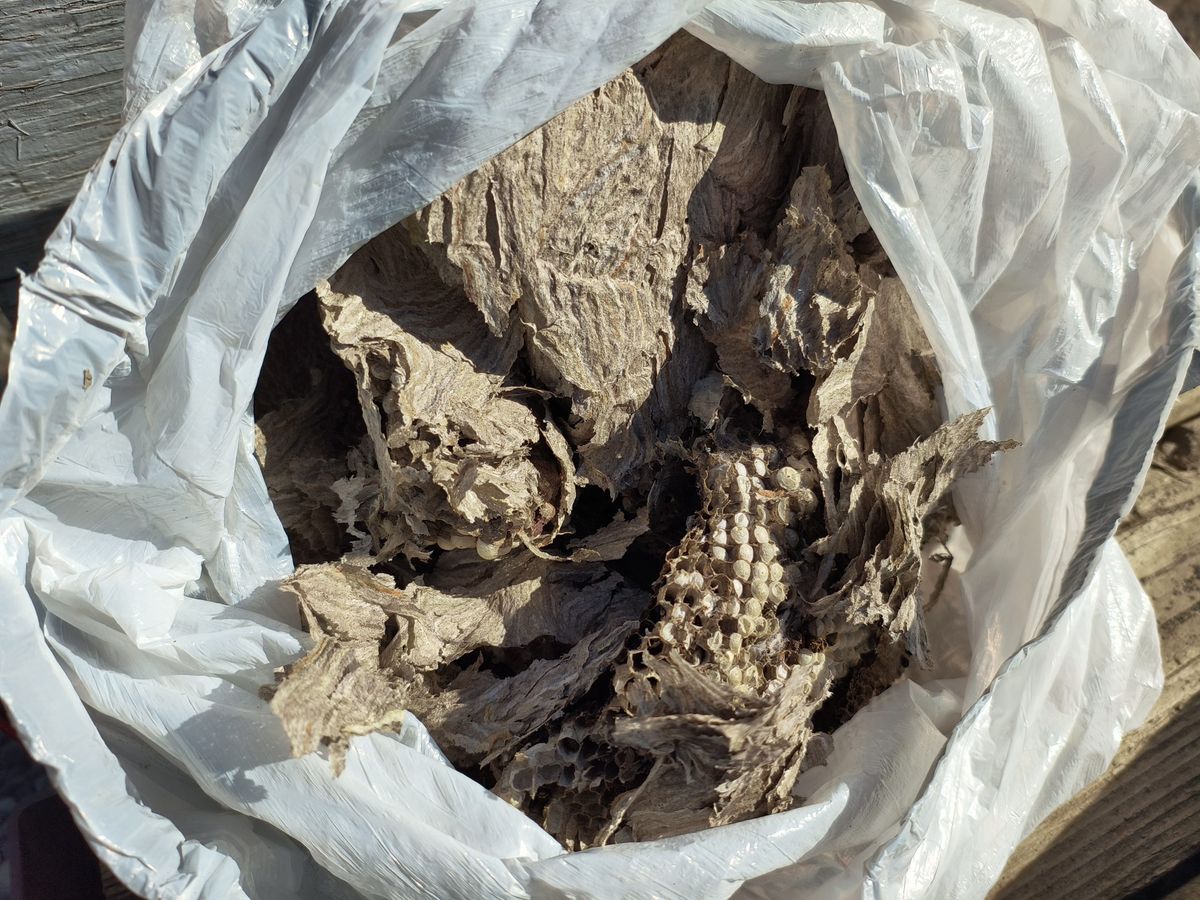
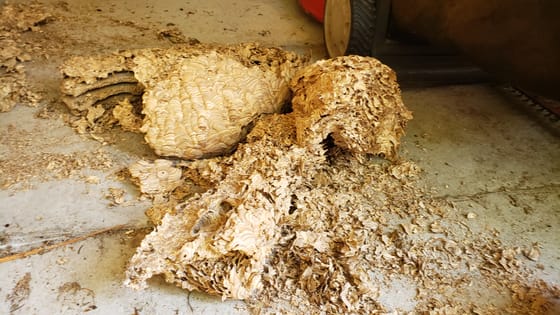
Wasp and hornet nests are made of chewed wood fiber. They are not reused: next year’s queens start fresh somewhere else. Once the colony is dead the nest dries out and becomes an inert papery structure in a cavity, and in the great majority of cases it can simply be left there.
The situations where removal is worth considering: a very large late-season nest where the volume of dead brood produces an odor that reaches the room; a nest in a location where staining is coming through drywall; a cavity that will be opened for other building work anyway; and any nest where secondary insects feeding on the remains are becoming a problem in the room beyond.
And the case where removal is not optional at all: honey bees. Comb and honey in a wall is a genuine building problem, not a cosmetic one.
Where a nest does need removing, that means opening the wall, which is a repair job as much as a pest job. We will tell you honestly whether it is warranted rather than selling the work by default.
Why the wall in the first place
If you want to reduce the chance of this recurring, it helps to know what a founding queen is looking for in April.
She wants a cavity with a small, sheltered, defensible opening. In a typical house here, the candidates are consistent: gaps where siding meets trim; the open ends of hollow vinyl siding and its J-channel; unscreened or damaged gable and soffit vents; the gap at a soffit-to-fascia junction; utility penetrations for dryer vents, heat pump lines, cable and outdoor outlets; the space behind loose or damaged shingles; gaps at a roof-to-wall junction; and openings around window and door frames where the trim has moved.
Almost all of these are small — a quarter inch is plenty — and almost all of them are also rodent entry points, moisture entry points, and heat loss points. Closing them is worth doing for several reasons at once.
The best time to do it is late autumn or winter, when nothing is nesting. The worst time is mid-summer, when you may be sealing something in.
What happens after the colony is gone
There is a second act to a wall-void nest that nobody warns people about, and it is worth knowing so it is not mistaken for a new problem.
A nest contains dead brood, dead adults and the paper structure itself, and that material is food for a small community of scavenging insects. Within weeks of a colony being treated or dying naturally, it is normal to see carpet beetles, larder beetles or small moths appearing in the room adjacent to the cavity — sometimes at a window, sometimes crawling out at a ceiling fitting.
This is not a treatment failure and it is not a new infestation. It is a temporary resource being consumed, and it generally resolves in a few weeks once the material has dried and been used up.
Where it does not resolve, or where the volume is genuinely unpleasant, that is one of the arguments for taking a large nest out rather than leaving it.
A brief odor is also normal, particularly with a large late-season colony, strongest in the first week or two and diminishing after. Persistent odor months later is unusual and worth another look.
None of this applies to honey bees, where the aftermath is not a few weeks of beetles but years of fermenting honey and recurring insect activity. It is the whole reason those colonies must be removed rather than treated.
Multi-unit buildings and rentals
Wall voids in shared buildings raise a practical complication that a single-family house does not.
The cavity behind one unit’s siding frequently runs past a party wall, so a nest entering at one address can be sitting in a void shared with the next. Treatment at one entrance may be the whole answer, or it may leave part of a colony accessible from the other side.
Responsibility is the other issue. In a rental, the exterior envelope is generally the owner’s rather than the tenant’s, and the sealing work that prevents recurrence is a building repair rather than a pest treatment. We are happy to put the finding and the recommended repair in writing so a tenant can pass it on, and we would rather do that than treat the same entrance every August.
Where a building manager coordinates the work across units, it is nearly always cheaper and more effective than each occupant dealing with their own hole. The openings tend to be the same detail repeated along a building, and closing them all at once is one job.
Timing across the season
An early-summer void nest is a small job. The colony is modest, the treatment is straightforward, and the amount of material left in the wall afterwards is negligible.
By late August or September the same nest in the same wall can be a substantially larger colony, more defensive, with more traffic and more insects to affect. The treatment is the same in principle and more involved in practice.
Very late in the season — well into October — the calculation changes again. The colony is naturally ending, the first hard frosts will finish it, and where the nest is in a wall away from doors, windows and outdoor seating there is a reasonable argument for leaving it and simply sealing the entrance in the winter once everything is dead.
We will make that argument where it applies. It is not what most people expect a pest control company to say, and it is frequently the right answer.
When it is inside a room
Occasionally the first sign is not traffic outside but wasps appearing indoors — one or two a day at a window, in a bedroom, in an upstairs hallway.
That usually means the void the nest occupies communicates with the interior somewhere: a gap at a ceiling fitting, an unsealed penetration for wiring, the top of an interior wall where drywall stops short, a recessed light housing, or a poorly sealed attic hatch.
It is worth taking seriously, not because a wasp in a bedroom is dangerous in itself but because it tells you the cavity is not closed to your living space, and because the numbers tend to increase as the colony grows.
If this is happening, keep the room’s door shut, do not seal the exterior entrance, and get it looked at. Sealing the interior gaps is worth doing as part of the work but it is not the fix on its own.
Staying safe while you wait
Most void nests are dealt with within a few days of the call, and there are sensible precautions for the interval.
Work out the flight path — the line wasps take on approach and departure — and keep people off it. A nest ten feet up is often harmless at ground level except directly beneath the entrance.
Keep the area below the entrance clear of things that draw people to it: seating, a barbecue, a bin, a hose reel, a bird feeder.
Do not pressure wash, paint, drill, hammer or run power tools on that wall. Vibration through the cladding provokes a defensive response even without anyone touching the entrance.
Close the windows on that elevation, particularly any within a few feet of the opening.
Tell everyone in the household where it is, including anyone who mows, gardens or does maintenance, and any visiting trades.
If somebody in the house has a known sting allergy, say so when you call. It changes how quickly the work gets scheduled.
What we will not sell you
A same-visit treat-and-seal. Sealing before returning foragers have stopped arriving is either premature or performed on a live colony, and neither is good work.
Wall opening as a default. Cutting into a wall is occasionally necessary and usually not. We will tell you which this is.
Treatment of a honey bee colony. It is the wrong answer to the wrong problem, and it leaves you with a building defect instead of an insect one.
A recurring plan for a seasonal nest. A void nest is a discrete job. It does not need a quarterly subscription attached to it.
Removal of a bumble bee nest that is doing no harm. Small colony, ending naturally, valuable insect. If it is somewhere nobody is at risk, our advice is to leave it.
What we do
We identify the insect first, because honey bees and bumble bees do not get treated and yellowjackets do.
We read the entrance and work out what the cavity behind it is likely to be, which is where knowing local construction earns its keep — a soffit run in a 1960s ranch and a stud bay in a 1990s two-story behave very differently.
We treat from outside, at the right time of day, with the right equipment, and we come back to seal once the traffic has genuinely stopped rather than closing a hole on a live colony.
And we tell you what we think about the nest itself: whether it needs to come out, whether it can stay, and what the other openings on your building look like while we are there.
Assessment is free, there is no term agreement, and if what you have is a honey bee colony or a nest that is three weeks from ending on its own, you will hear that instead of a quote.
Frequently asked questions
Why can I not just fill the hole?
Because the colony is still inside and needs a way out. Wasps blocked at their entrance will work at the surrounding material, and in a wall the softest direction is inward through drywall into your room. We see this happen.
How do I know the nest is in the wall and not outside?
Watch the traffic. Wasps arriving and disappearing into a single small opening in siding, soffit or trim, in a steady two-way stream on a warm afternoon, means the nest is behind that opening rather than on the surface.
Can you tell how big it is without opening the wall?
Not precisely, and we will not pretend to. The rate of traffic at the entrance gives a reasonable indication, and the time of year gives another. Late-season colonies in wall voids can be considerably larger than people expect.
Do you have to cut the wall open?
Usually not. The great majority are treated through the existing entrance, from outside. Opening a wall is a last resort, and where the nest is old and needs removing that is a repair conversation rather than a treatment one.
Does the old nest need to come out?
Often it can stay. Paper nests are not reused and they dry out. Removal matters where a nest is very large, where staining or odor is reaching the room, or where it is a honey bee colony, which is different and much more consequential.
Could it be honey bees instead?
It can, and that changes everything. Honey bees in a wall are a beekeeper's job, not a pest control job, and the comb and honey must come out or it causes serious secondary problems. We will identify which you have.
How soon can something be done about it?
Usually quickly, because the treatment is done from outside and does not need access to your rooms. The follow-up sealing waits until activity has genuinely stopped rather than being done on the same visit.
From the blog
Wasp & Hornet Control in Whatcom County?
Family-owned, no long-term contracts, and every treatment is backed by our 100% Service Guarantee.
Most calls in Whatcom County are out within 1–2 days, about 3 during the late-summer peak.
Last updated