Common Spiders in Washington State
Washington has two spiders of medical significance and the state health department names both: the black widow, which is mainly an eastern Washington animal, and the yellow sac spider. Everything else people find in a Whatcom County house — giant house spiders, hobo spiders, orbweavers, cellar spiders — is harmless, and brown recluses do not live here.
Call 360-410-2199 Request a free inspection
The short version
| Medically significant here | Two, per the state health department: black widow and yellow sac spider |
|---|---|
| Black widow range | Common in eastern Washington; a few small populations west of the Cascades |
| Brown recluse | Does not live in Washington, despite appearing in most national articles |
| Hobo spider | No longer considered dangerous; no evidence its venom causes necrotic wounds |
| Biggest spider in the house | Giant house spider — fast, alarming, harmless, and the one in the bathtub |
| Tiny red spiders | Clover mites, which are mites rather than spiders, and do not bite |
| Spider season | Late August to October, when mature males walk indoors looking for females |
- Count the legs and the body parts: eight legs and two body sections is a spider; eight legs and one blob is a mite or a harvestman.
- Measure it honestly against a coin rather than against the fright — most spiders people describe as huge are under an inch in the body.
- Photograph it from directly above, in focus, rather than trying to identify it from memory later.
- Check the web before the spider: a flat sheet with a funnel, a messy tangle and a neat wheel are three different animals.
- Ask whether it is indoors in autumn. A wandering male in September is normal and temporary.
- If you want a name, send us the photograph. We identify for free and tell people to leave most of them alone.
What you are actually likely to have
Nearly every spider call we take in Whatcom County turns out to be one of six animals, and five of them need nothing done about them at all.
Giant house spider — the big fast brown one, in the bathtub, in the garage, crossing the floor at nine in the evening in September.
Hobo spider — a close relative, similar enough that nobody identifies it by eye reliably, and no longer considered medically significant.
Cross orbweaver — the one that builds the perfect wheel across the back door overnight and sits in the middle of it with a pale cross on its abdomen.
Cellar spider — the pale, spindly one in the corner of a garage ceiling with a messy tangle of a web. The thing people call a daddy long legs.
Yellow sac spider — small, pale, usually spotted on a ceiling or a wall at night, and one of the two in the state worth a second look.
Clover mites — not spiders at all, but they arrive by the hundred and everybody searches for them as tiny red spiders, so they get a section here.
The rest of this guide takes them one at a time, says which is which, and is honest about the two that genuinely matter and the one that does not live here.
Do black widow spiders live in Washington state?
Yes, but almost certainly not where you are standing. The Washington State Department of Health describes black widows as common to eastern Washington, with a few small populations west of the Cascades. The animal is a dry-country species and the eastern half of the state suits it.
Whatcom County does not. In our own work here we do not find them, and we do not get calls that turn out to be one. The honest position is that a western Washington black widow is possible rather than expected — the state’s own wording allows for small western populations, and spiders travel in freight, firewood, plant deliveries and moving loads like everything else.
What a real one looks like is not subtle. The adult female is glossy jet black, round-bodied, roughly a half-inch in the body, and carries the red hourglass on the underside of the abdomen. She hangs upside down in a tangled, strong, slightly crackly web, usually in something undisturbed and sheltered at ground level — under a woodpile, in a meter box, inside a rarely used outbuilding, in the back of a crawlspace vent well.
The health department’s own description of the risk is calmer than the reputation: the venom is dangerous, but the spider will usually try to escape rather than bite unless she is guarding eggs.
If you are east of the mountains and you find one of these in the garage, treat it seriously. If you are in Ferndale and you have found a shiny black spider, the overwhelming likelihood is that it is a young orbweaver or a false black widow, and we would far rather look at a photograph than have you reach for anything. That profile covers the difference in detail, because it is the spider behind nearly every widow question we are asked.
Giant house spider, the big one in the bathtub
The giant house spider is the single most common source of alarm in this county and the single most harmless.
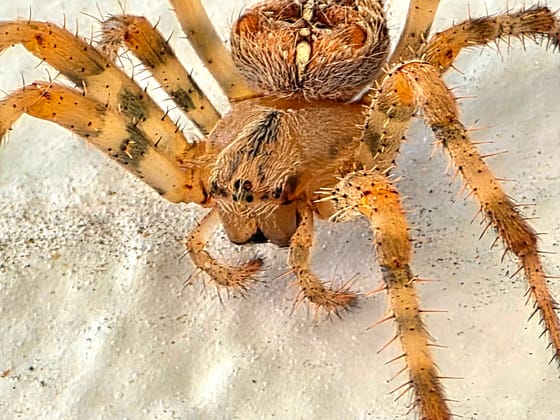
It is brown, hairy, with long banded legs, and a leg span that can reach the size of a drink coaster in a mature male. It builds a flat sheet web with a funnel retreat at one edge — in a garage corner, under a workbench, behind stored boxes, in a crawlspace. It is fast in a straight line and it stops dead, which is the behavior that makes people jump.
It is in the bathtub because it fell in. The glaze is unclimbable and the drain is a dead end, so a spider that went looking for water or for a female in the night ends up stranded in the bottom of the tub, where it is found at seven in the morning by somebody who did not want to find it.
It does not bite people in any meaningful sense, it has no medically significant venom, and it eats a great many other things you would like less.
Hobo spider, and the reputation it did not deserve
The hobo spider spent two decades on American pest control websites as a flesh-rotting menace, and it is not one.
The Washington State Department of Health now states that hobo spiders are not considered dangerous as previously thought, and that there is no evidence hobo spider venom has caused skin necrosis or necrotic wounds in people. That is a state health authority retracting a claim, which is rarer than it should be.
The identification problem is separate and it is real. WSU Puyallup published a whole bulletin on it — how to identify, or misidentify, the hobo spider — and the short version is that you cannot do it from a photograph, or from the chevron markings people are told to look for. It takes magnification and the right anatomy. Anyone naming a hobo spider confidently from a phone picture is guessing.
Which matters mostly because the two facts combine well: it is very hard to tell a hobo spider from a giant house spider, and since neither is dangerous, it has stopped being a question worth answering urgently. The whole business is on is this a hobo spider.
Yellow sac spider, and yellow spiders in Washington state
The yellow sac spider is the other one the state names as medically significant, and it is the one most people have never heard of.
It is small — a quarter-inch body — pale straw or greenish-cream, with a slightly darker stripe down the abdomen and dark tips to the jaws. It does not build a catching web. It hunts at night across walls and ceilings and spends the day in a small silk sac in a corner, a curtain fold or a ceiling junction. Those little white sacs in the angle of a ceiling are the usual sign.
The bite is genuinely painful and produces a red, sore, slow-healing mark. It does not produce the dramatic tissue loss the internet attributes to it, and a great many lesions blamed on this spider are something else entirely. The state health department records it in eastern Washington and in the Seattle area; it is present here, and it is the spider most likely to bite somebody in bed, because people roll onto one that has come down a wall.
Other yellow spiders in Washington. The one people photograph in the garden is usually the goldenrod crab spider — bright lemon or white, sitting motionless with its front legs held open on a flower head, waiting for a bee. It is an ambush hunter, it changes color slowly between yellow and white to match the flower it is sitting on, and it is harmless to people. Young cross orbweavers can also look strikingly yellow before they darken.
Cross orbweaver, the wheel across the doorway
If a perfect wheel of a web appeared across your back door overnight in September, this is what made it.
The cross orbweaver is the classic garden spider here: a fat round abdomen in brown, orange or cream, with a pattern of white dots that reads as a cross. It builds a new orb most nights, sits head down in the middle of it, and takes it apart and eats it again before morning.
It is harmless. It is also one of the best things in a garden, and the sensible response to one across a doorway is to move the web rather than the spider — break one anchor line with a stick and it will rebuild a foot to the left that night. Knocking it down every morning for a fortnight achieves nothing except making the spider rebuild, which costs it a great deal and costs you nothing.
Cellar spider, or daddy long legs, and the venom myth
The pale spindly thing in the corner of the garage ceiling with legs like threads is a cellar spider, and it is the subject of the most durable spider myth in circulation.
The claim is that it has the most powerful venom of any spider but fangs too short to break human skin. The Burke Museum at the University of Washington keeps a standing page on it, because it is the myth they get asked about most: daddy-longlegs would be deadly, and the short answer is that nobody has ever shown it to be true.
Part of the confusion is that three different animals share the name. The long-legged thing on the outside wall of a shed with one single body segment is a harvestman — an arachnid, but not a spider, and it has no venom at all. The long-legged thing bouncing off a lamp is a crane fly, which is an insect. The pale one in the ceiling corner with a messy web is the actual cellar spider.
All three are harmless, which makes the myth unusual: it is wrong about the venom, and it is frequently also wrong about which animal is being discussed.
Tiny red spiders, which are not spiders
Hundreds of bright red specks on a sunny windowsill, a south-facing wall or a concrete patio in spring or autumn, that leave a red smear if you wipe them.
Those are clover mites, and WSU PestSense describes them as occasional household pests that feed on clover and grasses, do not bite people or animals, and cause no structural damage. The red smear is body pigment, not blood.
They come from lawn growing right up against the building, and they come in numbers because that is how they live outdoors. They cannot feed or breed indoors and die within a day or two. The two useful responses are both outdoors: vacuum rather than wipe the ones inside, because crushing them stains grout, paint and curtains, and keep a band of bare ground or gravel between the turf and the wall so there is nothing to walk in from.
They are also the reason tiny red spiders is one of the highest-volume spider searches in the country while being almost entirely not about spiders. There is more on them, including what to do about a wall that gets them every year, on the clover mite profile.
Black spiders in Washington state, in order of likelihood
This is the search people make when they have found something dark and want to know whether to worry. In this county, running from most to least likely:
A young giant house spider or hobo spider. Immature individuals are much darker than the adults and are far and away the most common answer.
A false black widow. Glossy, round-bodied, dark brown to near-black, in a messy tangle web in a garage or crawlspace. This is the spider most often reported to us as a black widow. It has no hourglass — at most a pale crescent or collar at the front of the abdomen — and it is harmless.
A ground or wolf spider that came in under a door. Dark, stocky, hairy, fast across the floor, no web at all. It is lost, not resident.
A young cross orbweaver, which can be very dark before its pattern shows.
A jumping spider. Small, black, often with white markings, moves in deliberate hops and turns to look at you. Harmless and rather good company.
An actual black widow sits at the bottom of that list in Whatcom County, not the top, and the glossy jet-black body with the red hourglass underneath is not a judgment call when you see one.
When is spider season in Washington?
Late August to the middle of October, and nothing has gone wrong when it happens.
What changes in autumn is not the number of spiders in the building; it is their behavior. The large house-dwelling species mature at the end of summer, and the males then abandon their webs and walk, sometimes for weeks, looking for females. A male that spent his whole life in a crawlspace corner is suddenly crossing the living room floor in the open at nine in the evening. He was there in July. He was just not walking about.
A warm summer with good insect numbers reliably produces a heavier autumn, for the straightforward reason that more spiderlings survived to maturity. The season ends when the males have finished, which is usually within six weeks.
The practical consequence is that nothing treated in October changes the next six weeks much. What changes them is door sweeps, window screens and exterior lighting, done in August. That is covered in full on spiders appearing every fall.
What is not here, whatever the internet says
Brown recluse. The state health department states that brown recluse spiders do not live in Washington. There is no established population anywhere in the state. Specimens arrive occasionally in freight or in somebody’s belongings from the Midwest and do not persist. Nearly every recluse bite diagnosed in this state turns out to be a bacterial skin infection, and the medical literature on that is extensive and unkind to the spider.
Black widows in the quantity people expect. Covered above: an eastern Washington animal with a small western foothold, not a Whatcom County one.
Tarantulas, funnel-webs and the rest of the material in national articles. The Pacific Northwest Insect Management Handbook’s section on spiders is the regional reference, and the list it covers is short.
We mention this because a national pest control article that lists five dangerous spiders and then sells you a treatment is describing a country rather than a county, and the difference is most of the fear.
When a spider is actually worth treating
Rarely, and we will say so before we quote.
Spiders walk on the tips of their legs and do not groom themselves the way an insect does, so they pick up far less residue from a treated surface than a cockroach or an ant. A perimeter application has a real but modest effect on them, and most of what it does achieve is indirect — reducing the insects they came in to eat.
What actually works is mechanical, and most of it is not a pest control purchase. Sweeping webs down and continuing to do it. Door sweeps that meet the threshold. Screens intact. Gaps at utility penetrations closed. And the one people resist: moving exterior lights away from doors, or switching them to warm color temperatures, because a bright white light above a back door is an insect trap and the spiders are simply following the food.
We do treat for spiders in a few honest situations — a heavy orbweaver load on a commercial building’s loading face, a crawlspace being worked on anyway, a property where somebody has a genuine phobia that is affecting their life, or a confirmed yellow sac population in a bedroom. The rest of the time the right answer is a vacuum, a list of gaps, and the knowledge that it stops in October.
If you want a name for something before you decide, send us a photograph. We identify for free, we will tell you when there is nothing to do, and that is most of the time. The full service page is at spider control.
Frequently asked questions
Are there black widow spiders in Washington state?
Yes, but mainly in the east. The state health department describes black widows as common to eastern Washington with a few small populations in the west. In Whatcom County they are not something we find on jobs, and they are not a call we get.
What is the big brown spider in my bathtub?
Almost certainly a giant house spider. It is the largest spider most people here ever see indoors, it is fast, and it is harmless. It is in the bathtub because it fell in chasing something and cannot climb the glaze back out.
Are hobo spiders dangerous?
Not as previously thought. The Washington State Department of Health states there is no evidence hobo spider venom has caused skin necrosis in people. The necrotic reputation came out of a small number of studies decades ago and has not held up.
Do brown recluse spiders live in Washington?
No. The state health department says plainly that brown recluse spiders do not live in Washington. Specimens are occasionally carried here in freight or luggage, but there is no established population, and almost every reported bite turns out to be something else.
What are the tiny red spiders on my windowsill?
Clover mites, which are mites rather than spiders. They are the size of a pinhead, bright red, and arrive in numbers in spring and autumn from lawn and grass right against the building. They do not bite and they cannot survive indoors.
Is it true daddy long legs have the strongest venom?
No. The Burke Museum lists it among the most persistent spider myths there is. Nobody has ever demonstrated it, the claim is usually applied to three different animals at once, and the cellar spider in your garage is not a danger to anybody.
When is spider season in Washington?
Late August through October. Males of the large house-dwelling species reach maturity at the end of summer and leave their webs to look for females, which is why spiders suddenly appear indoors, in the open, moving fast, for about six weeks every autumn.
Should I have my house sprayed for spiders?
Usually not. Spraying a baseboard does very little to a spider that walks on the tips of its legs and does not groom like an insect. Removing webs, sealing gaps and fixing the exterior lighting does considerably more, and that is what we recommend first.
Sources
- Washington State Department of Health — Spiders — read November 11, 2026
- WSU Puyallup (PLS-116) — How to Identify, or Misidentify, the Hobo Spider — read November 11, 2026
- Burke Museum, University of Washington — Spider Myths: daddy-longlegs venom — read November 11, 2026
- WSU PestSense — Clover mites — read November 11, 2026
- Pacific Northwest Insect Management Handbook — Spiders — read November 11, 2026
Rules change. This page is scheduled for review against its sources by November 11, 2027. If you are reading it after that date and something looks out of step with the current rule, the rule is right and we are wrong — please tell us.
Related guides
Pest problem in Whatcom County?
Family-owned, no long-term contracts, and every treatment is backed by our 100% Service Guarantee.
Most calls in Whatcom County are out within 1–2 days, about 3 during the late-summer peak.
Last updated