
Yellowjackets in the Lawn
Yellowjackets nesting in the ground are the wasp situation most likely to injure somebody on a residential property, because the nest stays invisible until a mower or a foot disturbs it, and the colony defends an underground entrance in numbers and follows whoever disturbed it a surprising distance.
Call 360-410-2199 Request a free inspection
What to do, in order
- Stand about twenty feet back on a warm day and watch for the flight line that drops into one hole in the ground
- Mark the spot with a cane or bucket several feet away, never at the hole, and tell anyone who mows or does yard work
- Do not pour gasoline or boiling water down the entrance, block it, or go at it with a flashlight at night
- If the mower hits a nest, keep moving away, get children and pets indoors, and leave the mower there for the day
- Treat many stings, trouble breathing, swelling away from the sting or widespread hives as a medical emergency first
- Let a late-season nest in a far corner die with the frosts; call us when one sits by a mowing line, path, play area or someone with a sting allergy
The nest you cannot see
Every wasp situation on a residential property has its own character. A paper wasp nest under an eave is visible, small and usually manageable. A hornet nest in a tree is unmissable. A yellowjacket colony in the ground is neither, and that is precisely what makes it the one we take most seriously.
There is nothing to see. The entrance is a hole in the ground, frequently under an inch across, in a lawn, a bank, a border, a compost area or the untended margin between mown grass and rough ground. The colony itself may be a foot below, in a cavity that started as a rodent burrow and has been expanded through the season.
Which means nobody knows it is there until something disturbs it. Usually a mower. Sometimes a string trimmer, a rake, a wheelbarrow wheel, a dog, or a child running across a lawn.
And unlike most stinging insects, ground-nesting yellowjackets respond to disturbance at the entrance with a coordinated defense in numbers. They are capable of stinging repeatedly, they release alarm pheromone that recruits more of the colony, and they will follow a retreating person a considerable distance.
That combination — invisible, defended, and reached by accident — is why this is the wasp problem most likely to produce a serious injury on a domestic property in this county.
Where the nests are
Yellowjackets choose sites with a particular set of qualities, and once you know them you can predict where a nest will be on most properties.
Abandoned rodent burrows. By far the most common. The cavity already exists, it is the right size, it drains, and it has a defensible entrance. Any property with vole or mouse activity in the ground has candidate sites everywhere. UC IPM’s yellowjacket pest note names the old rodent burrow as the typical starting point for a ground colony too.
Banks and slopes. Sloped ground drains well and offers a horizontal entrance that stays dry. The bank at the edge of a lawn, the side of a ditch, the embankment along a driveway, and the cut behind a retaining wall are all classic.
Under structures at ground level. Sheds, decks, steps, porches and outbuildings on skids or blocks create a protected space with soil beneath.
In root plates and beneath stumps. The void left as a root system decays is ideal.
Under stored material. Timber piles, pallets, tarps, stacked pots and anything that has been sitting on the ground for a season.
In the untended margin. The strip between a mown lawn and a fence line, hedge or treeline is disturbed rarely and offers cover, which is why so many nests are found there in the week somebody finally decides to tidy it.
In retaining walls and rockeries, using the voids between stones.
Reading the year
The seasonal curve is the single most useful thing to understand about yellowjackets, because it explains almost everything people notice.
In spring a single overwintered queen starts the nest alone. Through early summer she raises the first workers, and the colony is genuinely small — a few dozen insects. It is present and it is easy to miss entirely.
Through July and August the colony grows steeply. Workers forage for protein to feed developing larvae, which is when they take an interest in barbecues, pet food and anything meat-based.
By late August and September the colony reaches maximum size — depending on species and conditions, that can be several thousand individuals — and the dietary preference shifts toward sugar, which is when they arrive at fallen fruit, sweet drinks, bins and outdoor eating in numbers.
This peak coincides exactly with the weeks people are outside most and doing the most yard work. That is not a coincidence in any meaningful sense, but it does explain why almost every serious sting incident we hear about happens in a four-week window at the end of summer.
With hard frosts the colony dies. Only newly mated queens survive, dispersing to overwinter elsewhere, and the nest is not reused.
Finding the entrance safely
If you suspect a ground nest, the way to confirm it is to watch, not to look.
Stand well back — twenty feet is comfortable — with the sun behind you or the light across the area rather than in your eyes. Mid-morning through afternoon on a warm day gives the most traffic.
Watch for a consistent flight line. Foraging yellowjackets do not wander toward a nest; they come in on a repeated path and drop into a single point. Two minutes of watching will usually resolve the entrance precisely.
Mark it from a distance. A garden cane pushed into the ground several feet away, or a bucket set down as a landmark, is enough. Do not put a marker at the hole itself.
Then keep everybody away from it. Rope off the area if children or pets use that part of the garden, and tell anybody who does yard work exactly where it is.
What not to do: never poke, dig, probe, uncover or shine a flashlight directly into a suspected entrance to check. That is the action that converts a manageable situation into an emergency.
Why the home remedies are a bad idea
There is a well-established folk repertoire for ground nests and every item in it puts a person directly over an angry colony.
Pouring gasoline or fuel down the hole. Genuinely dangerous, environmentally serious, contaminates soil, and does not reliably kill the colony. It also requires you to stand at the entrance for several seconds.
Boiling water. Rarely reaches the nest chamber, definitely reaches the wasps at the entrance, and leaves you at close range holding a full kettle.
Aerosols from the hardware store. These work on a visible nest at a distance. On a ground nest they deliver product to the top few inches of a tunnel while the colony below is unaffected and now alerted.
Blocking the hole. Yellowjackets will excavate a new exit, and in a nest under a structure that new exit sometimes opens into a building rather than outside.
Doing it at night with a flashlight. The reasoning is sound — the colony is home and less active — but a light held at the entrance gives an agitated colony a target to fly at, and you are working in the dark next to an obstacle course.
We have been called to enough badly stung people after each of these to say plainly that none of them is worth it.
What removal involves
Done properly, a ground nest is treated rather than excavated, and the equipment matters more than the technique.
Protective gear first: a proper suit, veil and gloves, not a jacket and sunglasses. Yellowjackets find gaps.
Treatment is generally a dust or an appropriately formulated product delivered into the entrance and the tunnel so that returning foragers carry it into the nest chamber. Depth and tunnel geometry decide how straightforward that is; a shallow nest in an open lawn is quick, and a colony a foot down behind a retaining wall is not.
Timing is deliberate — early morning or dusk, when the largest proportion of the colony is in the nest rather than out foraging.
Then the site is left alone for a period rather than immediately disturbed, because returning foragers continue to arrive for a day or two. Digging the nest out immediately is unnecessary and provocative.
And afterwards, where the site was a rodent burrow or a persistent structural void, closing or filling it reduces the chance of the same spot being chosen next year.
When leaving it alone is the right answer
We will say this on site and we will say it here: not every ground nest needs treating.
If the nest is well away from where anybody walks, works or plays — in a woodland margin, a far field boundary, a bank nobody crosses — and there is no realistic prospect of accidental disturbance, then leaving it is legitimate. The colony dies with the frosts and does not return to that hole.
If it is late in the season and the nest is marginal in position, the same calculation applies with more force, because you are only waiting a few weeks.
Yellowjackets are also, for what it is worth, substantial predators of other insects through the summer, and a colony in a far corner is doing more good than harm.
What changes the answer is proximity and traffic. A nest within range of a mowing line, a path, a play area, a shed people use, a dog run, or anywhere somebody works with power equipment is a different proposition, and so is any nest where a member of the household has a known sting allergy. In those cases it comes out.
If a nest has already been disturbed
This happens most often mid-mow, and the response matters.
Move away immediately and keep moving. Do not swat, and do not stand still to assess. Yellowjackets will pursue, and alarm pheromone marks whoever disturbed the nest.
Get indoors, or into a vehicle, and stay there. Get children and animals in first.
Leave the equipment where it is. A mower parked over an entrance can be retrieved later; nobody should go back for it that day.
Expect the area to stay dangerous for several hours, and possibly through the following day. The colony does not settle quickly.
If somebody has been stung multiple times, or shows any sign of a reaction beyond local pain and swelling — difficulty breathing, swelling away from the sting site, dizziness, widespread hives — that is a medical emergency and needs emergency care immediately rather than a phone call to us.
Telling them apart from the things they get confused with
Several insects nest in or near the ground here and only some of them are worth treating, so identification is worth a moment.
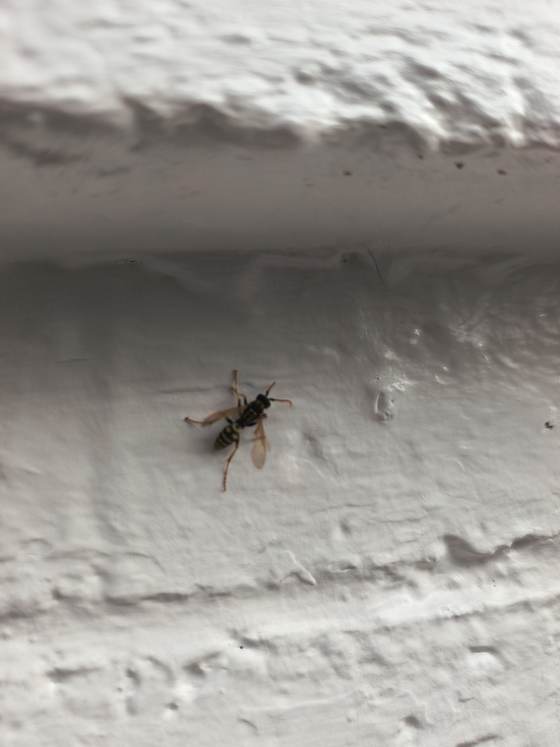
Yellowjackets are the ones this page is about: bright yellow and black, smooth-bodied with very little hair, fast, and defensive at the nest entrance. Traffic in and out of a single small hole in numbers is the signature.
Bumble bees also nest in the ground and in cavities, frequently in old rodent burrows, under sheds and in compost. They are large, round and densely furry, and the colony is small — dozens rather than thousands. They are important pollinators, they are not aggressive away from the nest, and the colony dies out naturally in late summer. We will not treat a bumble bee nest that can reasonably be left, and we will say so.
Mining and solitary bees produce small mounds of fine soil with a central hole across a lawn in spring, often many of them in one area. They look alarming because of the number, they are almost entirely harmless, they do not defend a colony, and they are gone within weeks. Treating them is a waste of money and a loss to the garden.
Honey bees occasionally occupy a ground cavity or a wall void. These are not a pest control job; a swarm or an established colony is a beekeeper’s business, and we will point you to one rather than treat.
Paper wasps build the small open-celled nests under eaves and rails rather than in the ground, and they are markedly less defensive.
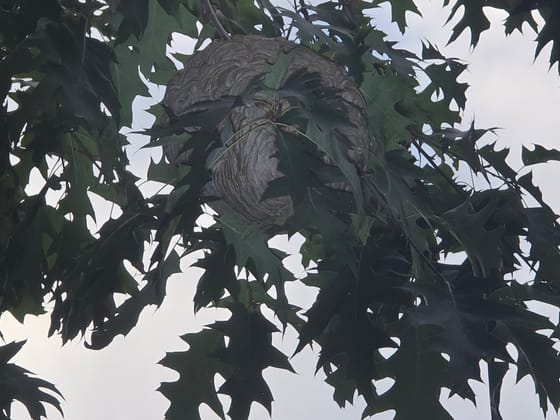
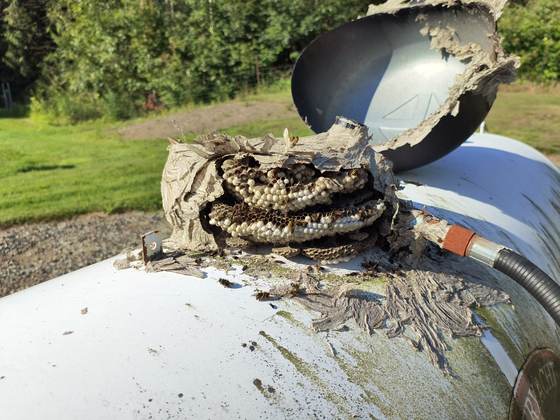
Bald-faced hornets build the large enclosed gray nests in trees and shrubs. Different insect, different job, same family.
If you can photograph the insect from a safe distance, or describe the size, shape and how furry it is, we can usually tell you on the phone which of these you have and whether it needs anything doing at all.
Reducing the odds next year
A few practical measures genuinely lower the number of ground nests on a property.
Walk the ground in late spring, when colonies are small and a queen founding a nest is much easier and safer to deal with than a mature colony in August. This is the single most effective habit and almost nobody does it.
Deal with rodent burrows, since they are the preferred site. A property with a managed rodent situation has fewer ready-made cavities.
Keep the margins tidier — the strip along a fence line or treeline that never gets attention is where nests go undetected longest.
Remove or lift stored material off the ground, and turn or move anything that has been sitting in the same place since spring.
Manage the food sources that concentrate foragers near living areas: lidded bins, fallen fruit picked up, pet food not left out, and drinks covered at outdoor tables in late summer.
And know where last year’s nest was, because the site conditions that suited a colony once will suit another.
Farms, acreage and working properties
A ground nest on a working property is a different risk calculation from one in a suburban back garden, and a good share of this county is working property.
The exposure is higher. Field margins, ditch banks, fence lines and equipment yards are exactly the ground yellowjackets prefer, and they are also where somebody is operating machinery, clearing brush or handling stock. A nest struck by a tractor or a brush cutter puts a person in a worse position than a mower does, because getting clear takes longer.
Livestock and working dogs complicate it further. Animals cannot be told where the nest is, and a horse or a dog that disturbs a colony can be stung repeatedly before anybody can intervene.
Outbuildings add sites. Barns, equipment sheds, feed stores and anything on blocks or skids create protected ground voids in numbers, and the margin around them is rarely walked.
The practical approach on acreage is different from a single-nest call. It is worth walking the working areas in early summer rather than waiting for an incident, marking what is found, and dealing with the nests that sit on routes people and animals actually use — while leaving the ones in far field corners alone. That is a smaller bill than treating everything and a better outcome than treating nothing.
If you have staff, seasonal help or contractors on the property, telling them where known nests are is worth as much as any treatment.
Do the traps help?
Hanging traps are the most common thing people buy for this, and the honest answer is that they have a narrow use.
A trap draws wasps toward it. That is the mechanism. Placed close to a patio or a door it therefore concentrates foraging insects exactly where you did not want them, which is why some households find traps make their late summer worse rather than better.
Placed well away from where people sit — at the far edge of a property, downwind, between the nest and the house — a trap can pull some traffic away from a seating area. That is a genuine but modest benefit.
What a trap will not do is reduce the colony. A mature nest produces workers far faster than a trap removes them, and catching a few hundred foragers does not change what is happening underground.
The spring-queen argument, that trapping in April removes founding queens before they establish, has some logic to it and thin evidence behind it. It is cheap, it does no harm, and we would not promise you a result from it.
Our view: traps are a comfort measure for outdoor eating, positioned away from people, and nothing more. They are not a substitute for dealing with a nest that sits on a mowing line.
What we do
We locate the nest properly, assess the access and the depth, and treat it with the right equipment at the right time of day.
We also walk the rest of the property, because where there is one ground nest there are often others, and finding the second one before a mower does is worth more than treating the first.
You get a straight account: where the nests are, which ones warrant treatment and which can be left, what the work involves and what it costs. Assessment is free, and we would rather tell you a late-season nest in a far corner is not worth your money than take the job.
Frequently asked questions
How do I find the entrance without getting stung?
Watch from a distance in good light. Traffic in and out converges on a single hole, and a steady stream of insects arriving on the same line will show you where it is from twenty feet away. Never probe the ground to look.
Can I pour something down the hole?
Please do not. Gasoline, boiling water and hardware store foams all put you directly over an entrance you have just angered, at close range, usually in the dark. This is the single most common way people get badly stung.
Why are they so much worse in August?
Because the colony has been growing all summer and peaks in late August and September. A nest that was thirty wasps in June can be several thousand by the end of the season, and defensiveness scales with it.
Will they die off in winter anyway?
Yes. The colony collapses with the first hard frosts and only mated queens survive, elsewhere. If a nest is somewhere nobody goes and it is already late in the season, leaving it alone is sometimes the right answer.
The mower went over it and now they are everywhere. What now?
Get everyone and any pets indoors and stay in. Disturbed ground colonies stay agitated for hours and will pursue further than you expect. Do not go back for the mower until it has been dealt with.
Do they come back to the same hole next year?
The same nest is not reused, but the same site often is, because the conditions that suited them — a bank, a rodent burrow, good drainage — are still there. It is worth knowing where last year's was.
What does it cost to have you deal with it?
We will quote when we have seen it, because access and depth change the work considerably. Assessment is free, and if the honest answer is to leave a late-season nest alone, that is what we will tell you.
From the blog
Wasp & Hornet Control in Whatcom County?
Family-owned, no long-term contracts, and every treatment is backed by our 100% Service Guarantee.
Most calls in Whatcom County are out within 1–2 days, about 3 during the late-summer peak.
Last updated