
Great Golden Digger Wasp — Sphex ichneumoneus
Sphex ichneumoneus · Stinging insects
A large wasp with rust-orange legs hauling a paralyzed katydid across bare ground is a great golden digger wasp. She is solitary, she digs a burrow in dry sandy soil, and she does not defend it. We do not treat these, and we will say so rather than sell you a service.
Call 360-410-2199 Request a free inspection
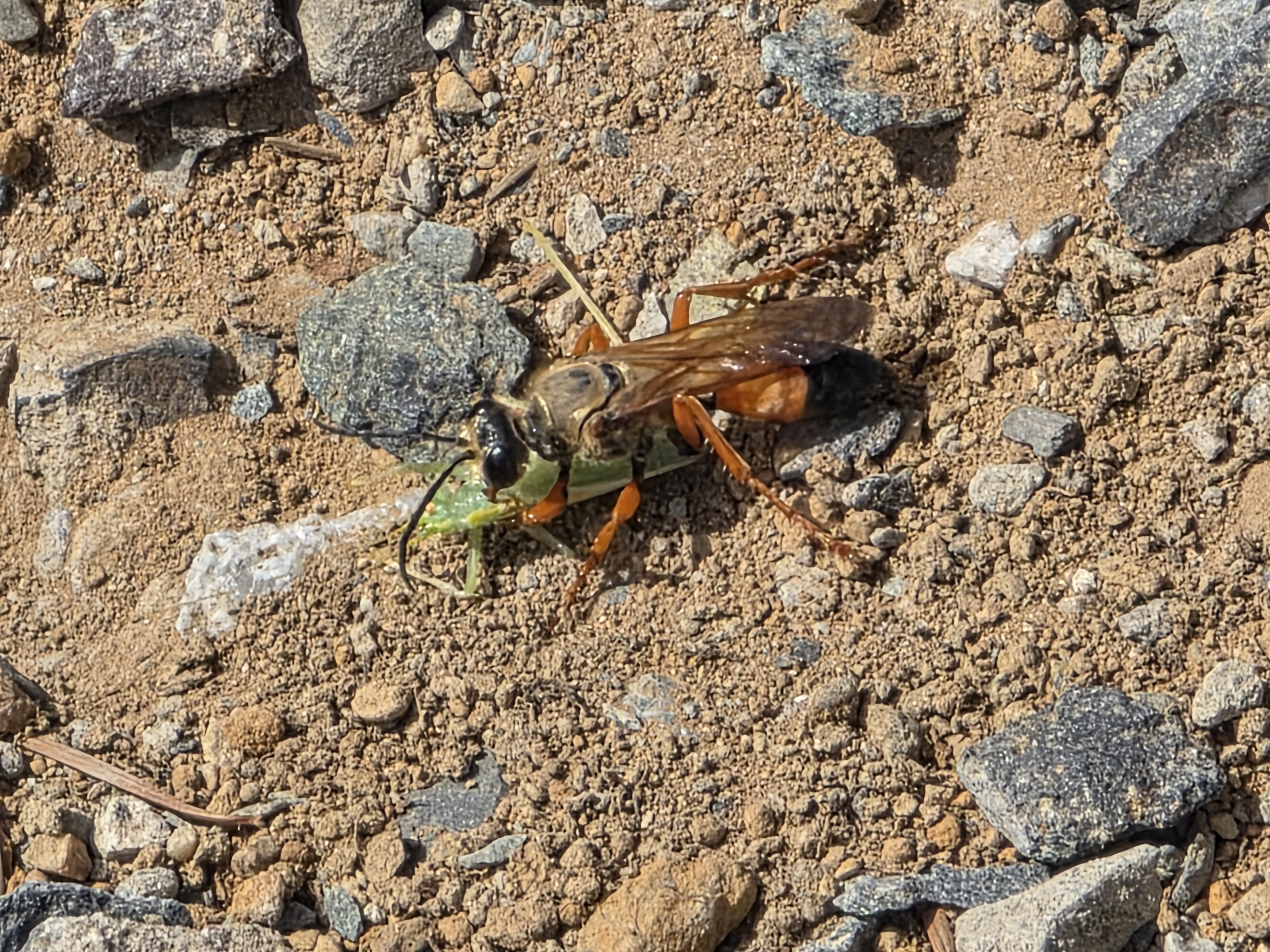
We do not treat this. Where to go instead is below.
Great golden digger wasp at a glance
| Size | Large — big enough to carry a katydid several times her own bulk |
|---|---|
| Color and markings | Rust-orange legs, orange abdomen with a dark rear, smoky wings, short golden hair on the thorax |
| How to tell it from a yellowjacket | One orange-legged female working alone, not a stream of banded yellow and black wasps from one hole |
| Nest | A single vertical burrow in dry, warm, sandy or gravelly ground with sparse cover |
| When you see it | Roughly July into early September here, peaking in the hottest, driest weeks |
| Stings | Generally will not — solitary, with no nest to defend |
| Do we treat it | No — a beneficial predator and flower visitor; we will say so rather than sell a service |
Signs you have them
- A large orange-legged wasp dragging a paralyzed katydid or cricket across a driveway or path
- A neat round hole, pencil to finger width, in bare ground with a small fan of soil beside it
- Burrows along a gravel drive edge, a sandy bank or the bare strip beside a shed or slab
- A single wasp loosening soil and backing out of the hole to scatter it clear of the entrance
What it looks like, and why it worries people
Big. That is the first thing. A great golden digger wasp is large enough to carry a katydid, which means she is large enough to make anybody step back when she lands on a driveway.
The coloring is distinctive once you have seen it: rust-orange legs, an orange abdomen with a dark rear, smoky wings, and a thorax covered in short golden hair that gives the species its name. Nothing else here that size looks like it.
She is solitary, and that is the whole safety answer
Every genuinely dangerous stinging insect on this site is social. A yellowjacket or a bald-faced hornet has a colony, workers whose job includes defense, and a nest worth dying for. That is what makes an accidental approach expensive.
A digger wasp has none of that. One female, one burrow, no workers. She gains nothing by stinging a person and loses her afternoon’s work. Field observers describe watching them from a few feet away without any reaction — solitary wasps, as the University of Wisconsin’s field station puts it, are frequently pretty laid-back.
The burrow and the soil
She digs a vertical tunnel with cells at the bottom, and where she digs it is particular. The nesting research on this species is about site selection: well-drained soil of moderate compactness, avoiding substrate loose enough to collapse and ground packed too hard to work. In practice that means sandy or sandy-loam ground, warm, with sparse vegetation.
That soil requirement is why this is mostly an eastern Washington insect and why finding one here is worth recording rather than assuming a misidentification. Most of western Whatcom County is too wet for her. Pockets of it are not — a dry gravelly bank, a sun-baked driveway edge, the sandy shoulder of a track — and that is where ours was photographed, working a burrow in exactly that substrate with a paralyzed katydid.
Why we will not treat it
Because there is nothing to treat. She is a solitary predator of katydids and crickets, she visits flowers as an adult, she will not defend a nest, and the season is short. A pesticide application here would be sold on the strength of her size and nothing else.
If she is nesting somewhere genuinely awkward — the middle of a path a child uses barefoot, say — say so and we will talk about it. Most of the time the right advice is the cheapest one, which is to watch her work.
The katydid, and what paralyzed means
The footage above shows the part people find hardest to believe. She is dragging a katydid several times her own bulk across open gravel, and the katydid is not dead.
She stings it in the nerve centers that control the legs. The venom does not kill; it disables. The insect stays alive, fresh and entirely immobile, and it will remain that way for weeks. That matters because a dead katydid would rot long before a wasp larva finished eating it, and a live one would climb out of the burrow.
She hauls it to the tunnel, takes it down, lays an egg on it, and closes the cell. The larva hatches, eats the provision, spins a cocoon and overwinters underground. One female does all of that alone, several times over, in a season that lasts a few weeks.
Whatever else anybody thinks about wasps, that is a remarkable piece of work to watch happening on a driveway.
Watching one work
If you find her, the sequence is worth two minutes of anybody’s time, and it is entirely safe to stand and watch.

She lands short of the burrow with the prey, sets it down, and goes into the tunnel alone — apparently checking it. She comes back out, takes the katydid by the antennae, and drags it in headfirst. Between trips she does maintenance: loosening soil, backing out with a load, scattering it clear of the entrance.
She is entirely uninterested in the person standing over her. That is not bravado on the observer’s part; it is what solitary wasps are like, and it is the single most convincing demonstration of the point the rest of this page is making.
The burrow, and what it looks like from above
A neat round hole, roughly pencil to finger width, in bare or thinly vegetated ground, often with a small fan of excavated soil beside it. The tunnel runs down several inches and branches into cells at the bottom.
There may be several burrows in the same patch of good ground. That is worth understanding properly, because it is where people go wrong: several solitary females nesting near each other because the soil suits them is not a colony. There is no shared nest, no queen, no workers, and no collective defense. It is a good neighborhood, not a hive.
The one confusion that actually matters
There is a ground-nesting wasp in this county that is genuinely dangerous, and telling it apart from this one is the most useful thing on this page.
Western yellowjackets nest in the ground in large colonies. The entrance looks superficially similar — a hole with traffic in and out. Everything else is different. A yellowjacket is banded yellow and black, thick-bodied, an inch or less, and there will be a steady stream of individuals coming and going rather than one animal working alone. Disturb that nest with a mower or a spade and you will be stung repeatedly by insects whose job is to sting you.
A great golden digger wasp is bigger, unmistakably orange-legged, and there is one of her. She carries katydids in; yellowjackets do not carry anything that size.
If you cannot tell which you have, do not test it by disturbing the hole. Send us a photograph from a safe distance, or call. The distinction is quick for us and there is no charge for making it.
Cicada killers are the other large ground-nester people ask about — larger still, black with yellow markings, and they provision with cicadas. Same solitary temperament, same lack of interest in people. This region has far fewer of them than the eastern states do.
Where she nests, and why that is usually the whole problem
The soil requirement is strict enough that her burrow is nearly always in one of a few places: a gravel drive edge, a sandy bank, a path, a dry sunny border with thin cover, the bare strip beside a shed or a slab.
That is why she gets noticed. She has chosen exactly the ground people walk on, and the same qualities that make it good tunnelling — dry, warm, compacted but workable, sparsely vegetated — are what make it a path in the first place.
Which also points at the only real preventive measure. If a specific patch of bare ground is being used year after year and it genuinely cannot be shared, planting it, mulching it heavily or otherwise removing the bare warm surface will make it unattractive. She wants exposed soil. Cover it and she goes elsewhere.
That is a landscaping change, not a treatment, and it is the only intervention on this page we would encourage.
Adults eat nectar
Worth saying, because it changes how people think about her.
The prey is for the larvae. The adult female feeds on nectar, and she visits flowers to do it — which makes her a pollinator in the plain sense of the word, alongside being a predator of the insects that eat garden plants.
So the animal being reported as a menace is, in the same season, pollinating and controlling katydid numbers. That is not a sentimental argument. It is the reason “we do not treat these” is a technically correct answer rather than a soft one.
The season here
Short. Adults are on the wing in the warm part of summer, roughly July into early September in this county, with the peak of provisioning in the hottest, driest weeks.
By autumn the adults are gone. The next generation is underground in cocoons and emerges the following summer. Nobody needs to do anything about the winter, and a burrow found in October is already finished.
That brevity is part of the answer to “should I do something”. A treatment applied in August is applied to an insect that has weeks left regardless.
What not to do
Do not pour anything down the burrow. Gasoline, diesel, bleach and boiling water all circulate as folk remedies for ground-nesting insects. Fuel poured into soil is a genuine contamination problem, it is unlawful to use a product in a way inconsistent with its labeling, and none of it is necessary here.
Do not treat it because it is big. Size is not a hazard signal in wasps and the largest ones in this region are among the least defensive.
Do not let somebody sell you a perimeter treatment for a ground nester. A residual sprayed on a foundation does not affect an insect that tunnels in a driveway edge and hunts in vegetation.
Do not disturb a hole you cannot identify. That is the yellowjacket distinction above, and it is the one mistake here that can genuinely hurt.
When we would actually do something
There is a version of this that warrants intervention and we would rather name it than pretend there is none.
If burrows are in the middle of a path a child uses barefoot, in a sandpit, or in the one patch of ground somebody with a serious sting allergy has to cross daily, that is a real conflict rather than a squeamish one. Even then the first answer is usually physical — cover the ground, reroute the path, mulch the strip — because it lasts and a treatment does not.
Tell us the actual situation and we will tell you honestly whether it is one of those. Most are not.
What a visit for this looks like
We identify the insect first, and on a ground nest that is the whole job in most cases: confirm it is a solitary digger and not a yellowjacket colony, which is a two-minute observation and the difference between “leave it” and “this needs handling today”.
Then we look at where the burrows are relative to how the property is used, and whether the bare ground can reasonably be covered.
Then, usually, we tell you there is nothing to buy. If you called us out for this and that is the answer, we are not going to invent a reason to charge for a visit.
What we will not sell you
We will not treat a solitary ground-nesting wasp because a customer found it alarming. If we did that we would be charging for the size of an insect.
We will not describe her as aggressive, or as a threat, or as an infestation. One female with a burrow is none of those things and the words matter.
And we will not use the alarm around this one to sell a program aimed at something else. If what you actually have in the ground is a yellowjacket colony, that is a different page, a different answer and a job we will take seriously.
The other solitary ground-nesters here
She is not the only insect that puts holes in bare ground, and the others get reported to us under the same description. Sorting them is quick.
Mining bees are the most common call by a wide margin. In spring, dozens or hundreds of small holes appear in a lawn or a sparse bank, each with a little cone of soil, and each with a bee coming and going. They are solitary bees, each female with her own hole, gathering pollen rather than hunting. They are gentle to the point of being difficult to provoke, the whole business lasts a few weeks, and the ground closes over afterwards. Nothing needs doing, and treating a lawn for them destroys a significant local pollinator population for a temporary cosmetic complaint.
Thread-waisted wasps of the genus Ammophila are slimmer relatives of the digger wasp with a long stalked waist and a red band, and they provision with caterpillars rather than katydids. Same solitary habit, same indifference to people.
Sand wasps are stouter, often with pale banding and green eyes, and they nest in loose sandy ground, sometimes in loose groupings. They hunt flies.
Bee flies are not wasps at all — furry, hovering, no sting — and turn up around mining bee holes because their larvae develop at the bees’ expense.
All of them are solitary, none of them defends a nest, and the answer for the whole group is the same as the answer on this page.
Photographing one for identification
Since the entire practical question is “is this the harmless one or the dangerous one”, and since nobody should be approaching a hole to find out, a photograph is usually the right first move.
Get the whole insect in frame rather than a close-up of part of it. Color of the legs and the shape of the waist do most of the identification work.
If you can safely include the nest entrance in a shot, do — a neat single hole in bare soil says something different from a hole in a bank with a stream of insects going in and out.
Note whether it is carrying anything. Prey is diagnostic: a katydid means this species, a caterpillar means Ammophila, a fly means a sand wasp, pollen on the legs means a bee.
And note whether you are watching one animal or many. That single observation separates every solitary species on this page from every colony that matters.
Send it and we will tell you what you have, without a visit and without a charge. We would far rather answer that in a message than have somebody find out by putting a spade into a yellowjacket nest.
What to tell whoever mows
The single most useful thing anybody can do about ground-nesting insects is tell the person operating the machinery where the holes are.
Almost every serious stinging incident we hear about in this county started with a mower, a strimmer or a tractor going over a nest nobody had marked. That is true of yellowjackets, which is the dangerous case, and it is worth extending to this one for a different reason: a digger wasp burrow is destroyed by a pass of a mower, and there is no need to destroy it.
Mark the spot with a cane, a flag or an upturned pot, tell whoever cuts the grass, and mow around it. On a property where the work is contracted out, say it at the start of the season rather than after somebody has found the nest the hard way. It costs nothing. For the harmless species it saves a nest that will be finished within weeks, and for the dangerous one it prevents the accident.
If she nests in the same place next year
She may, because the ground is what she chose it for, and a returning female is a sign the soil suits rather than a sign of an escalating problem. There is no accumulating nest and no growing colony. Each season is a fresh female doing the same short piece of work, and a burrow that reappears in the same bank three summers running is three separate insects rather than one expanding population.
Frequently asked questions
Is it dangerous?
No. She is solitary, which is the whole answer. There is no colony behind her and nothing to defend, so she has no reason to sting a person and generally will not. Observers routinely watch these at close range while they work. Her sting is for paralyzing katydids.
It is dragging a green cricket. What is it doing?
Provisioning a burrow. She stings a katydid or cricket into paralysis, hauls it back to a tunnel she has dug, seals it in a cell with an egg, and the larva eats it. Katydids and crickets are the favoured prey. The dragging is the part people see, because she does it in the open and it takes a while.
There are holes in my lawn or driveway edge. Should I fill them?
You can, but there is little point mid-season and no need at all. These are single-female burrows, not a colony, and the nesting season here is short. Filling one just makes her dig another.
Do you treat them?
No. They are solitary, beneficial, non-aggressive predators of Orthoptera and they visit flowers as adults. There is nothing here that warrants a pesticide, and we would rather say so and lose the call.
Are these not an eastern Washington insect?
Mostly they are, and the regional literature describes them as little known west of the Cascades until fairly recently. What they need is well-drained sandy or sandy-loam soil that warms up, and western Whatcom County has pockets of exactly that even though most of it is too wet. We have photographed one working a burrow in that kind of substrate here.
Sources
- University of Wisconsin–Milwaukee Field Station, Bug of the Week — Great Golden Digger Wasp (Family Sphecidae) — read September 9, 2026
- Brockmann 1979, Ecological Entomology 4(3) — Nest-site selection in the great golden digger wasp, Sphex ichneumoneus L. (Sphecidae) — read September 9, 2026
- Wikipedia — Sphex ichneumoneus — read September 9, 2026
Rules change. This page is scheduled for review against its sources by September 9, 2027. If you are reading it after that date and something looks out of step with the current rule, the rule is right and we are wrong — please tell us.
Pest problem in Whatcom County?
Family-owned, no long-term contracts, and every treatment is backed by our 100% Service Guarantee.
Most calls in Whatcom County are out within 1–2 days, about 3 during the late-summer peak.
Last updated