
Aerial Yellowjacket
Dolichovespula arenaria · Stinging insects
The aerial yellowjacket builds an enclosed gray paper nest in a shrub, a tree, an eave or a void, and it is yellow rather than black and white. That combination gets it mistaken for a bald-faced hornet by its nest and for a ground yellowjacket by its color.
Call 360-410-2199 Request a free inspection
Sometimes worth treating, sometimes not — it depends on what is below.
Aerial yellowjacket at a glance
| Size | Workers about half an inch, with a blunt abdomen; queens larger, seen mainly in spring and autumn |
|---|---|
| Color | Yellow and black bands, stout-bodied — the coloring of a ground yellowjacket |
| How to tell it from a bald-faced hornet | Same kind of gray paper nest, but the insects are yellow and black, not black with ivory-white markings |
| Telling it from a ground yellowjacket | It nests above the ground, so there is no entrance hole in the lawn to find |
| Nest | Enclosed gray paper envelope, entrance at the bottom; often smaller, lower and less tidy than a hornet nest |
| Stings or bites | Extremely defensive at the nest, and defenders sometimes bite and sting at once |
| At your table | No — it does not turn scavenger in late summer |
| Do we treat it | Depends on where the nest is; a high, out-of-the-way nest can be left alone |
Signs you have them
- A gray paper nest inside a dense hedge or shrub, often found by a hedge trimmer
- A paper nest tucked under a soffit, deck, porch roof or shed rafter
- Yellow and black wasps flying a steady line to a point above waist height
- Two-way traffic at the underside of a nest on a mild afternoon
- Wasps using a gap in a soffit, siding or an unscreened gable vent
The species in the middle
Whatcom County has two famous wasps and one that does most of its work without a name anybody uses.
The famous ones are easy to describe. There is the black and white insect with the gray football in the tree, and there is the yellow one that comes out of a hole in a lawn when the mower goes over it. Between them sits Dolichovespula arenaria, which has the nest of the first and the coloring of the second, and which consequently gets called whichever of the two the person looking at it noticed first.
That is not a trivia problem. It is a practical one, because the two misidentifications send people down two different wrong paths, and both of them waste time in a season where time matters.
This page is about what it actually is, what each mistake costs, and the thing that genuinely decides whether a nest is a problem — which is not the species at all.
What it is
A yellowjacket, in the strict sense — same subfamily, same enclosed paper architecture, same annual colony. WSU Hortsense lists it among the state’s common social wasps as one of the species with relatively stout bodies and distinct yellow and black banded coloring.
The Northeastern IPM Center puts workers at about half an inch, with a blunt abdomen and yellow and black banding, and notes that queens are larger and rarely seen except in spring and again in autumn. In the hand, or on a decent photograph, it looks very much like the ground-nesting species that dominates this county’s sting statistics.
Its genus, though, is the one it shares with the bald-faced hornet rather than the one it shares with the ground nesters. That single fact predicts almost everything else about it: where it builds, what it eats in September, and how it behaves when something knocks its nest.
The nest, and why it will not settle the question
An envelope of gray paper wrapped around several tiers of comb, with the way in at the bottom. UC IPM’s description of the aerial nesters covers both species at once — paper nests attached to the eaves of a building or hanging from the limb of a tree, with the entrance normally a hole at the bottom of the nest — and WSU’s bulletin says the same thing of both, in trees or on the outside eaves of buildings.
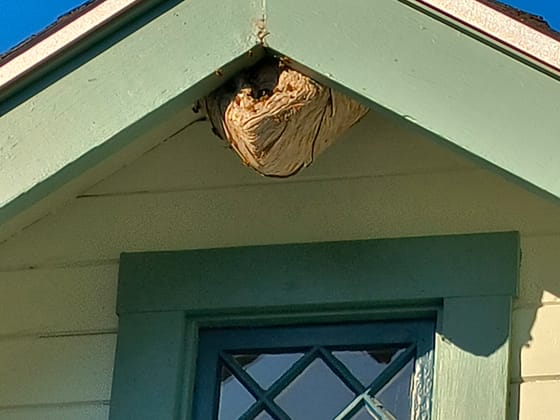
Which means the sentence people most often use when they call us, “there’s a big gray paper nest,” identifies a genus and stops there.
Some working differences do exist, and they are tendencies rather than rules. An aerial yellowjacket nest is usually the smaller of the two, and it is more often found low — in the body of a shrub, tight under a rail, inside the shelter of a porch — where its relative more often goes high into a tree. And the envelope is frequently less tidy, with a more irregular, layered, papery surface.
But if you want to know which one you have, look at an insect rather than at the structure. Yellow and black bands is this page’s species. Black with ivory-white markings on the face and body is the other one. There is no overlap and nothing subtle about it.
The first mistake: calling it a hornet
Somebody sees the paper nest, calls it a hornet nest, and adjusts their behavior to match a reputation.
The costs here are mild but real. It produces a level of alarm out of proportion to the situation, which occasionally leads to a bad decision made in a hurry — knocking a nest out of a shrub, spraying it from directly underneath, going up a ladder in a hurry to deal with something that had been quietly ignoring the household all summer.
It also skews expectations about size. Penn State describes bald-faced hornet colonies reaching one hundred to four hundred workers over a summer, and an aerial yellowjacket nest is typically a smaller structure than that. Neither is in the same league as the several thousand workers WSU records in a mature ground-nesting western yellowjacket colony. The visible nest is rarely the biggest colony on a property.
The one thing the hornet framing gets right is caution at close range, and that part is deserved.
The second mistake: hunting for a hole in the lawn
This one costs more, and we hear it several times a year.
Somebody identifies a yellow and black wasp correctly as a yellowjacket, goes looking for what every article about yellowjackets in the Pacific Northwest describes — an entrance in the ground, in a bank, in an old rodent burrow — and finds nothing, because there is nothing to find. The wasps are coming out of a paper nest in a laurel eight feet away, or from under the eave above the person’s head.
Two things follow from that dead end. Time gets lost during the weeks when the colony is growing fastest. And the ground-nest playbook gets applied to a situation it does not fit: people pour things into holes that are not the nest, they flood a bank, they mark a spot that has nothing in it, and they conclude that the treatment failed when nothing was ever treated.
Worse, the search itself puts somebody crouched over the ground, moving slowly, directly beneath a nest they have not noticed.
The corrective is simple. Before looking down, look up, along the eave line, into the dense middle of every shrub within thirty feet, under the deck rail and the porch soffit, and inside any open outbuilding. Watch the traffic instead of the ground — a flight line that converges on a point above waist height belongs to this species or its black and white relative.
Where it puts the nest
The Northeastern IPM Center’s observation is the important one for this county: this species will build in voids as well as trees, and in closer proximity to human activity than its relatives. That is the difference that matters, and it is why an aerial yellowjacket nest is more likely than a bald-faced hornet nest to be somewhere that forces the issue.

The recurring positions on property here:
Inside a dense shrub or hedge. Laurel, boxwood, escallonia, an overgrown rhododendron, a conifer hedge that has not been cut in two years. The nest sits in the middle of the mass where nothing shows from outside, and it is found by a hedge trimmer.
Under a soffit or a deep eave, tucked back against the wall where the overhang keeps the rain off. Frequently above a window.
Beneath a deck, a porch roof or a stair landing, attached to joists or the underside of decking.
In an open shed, a barn, a carport or a covered moorage, hanging from a rafter or a truss, in a space people walk into.
Against a gable end or in the angle of a roof-to-wall junction.
Inside a void. A soffit run, a boxed-out corner, a gap behind loose siding, an unscreened gable vent. This is where the species stops behaving like an aerial nester and becomes a wall-void job, with all the complications that carries — an invisible colony, an unknown cavity and a strict rule against sealing the entrance while anything is alive.
Low, in long grass at the base of a shrub or against a bank, which happens often enough that a nest at ankle height is not a reason to rule the species out.
That range — canopy to ankles, open air to closed cavity — is the reason no single answer applies to it.
How it behaves, near the nest and away from it
Near the nest, this is not a species to take liberties with. UC IPM’s language for the aerial nesters is that they are extremely defensive when their nests are disturbed, and it adds a detail specific to this one that is worth carrying around: defending individuals of D. arenaria sometimes bite and sting simultaneously.
That is not a folk exaggeration. It is a documented behavior, it is unpleasant, and it explains why people who have been through this describe the experience as worse than a yellowjacket sting rather than equivalent to one.
The disturbances that trigger it are mostly mechanical rather than personal. Cutting or shaking the plant the nest is in. A ladder set against the same wall. A pressure washer on the elevation. Hammering, drilling or nail-gunning on framing the nest is attached to. Slamming a shed door under a rafter nest. In almost every case the person had no idea the nest was there.
Away from the nest, the picture is entirely different, and it produces the one piece of good news on this page.
It is not the wasp at your table
UC IPM draws a line between the two groups of yellowjackets that almost nobody outside the field knows about: the aerial nesters do not become scavengers at the end of the season.
The ground-nesting species change diet as the colony matures and the brood stops supplying the adults with sugar, and that is what puts them on plates, in cans, around bins and into fallen fruit from mid-August. This species does not make that change. The Northeastern IPM Center describes adults feeding on nectar while workers hunt soft-bodied insects such as caterpillars for the larvae, and that stays the pattern.
The practical translation is worth reading twice, because it saves people money every year.
If wasps are bothering an outdoor eating area, the paper nest you can see is almost certainly not the source. Treat it and the problem at the table continues, because the colony causing it is in the ground or in a wall somewhere you have not looked. A visible nest is a convenient target and frequently the wrong one.
And a nest in a shrub at the back of a property is doing predatory work on flies, caterpillars and other soft-bodied insects for the whole season, without any of the scavenging nuisance that makes its ground-nesting cousins intolerable in September.
That combination — defensive at the nest, useful away from it, and not implicated in the late-summer food problem at all — is why so many of these nests are genuinely fine where they are.
Watching a nest from the ground
Once a paper nest has been found, almost every question worth asking about it can be answered from thirty feet away with no equipment and no risk. It is worth doing before anybody decides anything, because the answers change the recommendation.
Is it live? Stand back on a mild afternoon and watch the underside for two or three minutes. A working colony produces steady two-way movement at the entrance. An empty envelope produces nothing at all, no matter how long you wait, and a nest that has been finished for a while usually shows a ragged tear somewhere in the side where a bird has been at the brood.
How busy is it? A few insects a minute is an early or a small colony. A continuous stream in both directions in August is a mature one, and it changes how much room you want to give it.
Where is the flight line? Workers leave and return along a repeated path rather than wandering. Watching for a minute shows you which side of the shrub, which end of the deck or which stretch of path actually sits in the traffic — and that is frequently a much narrower strip than people assume, which means carrying on using most of the garden is a reasonable thing to do.
Is there more than one entrance? Rare on an open nest, and worth knowing on a void nest, where two or three active openings suggest a larger or connected cavity.
Is there a second nest? Where there is one, there is often another, and the second is usually found by looking rather than by being stung.
What not to do while watching: no throwing, no poking with a pole, no hose, no flashlight held up at the entrance after dark, and nothing that shakes whatever the nest is attached to. Binoculars and patience get you everything on this list.
The year, and what happens to the nest
One season, start to finish, like everything else in this group.
A queen that mated the previous autumn and overwintered somewhere sheltered starts alone in spring. Her first brood is all workers, and once they emerge they take over the building and the foraging while she does nothing but lay. The Northeastern IPM Center describes exactly that sequence, and adds the ending: late-season brood becomes new queens and males, only the fertilized females survive the winter, and the rest of the colony does not live to see cold weather.
WSU’s bulletin is unambiguous about what happens to the structure. The abandoned nests decompose and disintegrate over the winter, and they are not used again.
So the paper nest still hanging in a bare hedge in January is an empty object. Nothing is in it, nothing will be in it, and it will fall apart on its own. It is not a colony waiting for spring, it is not a reason to treat anything, and anybody selling a winter nest removal as pest control is selling you gardening.
What can repeat is the site, not the nest. A sheltered eave, a dense hedge or a dry rafter is attractive to a founding queen for the same reasons two years running, so a property that produced a nest last year is a reasonable place to walk in late April looking for a new one the size of a golf ball. Dealing with one at that stage is trivial, safe and the highest-value thing anybody can do about this species.
Nest position is what decides the job
This profile carries a verdict of depends, and it is the same verdict as its two relatives for the same reason: the species is not what decides. Position is. Sort the nest into one of these and the answer follows.
High and away. Well up in a tree, in a shrub at the far boundary, under a barn eave nobody passes. Nothing needs doing. The colony ends with the cold and does more good than harm before it does.
Low and reachable. In a hedge at chest height, in a shrub beside a path, at the top of a fence line somebody leans on. This is the version that produces injuries, because the disturbance arrives before the discovery does. It comes out.
On the building, near an opening. Under a soffit above a door, over a window that needs to open, above the steps. Access is usually straightforward and the proximity settles it.
Inside a structure people use. A shed, a garage, a carport, a boathouse. An enclosed space removes the option of backing away calmly, and the sensible interim measure is to stop using the building until it is dealt with.
In a void. No longer an aerial nest in any practical sense. The colony cannot be seen or measured, the cavity may run further than anybody thinks, and the entrance must be left open until the colony is finished. That case is covered in full on wasp nest in a wall void.
Anywhere at all, if somebody in the household reacts badly to stings. That takes it out of the realm of judgment.
And the seasonal overlay applies to every one of those. A marginal nest found in the third week of September has a few weeks left in it, and waiting is a real option that costs nothing. The same nest in the third week of June has the whole growth curve ahead of it, and dealing with it then is a smaller piece of work in every dimension.
What the work involves
Enclosed nests are treated as a unit, and the details differ from the ground-nest method more than people expect.
Protective equipment appropriate to a target at or above head height, because the response to an aerial nest comes outward in every direction rather than up out of a single hole.
The right hour, which is early morning or after dusk, when the population is concentrated inside the envelope rather than spread across the neighborhood.
Delivery through the entrance at the base and into the interior, from a position that is not directly beneath it, with equipment matched to the height. The species-specific note here is the shrub case: a nest inside dense foliage cannot be seen well and cannot be approached quickly, and the foliage itself is the thing that must not be moved.
A wait afterwards, because returning foragers keep arriving for a day or so and nothing is pulled down while that is still happening.
Then removal of the envelope where it makes sense — on a building, where left in place it sheds material and marks the finish, and in a shrub where somebody is going to have to prune eventually. In a tree it is optional.
Where the nest turned out to be in a cavity, the sequence gains a step: the opening is closed only after activity has genuinely stopped, and closing it before then is the mistake that puts wasps in a bedroom.
Reducing the odds next year
None of this involves treating anything, and all of it works better than anything that does.
Prune in winter. Dense unmanaged hedging and shrubs that have grown into a solid mass are the exact structure a queen wants in April. Ordinary maintenance cutting, done in the cold months, removes sites and carries no risk.
Walk the eaves and the open outbuildings in late spring, when a nest is the size of a walnut and contains a single insect.
Screen the vents and close the gaps in soffits, gable ends and siding, which takes the void option away entirely and does the same for rodents and cluster flies. That is exclusion and repairs work and late autumn is the time for it.
Note where last year’s nest was. The site is what recurs.
Keep the outbuildings visited. The nests that become dangerous are almost always in structures nobody entered between May and August.
Around the county
Sudden Valley, Geneva and the Lake Whatcom shore. Mature ornamental plantings run into native cover, and the shrub nest is the local version — found by somebody clearing an overgrown boundary in August.
Older Bellingham streets. Open soffits and porch roofs on small lots. This is where the void version turns up, and where a nest under an eave is automatically near a window.
Lynden, Everson, Nooksack and Sumas. Rafters in open barns, implement sheds and equipment shelters, where the encounter happens inside a building rather than in a garden.
Blaine, Birch Bay and Semiahmoo. Covered moorage, boat storage and seasonal properties, with the added complication that the person who finds it is often on a dock or a ladder.
Barkley, Cordata and newer hillside stock. Young landscaping offers little, so nests concentrate on the structures: deck framing, vented soffits and the ornamental shrubs against the front elevation.
Related work
The full seasonal picture and how the work is scheduled sit on wasp and hornet control. The black and white relative that builds the same kind of nest is the bald-faced hornet, and the aerial nest in a tree is covered in detail on bald-faced hornet nest in a tree. If the wasps turn out to be coming from the ground after all, that is the western yellowjacket and yellowjackets in the lawn. An open comb with visible cells and no covering is not this species at all — see European paper wasp.
Frequently asked questions
There is a paper nest hanging in my hedge. Is that a hornet nest?
Not necessarily. Both aerial species here build an enclosed gray envelope, so the structure alone will not tell you. If the wasps coming out of it are banded yellow and black rather than black with white markings, it is this species.
Why can I not find the hole in the lawn?
Because there may not be one. People who identify a yellow and black wasp reach for ground-nest advice and start hunting an entrance in the grass. This species nests above the ground, so the search is looking in the wrong plane entirely.
Are they as defensive as the ground-nesting ones?
At the nest, yes. UC IPM describes aerial nesters as extremely defensive when their nests are disturbed, and notes that defending individuals of this species sometimes bite and sting at the same time, which is unusual and worth knowing before anybody prunes.
Is this the wasp at our outdoor table in September?
Almost certainly not. UC IPM makes the point that aerial nesters do not turn scavenger at the end of the season. Something is at your table, but it will be coming from a nest in the ground or in a wall rather than from the paper one you can see.
The nest is in a shrub we need to cut back. How do we handle it?
Do not cut. Vibration through the plant the nest is attached to is the classic way people get stung by this species, and hedge work in August puts a person inside the defended space holding equipment that needs both hands.
Will they use the nest again next spring?
No. WSU Extension records abandoned nests decomposing over the winter and states they are not used again. The site can be chosen a second time by a different queen, because a sheltered eave stays a sheltered eave, but the paper itself is finished.
Can this species end up inside a wall?
It can. The Northeastern IPM Center notes it will build in voids as well as trees, closer to human activity than its relatives, which is why some wall-void calls in this county turn out to be this species rather than a German yellowjacket.
Sources
- UC IPM Pest Notes — Yellowjackets and Other Social Wasps — read September 2, 2026
- Northeastern IPM Center — Aerial yellowjacket — read September 2, 2026
- WSU Cooperative Extension EB0643 — Yellowjackets and Paper Wasps — read September 2, 2026
- WSU Hortsense — Vespidae: paper wasps, yellowjackets, hornets and potter wasps — read September 2, 2026
- Penn State Extension — Baldfaced hornet — read September 2, 2026
Rules change. This page is scheduled for review against its sources by September 1, 2027. If you are reading it after that date and something looks out of step with the current rule, the rule is right and we are wrong — please tell us.
Pest problem in Whatcom County?
Family-owned, no long-term contracts, and every treatment is backed by our 100% Service Guarantee.
Most calls in Whatcom County are out within 1–2 days, about 3 during the late-summer peak.
Last updated