Tick Control in Bellingham & Whatcom County
We treat for ticks as a targeted application to the margins where they wait, rather than a broadcast spray across a whole lawn. Tick pressure in Whatcom County is genuinely low, the season here is spring rather than summer, and plenty of callers will be told they do not need this.
Call 360-410-2199 Request a free inspection
Ticks: the job at a glance
| What it covers | The margins of a property — fence lines, mulch beds, the brushy edge, around decks — rather than a broadcast treatment of open lawn |
|---|---|
| What we apply | A bifenthrin granule whose label names ticks, plus EcoVia MT, a botanical product whose label names ticks and mosquitoes |
| The season here | Spring. State surveillance collected about 91% of the three primary vector species between March and May |
| Tick pressure in this county | Low. Statewide, 68 tick-borne disease cases were acquired in-state across 2011–2016, and 4.0% of western black-legged ticks carried the Lyme bacterium |
| What it will not do | Protect you on a trail. The exposure that matters here happens on brushy edges away from the treated ground, not on your grass |
| Who it is actually for | Properties where the used space meets tall grass or brush, dogs that work that margin daily, and children who play at that edge |
| What it costs | Quoted in writing from a visit, and usually sold alongside mosquito treatment because it is one application |
What this service is, and what changed
Until November 2026 this company did not sell tick treatment, and this site said so plainly on several pages. That has changed, and the honest thing is to say what changed and what did not.
What changed is that we now carry and apply products labeled for ticks, and we will treat a property’s margins on request or as part of a seasonal program.
What did not change is the underlying picture. Whatcom County has a low tick load. Tick-borne disease here is uncommon. The exposure that matters most happens away from your lawn. None of that was marketing when we wrote it and none of it becomes false now that there is a service attached. If anything, it is more important to say on a page that sells the work than on a page that declined it.
So this is not a page that discovered tick danger the moment there was something to sell. It is the same assessment with a service bolted onto the part of it that a treatment can actually address: the margin of a property, in spring.
It is also a new line for us, and the records show it. Our own job book for 2023 through 2025 contains zero tick jobs. What we bring is the licensing, the labeled products and the method — not a decade of tick work in this county.
How much tick pressure this county actually has
The best evidence for Washington is a statewide survey published in the CDC journal Emerging Infectious Diseases, covering 2011 to 2016. It is worth knowing the shape of it before anybody sells you anything.
Researchers collected 977 host-seeking ticks from 53 sites across 19 counties and identified six species. The western black-legged tick, Ixodes pacificus, accounted for 438 of them — the single most common, and the one that matters for Lyme disease.
Of those western black-legged ticks, 4.0% carried Borrelia burgdorferi sensu stricto, the bacterium that causes Lyme disease.
On the human side, the same work counted 202 tick-borne disease cases in Washington residents across those six years, of which 68 were acquired in-state. Sixty-eight cases, six years, the entire state. That is on the order of eleven in-state cases a year across all of Washington.
For comparison with the coverage you have probably read: the lone star tick, which drives a great deal of American tick anxiety and the alpha-gal meat allergy stories, is not established in Washington.
This is the number that should set your expectations, and it is the reason we sell this as margin work rather than as a whole-property acaricide program. Broadcast treatment of an entire yard is a real and reasonable practice in places with genuine tick density. At this load it is not proportionate, and we will not propose it.
Tick season here is spring, and that catches people out
The single most useful operational fact on this page.
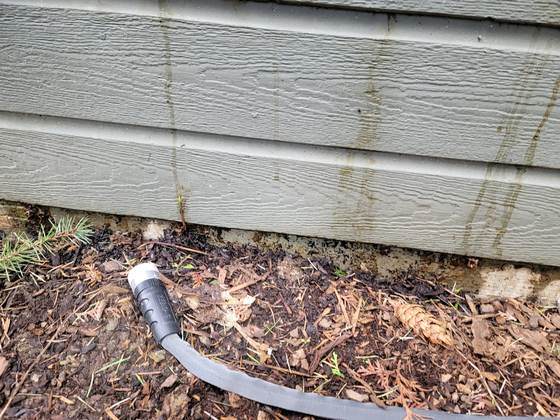
In that statewide survey, about 91% of the three primary vector species were collected between March and May. Spring. Not the deep summer that most people associate with bugs, and not the stretch when the phone actually rings about yard treatment.
Compare that with mosquitoes. WSU Extension puts peak mosquito season in this region at July through September. So the two halves of what gets sold as one combined treatment do not peak together at all — they are months apart, with ticks first.
The practical consequence: if you sign up for a combined mosquito and tick program in July, you have missed that year’s tick window. The treatment will still go down and the granule will still be on labeled ground, but the ticks it was aimed at were questing in April.
Nobody selling a summer mosquito-and-tick bundle has an incentive to tell you that. It follows directly from the state’s own surveillance, and it is the reason we would rather talk about tick work in February than in August.
One caveat worth keeping: that figure describes when ticks were out looking for a host, in a survey that ran March to October. It is a statement about the season’s shape, not a promise that nothing is questing in September.
What we apply, and what each label actually says
Two products, and the distinction between them is a legal one rather than a stylistic one. Under federal pesticide law a product must be used and described consistently with its accepted labeling, so the pest printed on the label decides what we may tell you the product does.
The bifenthrin granule. Ours is Bifen LP Insecticide Granules, EPA Reg. 53883-124. Its label reads: for use to control Ants (including Imported Fire Ants), Chinch Bugs, Fleas, Mole Crickets, Ticks and other insect pests on lawns in landscaped areas and perimeters around residential, institutional, public, commercial and industrial buildings, parks, recreational areas and athletic fields. Ticks are named on the label. The use areas it lists read like a description of tick habitat: lawns, flower beds, mulch beds, along fence lines, around decks and decking, and the perimeter and foundation of a structure.
EcoVia MT, a botanical product whose label names ticks and mosquitoes together, applied to the same margins and resting areas.
Both are the reason this is one visit rather than two. The ground a tick treatment needs — the boundary where mown grass meets taller growth, the mulch bed, the shaded strip behind the shed — is the same ground adult mosquitoes rest on through the day.
Every pesticide product this company applies is published on what we use with its EPA registration number, its active ingredients, and its label and safety data sheet hosted here as PDFs. One gap recorded honestly: EcoVia MT’s own label and data sheet are not in that register yet, because every entry there was built from the product’s label corroborated against its safety data sheet, and we are not going to break that standard by transcribing a supplier’s catalog page. It joins the register when the documents are in hand.
We will not call any of it safe. Federal law does not permit a pesticide to be described in terms that differ from its labeling, and “safe”, “harmless” and “non-toxic” are precisely the words that draw enforcement. You get the product, the label, and the precautions the label sets.
Where the treatment goes, and where it cannot
Ticks do not behave like mosquitoes and the treatment does not look the same.
A tick does not fly. It climbs a stem, waits with its front legs out, and latches onto what brushes past. That behavior is called questing, and it happens at the edges — where a lawn stops being mown, along a fence line overgrown with blackberry, in leaf litter under a hedge, on the tall grass beside a path.
That is where the application goes. Not scattered evenly across open lawn, because open sunlit lawn is poor tick habitat and a treatment there mostly treats nothing.
And here is the limit that no product solves. The tick encounters people in this county actually have overwhelmingly happen somewhere else: on Galbraith, at Chuckanut, along a logging road, in a field on a hunting trip, on a camping weekend east of the mountains. A treated margin at home does not follow you onto a trail.
So the real protection is behavioral, and it is free. Check yourself the same day you come back from brush, and keep checking for a couple of days. Check the dog, particularly around the neck and ears, in the leg folds, and between the toes. Keep fine-tipped tweezers somewhere you can find them. If you are unsure what you have removed, the Washington State Department of Health runs tick identification and is the authority we point to.
A yard treatment is a sensible addition for a property whose used space meets tick habitat. It is not a substitute for a tick check, and we would rather you heard that from the company taking the money.
Who should actually buy this
A short list, because the honest answer for a lot of callers is that they should not.

Worth it: a property where the lawn you use runs straight into tall grass, brush or woodland edge. A dog that works that margin every day. Children who play at that boundary. An acreage in Everson, Deming or along the Nooksack where the mown part is a small island in something taller. A rental or holiday property backing onto brush where guests will not be doing tick checks.
Probably not worth it: a tidy in-town lot in Bellingham with mown grass, fence to fence, and no brushy margin at all. If there is no questing habitat on the property, treating it accomplishes very little, and we will tell you that on the phone rather than after the invoice.
A different problem entirely: a dog bringing specks into the house is more often fleas than ticks here. A cabin with rodents in the walls raises a tick-borne relapsing fever question that is really a rodent question, and rodents in walls is long- standing work for us. Identification is free in every one of these cases, and it is worth doing before anybody treats anything.
Where to go next
If your property has the margin this is aimed at, call 360-410-2199 and we will come and look at it — ideally in late winter rather than in July.
To read further: mosquito control for the other half of the same visit, our guide to ticks in Washington for the full statewide picture from that CDC survey, and the western black-legged tick for identification and correct removal. The Whatcom County pest calendar sets out what our own job records say about the shape of the pest year here, including which months carry which work.
Frequently asked questions
Do you treat yards for ticks?
Yes, as of November 2026, and that is a change from what this site said before. It is sold as a targeted treatment of the margins where ticks wait rather than as a broadcast acaricide across a whole property, because a broadcast whole-yard treatment is not a proportionate response at the tick load this county carries. If your property has no brushy edge, we will say so.
How much Lyme disease is there actually in Washington?
Much less than in the eastern United States. State surveillance published in Emerging Infectious Diseases found that 4.0% of western black-legged ticks carried Borrelia burgdorferi sensu stricto, and counted 202 tick-borne disease cases in Washington residents across 2011 to 2016 — of which only 68 were acquired in-state. That is roughly eleven in-state cases a year, statewide.
When is tick season here, and when should treatment happen?
Spring, which catches most people out. The same state surveillance collected about 91% of the three primary vector species between March and May. That makes tick treatment an earlier job than mosquito treatment, where WSU puts the peak at July through September. If you buy a combined program starting in July, you have missed the tick window for that year.
Will a yard treatment stop me getting a tick?
Not if you walk. The exposure that produces most tick encounters in this county happens on brushy trail edges and in tall grass away from home — Galbraith, Chuckanut, a logging road, a fence line on someone else's land. Treated ground does not travel with you, and a household that believes it is covered because the yard was done is worse off than one that checks itself after a walk.
Which tick carries Lyme disease in Washington?
The western black-legged tick, Ixodes pacificus. It made up 438 of the 977 host-seeking ticks collected in that statewide survey across 53 sites in 19 counties. Our pest library profile covers how to tell it apart and how to remove one correctly, and the lone star tick that drives so much national tick coverage is not established in Washington at all.
Does the tick treatment come with the mosquito treatment?
It is the same visit. One of the two products on the program is labeled for ticks and mosquitoes together, and the bifenthrin granule's label names ticks among its target pests, so the application that covers tick margins is the application that goes down anyway. We price it as one job rather than two.
My dog keeps bringing ticks in. Is this the right service?
Possibly, but check the simpler answer first. A dog bringing small dark specks into a house is far more often a flea question than a tick question in this county, and flea control is a different job with a different method. Send us a photograph before you buy anything — identification is free, and it decides which of the two services you actually need.
Guides
Tick Control in Whatcom County?
Family-owned, no long-term contracts, and every treatment is backed by our 100% Service Guarantee.
Most calls in Whatcom County are out within 1–2 days, about 3 during the late-summer peak.
Last updated