Pillbug — Armadillidium vulgare
Armadillidium vulgare · Occasional invaders
A pillbug is a crustacean rather than an insect, breathing through gill-like structures that have to stay wet. It cannot hold moisture in a heated house, so the ones indoors are already dying, and they damage nothing. Seven pairs of legs, rolls into a ball, and lives outdoors in mulch and leaf litter.
Call 360-410-2199 Request a free inspection
Rarely worth treating. Usually this is a sealing or cleaning job.
Pillbug at a glance
| Size | About a third to three-quarters of an inch — pencil eraser to fingernail |
|---|---|
| Shape and color | Oval and domed with overlapping hard plates; slate gray to nearly black |
| Legs | Seven pairs, short and pale, tucked underneath — it is a crustacean, not an insect |
| When disturbed | Closes into a tight sphere; a sowbug cannot, and has two small tails sticking out behind |
| How to tell it from a millipede | A millipede is long and worm-like with two pairs of legs per segment and coils into a flat spiral |
| When you see it indoors | October into December, a day or two after heavy rain |
| Do we treat it | Rarely warranted — it dies indoors within days, harms nothing, and a broom is enough |
Signs you have them
- Small gray armored animals at a door threshold or garage floor after a storm week
- Animals that roll into a ball when touched
- Dead ones on the floor that feel like tiny shells rather than squashed insects
- Crowds of them under boards, pots, bark mulch or leaf litter against the foundation
- Ragged holes chewed in seedlings or low fruit sitting on wet soil in spring
The one fact that explains everything
A pillbug is not an insect.
It is a crustacean — order Isopoda, the same broad group as shrimp, crabs and crayfish — and Iowa State’s extension service puts the relationship plainly: these animals are more closely related to shrimp and crayfish than they are to insects. The University of Maryland goes a step further and describes sowbugs and pillbugs as the only crustaceans that have fully adapted to life on land.
That is not a piece of trivia. It is the reason for every single thing this animal does.
A crustacean breathes with gills. The pillbug’s are modified into gill-like structures on the underside of its abdomen, and the University of Idaho’s homeowner guide states the constraint exactly: the gills must be kept wet to extract oxygen, which restricts these creatures to moist habitats.
An animal that has moved onto land while keeping a breathing apparatus that only works wet has one non-negotiable requirement, and everything follows from it. It lives under things. It is active at night. It stays in mulch, leaf litter, compost and the damp layer against a foundation. It cannot cross open dry ground for long. And it cannot survive inside a heated building.
So when you find one on the kitchen floor in November, you are looking at an animal that has walked into an environment it cannot breathe in. It is not establishing, it is not feeding, and it is not going to be there next week.
What one looks like
Small, oval, armored, and instantly recognizable once you have the shape.
Size. UC IPM gives about a third to three-quarters of an inch; Maryland says half to three-quarters. Either way, roughly the size of a pencil eraser up to about a fingernail.
Shape. Oval, convex on top and flat underneath — a small dome. The back is a series of overlapping hard plates, which is what makes the rolling possible and what makes a dead one feel like a tiny shell rather than like a squashed insect.
Color. Slate gray through to nearly black, sometimes with a mottled or lighter margin. The Pacific Northwest handbook describes the group as light to dark gray with a hard shell.
Legs. Seven pairs, short, pale, tucked underneath and mostly invisible from above. That count is the definitional difference from an insect and it is countable on a dead specimen with a hand lens.
Antennae. One conspicuous pair, angled forward and jointed, waving as the animal walks. They are surprisingly expressive for such a small creature.
When disturbed. It stops, tucks its legs and antennae in, and closes into a sphere. This is called conglobation, and it is the single most reliable identification in the whole of this library — nothing else in a Whatcom County doorway does it.
Pillbug or sowbug
These two live under the same board, arrive at the same threshold, and get the same answer, but they are different animals and the separation takes a second.
The rolling test. The Pacific Northwest handbook reduces it to six words: pillbugs ball up when disturbed, sowbugs do not. A sowbug cannot make the sphere — it lacks the plate architecture for it — so it flattens against the surface or runs instead.
The tail test, which works on a dead one that will not oblige. UC IPM’s version: a pillbug has a smooth rounded rear end, while a sowbug carries distinct appendages protruding from its rear. Idaho’s phrasing is that a sowbug’s paired tails are visibly extended and a pillbug’s are too short to see from above. Two small prongs sticking out the back means sowbug.
Shape, roughly. Sowbugs tend to look slightly flatter and more sprawling; pillbugs sit higher and more domed. This is a weaker character than the other two and not worth relying on.
Nothing else differs in any way a householder would care about. Both are isopods, both are gill-breathers, both eat decaying plant material, both die indoors, and both are handled with the same broom. When this page says pillbug, read it as covering the sowbug too.
Pillbug or millipede
The other regular confusion, and this one is not close once you look properly.
Body plan. A pillbug is short and oval — a few segments, wider than it is tall, an armored disc with legs underneath. A millipede is long and worm-like, round in cross-section, with dozens of segments running the length of it.
Legs. Seven pairs on a pillbug, total. A millipede carries two pairs on nearly every segment, which adds up to a great many more and produces the distinctive rippling wave as it moves.
Defense. A pillbug closes into a sphere. A millipede winds into a flat spiral, like a watch spring lying on a table. Sphere against coil is the fastest way to tell them apart with the animal in front of you.
Speed and gait. Both are slow. A pillbug trundles on visible legs; a millipede flows.
What happens if you crush one. Nothing much with a pillbug. Some millipedes release a defensive fluid that stains and can irritate skin and eyes, which is the practical reason to vacuum rather than stamp on a line of them.
Everything else is shared. Both are detritivores working the same damp organic layer, both are moisture-dependent, both die indoors within days, and both arrive at the same doorways after the same weather. The millipede profile covers the autumn migrations in detail, and if you have one animal you very often have the other.
Where they actually live
Outside, in the layer of decomposing material against damp ground, and the list of preferred addresses is short and consistent.
Under bark mulch, particularly where it is deep and has been down long enough to break down into something that holds water.
In leaf litter, especially the band that accumulates along a foundation and never sees enough sun or wind to dry.
Under boards, pallets, pots, bricks, tarps and firewood lying directly on soil. Anything flat on damp ground is a pillbug hotel.
In compost heaps and grass clipping piles, which are close to perfect — warm, wet, and made entirely of food.
Under low dense ground cover growing right up against siding.
In wet crawlspaces, which is the one that matters structurally, and which is covered further down.
They feed on decaying organic material — the Pacific Northwest handbook’s phrasing is decaying organic matter, UC IPM’s is decaying plant material — which makes them part of the machinery that turns last year’s leaves into soil. UC IPM notes they will occasionally take seedlings, new roots, lower leaves, and fruit or vegetables sitting on the ground, and Idaho compares the feeding damage to slug damage, ragged holes chewed between the leaf veins. That is a real gardening consideration in a wet spring and it is a separate question from anything happening in a building.
The life cycle, briefly, because it is strange
Worth two paragraphs because it is unlike anything else in this library and it explains why the population is so persistent.
A female pillbug does not lay eggs into the soil. She carries them in a fluid-filled pouch on her underside — the marsupium — and Idaho Extension describes the eggs being brooded there for several weeks inside what is effectively a small sac of water. The young hatch inside it and emerge as miniature versions of the adult. It is a functioning tide pool carried around under a land animal, which is about as clear a statement as biology makes about where these things came from.
Growth is slow. Idaho records ten or more molts before adulthood, reached at about two years, which is a long life for something that size. That slow turnover means a population in a mulch bed is stable and long-lived rather than exploding and crashing, and it is part of why the numbers arriving at a doorway are so similar year after year on the same property.
Why they come inside, and why they leave feet first
Two triggers, both about water.
The common one here is saturation. When heavy rain fills the pore space in the litter layer they are living in, the ground stops being habitat and the animals move. They travel at night, meet the long dry obstacle of a foundation, follow it, pile up at corners and thresholds, and a proportion find a gap. In Whatcom County that means the wet stretch from October into the winter, following a genuinely heavy rain onto ground that is already loaded.
The less common one is the reverse — a dry spell driving them to seek moisture, which in a Northwest August occasionally sends them under a door toward a cool damp bathroom or laundry room.
Either way, the arrival is a mistake from the animal’s point of view. A heated house is drier than anything it has ever experienced, the gills stop working, and it desiccates. Idaho gives a few days at most without high moisture; Maryland says they dry out quickly and die indoors; Iowa State says they must have moisture and die quickly without a damp place to hide. Three extension services, one answer.
Which is why the correct response to a pillbug on a floor is a dustpan and nothing else. There is no colony under the boards, nothing is feeding, nothing is reproducing, and the animals present are already on a short clock whatever anybody does.
So: get a broom
Written as its own heading because it is the recommendation rather than an aside.
Sweep them up, or vacuum them, which is tidier. Empty the canister outside, well away from the wall, and get on with your day. If you would rather not kill them at all, a piece of card and a cup works perfectly well — they are not fast, they do not bite, and Iowa State’s summary is that they cannot damage household furnishings and are a nuisance only.
Do not treat the inside of the building. There is no reservoir behind the wall producing more of them, the ones on the floor are dying, and any product applied indoors is being applied to an animal that was already leaving.
And do not credit a treatment with the result. If a wet week ends and the arrivals stop, that is the wet week ending. The ground drained.
What actually changes next year
The durable work is all outdoors, all cheap, and all about how much wet organic material sits against the building.
Pull the mulch back off the wall and keep it thinner. UC IPM’s guidance is to keep plants, mulch and other debris several inches back from foundations. Deep bark run right to the siding is food, nursery and humid refuge in one strip, positioned exactly where you least want the population.
Clear the leaf litter from the foundation band. Not the whole garden, the strip against the building, which in a Northwest autumn never dries on its own.
Get things off the soil. Boards, pallets, pots, tarps, landscape fabric, firewood stacked flat. The Pacific Northwest handbook’s list for this group starts with removing organic matter such as grass clippings, leaf litter and bedding mulches, and that is the highest-yield hour anybody spends on this.
Change when you irrigate. UC IPM’s specific recommendation is to reduce the wetness of the soil surface and to water early in the day so surfaces are drier by evening. These animals move at night, so a bed that is soaking at dusk is a bed that is exporting pillbugs toward your door.
Move the roof water. Downspouts discharging clear of the building, gutters running, and grade falling away from the foundation. A great deal of the saturated soil that starts a movement is soil somebody is inadvertently watering.
Ventilate below. The handbook recommends improving ventilation in basements and crawl spaces, which is the part of this list that matters for the building rather than for the doorstep.
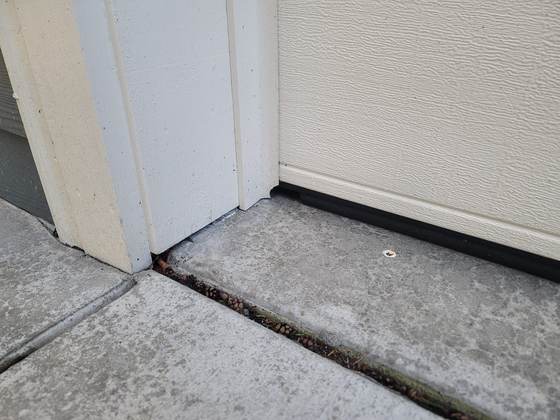
Then seal. Door sweeps first — they stop most of what walks in — then weatherstripping, vent screening, and utility penetrations. UC IPM lists weather stripping and door sweeps as the entry-point answer, and the handbook adds sealing gaps with caulk. That is exclusion and repair work, and the same half-inch of gap is being used by several other things.
What the pillbugs are telling you about the building
Here is the part worth reading even if the animal itself does not interest you.
A dozen pillbugs on a garage floor after a storm week is normal, and it is a comment on the weather.
Pillbugs living under your house is a comment on the house. If they are coming up through the floor rather than in under a door, or if the numbers in a basement are steady all year rather than clustered after rain, then the space below is wet enough to keep a gill-breathing animal alive continuously. That is a finding about moisture, and moisture is the expensive part.
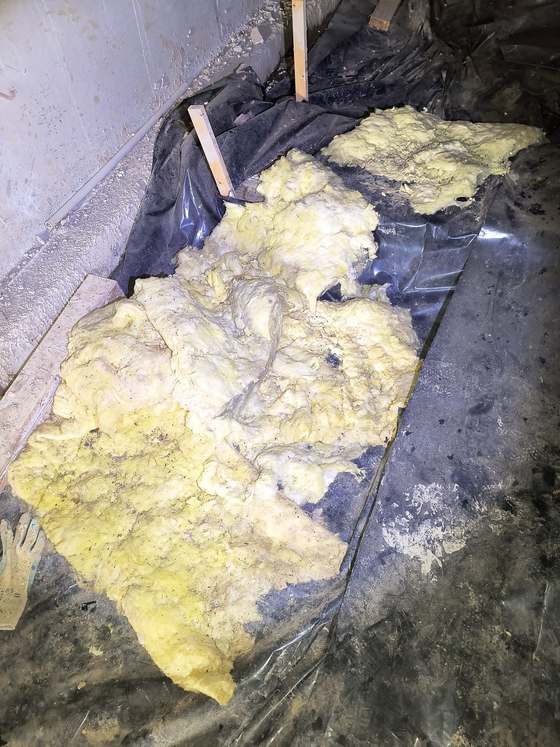
A crawlspace damp enough to support isopods year-round is damp enough for decay fungi to work on the joists above it, and fungal decay is what actually takes strength out of a building in this climate. The crawlspace guide explains the mechanism and crawlspace restoration is the fix.
The pillbug is not the problem in that scenario. It is the cheapest possible early warning about one, and it costs nothing to read.
Where this happens around the county
The property types that produce the heaviest arrivals have one thing in common, and it is not the age or quality of the house. It is how much wet organic material is banked against it.
Recently landscaped subdivisions — Barkley, Cordata, King Mountain, and the newer blocks around Ferndale, where deep fresh bark went in against the siding across a whole development in a single season. Those properties usually peak a few years after planting, once the bark has broken down into something that holds water and supports a population rather than sitting dry on top of the soil.
Lots against woodland, greenbelt or field — Sudden Valley, Silver Beach, Edgemoor, the greenbelt margins, and the rural blocks toward Everson and Sumas. A mature litter layer next door is a source with no ceiling on it, and the building is simply the first hard edge in the way.
Ground that collects water. Anywhere the lot falls toward the house, the downspouts discharge at a corner, or an irrigation zone soaks the strip beside the wall. The saturation that starts an arrival is often local and often self-inflicted.
Prewar city housing — the Lettered Streets, Columbia, Sunnyland, York, Roosevelt. A moderate number outside becomes a large number inside, because the envelope at ground level is more permeable: original vents, aged sweeps, a crawlspace hatch that has not seated properly in decades. On those houses the useful work is the building rather than the yard.
Properties with compost or livestock bedding near the house, common on acreage toward Lynden and Nooksack, where a heap fifteen feet from a back door is a standing population fifteen feet from a back door.
The year, as it runs here
October into December. The main event. Heavy rain onto ground that is already loaded pushes them out of the litter layer, and the arrivals at thresholds follow within a day or two of the weather. This is when the calls come.
January through March. Steady low-level activity outdoors, and the occasional arrival in a garage or a crawlspace-adjacent room. Nothing resets, because the winter here is wet and mild rather than cold enough to matter.
April and May. Breeding and growth in the mulch. This is also when the garden question comes up, because seedlings and low fruit are vulnerable on wet soil at exactly the moment the population is most active.
June through August. Largely invisible. A genuinely dry August can produce a small reverse movement toward cool damp rooms, which surprises people who associate this animal with rain.
Late summer is the right time to do the work — pull the mulch back, lift what is on the soil, fit the sweeps — because everything is dry, nothing is moving, and the next wet season is the one it pays off in.
Things that do not work
Interior perimeter sprays. Transient, dying animals with no reservoir behind the wall.
Bug bombs. No reach into a mulch bed, which is the only place the population exists, and product distributed through living space for nothing.
Diatomaceous earth broadcast outdoors here. It abrades the cuticle so the animal dries out, which means it only works while it is itself dry. Scattered around a foundation during a Whatcom County October it is finished after the first rain. In a dry crawlspace or under a covered deck it has a narrow legitimate use.
Sealing without clearing. Worth doing, not sufficient on its own. A tight house standing in a saturated bark bed still has a large population pressing at every joint.
Waiting for a hard winter. We do not get one. The litter layer here stays productive through mild wet months and the population is never reset.
When it is genuinely worth treating
Having spent the page recommending a dustpan, the other side.
A site where the ground cannot be changed — a lot backing onto woodland or a field margin, a strata-managed landscape, a house sitting downhill of everything around it. A perimeter application timed ahead of the wet season, rather than during an arrival, genuinely reduces what gets through.
A crawlspace or basement holding a continuous population, where the answer is drying rather than treating, and the pest work is the small part of a bigger job.
A commercial or institutional floor — food handling, healthcare, hospitality — where an animal on the floor is unacceptable regardless of what it does.
A gardening problem rather than a household one, where seedlings and low fruit are being grazed in a wet spring. That is a different conversation with different answers, most of which involve keeping fruit off wet soil.
Outside those, the verdict at the top of this page stands, and it is why we would rather publish this than sell an autumn program to everyone whose garage filled up after a storm.
What we will not sell you
A treatment for animals that cannot breathe in your house. Everything indoors is on a few days’ clock.
Credit for the weather. Applications made on the last day of an arrival produce a dramatic improvement the next morning, which would have happened anyway.
A story about damage. There is none. Not structural, not fabric, not stored food. The extension consensus is that they are a nuisance and nothing more.
A recurring plan for a seasonal event that a rake, a downspout extension and a door sweep handle better and permanently than we can.
Related work
The other slow armored animal at the same threshold is the millipede, and the fast one with long legs is covered on centipede and millipede control. If the population is under the floor rather than in the yard, that is crawlspace cleanout and restoration. The sealing is exclusion and repairs, and the other moisture-driven arrivals that share this exact message are silverfish and the earwig.
Frequently asked questions
Is a pillbug an insect?
No. It is a crustacean in the order Isopoda, and Iowa State's phrasing is that these are more closely related to shrimp and crayfish than to insects. Seven pairs of legs rather than six, an armored segmented back, and gills instead of the breathing tubes an insect uses.
How do they breathe?
Through gill-like structures on the underside that have to stay wet. University of Idaho Extension puts it plainly — the gills must be kept wet to extract oxygen, which restricts these animals to moist habitats. Everything else about their behavior follows from that one requirement.
How long will they survive in my house?
Not long. Idaho Extension gives a few days at most without high moisture, and Maryland Extension says they dry out quickly and die indoors. There is nothing for them to eat inside either, so the ones on your floor are in decline from the moment they cross the threshold.
What is the difference between a pillbug and a sowbug?
Rolling and tails. A pillbug closes into a tight sphere when disturbed and a sowbug physically cannot. Look at the back end too: a sowbug carries two small projections that stick out visibly, while a pillbug's are too short to see from above.
How do I tell one from a millipede?
Shape and posture. A pillbug is short, oval and armored, with seven pairs of legs, and it closes into a ball. A millipede is long and worm-like with dozens of segments and two pairs of legs per segment, and it coils into a flat spiral rather than a sphere.
Will they damage anything indoors?
No. Iowa State states they do not bite or sting and cannot damage household furnishings, and that they are a nuisance only. Outdoors they occasionally graze seedlings and low fruit sitting on wet soil, which is a garden question rather than a house one.
Why do they keep appearing at the same doorway?
Because that doorway sits next to their habitat. The population lives in the damp organic layer against the building — mulch, leaf litter, a board on the soil — and the nearest gap under a threshold is what a wandering animal finds first.
What actually reduces them next year?
Work on the ground rather than the house. Pull mulch and leaf litter back from the wall, lift boards and pots off the soil, move downspout water away, water in the morning so the surface dries by evening, and fit a door sweep.
Sources
- University of Idaho Extension CIS 1169 — Homeowner guide to pillbugs and sowbugs — read September 2, 2026
- PNW Insect Management Handbook — Nuisance and household pests: Pillbug and sowbug — read September 2, 2026
- UC IPM — Pillbugs and sowbugs — read September 2, 2026
- Iowa State University Extension, Yard and Garden — Sowbugs and pillbugs — read September 2, 2026
- University of Maryland Extension — Pillbugs and sowbugs — read September 2, 2026
Rules change. This page is scheduled for review against its sources by September 2, 2027. If you are reading it after that date and something looks out of step with the current rule, the rule is right and we are wrong — please tell us.
Pest problem in Whatcom County?
Family-owned, no long-term contracts, and every treatment is backed by our 100% Service Guarantee.
Most calls in Whatcom County are out within 1–2 days, about 3 during the late-summer peak.
Last updated