
Dampwood Termites in a Crawlspace
Dampwood termites in a crawlspace are a wood-decay problem before they are an insect problem. They require timber that is already wet, so finding them means finding the water, and the treatment only holds once the moisture that made the wood habitable has been corrected.
Call 360-410-2199 Request a free inspection
What to do, in order
- Keep a dozen swarmers or shed wings in a sealed bag; that settles termite versus carpenter ant without guesswork
- Do not bother killing the swarmers on the windowsill, since they die within hours and the colony that sent them is untouched
- Note where they emerged: inside a room or on an interior sill points into the structure, while an exterior light may just mean a nearby stump
- Look for the water at the foundation: downspouts discharging there, grade falling toward the house, a dripping hose bib, a slow leak under a bathroom
- Do not leave it another season if the floor above sags or feels springy, or there is standing water in the crawl area
- Book the free visit: the whole crawlspace gone over with a light, the structural timber probed and the water traced before any quote
- Fix the water first or alongside our borate treatment of the wood, and leave a failed sill plate or post to a builder; soil treatment is the wrong tool for dampwood
A moisture problem with an insect in it
Dampwood termites are the termite of this region, and the single most important thing to understand about them is that they are a consequence rather than a cause.
Unlike species that build tubes from soil into a dry building, dampwood termites need timber with high moisture content — wood that is already wet, and usually already decaying. They do not create that condition. They find it. The USDA Forest Products Laboratory sets out that relationship between wet timber and what colonizes it in its chapter on the biodeterioration of wood.
So when we find dampwood termites in a crawlspace, we are looking at two problems stacked together. There is an insect in structural timber, and behind it there is water that has been present long enough for decay to establish. Of the two, the water is generally the more consequential and always the more urgent to fix.
That framing matters because it determines what a real solution looks like. A treatment applied to wet wood in a wet crawlspace is a temporary measure. A treatment applied after the water is corrected and the failed timber is replaced is a resolution.
What they are and what they look like
Dampwood termites in the Pacific Northwest are notably large as termites go, and they are most often encountered in one of three forms.
Swarmers, or alates. The reproductive stage, and by far the most commonly seen. Large winged insects, brownish, emerging typically in late summer and autumn, often in the evening and often around lights. Their wings are four, roughly equal in length, and they shed them readily — a scatter of discarded wings on a windowsill or a crawlspace floor is a classic finding.
Nymphs and workers. Pale, soft-bodied, and living entirely within the wood. They are rarely seen unless timber is opened.
Soldiers. Distinguished by a large dark head and prominent mandibles, defending the colony. Also only found inside the wood.
The confusion is nearly always with carpenter ant swarmers, and the distinction is straightforward once you know it. A termite has a broad, straight-sided body with no pinched waist, straight bead-like antennae, and four wings of about equal length. A carpenter ant swarmer has an obvious narrow waist, elbowed antennae, and forewings noticeably longer than the hind pair.
Getting this right matters because the two carry different implications and different work.
Where they turn up
The list of locations in a Whatcom County crawlspace is short and consistent, because it follows the water.
The sill plate and rim joist. The timber sitting directly on the foundation, which takes moisture from splash-back, from a foundation wicking ground water, from poor grading and from persistent crawlspace humidity. Structural, and the most common finding.
Posts and piers in ground contact, particularly older wood posts set directly into soil or standing on a pad that has silted over.
Joists and subfloor under a bathroom, kitchen or laundry, where a long-running slow leak has kept an area wet for years.
Beams and girders where they bear on a foundation pocket that traps water.
Deck ledgers and framing where a deck was attached without flashing, keeping the rim behind it permanently wet.
Anywhere timber meets soil, including buried construction debris, form boards left in place, and stumps under an addition.
Reading the damage
Termite work looks different from the other things that eat into timber here, and the differences are visible without magnification.
Galleries cross the grain. Carpenter ants follow the softer grain and produce smooth, clean, almost sanded chambers. Termites cut across growth rings as well as along them, producing a more chambered, layered appearance.
Debris stays in. Carpenter ants housekeep, pushing frass out and leaving galleries swept clean. Termite galleries are frequently packed with dark material — fecal pellets and chewed wood — which is one of the more reliable field distinctions.
Pellets. Dampwood termites produce hard, six-sided fecal pellets, and where they are pushed out of a gallery they collect in small piles beneath. These feel like coarse grit rather than powder or fiber.
Softness. Because the wood was decaying before the termites arrived, the surrounding material generally gives under a blunt probe. Sound timber resists.
Discarded wings. Around windows, on a vapor barrier, in a corner of the crawl area, particularly in late summer.
What else is going on down there
A crawlspace that has produced dampwood termites will almost always show the rest of the damp-building picture, and it is worth looking at all of it at once.
Decay fungi in the timber, sometimes visible as discoloration, a white or brown growth, or a cubical cracking pattern where the wood has broken down.
Moisture ants, which occupy exactly the same conditions and are frequently found alongside — small, yellowish, and another reliable indicator of wet decaying wood.
Springtails, sowbugs, millipedes and silverfish in numbers, all of which need moisture and none of which persist in a dry space.
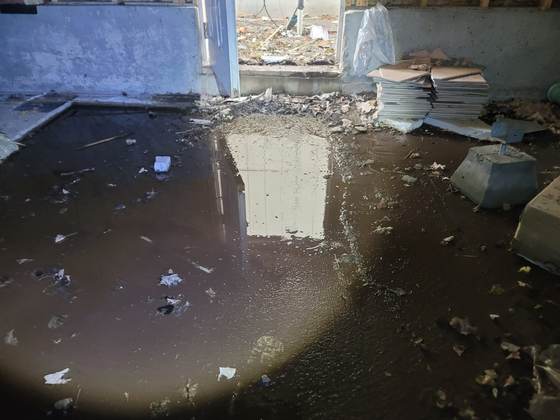
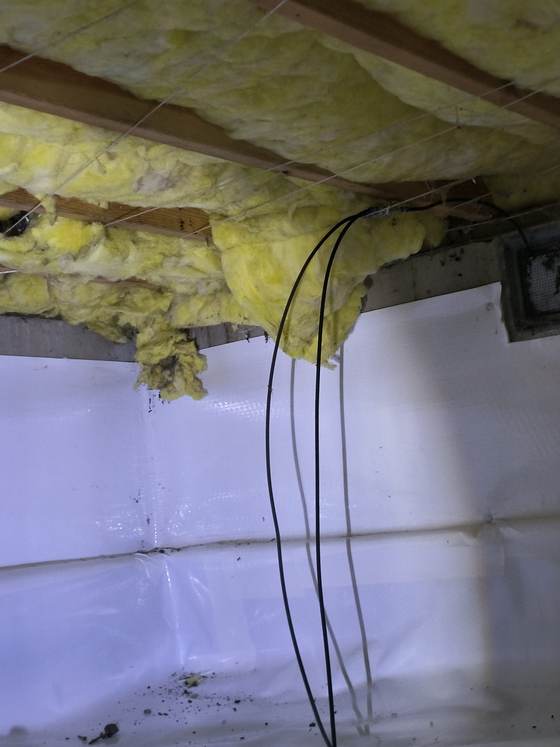
Standing water or a saturated vapor barrier, or no vapor barrier at all.
Corroded vent screens and a hatch that no longer seals, which is a rodent problem waiting to happen alongside everything else.
And the causes: grade falling toward the building, downspouts discharging at the foundation, a plumbing failure, a hose bib dripping, blocked or buried crawl vents, a fan discharging into an enclosed space, and roof water with nowhere to go.
What we can and cannot do
We want to be exact about this because it affects who you need to call.
We are certified to treat wood-destroying organisms. That is a licensed category and it covers the treatment of dampwood termites, along with the other structural pests in that group. Where a finding has been identified — by a buyer’s inspector, by a builder, by another professional, or by us on a visit — we handle the treatment.
We are not structural pest inspectors. We do not perform the formal examination that a real estate transaction requires and we do not issue that document. If your situation needs one, it needs a separately licensed professional, and we will say so rather than blur the line to keep the work.
We are not builders or engineers. We will tell you where timber has lost capacity and where it is sound, because a probe and experience establish that much. Decisions about repair, load paths and replacement belong to a contractor or, where the loss is significant, an engineer.
Being clear about the boundaries is not a limitation on the help you get. It means the right people are doing the right parts.
What treatment involves
Assuming the identification is settled, the work has a defined shape.
Locate the extent. This means going the length of the crawlspace with a light and probing rather than looking, because the affected area is nearly always larger than the visible sign. Sill plate, rim joist, posts, beams, joists and subfloor, methodically.
Trace the moisture. Where is it coming from, how long has it been there, and what will stop it. This is not optional and it is not an upsell — it is the part that decides whether anything holds.
Treat the affected timber. Direct application into galleries and into the affected members, with borate-based products or other appropriate materials depending on the situation. Treating wood rather than soil is the approach here, because the colony is in the wood.
Remove the moisture source. Drainage, grading, downspouts, a vapor barrier, crawl ventilation, the plumbing repair, the flashing detail. Usually somebody else’s trade and always part of the plan.
Replace what has gone. Timber that has lost structural capacity to decay does not recover when it dries. Where the sill plate, rim joist or a post has failed, it needs cutting out and replacing, and that is a builder’s job.
Follow up. Once the space is dry and the repairs are done, a check confirms that nothing has been missed and that the conditions have genuinely changed.
Order of operations
The sequence saves money, so it is worth stating plainly.
Water first, or at least concurrently. Treating wet wood and leaving it wet produces a repeat visit.
Structural replacement after the water is dealt with, so new timber goes into a dry environment rather than the one that destroyed the old timber.
Treatment of remaining affected members alongside or after, with borate treatment of new timber where it is going into a location that has a history.
And the crawlspace improvements — vapor barrier, ventilation, drainage — as part of the same project rather than as a separate thought, because they are what prevent the next thirty years repeating the last thirty.
The other termite in this region
Dampwood is the species most people here encounter, but it is not the only one, and the distinction changes the work substantially.
Subterranean termites occur in Washington, but the range statement matters more than the presence does. WSU Cooperative Extension bulletin EB0787 puts the subterranean termite only as far north as Seattle in western Washington, and this county lies about ninety miles past that. So the species is documented in the state and not documented this far up it, which is a meaningfully different claim from “present in western Washington” and the one the source actually supports.
Where it does occur it behaves differently in one crucial respect: it nests in soil and travels from there into wood, maintaining a connection to the ground for moisture. That connection shows as mud tubes — pencil-width earthen tracks running up a foundation wall, a pier, a post or the inside face of a stem wall. Tubes in a crawlspace would be a different and generally more serious conversation, because a soil-based colony is not limited by the wetness of a single piece of timber and the treatment has to address the ground as well as the wood.
Drywood termites are largely a problem of drier, warmer regions and are not established here. They occasionally arrive in furniture or timber brought from elsewhere. Their signature is the hard six-sided pellets accumulating below small kick-out holes in dry wood well away from any moisture.
Which sets the practical rule in this county, and it is the reverse of the one most termite writing gives. Dampwood is the working assumption under a Whatcom County floor. Subterranean is the low-probability exception, and mud tubes are what would move it out of that category rather than what you start from.
Look for them anyway. Thirty seconds of a flashlight along a stem wall costs nothing, tubes are unmistakable once you have seen one, and on the rare occasion they are there the whole scope changes. So the tubes get looked at on every crawlspace visit regardless of what the call was about, and that will not be changing.
What that look is not is a way of clearing a building. Finding no tubes in a crawlspace here is close to the expected result and therefore carries very little information — it confirms the likely thing rather than ruling out the unlikely one. The mistake worth naming is the opposite of the usual one: not missing subterranean termites, but treating their absence as evidence that nothing is wrong in timber that a probe is already sinking into.
What the swarm means
Most households first learn about this from a swarm rather than from a crawlspace, so it is worth explaining what that event is telling you.
A colony that has been established for several years — often quite a few — begins producing winged reproductives. In late summer and autumn, usually on a warm still evening, they emerge, fly a short distance, drop their wings and pair off, looking for wet wood to start again.
Two things follow from that. First, a swarm is evidence of a mature colony, not a new arrival. Whatever produced it has been in that timber for some time. Second, the swarmers themselves are harmless and will mostly die within hours; killing the ones on your windowsill accomplishes nothing about the colony that sent them.
Where the swarm emerges matters more than how many there are. Insects appearing inside a room, or a scatter of shed wings on an interior windowsill, points to a colony within the structure. Swarmers around an exterior light on a warm evening may have come from a stump forty feet away.
Keep some. A dozen in a sealed bag settles the identification question immediately and separates termite from carpenter ant without any guesswork.
When a sale is involved
This finding shows up in transactions more than most, because a crawlspace is exactly where a buyer’s inspector looks and the sill plate is exactly what they probe.
Where a report has identified dampwood termite activity and decayed structural timber, the request is usually for a repair and a treatment. The repair is a builder’s. The treatment is ours, and we are glad to handle it.
What we will not do is provide a document that reads as something it is not. What you get from us is a record of the treatment performed — the product, the locations treated, the date. Under Washington’s rules, a document that sets out findings of wood-destroying organism damage or infestation is a regulated report with its own requirements, and issuing one is not something we do. That belongs to a separately licensed inspector, and where a transaction needs one we will say so rather than hand you a treatment record that looks like it.
For sellers, the practical point is the familiar one: this does not improve while a house is on the market, and it is considerably cheaper to deal with in your own time than under a deadline with somebody else’s estimate in front of you.
Prevention, which is mostly plumbing and drainage
The measures that keep dampwood termites out of a building have almost nothing to do with insects.
Keep the crawlspace dry. A complete lapped vapor barrier over the ground, open and screened vents that are not buried by landscaping, and a sump where the ground genuinely holds water.
Get roof water away. Gutters that work, downspouts extended well clear of the foundation, and no discharge point that soaks the ground against a wall.
Grade away from the building. Soil should fall away, not toward, and it should not be built up against siding.
Break ground contact. No timber sitting in soil — posts on proper pads, form boards removed, debris cleared, and firewood stored away from the building rather than against it.
Fix leaks promptly, including the slow ones under bathrooms and kitchens that never show themselves anywhere visible.
Flash decks properly where they attach, because the ledger detail is one of the most reliable producers of wet rim joist in this county.
Borate-treat new structural timber going into any location with a history of moisture. It is inexpensive at the point of construction and effective for a long time.
How urgent is it, honestly
People understandably want to know whether their floor is about to fail, and the proportionate answer sits between the two extremes people arrive with.
Dampwood termites work slowly compared with the reputation termites carry generally. A colony does not consume a sill plate over a winter. Damage accumulates across years, which is why the finding so often coincides with a water problem that has also been running for years.
At the same time, the material involved is structural and it is at the base of the building, and the decay that preceded the insects has usually taken more capacity than the insects themselves. So this is not something to leave for another season, and it is not something to panic about tonight.
The signals that raise the urgency: a probe sinking easily into a sill plate or a post; visible sagging, springiness or movement in the floor above; standing water in the crawl area; damage found in more than one location; or mud tubes, which change the species question entirely.
The signals that lower it: localized damage in one member, wood that is wet but still firm under a probe, a moisture source that is identified and easily fixed, and a crawlspace that is otherwise dry and ventilated.
Either way the first step is the same and it is free: have somebody go under there properly and tell you which of those two descriptions fits.
What we will not sell you
A treatment over an unrepaired leak. It is the definition of a job that comes back.
A whole-structure program for a localized finding. The scope follows the timber that is actually affected.
A soil treatment for a dampwood colony. That is the approach for a subterranean species, and applying it to the wrong one is money spent on the wrong mechanism.
An annual contract attached to a one-off repair. Once the water is fixed and the failed timber is replaced, the condition that supported the colony is gone.
A document that implies an authority we do not hold. You get a clear record of the treatment performed, and nothing dressed up to resemble the regulated report a transaction requires.
What we will do
We will go under the building properly — the whole length with a light, not a look from the hatch — and probe the structural timber rather than glancing at it.
You get a plain account: what is there, whether it is dampwood termites or carpenter ants or moisture ants or decay alone, how far it extends, where the water is coming from, which parts we treat, which parts need a builder, a plumber or a drainage contractor, and what order to do it in.
Assessment is free, there is no term agreement, and where the honest answer is that you need a drainage fix and a section of sill plate replaced rather than a pest treatment, that is what you will be told.
Frequently asked questions
Are dampwood termites as serious as other termites?
They are limited by moisture, which is a real constraint, but the timber they occupy is structural — sill plates, joists, posts and beams. The damage matters because of where it is, and because the decay that let them in matters too.
Can you treat them if somebody else identified them?
Yes. Treatment of wood-destroying organisms is within our licensed categories, and where a buyer's inspector or another professional has identified the finding in their report, we handle the treatment side of it.
Do you carry out the inspection yourselves?
We are not structural pest inspectors and we do not issue those reports. If a transaction needs one, that is a separate licensed professional. What we do is treat what has been found, and tell you plainly what we can see.
What does the damage look like?
Galleries cut across the grain as well as along it, with a smooth chambered appearance, often packed with dark material rather than swept clean. The wood is usually already soft with decay, and a probe sinks into it.
How did they get in?
They do not need soil contact the way subterranean species do. A winged pair finds wood with high moisture content and starts a colony directly in it, which is why the water problem always comes first in the story.
Does the timber have to be replaced?
Where it has lost structural capacity, yes, and decay damage does not recover on drying. Where the wood is wet but still sound, correcting the moisture and treating may be enough. We will tell you which you have.
What does it cost to have somebody look?
Nothing. We will go the length of the crawlspace with a light, probe the structural timber, trace where the water is coming from, and tell you what needs doing and by which trade before anything is quoted.
Guides
Termite & Wood-Destroying Pest Control in Whatcom County?
Family-owned, no long-term contracts, and every treatment is backed by our 100% Service Guarantee.
Most calls in Whatcom County are out within 1–2 days, about 3 during the late-summer peak.
Last updated