
Bumble Bees in Whatcom County — Bombus spp.
Bombus spp. · Stinging insects
We do not treat bumble bees. Washington has at least 23 species, several are in documented decline, and the western bumble bee has all but disappeared from its former range. Colonies are small, annual, and dead by autumn, and the nest is never used again, so waiting is almost always the right answer.
Call 360-410-2199 Request a free inspection
We do not treat this. Where to go instead is below.
Bumble bee at a glance
| Size | About 0.4 to 1.0 inches, robust and stout |
|---|---|
| Color and fur | Very hairy all over, banded black and yellow, with orange, red or white on some species |
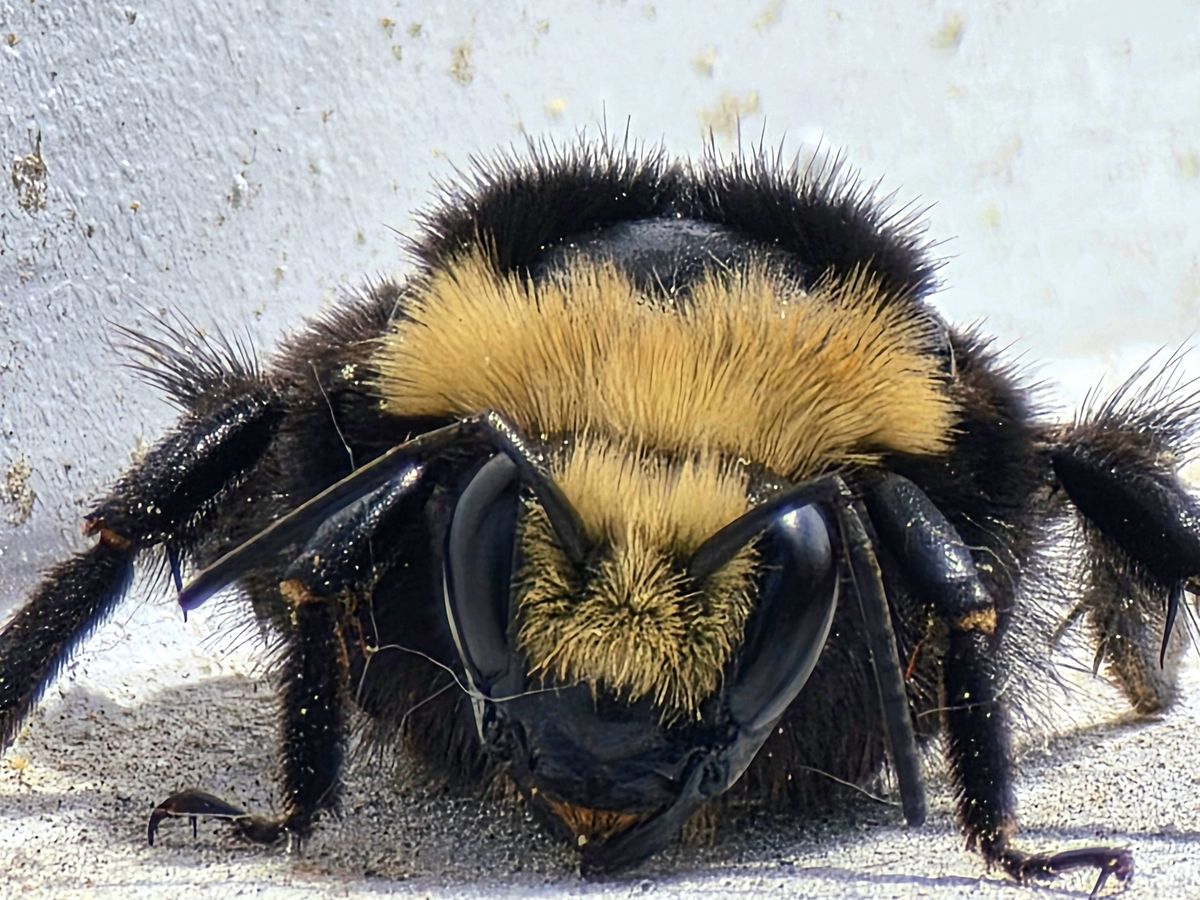
| How to tell it from a carpenter bee | Furry to the tip of the abdomen; a carpenter bee is glossy and bare at the rear |
| How to tell it from a honey bee | A honey bee is slimmer, smaller and amber-brown, with fine hair rather than fur |
| Nest | Loose cluster of ball-like wax cells in old rodent burrows, compost, insulation or under sheds |
| Colony | A few dozen to a few hundred bees; dies out by autumn and the nest is never reused |
| Stings | Very mild in temperament; can sting more than once, but only if the nest is seriously disturbed |
| Do we treat it | No — we do not treat bumble bees; roping off the area and waiting is the answer |
Signs you have them
- Large furry bees flying in and out of a hole in a bank, lawn or under a shrub
- Bees coming and going from the gap under a shed, deck or outbuilding floor
- Bees working into a compost heap, a folded tarp or an old bird box
- Bees entering loose insulation through a small gap in a wall, crawlspace or garage ceiling
- A loud, slow bee working flowers on a cold, damp or overcast morning
The position, stated first
We do not treat bumble bees.
That is not a case-by-case judgment we will walk back once somebody is annoyed enough, and there is no reason to make you read down the page for it. If what you have found is a bumble bee colony — under a shed floor, in a compost heap, in an old rodent burrow in a bank, in the loose insulation of a wall or a crawlspace, in the bottom of a bird box — the answer is nearly always to leave it where it is and let the season finish it.
That is not sentiment and it is not us being difficult. It rests on three facts, all of which are checkable, and all of which point the same way.
The colony is small. The colony is over by autumn, permanently. And several of the species doing this in Whatcom County are in real trouble.
The trouble part, because it is the part people do not know
Washington has at least 23 species of bumble bee, which is a larger number than most people expect and a genuinely good thing for a state whose agriculture leans on pollination.
Some of them are doing badly.
The clearest case is the western bumble bee, Bombus occidentalis, which was once one of the most common and widespread bumble bees in the West. The Washington Department of Fish and Wildlife’s account of what happened to it is stark. Populations crashed in the 1990s. Occupancy across its range fell by about 93 percent over roughly two decades. Surveys have since located only a handful of populations anywhere in Washington, and those are mostly in remote subalpine and montane sites rather than in the lowland country where the species used to be ordinary. It carries state Candidate status, it is listed as a Species of Greatest Conservation Need under Washington’s State Wildlife Action Plan, and a federal status review has been underway to decide whether it warrants listing.
WDFW’s assessment of the cause is worth reading directly, because it is not the one most people assume: the speed and breadth of the collapse, including out of apparently high-quality habitat, supports the prevailing hypothesis that pathogens escaping from commercial bumble bee rearing facilities into wild populations are the main factor.
It is not the only species in difficulty. WSU’s home garden guide notes that Franklin’s bumble bee — a species with one of the smallest known ranges of any bumble bee in the world, in southern Oregon and northern California — may now be extinct.
That is the background against which somebody asks whether we will spray a nest in a compost heap. The answer is no, and now you know why.
The colony is annual, and that decides most cases
This single fact resolves the great majority of bumble bee calls, and it is different in kind from what a honey bee or a yellowjacket does.
A bumble bee colony lasts one season and then ends. There is no perennial hive, no stored surplus carried through winter, and no returning population.
WSU’s account of the cycle: young queens that mated the previous summer overwinter alone, and emerge very early in the year — nest-seeking usually happens in February and March here, depending on temperature. A queen who finds a suitable cavity founds the colony by herself, building a small irregular cluster of ball-like wax cells and laying a batch of about a dozen eggs, which she incubates and feeds until the first workers take over the foraging.
The colony builds from there to somewhere between a few dozen and a few hundred individuals. Late in the cycle it produces males and new queens, those mate, and then the colony declines and dies. WSU puts the end anywhere from as early as May or June to as late as October, depending on species. Only the mated young queens survive, and they scatter to overwinter individually somewhere else entirely.
And the site is finished. WSU’s note is that the deserted wax nest is soon eaten by wax moths and other scavengers. There is nothing left to reoccupy and nothing that draws next year’s queens back to the same hole. A shed that had a colony this year is no more likely to have one next year than the shed next door.
So the practical shape of nearly every bumble bee problem is: this is temporary, it is on a clock you can count, and doing nothing produces the same end state as doing something, minus the cost and minus the dead bees.
Recognizing one
The identification matters more than it looks, because the three things people call bumble bees have three different answers.
Bumble bee. WSU Hortsense describes them as robust, stout and very hairy, from about 0.4 to 1.0 inches long. Dense fur all over, including the abdomen, banded in black and yellow with orange, red or white on some species. Slow, loud, and unbothered. They fly in weather other bees will not — cold, damp, overcast mornings are exactly when you see them working, which is one of the reasons they matter so much in a climate like this one.
Honey bee. Slimmer, smaller, amber and brown, finely haired rather than furry. Colonies in the tens of thousands, perennial, and living in a cavity rather than in a small pocket of fluff. We do not treat those either, and the reasoning is different enough to have its own page.
Carpenter bee. Similar size and outline to a bumble bee, and separated by the back half of the insect. UC IPM’s description is that carpenter bee abdomens are shinier than those of bumble bees, with fringes of hairs on only some segments. In practice: furry all the way down means bumble bee, glossy and bare at the rear means carpenter bee. The other useful fact is distributional — carpenter bees are uncommon in northwest Washington, so a large dark bee here is overwhelmingly likely to be the bumble bee. If there is also a perfectly round half-inch hole in bare wood, that changes things and belongs on the carpenter bee page.
Yellowjacket, which is not a bee at all. Smooth, shiny, narrow-waisted, fast, and interested in your food. Nothing furry about it. If it is at the table in September it is a wasp, and that is a different service and a different answer.
Buzz pollination, and why the species matter here
Worth a paragraph because it explains why an agricultural county cares.
WSU Hortsense describes bumble bees vibrating their entire bodies at a frequency close to middle C to shake pollen loose from flowers that will not release it otherwise — buzz pollination, or sonication. Tomatoes, peppers and blueberries are on WSU’s own list of crops where this matters. Honey bees cannot do it.
Whatcom County grows a great deal of blueberry and raspberry. The bumble bee in your compost heap is not an abstraction about biodiversity; it is a working pollinator of the crops in the fields a few miles north of here, and the colonies in gardens and hedgerows are part of the same regional population as the ones in the fields.
WSU’s management recommendation for the genus, in the field of a fact sheet where a pest guide would normally tell you what to apply, reads: none recommended.
Where the nests are, and what they look like
Bumble bees do not excavate. They find a ready-made cavity with soft material in it and move in, which is why the sites are so consistently domestic.
WSU’s list of what they use: old mouse nests, bird nests, house insulation, and other places above or below ground where dry fluffy nest material is available. In Whatcom County that plays out as:
Abandoned rodent burrows in banks, lawns and under shrubs. The single most common nest site, and the reason so many people report “bees in the ground.”
Under sheds, decks and outbuildings, in the void between the floor and the soil.
Compost heaps, which are warm, fibrous, dry in the middle and undisturbed — close to ideal.
Loose insulation in a wall, a crawlspace, a garage ceiling or an unfinished attic, where a queen has found a route in and settled into the fiber.
Stacked material — a tarp folded on a pallet, a bag of potting soil, an old mattress in a barn, a coil of hose left over winter.
Bird boxes with old nesting material still in them, which is a classic.
What you will find, if you can see it, is not a comb. WSU describes an irregular cluster of ball-like wax cells, more like a small heap of waxy marbles than the neat hexagonal sheets of a honey bee. There is no honey worth taking, no structure worth removing, and nothing that will rot into your framing when the colony ends. That last point is the difference between this and a honey bee colony in a wall: when a bumble bee colony finishes, there is essentially nothing left behind to deal with.
The insulation case, which is the one that worries people
Of all the nest sites on that list, the one that produces the most anxious phone calls is a colony in the insulation of a wall, a crawlspace, a garage ceiling or an unfinished attic. It feels like the honey bee scenario, and it is not.
What makes a honey bee colony in a wall a building problem is the mass of comb and stored honey left behind when the bees go. That is what ferments, bursts its cappings, runs down framing and feeds a second wave of insects for years. A bumble bee colony has none of it. There is no honey surplus, no sheet comb, and the entire structure is a small loose cluster of wax cells sitting in the fibrous material the queen found. When the colony ends, scavengers work through what is left and there is essentially nothing to clean up.
So the correct response to bees in loose insulation is the same as the response to bees under a shed: identify it, mark the entrance, keep away from it, and wait for autumn. The one addition is that once the colony has finished, the hole they were using is worth closing — not because the bees will return, but because a route into insulation is a route for rodents in November and for overwintering insects in October, and it will get used by something.
The failure mode to avoid is sealing the entrance while the colony is live. Shut in, the bees work at the material around them looking for another way out, and in a building the softest direction is frequently toward the room. A colony that was outside your living space becomes one inside it, which is a worse problem than the one somebody was trying to solve.
Temperament, and stings
Bumble bees have a bad reputation they mostly do not earn, and one genuine capability worth knowing.
WSU describes Pacific Northwest bumble bees as very mild in temperament, and notes that they will not attack unless the nest is seriously disturbed or threatened. A bumble bee working a flowering shrub beside a walkway is not a hazard and does not become one because you walk past it.
The capability: unlike a honey bee, a bumble bee’s sting is not barbed, so it does not tear free and the bee does not die. It can sting more than once. In practice this comes up when somebody puts a hand into a nest, mows directly over one, or lifts the thing the colony is under — which is the entire list of ways people get stung by this insect.
Which is exactly why the standard advice works. Mark where the nest is. Keep the mower and the strimmer away from it. Keep children and dogs out of that corner. Do not put a hand into a compost heap you have not looked at. Then get on with your summer.
The honest version of relocation
People ask, and the answer they want is that we will scoop the nest into a box and put it in a hedgerow.
We would rather tell you what usually happens.
Moving a bumble bee colony has a poor record and there are two reasons for it. The nest itself is a loose cluster of soft wax cells bedded in fluff, without the structural frame that lets a beekeeper lift a honey bee comb intact — it comes apart. And the foragers navigate to a fixed location, so a colony moved even a short distance leaves its working bees orienting to an empty patch of ground. Move it far enough that they do not return and you have stranded them; move it close enough that they find it and you have not really moved it.
There are people who attempt it and occasionally succeed, usually early in the season with a small colony and a well-prepared site. It is not a service we offer and it is not something we would sell as reliable. Where somebody wants to try, a local beekeeping association or a native pollinator group is a better first call than a pest control company, and the honest expectation to set is that it may not work.
The alternative — waiting — has a success rate of one hundred percent, costs nothing, and finishes by autumn.
When it genuinely cannot stay
There are real cases, and pretending otherwise would make the rest of this page less credible.
A nest in the immediate path of daily use. Directly beside a back door, in the frame of a gate that has to be opened, under a step, or in the section of lawn a small child plays in. Proximity that cannot be worked around is different from proximity that is merely uncomfortable.
A diagnosed sting allergy in the household, combined with a nest that cannot be avoided. That is a medical consideration rather than a preference, and it changes how quickly the conversation needs to happen.
A commercial or institutional site — a school entrance, a care facility doorway, a working area on a farm — where the ground cannot simply be roped off for two months.
A nest inside living space rather than in the structure around it, where bees are coming through a light fitting or a vent into a room.
In every one of those, the first question we ask is still whether the area can be worked around for the remainder of the season, because in a surprising number of cases it can — a doorway can be swapped for another doorway, a play area can move ten yards, a mowing pass can be skipped until October. Where it genuinely cannot, we will talk it through with you, and what we will not do is treat it as the default.
The one thing we would ask is that nobody pours something into the hole first and calls afterward. That is how a mild colony becomes a defensive one, and it takes the good outcomes off the table.
What we will actually do on a bumble bee call
Identify it, at no charge. A photograph settles it in under a minute, and a large share of these calls end there. The single most common outcome is that it turns out to be a western yellowjacket in the ground, which is a wasp, is a different animal in every respect, and is something we do treat.
Tell you the timeline. Which stage of the season the colony is in, and roughly when it will finish, which is usually the only piece of information somebody actually needs.
Suggest the workaround. Where to rope off, what not to mow, which door to use, and how long for.
Deal with the building afterward, if it is in the building. Once a colony in insulation or a wall void has ended naturally, closing the route in is ordinary exclusion and repair work, and it stops the same opening being used by rodents and overwintering insects. That is a job worth doing in October.
Handle the wasps. Which is most of these calls.
Around this county
The agricultural corridor — Lynden, Everson, Nooksack, Sumas. Berry and tree fruit production here depends on pollination, wild bumble bees are part of that workforce, and a nest in a field margin or a hedgerow is doing paid work nobody is paying for.
Lake Whatcom and the forest edge — Sudden Valley, Silver Beach, Edgemoor. Ground nests in banks, under decks and in old rodent burrows, in numbers, and almost always somewhere that can simply be left alone.
Older city neighborhoods — the Lettered Streets, Columbia, Sunnyland, York. Crawlspace insulation, garage ceilings and the voids under back steps, where a queen has found a small route into soft material.
Newer subdivisions around Barkley, Cordata, King Mountain and Ferndale, where the nests are more often in landscape features — a bark bed, a retaining wall, a compost bin — than in the buildings.
Rural acreage anywhere, where the answer is nearly always that nobody needs to do anything and frequently that nobody had noticed until they mowed.
Pesticide practice, since it is relevant here
One thing worth stating because it applies well beyond this page.
Our routine work is targeted — perimeters, entry points, harborage and structure — rather than broadcast across vegetation. Broad application over anything in bloom is one of the main ways general pest work damages pollinators, so we avoid treating flowering plants, work around bloom where an application has to happen near it, and prefer timing when foraging is not underway.
On properties adjacent to managed hives or commercial berry ground, that coordination matters more, and it is worth telling us when you book. None of that is a certification or a badge. It is a set of ordinary choices a company either makes or does not, and we would rather say which.
The short version
A bumble bee colony is small, gentle, temporary, and made up of an animal that several state and university programs are actively trying to keep from disappearing. It will be over by autumn. The nest will never be used again. There is no honey to rot in your wall and no population to come back.
Rope it off, leave it be, and it resolves itself. That is the whole recommendation, and it is the same one WSU gives: avoid the area near the nest for a couple of months until the bees finish their yearly life cycle.
Related work
The other bee we will not treat, and the reasons a colony in a wall is a building problem, are on honey bee. Our overall position on bees, including mason and mining bees, is on bee removal. A large bee and a round hole in bare wood is carpenter bee territory. And if the insect at your table is smooth, fast and after your drink, that is the western yellowjacket and it belongs with wasp and hornet control.
Frequently asked questions
There is a bumble bee nest under my shed. What should I do?
Rope the area off, keep children and pets out of it, and wait. WSU's own advice to homeowners is to avoid the area near a nest for a couple of months until the bees finish their yearly cycle. The colony dies out on its own and never uses the site again.
Will they come back to the same nest next year?
No. WSU records that the abandoned wax nest is soon eaten by wax moths and other scavengers, and that colonies start fresh each spring from young queens that mated the previous summer. Whatever is under your shed this July will be gone and unusable by spring.
How many bees are in a bumble bee nest?
Far fewer than people expect. A colony runs from a few dozen to a few hundred, against the tens of thousands in a honey bee hive. It is founded by a single queen working alone in spring, and it never gets big enough to behave like a honey bee colony does.
Are they in trouble in Washington?
Several species are. The western bumble bee is now rare in the state, is listed by WDFW as a state Candidate species, and surveys have found only a handful of remaining Washington populations, mostly in remote subalpine and montane sites. Franklin's bumble bee may now be extinct.
Can bumble bees sting more than once?
Yes. Unlike a honey bee, a bumble bee's sting is not barbed, so it does not tear free and the bee survives. In practice this rarely comes up, because WSU describes them as very mild in temperament and unwilling to attack unless a nest is seriously disturbed.
Can the nest be moved somewhere else instead?
It can be attempted and it usually fails. A bumble bee colony sits in a loose cluster of wax cells inside soft nest material, foragers navigate back to a fixed location, and both the structure and the orientation break in a move. Waiting out the season has a far better record.
How do I tell a bumble bee from a carpenter bee?
Look at the back half. A bumble bee is furry to the tip of the abdomen. UC IPM describes carpenter bee abdomens as shinier, with fringes of hair only on some segments. Carpenter bees are also uncommon in northwest Washington, so the large bee here is usually the bumble bee.
Somebody in the house is allergic. Does that change the answer?
It changes the urgency and it does not automatically change the recommendation. A diagnosed sting allergy near a nest by a doorway is a genuine medical consideration and worth a conversation. A nest at the back of a lot with a diagnosed allergy in the house is usually still a wait.
Sources
- WSU Extension Home Garden Series — Washington Bumble Bees in Home Yards and Gardens — read September 2, 2026
- WSU Hortsense — Apidae: Bumble bees (Bombus spp.) — read September 2, 2026
- Washington Department of Fish and Wildlife — Western bumblebee (Bombus occidentalis) — read September 2, 2026
- UC IPM — Carpenter bees — read September 2, 2026
Rules change. This page is scheduled for review against its sources by September 2, 2027. If you are reading it after that date and something looks out of step with the current rule, the rule is right and we are wrong — please tell us.
Pest problem in Whatcom County?
Family-owned, no long-term contracts, and every treatment is backed by our 100% Service Guarantee.
Most calls in Whatcom County are out within 1–2 days, about 3 during the late-summer peak.
Last updated