
European Earwig — Forficula auricularia
Forficula auricularia · Occasional invaders
The European earwig is a nocturnal outdoor insect that shelters in mulch, leaf litter and under boards against a foundation, and hunts aphids and soft-bodied insects at night. Its forceps are defensive and carry no venom. It does not breed indoors and damages nothing in a building.
Call 360-410-2199 Request a free inspection
Rarely worth treating. Usually this is a sealing or cleaning job.
European earwig at a glance
| Size | About five-eighths of an inch, up to three-quarters |
|---|---|
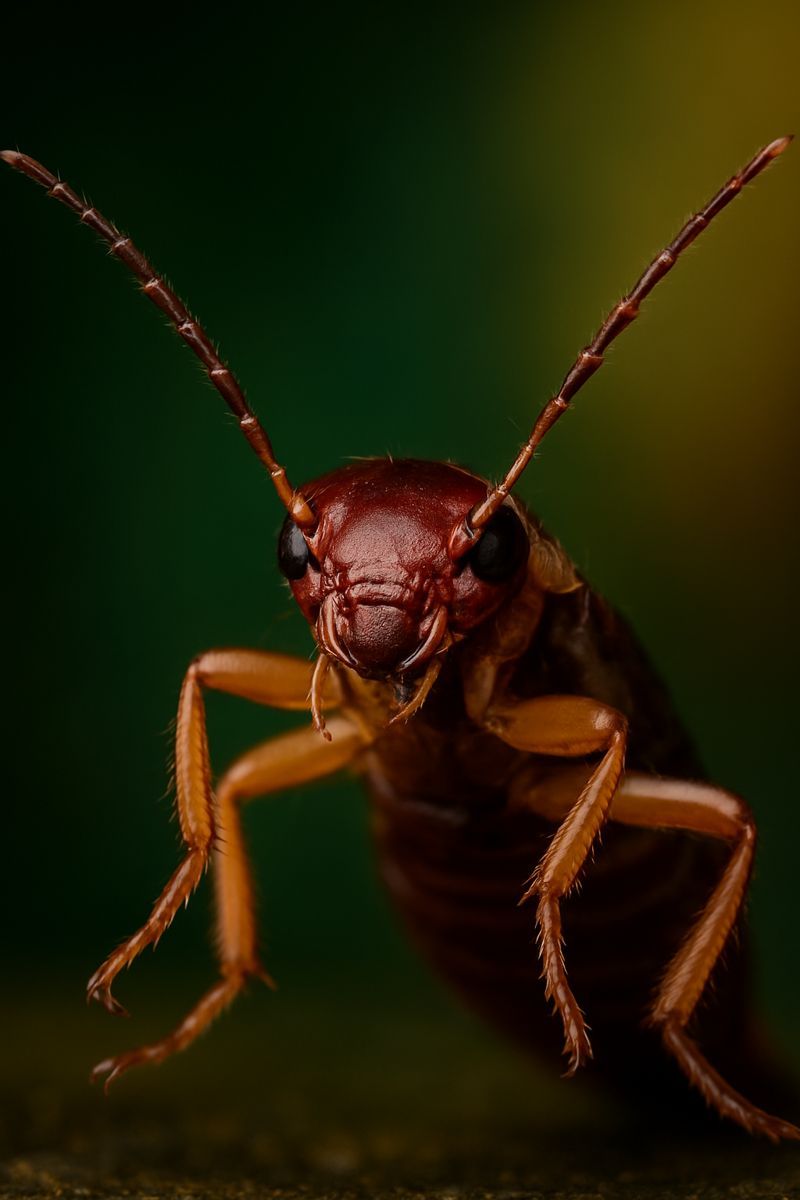
| Color and body | Light to dark reddish-brown with pale legs; flattened and elongate for wedging into gaps |
| Forceps | A pair at the tail end — curved on males, straighter on females; defensive, with no venom |
| How to tell it from a rove beetle | Check the tail: forceps mean earwig, and nothing else in a house here carries them |
| Where it lives | Outdoors in mulch, leaf litter and under boards against the foundation; it does not breed indoors |
| When you see it | Active at night; the population peaks around August and September |
| Do we treat it | Rarely warranted — clearing mulch from the siding and fitting a door sweep usually does it |
Signs you have them
- Earwigs in the bathroom, laundry or kitchen, usually after a warm night
- A scatter of them when you lift a board, pot or paver in a garden bed during the day
- The mulch bed against the house moving with them an hour after sunset
- Dahlias, strawberries, lettuce or seedlings with irregular holes and chewed edges
- Corn silk chewed back, followed by poorly filled ears
The pincers first, because nothing else gets read until they are dealt with
Almost every call about this insect is really a call about the back end of it, so we will settle that before anything else.
The forceps are a bluff. UC IPM’s Pest Notes describe them as a pair of prominent appendages used in defense and state directly that earwigs do not attack humans. There is no venom gland attached to them. There is no sting. There is no bite in the sense that matters — no mouthparts driving into skin, nothing injected, no reaction to manage afterward. A large male can close the forceps on a fingertip firmly enough that you would rather he did not, and that is the entire extent of the risk this animal presents to a person.
The forceps are mostly aimed at other earwigs. Males carry curved ones, females straighter, and Penn State records male forceps varying in length from three sixteenths to three eighths of an inch — the kind of variation you see in a structure used for contests within a species rather than for defense against something a thousand times its size.
And the ear. Penn State’s fact sheet names the belief for what it is: a widespread superstition that these insects crawl into the ears of sleeping people, once extended to a story about boring into the brain, and it states that they do not crawl into the human ear. The English name is very old, the folklore is older, and neither is evidence.
That is the whole of it. Everything else on this page is about mulch.
What the animal actually is
Size and color. Adults run about five eighths of an inch by Penn State’s figure and up to three quarters by UC IPM’s, dark reddish-brown, with a reddish head and yellow-brown legs. The Pacific Northwest handbook gives about five eighths of an inch, light to dark brown, with pale legs — which is the description that matches what turns up here.
Body. Flattened and elongate, built for wedging into a tight gap. That shape is the single most useful thing to know about the animal, because it explains both where it spends the day and how it gets under a door.
Habits. Nocturnal. During daylight they are jammed into something dark and humid; after dark they come out and forage. Lift a board in a Bellingham garden bed at two in the afternoon and you get a sudden scatter of them, which people routinely report as an infestation and which is simply what the ground looks like here.
Maternal care, which is genuinely unusual among insects and worth knowing. UC IPM describes the female digging a cell in the soil, laying a mass of thirty or more eggs, and protecting the nymphs until their first molt. Penn State gives thirty to fifty-five eggs in the spring brood and describes high maternal care of the eggs and early nymphs, with the female gathering them into a pile and standing guard. Insects that tend their young are a small minority, and this one does it in the soil under your hydrangea.
Why this county produces so many
One generation a year, and the population is decided before anybody notices it.

UC IPM describes overwintering pairs in soil cells, with the female laying in late winter or spring and typically producing two broods. Penn State has the nymphs moving through four stages, first inside the nest under maternal care and then foraging on their own, reaching adulthood around August and September. Where winters are mild, UC IPM notes, some populations stay active rather than truly hibernating.
Whatcom County supplies exactly the conditions that arithmetic needs. There is no hard freeze to cut the overwintering females back. There is roughly thirty-five inches of rain keeping the top inch of soil and everything lying on it damp from October through May. And there is the landscaping convention — deep bark mulch installed to the siding on essentially every lot — which supplies the damp, dark, insulated shelter the young need at exactly the moment they need it.
The practical consequence, and it is the most useful sentence on this page for anybody planning work: the number you experience in August was set in March. Clearing shelter in early spring removes harborage before the population builds. Treating in late summer is managing a number that has already been decided.
The population is in the first three feet
This is where the job is, and it is a narrow band.
Bark mulch held against the foundation. The largest single factor on most properties in this county, and the one nobody installed on purpose. Mulch does precisely what it is sold to do — holds soil moisture and evens out temperature — and held to the wall it produces a permanently damp strip at grade in the dark against the siding.
Leaf litter banked into beds and against walls, particularly on the shaded lots around the lake and along the greenbelts, where it never really dries.
Anything lying flat on soil. UC IPM’s list of daytime refuges is boards, loose clods of soil, dense vines and weeds. Add to it, from local experience: pavers, stacked pots, firewood on the ground, landscape fabric, a tarp that has been there since spring, a child’s plastic sled.
Dense low ground cover against the wall — ivy, vinca, thick perennial planting — which holds humidity at soil level through the day.
The gap behind trim and siding at grade, and the joints of retaining walls.
A damp open crawlspace, which through unscreened vents is functionally part of the same outdoor habitat rather than part of the house.
Every one of those is outside. None of them is in your kitchen.
They do not infest a structure
Stated flatly, because it is the fact that decides the verdict.
The Pacific Northwest handbook says that earwigs do not establish breeding populations inside homes. They are outdoor animals that wander in, and indoors they are in the wrong environment: dry heated air, no damp harborage, nothing they recognize as food in useful quantity, nowhere to make a soil cell. What they do next is dry out.
So the earwig walking across your bathroom floor is not part of an indoor population. It is a single animal that came under a door within roughly the last day and is already losing. The handbook’s only note about indoor damage is occasional damage to clothing, and even that is not something we are often called about.
That is why interior treatment is the wrong instrument. Applying product along baseboards puts it where people live to kill insects that were not going to last the week, and it does not touch the population that keeps supplying replacements from a mulch bed eight feet away.
The correct indoor response is a vacuum or a dustpan. That is not us being coy about scope. It is the accurate answer.
Where they come in
They are flat, they are small, and they are following dark and damp.

Under exterior doors with worn or missing sweeps, which is the single most productive gap on most houses. Along sliding door tracks. Around ground-level window frames. Through unscreened or corroded crawlspace and foundation vents. Around utility and hose-bib penetrations. Up through gaps at the sill plate. And straight through an open door on a warm evening, because the porch light is on and there are insects at it.
Indoors they head for the humid rooms — bathroom, laundry, kitchen — because those are the only rooms that suit them at all. That is why the same two rooms produce nearly every sighting in a house, and it is a useful thing to mention when you call.
UC IPM adds a detail worth acting on: replacing outdoor lighting with yellow or sodium-vapor lamps makes it less attractive to them. Moving a fixture away from a door does the same job with no bulb to buy.
Outdoors they are mostly on your side
This is the part of the page most likely to change what somebody does, so it is worth the space.
UC IPM describes earwigs as voracious feeders on soft-bodied insects such as aphids and insect eggs, states that they have been shown to be important predators of aphids, and says they can exert significant biological control under some circumstances. WSU’s Hortsense lists their prey as aphids, mites, thrips, leafhoppers, centipedes, millipedes, caterpillars, insect eggs and whiteflies, and concludes that at moderate levels the earwig probably does far more good than bad in most gardens.
The rest of the diet is decaying plant material. They are working the litter layer, breaking down what falls, in the same way the sowbugs and millipedes alongside them are.
And they do chew living plants, which is the other half of an honest account. UC IPM records seedlings losing leaves and stems outright, mature plants left with irregular holes or edges chewed away, shallow gouges in stone fruit, and feeding on corn silk that prevents pollination and produces poor kernels. The ornamentals named are zinnias, marigolds and dahlias. In this county the recurring complaints are dahlias, strawberries, lettuce and other tender greens, and corn.
So the animal is genuinely both, and the sensible response is targeted rather than broad. Where a specific bed is being damaged, UC IPM’s trapping methods work and cost almost nothing: a shallow can of fish or vegetable oil sunk to soil level, or a rolled newspaper, a piece of corrugated cardboard, a bamboo tube or a short length of hose set near the affected plants before dark and emptied into soapy water in the morning. The Pacific Northwest handbook gives the same rolled-newspaper method.
What those traps will not do is reduce a property-wide population, because they are competing with every board, pot and inch of mulch already available. They protect a row of dahlias. They do not clear a yard, and nothing does.
Why the verdict is “rarely warranted”
Because on most properties the honest work is an afternoon with a rake and a door sweep, and that is what “rarely warranted” means on this site.
The order that actually reduces them:
Pull the mulch back. A clear band between mulch and siding — the Pacific Northwest handbook puts the figure at six inches minimum, and a foot is better where you can spare it. Gravel, bare soil or nothing. It removes the habitat sitting against the wall, it keeps damp material off the siding, and it costs the price of an afternoon.
Thin the mulch that remains. Depth matters as much as position. A deep blanket holds a humid layer under it all season.
Lift what is on the ground. Boards, pots, bricks, tarps, landscape fabric, firewood — off the soil and away from the wall, or gone.
Cut the ground cover back from the foundation. UC IPM is explicit about removing refuge in the form of ivy, weeds and piles of leaves.
Fix the exterior water. Downspouts discharging well clear of the building, gutters clear, grade falling away, irrigation not spraying the siding. Damp is the requirement; take it away and the shelter stops being shelter.
Close the threshold. Door sweeps, weatherstripping, vent screening and sealed utility penetrations. That is exclusion and repair work, it takes an hour or two, and it stops several unrelated things at the same time.
Deal with a wet open crawlspace if you have one, because it is functionally outdoor habitat directly under the floor. Why so many of them here stay wet, and what the code actually asks for, is set out in the crawlspace guide.
And what makes it warranted anyway
Having spent this page recommending a rake, here is the other side, because “rarely” is not “never”.
A heavy year on a property where the landscaping cannot practically change. Some sites are stuck — a strata-managed complex, a mature garden nobody is going to tear out, a lot that backs onto a field margin. A perimeter and harborage treatment timed to spring, before the population builds, genuinely reduces what arrives in August. Timed to August it mostly does not.
Ground-floor units in a landscaped complex. The residents get the complaints and the cause is the planting specification. Treating unit by unit is expensive and ineffective; the beds and the perimeter are the job.
A commercial setting where the tolerance is legitimately zero — food handling, hospitality, healthcare — where an insect on a floor is a problem regardless of whether it was dying.
A crop being lost. Market gardens and berry rows in the Lynden, Everson and Nooksack country, where the damage is measurable rather than annoying.
Where the crawlspace is the real reservoir and the earwigs are one of several things it is producing. Then the moisture work is warranted on its own terms and this species comes along with it.
What is not on that list is a house with a few earwigs in the bathroom in August. That is the common case, and the answer to it is free.
Where they turn up hardest in this county
The distribution follows landscaping and shade rather than housekeeping, which is worth saying because these calls often arrive with an apology attached.
The gardened city neighborhoods — Columbia, Sunnyland, York, Roosevelt, Cornwall Park, Happy Valley. Mature planting, generous beds worked right up to the foundation, and prewar houses whose door sweeps and vent screens are as old as the rest of them.
Newly landscaped subdivisions — Barkley, Cordata, King Mountain and the newer stock around Ferndale. Fresh deep bark laid to the siding on every lot in the development at once. These properties often have their worst summer two or three years after planting, once the mulch has broken down enough to hold water like soil.
Shaded and forest-edge lots — Sudden Valley, Silver Beach, Edgemoor, the margins along Whatcom Falls. Deep leaf litter, ground that does not dry between rain events, and ground cover pressed to cedar siding.
Farm country — Lynden, Everson, Nooksack, Sumas. Field margins, irrigation, outbuildings, stacked material, and the only local setting where crop damage is worth a treatment decision on its own.
Waterfront and seasonal housing — Blaine, Birch Bay, Semiahmoo. Damp ground, stored gear, driftwood, and a perimeter that nobody manages for months at a time.
None of that is a statement about the households. It is a statement about shade, planting and rain.
Telling it from what it is not
Misidentification is less common here than with the spiders, but it happens in three predictable directions.
Rove beetles are the usual mix-up, and they are the more alarming-looking of the two to anybody who does not know them. They are elongate and dark with very short wing covers that leave most of the abdomen exposed, and when disturbed many of them curl the tail end upward in a threat display that reads as a scorpion. No forceps at the back. Beneficial predators, and not this animal.
Young cockroaches get reported as earwigs in older commercial buildings and basements. They have long trailing antennae, no forceps, and they run for cover in a way an earwig does not. That identification matters a great deal more than this one does, so it is worth confirming rather than assuming.
Silverfish come up because both are quick and both live in the same damp band. Silver scales and three tail bristles against reddish-brown armor and a pair of forceps — a photograph settles it instantly.
The check that ends all three: look at the tail end. Forceps mean earwig, and nothing else in a Whatcom County house carries them.
What people have usually already tried
Most households have done two or three things before they call, and it is worth saying which of them were wasted effort.
Indoor perimeter sprays from the hardware store. These treat the wrong side of the wall. The insects reached are the ones already failing.
Bug bombs. No reach into the mulch bed, which is the only place that matters, and product distributed across living space for no gain.
Sealing without clearing. A door sweep is genuinely worth fitting, but a sealed house next to a saturated bark bed is still a house with a large population pressed against it, finding the next gap.
Cleaning the beds the morning of the visit. Understandable, and it removes the evidence that would have told a technician where the harborage was.
Waiting for a hard winter to fix it. It is not coming. That is the premise of this whole library: without a real freeze, nothing here gets reset, and population control has to be structural rather than seasonal.
What we will not do
Spray the inside of a house for an insect that is dying on the floor. The ones indoors have days at most. Product applied to interior baseboards changes their outcome very little and the outdoor population not at all.
Sell a recurring plan for a garden predator. An annual schedule for an animal that eats aphids is a poor trade for the customer and we would rather say so.
Treat a whole garden. Broadcast work in a planted yard takes out the beneficial side of this insect along with everything else in the litter layer, and the beneficial side is real.
Frighten anybody about the pincers. They are a bluff, we have said so at length, and a company that leans on that image to sell a treatment is trading on a superstition.
What to tell us if you do call
Which rooms. Bathroom, laundry and kitchen means humidity and a threshold. An upstairs bedroom is a different picture and worth mentioning.
How many and how often. One or two after a warm night is normal in this county. A dozen a night for a week means a heavy population immediately outside and a specific gap.
What is against the wall. Mulch depth, how close it runs to the siding, whether there is ivy or heavy ground cover, and what is lying on the soil. That is most of the assessment before anybody arrives.
Go out after dark with a torch, an hour after sunset, and look at the mulch bed against the house. If the surface is moving, you have found the population and you have found where the work goes.
Leave the perimeter as it is until somebody has seen it. Clearing everything the day before makes the visit less useful, and the point of the visit is to tell you what to clear.
Frequently asked questions
Do earwigs crawl into people's ears?
No. Penn State's extension fact sheet describes the belief as a widespread superstition and states plainly that these insects do not crawl into the human ear. The name is centuries old and the story attached to it was never true.
Are the pincers dangerous?
No. UC IPM describes the forceps as defensive appendages and states that earwigs do not attack people. There is no venom, no sting and no injected anything. A large male can close them on a fingertip hard enough to notice, which is the whole of it.
They keep turning up in my bathroom. Is there a nest in the wall?
Almost certainly not. The Pacific Northwest handbook states that earwigs do not establish breeding populations inside homes. Steady indoor sightings mean a heavy population immediately outside plus a route in, which is a threshold and a mulch bed rather than a wall void.
Should I get rid of them in the garden?
Think carefully first. UC IPM calls earwigs important predators of aphids and says they can exert significant biological control. WSU's Hortsense goes further and says that at moderate numbers the earwig probably does far more good than bad in most gardens.
What is the one change that reduces them most?
A clear band between mulch and siding. The Pacific Northwest handbook recommends keeping mulch at least six inches away from structures, and that strip removes the damp dark harborage sitting directly against the building where the population concentrates.
Why are there so many some years?
One generation a year means the whole population is set by how many overwintering females survive and how much damp shelter their young find in spring. A mild wet spring over deep ground cover produces a heavy August, and nothing done in August changes that year's number much.
Do they damage a house?
No. They do not chew wood, bore, nest in cavities or feed on anything structural. The Pacific Northwest handbook notes occasional damage to clothing indoors and nothing else, and even that is uncommon.
Sources
- UC IPM Pest Notes 74102 — Earwigs (copy hosted by Maine Dept. of Agriculture, Conservation and Forestry) — read September 2, 2026
- WSU Hortsense — Earwigs — read September 2, 2026
- Penn State Extension — European Earwigs — read September 2, 2026
- PNW Insect Management Handbook — Nuisance and household pests: Earwig — read September 2, 2026
- WSU Extension EB1206E — European Earwig Prevention and Control — read September 2, 2026
Rules change. This page is scheduled for review against its sources by September 1, 2027. If you are reading it after that date and something looks out of step with the current rule, the rule is right and we are wrong — please tell us.
Pest problem in Whatcom County?
Family-owned, no long-term contracts, and every treatment is backed by our 100% Service Guarantee.
Most calls in Whatcom County are out within 1–2 days, about 3 during the late-summer peak.
Last updated